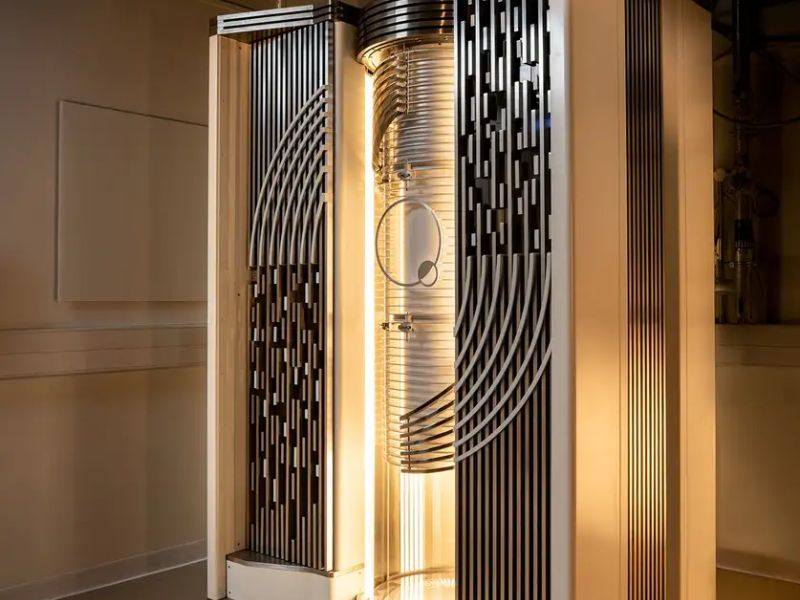
Quantum Motion has developed a machine that is now housed at the National Quantum Computing Centre (NQCC) in Oxfordshire. Researchers there will explore its potential for solving real-world challenges, such as drug discovery.
A Comprehensive Quantum Computing System Built on Scalable Silicon CMOS Technology
A full-stack quantum computer is an all-in-one system integrating a Quantum Processing Unit (QPU), user interface, and control stack compatible with standard quantum software.
By using standard silicon CMOS (Complementary Metal-Oxide-Semiconductor) technology—the same material used in global semiconductor manufacturing—Quantum Motion’s quantum computers have the potential to be scaled up for mass production more easily.
Founded in 2017 by Professors John Morton (UCL) and Simon Benjamin (Oxford), the company now has over 100 employees. Its headquarters are in London, with additional teams based in the US, Australia, and Spain. To date, it has secured more than £62 million through equity and grant funding.
Silicon-Based Quantum Computing Celebrated as a Major Milestone by Experts and UK Officials
Professor Morton, now CTO, said: “The system delivered to the UK’s National Quantum Computing Centre marks the arrival of silicon-based quantum computing.”
UK Science Minister Lord Vallance stated: “The National Quantum Computing Centre provides a one-of-a-kind environment for innovators to test emerging quantum technologies.”
He added that Quantum Motion’s new quantum computer moves the technology closer to commercial use, with potential to transform healthcare and clean energy.
Harnessing Atomic-Scale Physics to Revolutionize Computing and Problem-Solving
Quantum computers use physics at atomic and subatomic levels, giving them powerful abilities to simulate and understand nature.
They could surpass today’s top supercomputers, quickly performing complex tasks like discovering new materials, medicines, and aiding climate change efforts.
James Palles-Dimmock, CEO of Quantum Motion, said, “This is the defining moment for silicon-based quantum computing. Today’s announcement demonstrates that engineers can build a reliable, functional quantum computer using the world’s most scalable, mass-producible technology.
Dr. Michael Cuthbert, NQCC Director, said, “The NQCC advances UK quantum capabilities by evaluating hardware from top global companies.” The successful installation of Quantum Motion’s system represents a significant milestone in our quantum computing testbeds program. Our team begins testing the system to better understand its real-world silicon-based applications.
Researchers from the Moscow Institute of Physics and Technology, working with colleagues in the U.S. and Switzerland, managed to revert a quantum computer’s state by a fraction of a second. They also estimated the probability of an electron in the vacuum of interstellar space spontaneously returning to a previous state in its own timeline.
Lead author Gordey Lesovik explained, “This work is part of a broader series exploring the potential to challenge the second law of thermodynamics. That law is deeply connected to the concept of the arrow of time, which describes time’s one-way flow from past to future.”
Researchers Challenge Thermodynamics with Engineered Quantum Time Reversal
“Our first paper introduced a concept known as a local perpetual motion machine of the second kind. In December, we explored how Maxwell’s demon could be used to violate the second law. In this latest study, we approached the issue from a new angle—by artificially generating a state that moves in the opposite direction of the thermodynamic arrow of time.”
The team wanted to explore whether time could spontaneously reverse—even briefly—for a single particle. To investigate this, they focused on observing a lone electron in the emptiness of interstellar space.
Study co-author Andrey Lebedev, from MIPT and ETH Zurich, explained, “Let’s say we begin observing an electron that’s localized — meaning we have a fairly good idea of where it is in space. Quantum mechanics doesn’t allow us to pinpoint its exact position, but we can define a small area where it’s most likely located.”
“As time progresses, the electron’s state evolves according to Schrödinger’s equation. Although this equation doesn’t favor a direction in time, the electron’s position rapidly becomes more uncertain, causing its probability distribution to spread out. This increasing uncertainty mirrors the growing disorder—or entropy—in larger systems, like billiard balls scattering on a table, a hallmark of the second law of thermodynamics.”
Schrödinger’s Equation Suggests Time Reversal Is Theoretically Possible Under Rare Cosmic Conditions
Valerii Vinokur, another co-author from Argonne National Laboratory in the U.S., added, “Still, Schrödinger’s equation is reversible. That means, mathematically, if we apply a transformation known as complex conjugation, it would describe the reverse: a dispersed electron re-localizing into a small area in the same amount of time. While this doesn’t naturally occur, it’s theoretically possible through a random fluctuation in the cosmic microwave background that fills the universe.”
The team then calculated the chances of such a reverse, where a spread-out electron spontaneously regains its previous localized state. Their findings showed that even if 10 billion newly localized electrons were observed continuously for the entire 13.7-billion-year lifespan of the universe, this time-reversal would only occur once. And even then, the electron would only shift back in time by a mere ten-billionth of a second.
When applied to large-scale events—like aging or volcanoes erupting—the sheer number of particles and the much longer timescales involved make time reversal essentially impossible. That’s why we don’t witness people growing younger or ink separating from paper.
To explore this further, the researchers conducted a four-phase experiment to simulate time reversal—not with an electron, but using a quantum computer made up of two, and later three, superconducting qubits.
The four stages of the actual experiment on a quantum computer mirror the stages of the thought experiment involving an electron in space and the imaginary analogy with billiard balls. Each of the three systems initially evolves from order toward chaos, but then a perfectly timed external disturbance reverses this process. Credit: @tsarcyanide/MIPT
Stage 1: Order
The experiment begins with each qubit set to its ground state, or zero. This represents a highly ordered setup, similar to an electron confined to a small space or a neatly arranged rack of billiard balls before the game starts.
Stage 2: Degradation
Next, order breaks down. Like an electron’s position spreading out or the balls scattering on a pool table after the break, the qubit system becomes increasingly complex, forming a shifting pattern of zeros and ones. This is done by briefly running an evolution program on the quantum computer. Although a similar breakdown could naturally occur from environmental interactions, using a controlled program allows the researchers to eventually reverse it.
Stage 3: Time Reversal
At this stage, a special program alters the quantum computer’s state to make it evolve in reverse—from disorder back to order. This deliberate “kick” mimics the improbable cosmic fluctuation that might reverse an electron’s state, but here it’s intentionally programmed. In the billiard analogy, it’s like giving the table an exact nudge that sends the balls rolling back to their original triangle.
Stage 4: Regeneration
The same evolution program from Stage 2 is run again. If the reversal “kick” was accurate, the system doesn’t spiral further into chaos—it rewinds. The qubits return to their original state, much like an electron refocusing or billiard balls retracing their paths back into formation.
The results were promising: in about 85% of trials, the two-qubit system successfully reverted to its original state. When a third qubit was added, the success rate dropped to around 50%, mainly due to hardware imperfections. The researchers believe that as quantum computers improve, error rates will decrease.
Lebedev noted, “What’s exciting is that this time-reversal algorithm might also help enhance the precision of quantum computers. It could be adapted to test and debug quantum programs by identifying and correcting noise and errors.”
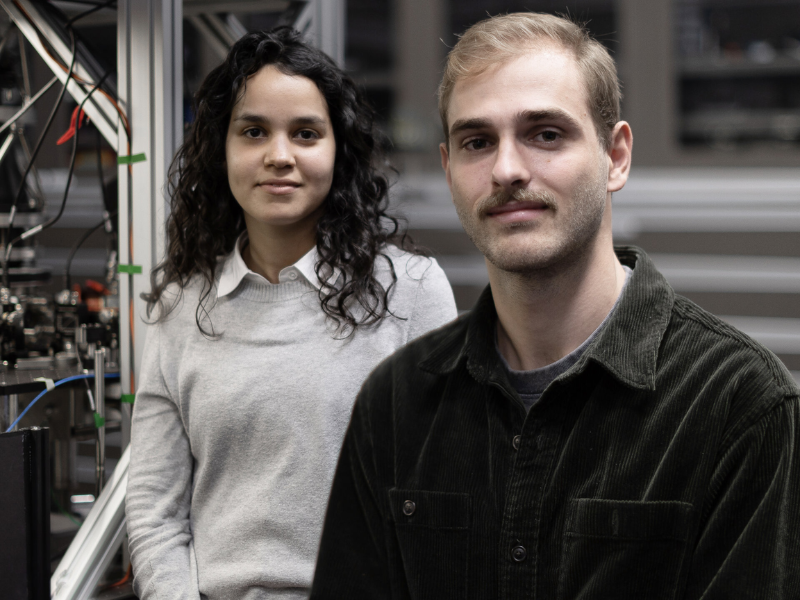
Dr. Christophe Valahu and Vanessa Olaya Agudelo, the study’s lead authors, in front of the experiment’s quantum computer at the Sydney Nanoscience Hub. Credit: University of Sydney/Stephanie Zingsheim.
Scientists at the University of Sydney achieved a groundbreaking feat by leveraging a quantum computer to observe and manipulate a crucial chemical reaction process, slowing it down by an astonishing factor of 100 billion.
Unlocking New Frontiers in Science and Technology
The pioneering research conducted by University of Sydney scientists using a quantum computer holds transformative potential for fields like materials science, drug design, and solar energy harvesting, offering insights into fundamental processes within molecules.
Understanding these processes can pave the way for advancements in combating smog, mitigating ozone layer damage, and other applications reliant on molecular interactions with light.
The research team, led by joint lead researcher Vanessa Olaya Agudelo, accomplishes the unprecedented feat of directly observing a geometric phenomenon known as a “conical intersection” in chemical dynamics, a challenge that has persisted since the 1950s.
Conquering Timescale Challenges through Quantum Innovation
To surmount the obstacle of ultra-rapid timescales, the researchers ingeniously employ a trapped-ion quantum computer, applying a novel approach to slowing down the process by an astounding factor of 100 billion, effectively extending the timescale from femtoseconds to milliseconds.
Credit: University of Sydney
This pioneering technique opens the door to meaningful observation and provides crucial insights into the dynamics of processes that were previously beyond direct experimental reach.
Dr. Christophe Valahu, another lead author, likens the achievement to studying wind patterns around a plane wing in a wind tunnel. Through this quantum-enabled experimentation, the researchers delve into the realm of ‘geometric phase’ dynamics, which had remained elusive due to their extreme speed.
Unveiling the Essence of Photochemical Reactions
The groundbreaking research has direct implications for processes like photosynthesis, where lightning-fast energy transfer occurs in molecules. By decelerating these processes in the quantum computer, the researchers uncover distinctive features associated with conical intersections in photochemistry.
This revelation sheds light on the hallmarks of these reactions, previously theorized but never observed, enhancing our comprehension of ultrafast molecular dynamics.
Synergistic Collaboration and Quantum Advancements
The collaboration between chemistry theorists and experimental quantum physicists leads to this remarkable achievement, where the computational prowess of quantum technologies is harnessed to tackle a longstanding challenge in chemistry.
Associate Professor Ivan Kassal, a co-author and research team leader, highlights the pivotal role of the University’s cutting-edge programmable quantum computer, provided by the Quantum Control Laboratory of Professor Michael Biercuk.
This groundbreaking accomplishment marks a significant stride in both quantum research and chemistry. It empowers scientists to observe and manipulate previously inaccessible processes, offering a profound understanding of fundamental dynamics and their applications in various scientific and technological domains.
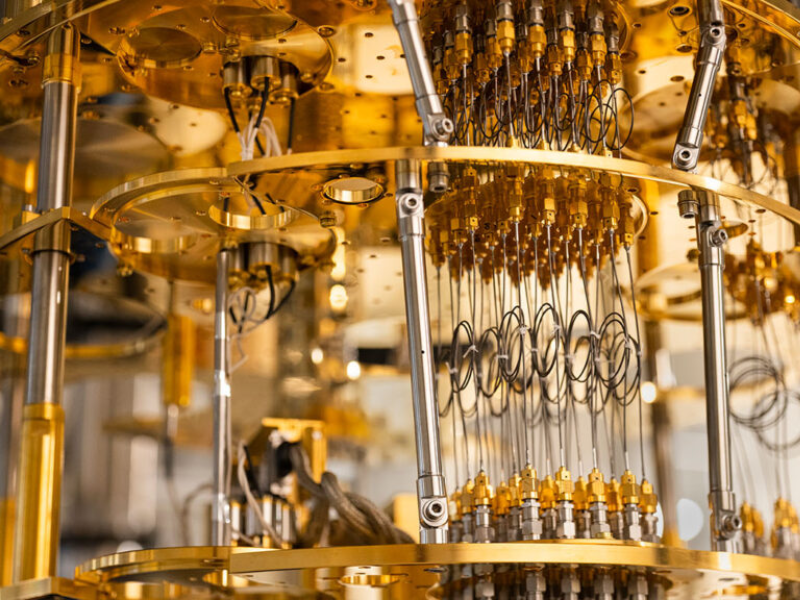
The quantum computer at Chalmers with the outer shielding of the dilution refrigerator removed. Credit: Microsoft.
The potential of quantum computer to revolutionize the field of chemistry and enable the simulation of complex chemical processes could have significant implications for the development of new pharmaceuticals and materials. Recently, researchers at Chalmers University successfully carried out calculations within a real-life chemistry case, marking the first time this has been achieved in Sweden.
The Department of Chemistry and Chemical Engineering’s Associate Professor in Theoretical Chemistry, Martin Rahm, led a study demonstrating that quantum computers can handle complex electron and atomic nuclei movements, pushing the boundaries of what scientists can calculate and comprehend. Unlocking the full potential of quantum computers could lead to a new era of possibilities for computational chemistry.
Quantum mechanics, which is used in the field of quantum chemistry, determines possible chemical reactions, structures, and materials, as well as their properties. Although these studies are typically conducted using supercomputers with conventional logical circuits, there is a limit to the calculations that these machines can handle.
The new method reduces errors in quantum chemical calculations
Due to the laws of quantum mechanics that dictate the behavior of nature at a subatomic level, several scientists suggest that quantum computers may be more adept at conducting molecular calculations than conventional computers.This hypothesis stems from the unique properties of quantum computing, which allow for the exploitation of quantum mechanical phenomena to perform calculations in ways that classical computers cannot replicate. As a result, quantum computers could offer a significant advantage in molecular-level simulations and calculations, opening up new frontiers in chemistry research.
To reduce errors in quantum chemical calculations, scientists have discovered a promising technique called Reference-State Error Mitigation (REM), which corrects for errors caused by noise in quantum computers.
Researchers have developed a technique called “Reference-State Error Mitigation” that enables high-accuracy quantum computation of chemistry by comparing calculations from both quantum and conventional computers. This approach allows scientists to estimate the amount of error caused by noise and correct the solution for the original complex problem. The findings have been published in the Journal of Chemical Theory and Computation.
Chalmers University scientists have developed a unique REM (Reference Energy Method) technique that enables the computation of intrinsic energy for small molecules such as hydrogen and lithium hydride using the quantum computer, Särimner. While this calculation can be performed faster on conventional computers, this new approach marks a significant milestone in quantum chemical computation in Sweden as it is the first demonstration of such a calculation on a quantum computer.
Quantum computer built at Chalmers
The study was conducted in collaboration with colleagues from the Department of Microtechnology and Nanoscience, who were responsible for constructing the quantum computers used in the research and performing the precise measurements necessary for the chemical calculations.
According to Jonas Bylander, Associate Professor in Quantum Technology at the Department of Microtechnology and Nanoscience, real quantum algorithms are essential to understanding the performance of quantum hardware and identifying opportunities for improvement. By leveraging the potential of quantum computers in chemical calculations, the collaboration with Martin Rahm’s group holds significant value.
Read the original article on PHYS.
Read more: The Way Mouse Embryos Determine Between The Left And Right Sides.
We use cookies on our website to give you the most relevant experience by remembering your preferences and repeat visits. By clicking “Accept All”, you consent to the use of ALL the cookies. However, you may visit "Cookie Settings" to provide a controlled consent.
This website uses cookies to improve your experience while you navigate through the website. Out of these, the cookies that are categorized as necessary are stored on your browser as they are essential for the working of basic functionalities of the website. We also use third-party cookies that help us analyze and understand how you use this website. These cookies will be stored in your browser only with your consent. You also have the option to opt-out of these cookies. But opting out of some of these cookies may affect your browsing experience.
Necessary cookies are absolutely essential for the website to function properly. These cookies ensure basic functionalities and security features of the website, anonymously.
Cookie
Duration
Description
cookielawinfo-checkbox-analytics
11 months
This cookie is set by GDPR Cookie Consent plugin. The cookie is used to store the user consent for the cookies in the category "Analytics".
cookielawinfo-checkbox-functional
11 months
The cookie is set by GDPR cookie consent to record the user consent for the cookies in the category "Functional".
cookielawinfo-checkbox-necessary
11 months
This cookie is set by GDPR Cookie Consent plugin. The cookies is used to store the user consent for the cookies in the category "Necessary".
cookielawinfo-checkbox-others
11 months
This cookie is set by GDPR Cookie Consent plugin. The cookie is used to store the user consent for the cookies in the category "Other.
cookielawinfo-checkbox-performance
11 months
This cookie is set by GDPR Cookie Consent plugin. The cookie is used to store the user consent for the cookies in the category "Performance".
viewed_cookie_policy
11 months
The cookie is set by the GDPR Cookie Consent plugin and is used to store whether or not user has consented to the use of cookies. It does not store any personal data.
Functional cookies help to perform certain functionalities like sharing the content of the website on social media platforms, collect feedbacks, and other third-party features.
Performance cookies are used to understand and analyze the key performance indexes of the website which helps in delivering a better user experience for the visitors.
Analytical cookies are used to understand how visitors interact with the website. These cookies help provide information on metrics the number of visitors, bounce rate, traffic source, etc.
Advertisement cookies are used to provide visitors with relevant ads and marketing campaigns. These cookies track visitors across websites and collect information to provide customized ads.