A team of physicists affiliated with many institutions in the united state has collaborated on a paper that discusses the possibility of utilizing the Laser Interferometer Gravitational-Wave Observatory (LIGO) to search for proof of aliens piloting giant spacecraft around the Milky Way. They team has posted their paper on the arXiv preprint server.
Over the past several years, astrophysicists and sci-fi enthusiasts alike have grown increasingly frustrated with humankind’s inability to detect the existence of life anywhere in the universe other than planet Earth. Researchers have noted that based on the billions of planets that have been discovered in habitable zones around the universe, and the fact that life does exist in one area on Earth, there should be life somewhere else, too.
The problem, currently referred to as the Fermi paradox, is that scientists have yet to discover also the smallest shred of evidence for it. Prominent scientists have increasingly begun calling for recent and more exotic ways to search.
Scientists’ findings after using LIGO
In this new effort, the scientists note that science has advanced to the point that gravity waves can be spotted by technology such as LIGO. They further recommend that it is not beyond the realm of probability that aliens piloting spacecraft might leave gravity waves in their wake that could be spotted here on Earth using such technology.
Intrigued by their own idea, the scientists imagined the factors that may be involved for such a scenario to unfold. Initially, they factored the size of such a craft. They discovered it would have to be really big to generate gravity waves strong sufficient to reach Earth— perhaps the size of Jupiter.
It should also have to be moving really quickly– their calculations showed roughly 1/10 the speed of light. And it would have to be reasonably close– state about 326,000 light-years from Earth. They noticed that if they were to arise under such conditions, scientists at LIGO should be able to detect the gravity waves produced.
The researchers likewise note that if aliens are utilizing warp drives, scientists on Earth should be able to find them, too, using the same technology because such a craft would likewise generate gravity waves.
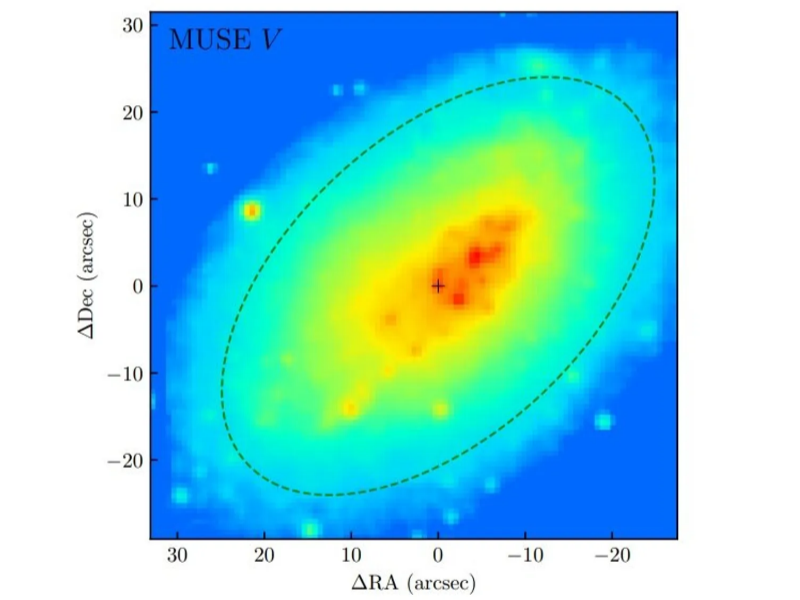
V-band image of NGC 2915 obtained by collapsing the wavelength dimension of the MUSE data cube. Credit: Tang et al, 2022
Galaxy NGC 2915
Utilizing the Very Large Telescope (VLT), Chinese astronomers have inquired a next blue compact dwarf galaxy known as NGC 2915. Outcomes of the research, shown in a paper released October 12th on arXiv.org, return crucial understandings relating to the star development background of this galaxy.
Blue compact dwarfs (BCDs) are low-luminosity and also low-metal content dwarf galaxies experiencing fierce bursts of star formation. Due to very concentrated starburst tasks, they are characterized by a compact optical appearance and H II-region-like spectra.
Features of the galaxy NGC 2915
At a distance of some 13.4 million light yers, NGC 2915 (also called PGC 26761) is among the closest BCDs to terrestrial globe. It is an extreme situation of BCDs in the local universe as its neutral atomic hydrogen (H I) gas material is extremely high and also exceptionally expanded in distribution. And almost all the young stellar populations and areas of ionized atomic hydrogen (H II) lie near the center of this galaxy.
Nevertheless, although NGC 2915 is very abundant in gas, the star development task is barely identified in its extensive external H I disk. Furthermore, the causing mechanism of this galaxy’s very concentrated star formation stays uncertain.
A more comprehensive study
Consequently, to more investigate the star formation action in NGC 2915, a team of astronomers led by Yimeng Tang of the University of Science and Technology of China in Hefei, China, performed a comprehensive analysis of deep integral field spectroscopic observances of the galaxy’s central area made with VLT’s Multi-System Spectroscopic Explorer (MUSE).
“To uncover the starburst-triggering mystery of NGC 2915, we execute a detailed evaluation of deep VLT/MUSE integral area spectroscopic observances that cover the central kiloparsec star-forming region,” the scientists wrote in the paper.
The results of the study
The research study discovered that worldwide star development in NGC 2915 peaked around some billion years back, when the most enormous star cluster was created. The outcomes proposes that the most recent episode of bursty star development took place about 50 million years ago, has lasted for about 50– 100 million years, and also was responsible for the development of some 3% of the galaxy’s overall stellar mass.
According to the study, episodes of bursty star development equal to one of the most current one might have reoccured for less than 4 times in different areas in the last billion years.
Nevertheless, these episodes turned out to be largely restricted within the galaxy’s central area (with a radius of about 1,300 light years).
The study also located that the stellar disk of NGC 2915 exhibits a fairly weak but significant rotation within the central 1,600 light yrs in radius and that the stellar turning axis seems anti-parallel to that of the prolonged neutral H I disk. This finding shows that the current episodes of bursty star development have been sustained by externally accreted gas.
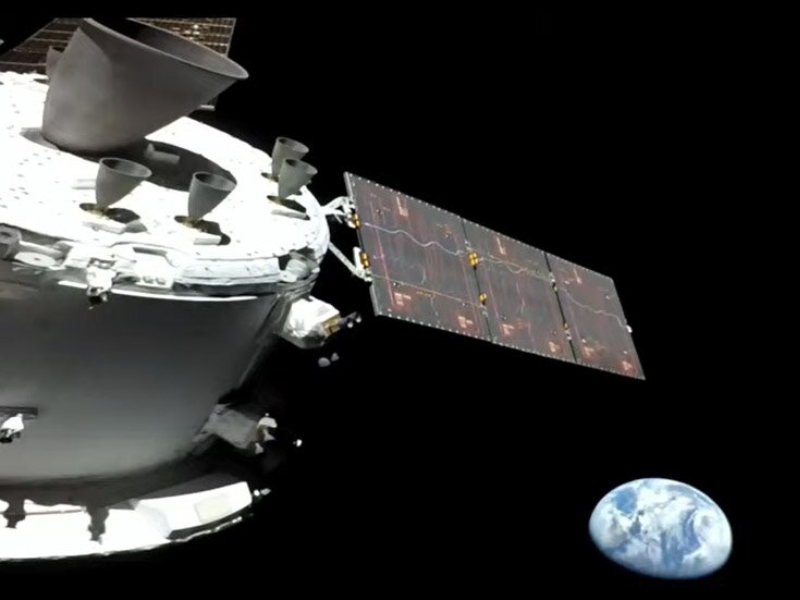
NASA’s Orion spacecraft en route for the Moon, with the Earth in the background, in a photo released by NASA in November 2022.
Exceeding expectations
On the third day after taking off from Florida bound for the Moon, the Orion spacecraft is “surpassing effectiveness expectations,” NASA officials stated on Friday.
First flight aims to ensure vehicle safety
The spacecraft is to take astronauts to the Moon in the next years– the initial to set foot on its surface because the last Apollo mission in 1972.
Without a team aboard, this initial test flight aims to guarantee that the vehicle is safe.
“Today we met to evaluate the Orion spacecraft efficiency … it is exceeding performance expectations,” stated Mike Sarafin, head of the Artemis 1 mission.
Spacecraft features
The spacecraft’s 4 solar panels, about thirteen feet (4 meters) long, deployed correctly and are offering more power than expected, stated Jim Geffre, the Orion administrator at the Johnson Space Center in Houston.
It is from that control center in Texas where the spacecraft is being piloted.
Spaceship location
Orion is currently some 200,000 miles (320,000 kilometers) from Planet and preparing to effectuate the initial of four primary thrusts arranged throughout the objective using its engines.
This maneuver, which will happen early Monday morning, will bring the spacecraft as close as eighty miles (130 kilometers) from the lunar surface area in order to benefit from the Moon’s gravitational force.
Considering that this will take place on the Moon’s far side, NASA is expected to lose interaction with the spacecraft for roughly 35 minutes.
“We will be passing over a few of the Apollo landing sites,” stated flight director Jeff Radigan, although they will be in darkness. Footage of the flyover will be launched by NASA. 4 days later on, a second thrust from the engines will place Orion in a far orbit around the Moon.
The ship will rise to 40,000 miles further the Moon, a record for a habitable capsule.
It will, after that, start the trip back to Planet, with a landing in the Pacific Ocean set up for December 11th, after just over 25 days of travel.
The Effects of the Moon Mission
The prosperity of this mission will define the future of the Artemis 2 mission, that will take astronauts around the Moon without landing, and after that, Artemis 3, which will lastly point out the return of human beings to the lunar surface.
Those missions are arranged to occur in 2024 and 2025, specifically.
Sarafin also stated Friday that ten scientific micro-satellites had been installed when the rocket lifted off; however, that half of them were experiencing technological or communication problems.
Those experiments, performed separately by independent teams, will have no effect on the principal mission.
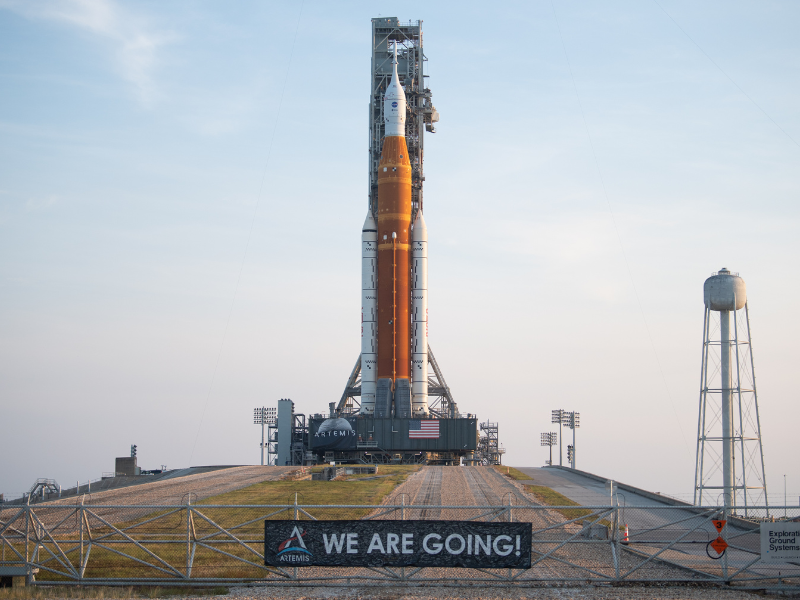
NASA’s Space Launch System (SLS) rocket with the Orion spacecraft aboard is seen atop a mobile launcher at Launch Pad 39B, Wednesday, Aug. 17, 2022, after being rolled out to the launch pad at NASA’s Kennedy Space Center in Florida. Credit: NASA/Joel Kowsky
After several setbacks, NASA is slowly scheduling its Artemis I mission’s launch dates of September 23rd or 27th. Several things will need to go right for both dates to be possible, such as repairs to the rocket’s fueling system, a sign-off from the Space Force, and managing to stay clear of an array of space scheduling conflicts.
Artemis I will mark NASA’s first launch of the massive Space Launch System (SLS) rocket and will launch a spacecraft called Orion into orbit far past the Moon. This mission will have no crew and function as a test for future missions that will deliver astronauts back to the Moon for the first time in years.
After a hydrogen leak hindered NASA’s third attempt to go forward whit the launch on September 3rd, NASA chose to perform repairs while remaining on the launchpad. They will be switching out seals on the connection between the rocket and the fuel lines that deliver liquid hydrogen to the rocket. Remaining on the pad will allow the team to assess the new seals at cryogenic temperatures, simulating conditions that would occur throughout a real launch.
September 17th is now the target for the crucial cryogenic test, just leaving a few days before the first launch window opens on the 23rd. During a press conference, Mike Bolger, the Exploration Ground Systems program manager at Kennedy Space Center, stated that the team would require approximately four days between a successful test and a launch attempt.
Other than the immediate necessity to repair and evaluate the seals, there are additionally a few other significant concerns that might impact NASA’s ability to get Artemis I off the ground. Among the most significant includes a system inside the rocket known as the flight termination system, which enables the destruction of the rocket if something fails during launch.
Space Force to give the green light
It is an essential safety system when handling large rockets or missiles. It is required to be operational at the time of launch. The Space Force supervises launches within the Eastern Range, where NASA is trying to launch the rocket. It demands that the batteries on the flight termination system be certified as in working order at the moment of launch, something that can only be done at the Vehicle Assembly Building, 6.5 Km (and several hours) far from the launchpad.
NASA obtained one extension on the system’s certification, giving them a little breathing room during their earlier launch attempts. However, that waiver has passed, and they need to apply for a new extension. Eventually, it falls to the Space Force to say whether it believes the launch can safely move forward without rolling back into the VAB.
After that, there is everything else taking place in space. Now that NASA has passed up the late August / early September launch windows, the SLS must contend with other missions’ schedules. The agency picked the 23rd and the 27th to avoid conflicts with NASA’s Double Asteroid Redirection Test (DART) mission, planned to smash into an asteroid on September 26th. There’s additionally a crew booked to journey to the ISS in early October. If Artemis I misses the following launch windows, whether due to hold-ups in repairs or needing to roll back into the VAB for an inspection, the next opportunity to launch might be later in October.
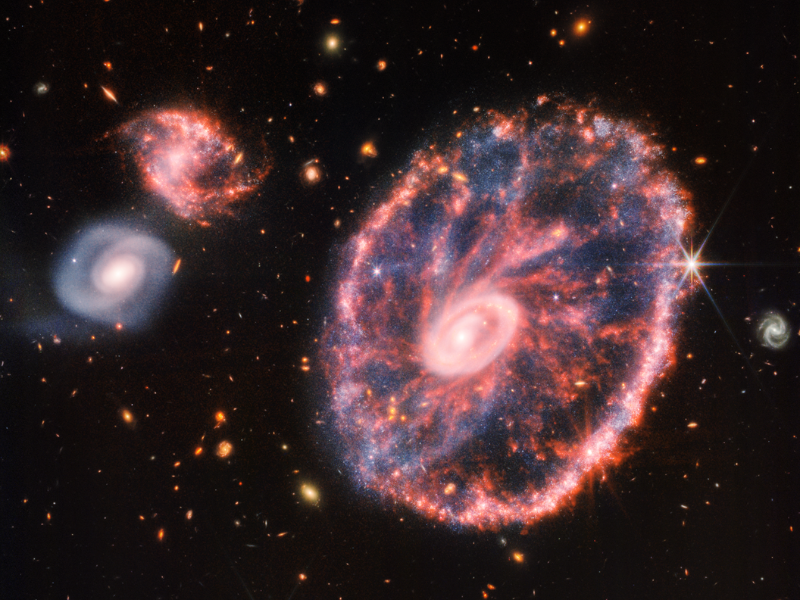
Image of the Cartwheel Galaxy and its companion galaxies is a composite from Jame Webb’s Near-Infrared Camera (NIRCam) and Mid-Infrared Instrument (MIRI). MIRI data is colored red while NIRCam data is colored blue, orange, and yellow. Credit: NASA, ESA, CSA, STScI
The space telescope’s powerful infrared gaze offers a new sight of just how the galaxy has changed throughout billions of years.
The James Webb Space Telescope, belonging to NASA, has gazed into the disarray of the Cartwheel Galaxy, revealing fresh insights into star formation and the central black hole of the galaxy. Using its potent infrared detection capability, the Webb telescope produced an intricate image of the Cartwheel galaxy, along with two smaller companion galaxies, set against a backdrop of many other galaxies. This picture delivers a new view of how the Cartwheel Galaxy has evolved over billions of years.
The Cartwheel Galaxy is a peculiar sight, located in the Sculptor constellation and situated roughly 500 million light-years away. The wagon-wheel-like appearance of the Cartwheel Galaxy is the outcome of a violent event – a high-velocity crash between a big spiral galaxy and a smaller galaxy that is not visible in this image. Galactic-scale impacts typically trigger a series of smaller events between the involved galaxies, and the Cartwheel Galaxy is not exempt from this phenomenon.
Image from Jame Webb’s Mid-Infrared Instrument (MIRI) shows a group of galaxies, including a large, distorted ring-shaped galaxy, known as the Cartwheel, that is composed of a bright inner ring and an active outer ring. While this outer ring has a lot of star formation, the dusty area in between reveals many stars and star clusters. Credit: NASA, ESA, CSA, STScI, Webb ERO Production Team
The impact most significantly impacted the galaxy’s shape and structure. The Cartwheel Galaxy sports two rings– a bright internal ring and a surrounding, vibrant ring. These two rings expand outwards from the center of the impact, like ripples in a pool after a stone falls into it. As a result of these distinguishing characteristics, astronomers call this a “ring galaxy,” a construct less common than spiral galaxies like our Milky Way.
The luminous nucleus of the Cartwheel Galaxy is distinguished by an exceptional concentration of high-temperature dust, and the most intense sections are the locations of enormous, recently-formed clusters of stars. In contrast, the outer ring of the galaxy has been expanding for approximately 440 million years and is predominantly characterized by the formation of new stars and supernovas. As this ring increases, it smashes into surrounding gas and gives start to star formation.
Before this, other telescopes, such as the Hubble Space Telescope, also studied the Cartwheel Galaxy. However, due to the substantial amount of dust obstructing the view, this stunning galaxy has remained shrouded in mystery.
With its potential to identify infrared light, Webb now gives us a better understanding of the nature of the cartwheel galaxy. The Near-Infrared Camera (NIRCam), Webb’s main imager, searches in the near-infrared spectrum from 0.6 to 5 microns, observing essential wavelengths of light that can expose even more stars than observed in visible light. Young stars, which are mainly forming in the outer ring, are less obscured by dust when viewed in infrared light.
The NIRCam data in this image is represented using shades of blue, orange, and yellow. The galaxy exhibits several distinctive blue dots that correspond to either individual stars or clusters of stars forming in pockets. Furthermore, the NIRCam illustrates a contrast between the smooth distribution or shape of the previous generations of stars and the dense concentration of dust in the nucleus, in comparison to the uneven, patchy forms that correspond to the younger population of stars situated beyond it.
However, understanding finer details concerning the galaxy’s dust calls for Webb’s Mid-Infrared Instrument (MIRI). MIRI data is colored red in this composite picture. The Cartwheel Galaxy regions that are abundant in hydrocarbons and other chemical substances, as well as silicate dust akin to the dust found on our planet, are emphasized in the Webb telescope image. These regions are arranged in a set of spiral spokes that serve as the galaxy’s structural support. While these spokes were present in earlier Hubble observations from 2018, they are much more prominent in the Webb image.
Webb’s monitorings highlight that the Cartwheel is in a highly transitory phase. The galaxy, which was supposedly a typical spiral galaxy like the Milky Way before its impact, will remain to change. While Webb provides a snapshot of the present state of the Cartwheel, it additionally offers an understanding of what occurred to this galaxy in the past and how it will progress in the future.
The James Webb Space Telescope is the foremost space science observatory in the world. The James Webb Space Telescope, a collaborative effort between NASA, the European Space Agency (ESA), and the Canadian Space Agency, aims to unravel enigmas in our solar system, explore distant exoplanets orbiting other stars, and investigate the hidden structures and beginnings of our universe and humanity’s position within it.
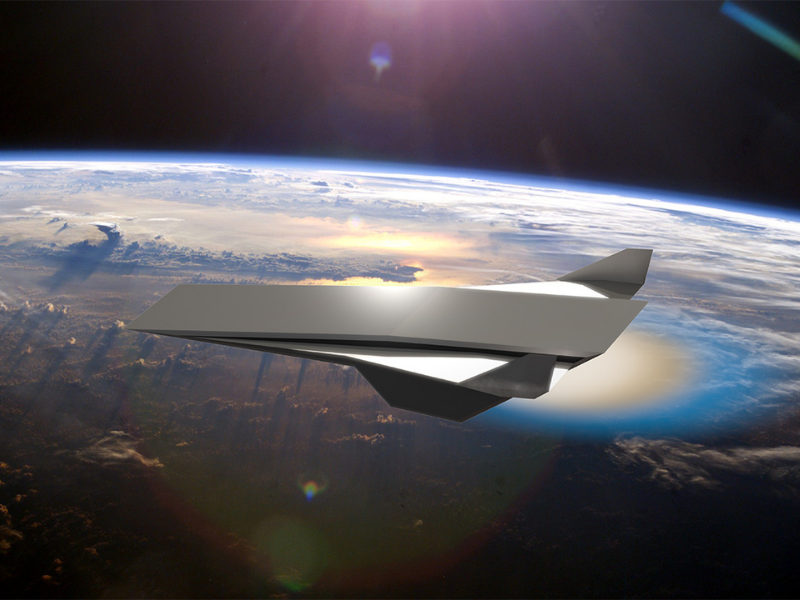
A conceptual hypersonic aircraft is pictured. Background image credit: NASA. Aircraft and composite image credit: Daniel Rosato, UCF.
The UCF-developed propulsion system might allow for flight To reach speeds of Mach 6 to 17 (beyond 7,403 to 20,921 kilometers per hour) and have air and space travel applications.
University of Central Florida scientists are improving their technology that might one day lead the way for hypersonic flight, such as traveling from New York to Los Angeles in under half an hour.
In their most recent study released in the journal Proceedings of the National Academy of Sciences, the scientists found a method to stabilize the detonation required for hypersonic propulsion by producing a specific hypersonic reaction chamber for jet engines.
Kareem Ahmed, study co-author and associate professor in UCF’s Department of Mechanical and Aerospace Engineering, says that there is an intense international effort to create robust propulsion systems for hypersonic and supersonic flight; this would enable flight through our atmosphere at extremely high speeds and additionally permit a more efficient entry and departure from planetary atmospheres. Kareem Ahmed continued by saying that the discovery of stabilizing a detonation– one of the most effective types of extreme reaction and energy release– has the potential to transform hypersonic propulsion and energy systems.
The system could allow for air travel at speeds of Mach 6 to 17, which is over 7,403 to 20,921 kilometers per hour. The technology takes advantage of the power of an oblique detonation wave, which they developed by utilizing an angled ramp inside the reaction chamber to produce a detonation-inducing shock wave for propulsion.
Unlike revolving detonation waves that rotate, oblique detonation waves are stationary and stabilized.
The technology enhances jet propulsion engine performance to produce more power while utilizing less fuel than conventional propulsion engines, therefore lightening the fuel load and decreasing expenses and emissions.
Along with faster flight, the technology could additionally be utilized in rockets for space missions, reducing the rocket’s weight by needing less fuel, traveling farther, and burning more cleanly.
Detonation propulsion systems have been researched for over half a century yet have not been successful as a result of the chemical propellants utilized or the methods they were mixed. Previous work by Ahmed’s team conquered this issue by very carefully stabilizing the rate at which the propellants hydrogen and oxygen were released into the engine to produce the initial experimental proof of a rotating detonation.
Having said that, the brief duration of the detonation, typically taking place for just milliseconds, makes them challenging to study and impractical for use.
On the other hand, in the new study, the UCF scientists had the ability to maintain the length of a detonation wave for three seconds by producing a new hypersonic reaction chamber, referred to as a hypersonic high-enthalpy reaction, or HyperREACT, facility. The facility consists of a chamber with a 30-degree angle ramp near the propellent blending chamber that stabilizes the oblique detonation wave.
Ahmed says this is the first time a detonation has actually been revealed to be stabilized experimentally. Ahmed continued by saying that the team is ultimately able to hold the detonation in space in oblique detonation form. It’s practically like freezing an extreme explosion in physical space.
Gabriel Goodwin, an aerospace engineer with the Naval Research Laboratory’s Naval Center for Space Technology and study co-author, states that their research assists in addressing a lot of the essential concerns surrounding oblique detonation wave engines.
Goodwin’s function in the study was to make use of the Naval Research Laboratory’s computational fluid dynamics codes to simulate the experiments conducted by Ahmed’s team.
Goodwin stated that studies such as this are essential to progressing the understanding of these intricate phenomena and bringing us closer to creating engineering-scale systems.
Goodwin mentions that the work is interesting and drives the limits of both simulation and experiment, sharing that he is honored to be a part of the project.
The research’s lead author is Daniel Rosato ’19 ’20MS, a graduate research assistant and a recipient of UCF’s Presidential Doctoral Fellowship.
Rosato has been working with the project since he was an aerospace engineering undergraduate student and is in charge of experiment design, manufacture, and operation, in addition to data analysis, with support from Mason Thorton, a study co-author, and an undergraduate research assistant.
Rosato says the following actions for the research are the inclusion of new diagnostics and measurement devices to acquire a deeper understanding of the phenomena they are studying.
As said by Rosato, afterward, the team will certainly proceed to explore more experimental arrangements to identify in more detail the requirements with which an oblique detonation wave can be stabilized.
If successful in advancing this technology, the scientists claim that detonation-based hypersonic propulsion could be incorporated right into human atmospheric and space travel in the coming ten years.
Originally published byscitechdaily.com. Read the original article.
Reference: “Stabilized detonation for hypersonic propulsion” by Daniel A. Rosato, Mason Thornton, Jonathan Sosa, Christian Bachman, Gabriel B. Goodwin and Kareem A. Ahmed, 10 May 2021, Proceedings of the National Academy of Sciences. DOI: 10.1073/pnas.2102244118
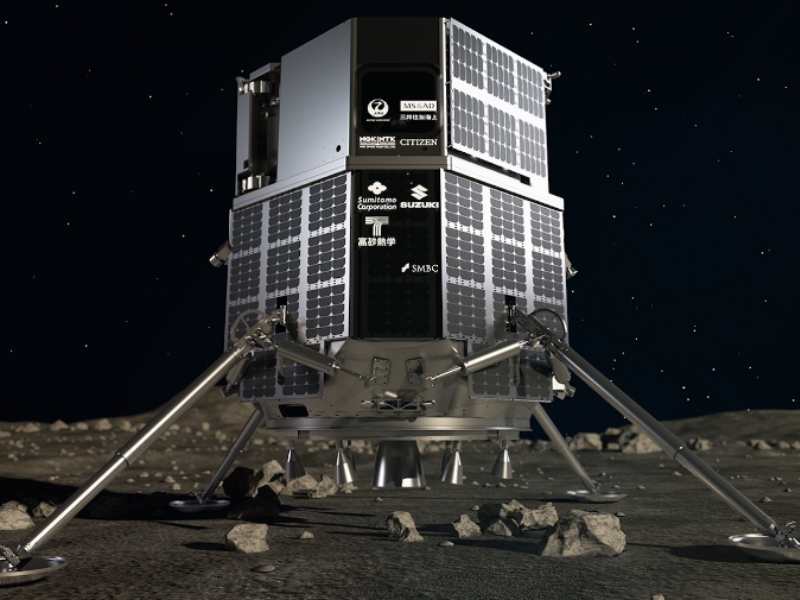
The technician team working from lunar exploration start-up ispace has unveiled its coming generation lunar lander, in time for its third lunar mission.
According to Series 2, the lander is at the moment anticipated to launch in 2024 and is greater in size and haul storage capacity than the company’s previous Series 1 lander, based on the company’s press release.
The Series 2 will measure 9 feet in height, and 14 feet in width (approximately. 2.7 metres by 4.2 metres), and will be engineered, manufactured and delivered in the United States.
Ispace is teaming up nearly with experts in the field, along with the General Atomics Electromagnetic Systems Group( GA- EMS) and Draper, who will play key roles in the lander’s evolution.
The Series 2 mission
The functions of the lander will be transporting shuttles to both lunar orbit and the lunar surface. Its carrying capacity for lunar surface transports will range from 1,102 pounds (500 kg) and up to 4,409 pounds (2,000 kg) for lunar orbit. The transport module can carry government, commercial, and scientific transportation due to its modular transport bay design.
Takeshi Hakamada, the founder & CEO of ispace said that as we look to the not so distant future, Series 2 will not only enable us to increase our skills, but also provide greater access and possibilities to our users. The Series 2 is a welcome step in realising a varied and maintainable cislunar ecosystem.
Furher unexpectedly, conceivably,, is the fact that the Series 2 lander intends to be the first marketable lunar lander to endure a freezing lunar night – that can last as long as 14 Earth days, also, it’s being developed to land on either the near or far side of the Moon, including its polar regions.
In particular, the landing module is designed to provide one of the most technically advanced and most accurate landing systems available, including relative surface velocimetry, precision landing location, and risk avoidance.
Even though ispace is currently still seen as a start-up, it has been remaining in the space game for years, operating closely with SpaceX through the course of its HAKUTO-R programme. Furthermore, even though NASA has recently announcement its plans to send people into space by 2024 are destroyed, the space race will continue, and it seems that ispace will certainly progress along with the best the industry has to provide.
Originally published on interestingengineering.com. Read the original article.
Preparing to Launch The World’s First Private …. READ MORE IN SCIENCE ALERT.
READ MORE…
We use cookies on our website to give you the most relevant experience by remembering your preferences and repeat visits. By clicking “Accept All”, you consent to the use of ALL the cookies. However, you may visit "Cookie Settings" to provide a controlled consent.
This website uses cookies to improve your experience while you navigate through the website. Out of these, the cookies that are categorized as necessary are stored on your browser as they are essential for the working of basic functionalities of the website. We also use third-party cookies that help us analyze and understand how you use this website. These cookies will be stored in your browser only with your consent. You also have the option to opt-out of these cookies. But opting out of some of these cookies may affect your browsing experience.
Necessary cookies are absolutely essential for the website to function properly. These cookies ensure basic functionalities and security features of the website, anonymously.
Cookie
Duration
Description
cookielawinfo-checkbox-analytics
11 months
This cookie is set by GDPR Cookie Consent plugin. The cookie is used to store the user consent for the cookies in the category "Analytics".
cookielawinfo-checkbox-functional
11 months
The cookie is set by GDPR cookie consent to record the user consent for the cookies in the category "Functional".
cookielawinfo-checkbox-necessary
11 months
This cookie is set by GDPR Cookie Consent plugin. The cookies is used to store the user consent for the cookies in the category "Necessary".
cookielawinfo-checkbox-others
11 months
This cookie is set by GDPR Cookie Consent plugin. The cookie is used to store the user consent for the cookies in the category "Other.
cookielawinfo-checkbox-performance
11 months
This cookie is set by GDPR Cookie Consent plugin. The cookie is used to store the user consent for the cookies in the category "Performance".
viewed_cookie_policy
11 months
The cookie is set by the GDPR Cookie Consent plugin and is used to store whether or not user has consented to the use of cookies. It does not store any personal data.
Functional cookies help to perform certain functionalities like sharing the content of the website on social media platforms, collect feedbacks, and other third-party features.
Performance cookies are used to understand and analyze the key performance indexes of the website which helps in delivering a better user experience for the visitors.
Analytical cookies are used to understand how visitors interact with the website. These cookies help provide information on metrics the number of visitors, bounce rate, traffic source, etc.
Advertisement cookies are used to provide visitors with relevant ads and marketing campaigns. These cookies track visitors across websites and collect information to provide customized ads.