Author: cumbonguala

  • DJI Mavic 4 Pro Review A New Benchmark in Consumer Drone Technology

    DJI Mavic 4 Pro Review A New Benchmark in Consumer Drone Technology

    DJI's highly anticipated Mavic 4 Pro drone has finally been released, but there’s some bad news. Because of Trump’s tariffs and other market uncertainties, such as the possibility of a DJI ban, it’s not available for sale in the U.S. yet, and there’s no information on when it will be or at what price. This will likely frustrate U.S. buyers, as the Mavic 4 Pro is the most advanced consumer drone to date.
    Credit: Steve Dent for Engadget

    DJI’s highly anticipated Mavic 4 Pro drone has finally been released, but there’s some bad news. Because of Trump’s tariffs and other market uncertainties, such as the possibility of a DJI ban, it’s not available for sale in the U.S. yet, and there’s no information on when it will be or at what price. This will likely frustrate U.S. buyers, as the Mavic 4 Pro is the most advanced consumer drone to date.

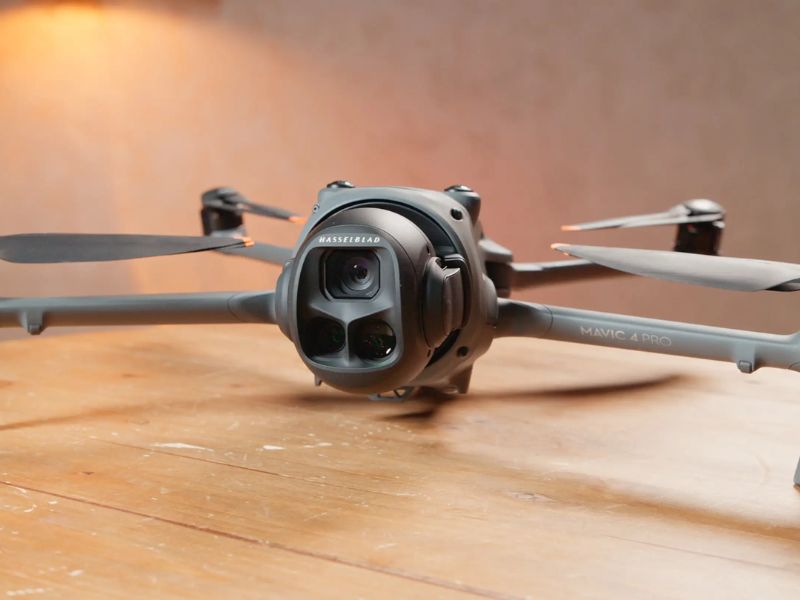
    Equipped with a unique triple-camera setup in an eye-catching round gimbal, the Mavic 4 Pro can record up to 6K at 60 fps with 16 stops of dynamic range, outperforming not only other drones but even many cameras. DJI has also enhanced the drone’s top speed, battery life, and range, while upgrading obstacle avoidance in low-light conditions with a new LiDAR system. Additionally, the company unveiled the RC Pro 2 controller, featuring a practical new foldable design.

    I’ve been using the Mavic 4 Pro for a few weeks, and it performs even better than the specs indicate. While it’s on the pricier side, this drone is so refined and powerful that nothing else comes close to matching it.

    Layout

    The standout feature, as revealed by leaks and a teaser last week, is the large round triple-camera “Infinity Gimbal” module at the front. This design allows the gimbal to rotate freely, enhancing stabilization and offering unique camera angles. It increases the tilt-up angle from 60 to 70 degrees and enables the gimbal to move at any angle, creating dynamic “Dutch” angles for more creative shots. Additionally, it can rotate 90 degrees to capture full-resolution vertical video perfect for social media.

    Thanks to the new housing and slightly larger batteries, the Mavic 4 Pro weighs 2.3 pounds, which is 0.2 pounds heavier than the Mavic 3 Pro. The propeller arms have been redesigned to allow for folding and unfolding in any order, a change from the previous model. Additionally, the body is more aerodynamic, improving both efficiency and speed.

    The Mavic 4 Pro features a forward-facing LiDAR sensor and six omnidirectional fisheye sensors for enhanced night-time obstacle detection, working in light as low as 0.1 lux. The standard model offers 64GB of internal storage (42GB usable), while the Creator Combo version includes 512GB (460GB usable), both with a microSD card slot.

    Credit: DJI’s new RC2 Pro screen controller folds up and flips sideways. (Steve Dent for Engadget)

    The Mavic 4 Pro comes with the RC2 controller, featuring a 7-inch HDR display, retractable joysticks, camera controls, HDMI and USB-C ports, and Wi-Fi 6 for fast data transfers.

    Its new 95Wh batteries offer up to 51 minutes of flight time (40-45 minutes with typical use), a big improvement over the Mavic 3 Pro. They also charge faster, taking 51 minutes for one or 90 minutes for three with the Fly More kit charger.

    Capabilities and Functionality

    The Mavic 4 Pro can reach 56 mph (90 km/h) in sport mode, up from 47 mph, and 40 mph in normal mode with obstacle avoidance. However, it’s still a large drone, lacking the agility of the Mini 4 Pro and not ideal for tight spaces without propeller guards.

    Its noise level is 83 dB, similar to the Mavic 3 Pro, but with a less intrusive lower frequency. The O4+ transmission system extends its video range to 18.6 miles (30 km), with fewer dropouts, improved interference resistance, and bright 10-bit HDR 1080p live video.

    Credit: Steve Dent for Engadget

    The Mavic 4 Pro’s ActiveTrack 360 lets you adjust the camera angle while keeping the subject centered, even when partially obscured. It tracked a car at 30 mph with full obstacle avoidance and followed a cyclist creatively, though it had a minor collision with a tree branch. It also performed well for vlogging, smoothly following a preset route.

    At night, the Mavic 4 Pro used its LiDAR and low-light sensors to navigate trees and buildings, reliably avoiding obstacles. The LiDAR sensor works only facing forward, and the return-to-home feature now works without GPS in well-lit conditions, as the drone can remember its flight path.

    Video Performance

    Credit: Steve Dent for Engadget

    The Mavic 4 Pro features an upgraded camera system with exceptional video quality, including a 28mm Hasselblad-branded wide-angle lens with a 100MP dual ISO 4/3 sensor, capable of shooting 6K at 60 fps or 4K at 120 fps. It supports D-Log and D-LogM color profiles for enhanced dynamic range and offers a variable aperture (f/2.0 to f/11) for better control in varying lighting conditions.

    The drone also includes a 70mm medium telephoto lens and a 168mm telephoto lens, both delivering high-quality images. Video is sharp and color-accurate, with strong dynamic range, and the Creator Combo version supports H.264 All-I recording at 1,200 Mbps for efficient editing. However, it lacks the ProRes 4:2:2 HQ option available on the Mavic 3 Pro Cine edition.

    Credit: Steve Dent for Engadget

    The Mavic 4 Pro excels in low light with its dual ISO, capturing cityscapes with minimal grain and balancing bright skies and dark ground in D-Log mode. The 100MP mode offers detailed photos, while the 25MP mode reduces noise in low light. The RAW DNG format allows for easy adjustments in high-contrast settings.

    The 70mm telephoto camera (3x) is ideal for portraits and landscapes, supporting 4K at 120 fps with D-Log or D-LogM. While its low-light performance isn’t as strong, the 168mm camera is great for wildlife photography and offers decent video quality.

    Conclusion

    Credit: Steve Dent for Engadget

    The Mavic 4 Pro showcases DJI’s dominance in the consumer drone market, outperforming the Mavic 3 Pro in almost every aspect. Its closest competitor, the Autel Evo II Pro 6K, has a smaller sensor, shorter range, and lower endurance.

    While the Mavic 4 Pro is unavailable in the U.S. due to potential sales bans, it is available in other regions, priced from €2,099 (£1,879) for the standard RC2 controller model. The Fly More kit is €2,699 (£2,459), and the Creator Combo, with additional features, is €3,539 (£3,209). The RC2 Pro controller alone costs €999 (£879).


    Read the original article on: Engadget

    Read more: U.S. Drone Outperforms Rivals at Chinese-Level Prices

  • Google I/O 2025: Where to Stream All the AI and Android Announcements

    Google I/O 2025: Where to Stream All the AI and Android Announcements

    Google is preparing to host its biggest developer event of the year, Google I/O 2025, on May 20 and 21. Major announcements from CEO Sundar Pichai, DeepMind CEO Demis Hassabis, and other top executives overseeing Search, Cloud, and Android are expected to showcase significant product updates.
    Image Credits:Justin Sullivan / Getty Images

    Google is preparing to host its biggest developer event of the year, Google I/O 2025, on May 20 and 21. Major announcements from CEO Sundar Pichai, DeepMind CEO Demis Hassabis, and other top executives overseeing Search, Cloud, and Android are expected to showcase significant product updates.

    AI will be a dominant theme—expect Google’s Gemini AI model to be in the spotlight as the company aims to stay ahead of rivals like OpenAI, xAI, and Anthropic. We’ll likely see news about DeepMind’s ongoing projects, including Project Astra, its multimodal AI system. Last year, Project Astra-powered smart glasses were teased during the event.

    AI at the Heart of Google I/O 2025

    Google I/O 2025 will emphasize how AI is transforming the company’s entire product ecosystem. For instance, Elizabeth Reid, Google’s head of Search, will present on how generative AI is reshaping how we search. Other sessions will explore AI’s role in scientific research, app integration by AI agents, and how Waymo’s self-driving cars navigate using AI.

    The main keynote begins at 10 a.m. PT on May 20 at the Shoreline Amphitheater in Mountain View and will be livestreamed online. A developer-focused keynote will follow at 1:30 p.m. PT.

    Demis Hassabis Discusses AI’s Global Impact at Google I/O 2025

    At 3:30 p.m. PT, DeepMind CEO Demis Hassabis will join Alex Kantrowitz, host of the Big Technology Podcast, for a conversation about the future of DeepMind’s AI and its global implications. Concurrently, livestreamed sessions will highlight the newest developments across Android, Chrome, and Google Cloud.

    While not all presentations at Google I/O will be streamed, TechCrunch will be reporting live from the event to bring you coverage of the most important announcements.

    This year, Google will unveil its Android updates a week before Google I/O 2025 at a dedicated event called “The Android Show.” The livestream begins Tuesday at 10 a.m. PT, and you can tune in to watch it here.


    Read the original article on: TechCrunch

    Read more: Google and Duolingo think AI can transform language learning. Do they?

  • Mastercard and Visa Use AI to Transform Payments and Shopping

    Mastercard and Visa Use AI to Transform Payments and Shopping

    Global payment leaders Mastercard and Visa have unveiled new AI-driven solutions aimed at transforming how consumers make payments and shop online. Both companies are fully embracing the AI agent trend, with systems capable of performing automated tasks based on user commands.
    Mastercard and Visa Launch AI Solutions to Automate Payments and Shoppin

    Global payment leaders Mastercard and Visa have unveiled new AI-driven solutions aimed at transforming how consumers make payments and shop online. Both companies are fully embracing the AI agent trend, with systems capable of performing automated tasks based on user commands.

    With these innovations, Visa will enable platforms like ChatGPT and other AI tools to use stored card information to complete purchases. Previously, this process required human intervention, but now, consumers will be able to finalize orders directly through intelligent agents.

    Mastercard, on the other hand, introduced Agent Pay, its own smart shopping assistant. This solution can suggest items such as clothing and accessories for specific events and autonomously complete the purchase, while also recommending the best payment option. The system uses tokenization, a technology that replaces sensitive card data with unique tokens for each transaction, enhancing security—this method is already used by Apple Pay, Google Pay, and Samsung Pay.

    Additionally, Mastercard has announced strategic partnerships to expand the use of AI in commerce. The company is working with Microsoft to develop intelligent shopping agents and collaborating with IBM on B2B (business-to-business) solutions.

    AI Agents: What They Are and How They Work

    AI agents are systems that can automatically perform tasks on behalf of users. They can fill out forms, make restaurant reservations, or even complete purchases without requiring direct consumer interaction.

    Companies like OpenAI with ChatGPT’s Operator, Anthropic with Claude, and tech giants such as Amazon, Microsoft, and Google are also developing their own versions of these smart assistants, further integrating AI into daily life.

    Mastercard and Visa’s initiatives highlight the global race to integrate AI into the financial sector, promising greater convenience, security, and automation for both consumers and businesses.


    Read the original article on: Engenharia

    Read more: Hugging Face Unveils a Free AI Tool with Operator-Like Agent Capabilities

  • Why Did This Robot Go Haywire And Endanger Its Handlers?

    Why Did This Robot Go Haywire And Endanger Its Handlers?

    A disturbing video circulating on social media seems to show a chilling scenario: a rogue killer robot. In the short clip, a humanoid robot malfunctions, thrashing its limbs and coming dangerously close to two nearby technicians.
    Credit: Pixabay

    A disturbing video circulating on social media seems to show a chilling scenario: a rogue killer robot. In the short clip, a humanoid robot malfunctions, thrashing its limbs and coming dangerously close to two nearby technicians.

    A Powerful and Potentially Dangerous Humanoid Robot

    People believe the robot is a  Unitree H1, a versatile humanoid model priced at US$90,000. It has previously danced with humans, climbed stairs, and even performed backflips. It stands 5.9 feet (180 cm) tall and weighs 104 pounds (47 kg).

    That puts it on par in size with an average adult, but what’s truly concerning is its ability to generate a powerful joint torque of 365 lb.ft (360 Nm), enough to lift heavy loads. When its limbs are swinging at high speed, the risk of serious injury to anyone nearby is real.

    But is this truly a real-life scene out of Terminator? Maybe not. Some technical explanations and context have surfaced, though there’s been no official confirmation from Unitree yet. Still, it’s worth examining—here’s what might actually be happening in the video, which reportedly first been posted on Reddit last week.

    Loss of Balance and Overcompensation

    The YouTube channel ‘Chris Wabs’ suggested that the clip filmed during a public event aimed to showcase the H1’s capabilities. Notably, the robot appears tethering its head to a stand when powered on—something that may disrupt its balance and orientation.

    The robot might interpret its situation as a loss of balance and react with exaggerated corrective motions—what may appear as violent thrashing.

    Alternatively, nearby technicians could have caused the unexpected behavior by a malfunction or an error in a program they ran.

    The video is certainly disturbing, but much of that impact may stem from the absence of context around the event. And honestly, if a robot can get thrown off just by feeling unsteady, we might not need to fear an AI-led robot uprising anytime soon.

    An earlier video from February—though I haven’t confirmed its authenticity—seemed to show a Unitree humanoid at a festival acting aggressively or menacingly toward attendees, until security intervened and subdued it. This new clip is also unsettling and brings up an important question: how do you safely defuse a potentially dangerous situation involving a robot?


    Read the original article on: New Atlas

    Read more: Modular Firefighting Robot Dog Strides Into Hazardous Areas

  • How To Install And Configure A VPN On Apple TV

    How To Install And Configure A VPN On Apple TV

    Apple TV is one of the top streaming devices available today, letting you add apps like Netflix, Disney+, and Max to your regular TV. While it's pricier than some rivals, it delivers a smoother, more refined experience—complete with stunning screensavers—and stronger privacy features.
    Credit: Pixabay

    Apple TV is one of the  best streaming devices available today, letting you add apps like Netflix, Disney+, and Max to your regular TV. While it’s pricier than some rivals, it delivers a smoother, more refined experience—complete with stunning screensavers—and stronger privacy features.

    A lesser-known benefit of Apple TV is its compatibility with several native VPN apps. With a VPN, you can access shows, movies, and sports broadcasts typically limited to other regions. By switching your IP address to a different virtual location, a VPN can trick streaming platforms into offering content from that area. Here’s how to set up a VPN on your Apple TV—and why it could be worth doing.

    How to Connect a VPN to Your Apple TV

    Since the release of the tvOS 17 update in  September 2023 release Apple TV now supports third-party VPN apps. Setting them up is straightforward—just follow these steps (though they might differ slightly depending on the VPN):

    1. In the Apple TV App Store, either search for the specific VPN you want to install or enter the keyword “VPN” to browse available options.
    2. Download and set up the VPN you selected.
    3. Create an account or sign in.
    4. Select a server based in another country.
    5. After the VPN is active, go back to the home screen and launch your preferred streaming app. In some instances, it will provide access to a different selection of content based on your new virtual location.

    We offer a detailed guide on streaming video to your TV with a VPN, including instructions for setting up a VPN on Apple TV and other methods for connecting a VPN to your device.

    Reasons to Use a VPN on Apple TV

    As mentioned earlier, using a VPN on your Apple TV lets you alter your IP address to appear as if you’re browsing from another country. This works because the VPN server interacts with the internet on your behalf, and encryption ensures that your true identity remains hidden. For example, if you’re in the US and connect to a UK VPN server, you’ll gain access to the UK Netflix library and be able to stream content from UK-exclusive services like BBC iPlayer.

    VPNs are crucial for online security, though their benefits are most noticeable on devices like smartphones or PCs, where you do most of your browsing. If you get a VPN subscription for your Apple TV, it’s also worth using it on your smartphone and laptop. A VPN can help protect your privacy by keeping you anonymous online and safeguarding your data from cyber threats and advertising networks. If digital privacy and anonymity are important to you, it’s a good idea to use a VPN on all your internet-enabled devices.

    Selecting the Best VPN

    Apple TVs are compatible with only a select number of VPNs. While this may seem limiting, Apple carefully reviews the VPNs available on its App Store, ensuring that they’re reliable and trustworthy. All of the best VPNs on our recommended list are available in the Apple TV App Store.

    We recommend conducting your own research when selecting a service. While all VPNs offer similar basic functions, their pricing and additional features can differ. Before making a decision, take time to explore what each option provides and check reviews from other users to find the best fit for your needs and devices.

    VPN Choices for Other Streaming Services

    Don’t have an Apple TV? That’s not a problem! There are plenty of solid VPN options—or alternative methods—for streaming on other major platforms too. Whether you’re using a smart TV, gaming console, or streaming device like Roku, Amazon Fire TV, or Chromecast, you can still access geo-restricted content and protect your privacy. Many VPNs offer dedicated apps or easy-to-follow setups for these devices, ensuring that you can enjoy secure, unrestricted streaming on a wide range of platforms. So, even without an Apple TV, you can still unlock content from around the world with the right tools.


    Read the original article on: Engadget

    Read more: Can The Use of Software-Defined Perimeters Replace the Need For VPN?

  • Food Scientist Reveals Best Way To Peel A Boiled Egg

    Food Scientist Reveals Best Way To Peel A Boiled Egg

    We've all struggled with peeling a boiled egg, only to ruin it as the shell clings tightly to the white, often leaving behind annoying bits of membrane.
    Credit: Pixabay

    We’ve all struggled with peeling a boiled egg, only to ruin it as the shell clings tightly to the white, often leaving behind annoying bits of membrane.

    The internet is full of so-called “hacks” for easier egg peeling, but the real issue lies in the multiple factors that make eggs tough to peel. Fortunately, science offers practical solutions to tackle the problem.

    Credit: Vinegar in the boiling water may help detach the membrane from the shell. (Gilson Gomes/Unsplash)

    Factors Affecting How Easily Eggs Peel

    Eggs are made up of a hard, porous shell, two membranes (inner and outer), the egg white (albumen), and a yolk at the center, all enclosed by a membrane. There’s also an air cell between the inner and outer membranes next to the shell.

    Extensive research conducted in the late 1960s and 1970s explored the factors that influence how easily eggs peel after being boiled.

    One of these factors is the pH level of the egg white. A 1960s study found that for easier peeling, the pH of the egg white should fall within the range of 8.7 to 8.9, which is relatively alkaline.

    Storage temperature also affects how easily eggs peel. A study from 1963 that keeping eggs at around 22°C (72°F) results in better peelability compared to storing them at cooler temperatures, such as 13°C or in the fridge at 3–5°C.

    However, storing eggs at higher ambient temperatures carries the risk of spoilage.

    The studies found that letting eggs age for a longer period before boiling – by using less fresh eggs – also made them easier to peel.

    Step one: steer clear of fresh eggs

    It’s widely known that fresh eggs are more difficult to peel, and there are a few reasons for this based on the factors mentioned above.

    Firstly, in a fresh egg, the air cell is still small. As the egg ages, it gradually loses moisture through the porous shell, causing the air cell to expand while the rest of the egg contents shrink. A larger air cell makes it easier to begin peeling.

    Moreover, while egg whites start off somewhat alkaline, they increase in pH as the eggs age, which also helps make peeling easier.

    Credit: The older the eggs, the easier they might be to peel. (Alexander Belov/Unsplash)

    Step two: temperature of the water

    Some egg boiling enthusiasts argue that starting off with boiling water and then reducing it to a simmer before carefully adding the eggs yields better results. However, it’s important to use eggs at room temperature to prevent them from cracking due to a sudden temperature shift.

    The reasoning behind this method is that starting with higher temperatures helps the membrane separate from the shell and egg white more easily.

    Additionally, the rapid heat helps the egg white proteins denature (change structure as they cook) and bond to each other instead of to the membrane.

    After boiling the eggs for your preferred time (usually 3–5 minutes for runny yolks, 6–7 minutes for jammy yolks, and 12–15 minutes for hard boiled), you can cool them in ice water. This helps the egg white slightly shrink away from the shell, making peeling easier.

    Step three : Adding ingredients to the water

    Others suggest adding salt to the boiling water to improve peelability, though results vary. One study showed this method did make peeling easier, but the effect faded as the eggs aged.

    Both acids and alkalis have also been shown to help with peeling or removing the eggshell. A patent describing this process used more aggressive substances aimed at dissolving the shell.

    Building on this idea, you could experiment with adding baking soda or vinegar to the water. The theory behind vinegar is that it reacts with the calcium carbonate in the eggshell, helping to loosen it. As for baking soda, being alkaline, it may assist in separating the membrane from the shell.

    Credit: Starting in hot water might help peelability, especially if you plunge the eggs in ice water afterwards. (Alexander Grey/Unsplash)

    Bonus: other ways to cook eggs

    There are alternative ways to hard-cook eggs, including pressure steaming, air frying, and even using a microwave.

    With steamed eggs, some suggest that the water vapor penetrates the shell, helping to loosen the membrane from the egg white, which makes peeling easier.

    Although recent studies have explored air frying other foods, researchers still need to study how this cooking method affects eggshells and makes peeling easier.

    Finally, once you’ve peeled your eggs, don’t toss the shells—there are many ways to reuse them. You can compost them, use them as natural pest deterrents in the garden, turn them into biodegradable seedling pots, or even repurpose them for advanced uses like scaffolds in cancer research.


    Read the original article on: Sciencealert

    Read more: Eating One Egg per Week Reduces the Risk of Dying from Heart Disease by 29%

  • Ferrari Suggests That A Manual Transmission Could Make A Comeback

    Ferrari Suggests That A Manual Transmission Could Make A Comeback

    Ferrari has been on a strong streak recently, with a waiting list extending until 2026. Despite this, the Italian automaker is still working on its debut electric car, set to launch later this year.
    Credit: Pixabay

    Ferrari has been on a strong streak recently, with a waiting list extending until 2026. Despite this, the Italian automaker is still working on its debut electric car, set to launch later this year.

    But there’s more in the pipeline. Industry rumors have persisted for years, hinting that Ferrari may be planning to reintroduce the manual transmission after a 13-year absence.

    Ferrari’s chief product development officer, Gianmaria Fulgenzi, has confirmed to Carsales  that the company is open to reintroducing the gated manual gearbox—though only for models they consider appropriate.

    Credit: One model that could be resurrected with a manual transmission would “probably (be) an Icona car, because it’s a car that represents (Ferrari’s) heritage, a car to be admired and to be driven in a certain way”
    Ferrari

    Ferrari Considers Manual Transmissions for Icona Models to Honor Heritage

    Fulgenzi stated, “Mechanical gear changes could be part of the future, depending on the product.” When asked which Ferrari models might feature manual transmissions again, he identified an Icona car, saying it showcases the brand’s heritage and encourages a particular style of driving and appreciation

    He also explained that Icona models would offer more limited performance than other Ferrari supercars and hypercars, since their high torque would demand a strong leg to operate the heavy clutch.

    This becomes more intriguing when you consider that Ferrari built Icona models like the Daytona SP3 and Monza SP1/SP2 to emphasize emotional engagement rather than pure performance metrics. In the past, Ferrari consistently dismissed manual gearboxes due to their impact on overall performance. However, it seems the company may now be willing to make an exception.

    Credit: The California, which was discontinued in 2012, was the last Ferrari to have a manual gearbox
    Ferrari

    The End of an Era: Ferrari’s Shift from Manual Gearboxes to Dual-Clutch Automatics

    The California, discontinued in 2012, was the last Ferrari to feature a manual gearbox. Since then, Ferrari has relied on dual-clutch automatics, which offer enhanced efficiency and performance. However, for those who value a more connected driving experience over sheer acceleration, the tactile feel of a traditional gearbox remains preferred.

    Fulgenzi discovered that manual Ferraris attract not only nostalgic collectors but also a broader range of enthusiasts. High-profile figures like seven-time Formula One champion Lewis Hamilton have also expressed support for the return of manual transmissions. Some reports indicate that Hamilton actively supports creating a modern tribute to the iconic Ferrari F40, which he envisions naming the F44—likely a reference to his racing number

    Ferrari’s current lineup, including the  SF90 XX, can accelerate from 0 to 60 mph (97 km/h) in just 2.4 seconds, nearing Formula One performance levels. However, pushing performance further may be unnecessary and physically taxing for everyday drivers, according to Fulgenzi.

    Nevertheless, he stressed that engineers must focus entirely on improving driving characteristics. In the era beyond peak performance, Ferrari is prioritizing driving enjoyment to ensure customers remain engaged with their vehicles.

    Credit: Ferrari looks to emphasize enjoyment behind the wheel, to make sure customers are interested in driving their vehicle as much as possible
    Ferrari

    Ferrari Focuses on Accessibility: Not Every Owner is a Professional Driver

    It’s reasonable to assume that most of the over 13,000 Ferrari vehicles sold last year didn’t go to fighter pilots or Formula One drivers. As Fulgenzi pointed out, “I don’t think all of our customers want to train every morning just to drive our cars.”

    Looking ahead, Ferrari’s focus over the next decade will likely shift toward driving experience and connection rather than just performance metrics. There’s no official timeline yet for the release of the new manual models.


    Read the original article on: New Atlas

    Read more: Rezvani Vengeance: The SUV that Offers More Than the Usual

  • WhatsApp’s Newest Update Adds An Extra Layer Of Privacy To Your Messages

    WhatsApp’s Newest Update Adds An Extra Layer Of Privacy To Your Messages

    On Wednesday, WhatsApp revealed the introduction of a new feature designed to enhance user privacy within the app. The “Advanced Chat Privacy” setting updates the app, giving users greater control over how they manage their conversations and shared content. The “Advanced Chat Privacy” setting updates the app, giving users greater control over how they manage their conversations and shared content. It also prevents both you and your contacts from exporting chat histories, stopping anyone from saving or sharing conversations externally. Additionally, the feature disables the automatic downloading of media, such as photos, videos, or audio files, onto the recipient's device. This added level of protection aims to keep your messages and shared content more secure and private within the chat environment.
    Credit: Jakub Porzycki/NurPhoto / Getty Images

    On Wednesday, WhatsApp revealed the introduction of a new feature designed to enhance user privacy within the app. The “Advanced Chat Privacy” setting updates the app, giving users greater control over how they manage their conversations and shared content.

    The “Advanced Chat Privacy” setting updates the app, giving users greater control over how they manage their conversations and shared content. It also prevents both you and your contacts from exporting chat histories, stopping anyone from saving or sharing conversations externally.

    Additionally, the feature disables the automatic downloading of media, such as photos, videos, or audio files, onto the recipient’s device. This added level of protection aims to keep your messages and shared content more secure and private within the chat environment.

    Enhanced Privacy Mode Limits Interaction with Meta AI to Strengthen Chat Security

    The new setting also introduces restrictions on how users can interact with Meta AI within their conversations. Specifically, it disables the ability to directly mention Meta AI in chats or to pose questions to the AI assistant. This means that, while using this enhanced privacy mode, users will no longer be able to access or engage with Meta AI’s capabilities through their messages.

    The intention behind this limitation is to further strengthen the privacy of your conversations by minimizing outside interaction, even with built-in AI tools, thereby keeping your chats more secure and focused solely on the participants involved.

    The purpose of this feature is to provide all members of a group chat with greater peace of mind by ensuring that anything shared or discussed stays within the chat.WhatsApp designed it to create a more secure and trustworthy environment, helping participants feel confident that no one can take or share their messages and media outside the conversation.

    It’s important to mention that, at this time, users are still able to take individual screenshots of their chats. However, WhatsApp has indicated that it intends to expand the Advanced Chat Privacy feature in the future, with plans to introduce additional security measures. This suggests that WhatsApp might eventually restrict the ability to take screenshots as part of a broader effort to strengthen privacy and better protect shared content within chats.

    Credit: WhatsApp

    New Privacy Feature Supports Safer Conversations in Sensitive Group Chats

    Meta-owned WhatsApp highlights this new feature as especially useful when people in a group chat don’t know each other well but are discussing sensitive or personal topics. For instance, participants might be sharing health-related experiences in a support group or collaborating on an important community initiative. In these types of conversations, the added privacy can help create a safer space for open and honest communication.

    To enable the new setting, tap on the chat name and choose the “Advanced Chat Privacy” option. WhatsApp is gradually releasing this feature over the next few months, making it available in both individual and group chats.

    Although end-to-end encryption already secures WhatsApp chats, Advanced Chat Privacy adds an extra layer of protection. This new option complements WhatsApp’s existing privacy features, such asdisappearing messages  and chat lock.


    Read the original article on: TechCrunch

    Read more: YouTube Expands its AI Fake Detection to Top Creators

  • Zuckerberg Once Considered Separating Instagram To Protect Facebook

    Zuckerberg Once Considered Separating Instagram To Protect Facebook

    In a private email revealed during the antitrust trial, Zuckerberg warned that buying Instagram might cause a “network collapse” of the more profitable Facebook.
    Credit:Alex Wong / Getty Images

    In a private email revealed during the antitrust trial, Zuckerberg warned that buying Instagram might cause a “network collapse” of the more profitable Facebook.

    Zuckerberg proposed integrating Meta’s apps to counter Instagram’s impact on Facebook’s relevance and even considered making Instagram an independent company.

    In its case against Meta, the U.S. Federal Trade Commission (FTC) is trying to demonstrate that the company holds a monopoly in social networking and used acquisitions like Instagram and WhatsApp to preserve its market dominance. To support this claim, prosecutors are presenting emails and other communications showing that Zuckerberg recognized Instagram as a potential threat to Facebook, even after the platform was integrated into Meta’s ecosystem.

    In a May 2018 email, Zuckerberg warned top execs that Facebook’s app strategy might be flawed.

    Instagram negatively impacted Facebook’s growth.

    Credit:Chesnot / Getty Images

    Zuckerberg raised concerns that Instagram’s rapid growth was hurting Facebook, citing internal data showing declining engagement as users shifted platforms. He warned that pushing Instagram to Facebook’s scale could backfire, potentially causing broader harm.

    He noted Instagram’s growth relied on Facebook’s app and network, warning it risked replacing the more profitable Facebook with a less lucrative platform.

    To address this, Facebook reduced Instagram promotions and encouraged features that would drive users back to Facebook. Zuckerberg called for tighter integration between the platforms to function more as a unified network.

    Zuckerberg suggested, for instance, that it should be simpler for video creators with large followings to engage across both apps. Additionally, he proposed merging the voice and video calling networks of WhatsApp, Messenger, and Instagram into a single network. (Meta later introduced cross-platform messaging in 2020, but eventually reversed the change in subsequent years.)

    The approach of a unified family of apps versus separating them into individual entities.

    Credit:Chesnot / Getty Images

    Zuckerberg noted challenges in developing Instagram and WhatsApp due to strong founder influence and regretted that management couldn’t openly voice concerns without risking team morale or losing Instagram’s co-founders.

    He also advocated for the company to reconsider its product branding, ensuring that Facebook’s brand stayed at the forefront.

    Zuckerberg suggested in his email, “When you open those apps, it should say ‘Instagram by Facebook’ and ‘WhatsApp by Facebook.’ We might even need to incorporate Facebook branding into the app interface, where the app names and logos are currently, to reinforce this connection in users’ minds.”

    Zuckerberg urged Meta to reconsider its branding strategy to ensure that Facebook remained the focal point.

    In 2021, Facebook chose to rebrand as Meta, with its logo now featured on all of the company’s apps.

    If the FTC succeeds in its case, Meta may be forced to separate Instagram and WhatsApp into independent businesses. Ironically, this is a strategy that Zuckerberg himself proposed in a 2018 email, suggesting it could be the “only structure” to achieve the company’s objectives. He argued that spinning off Instagram could help maintain Facebook’s growth, streamline Meta’s teams, and potentially allow the company to retain Systrom, Wrote Zuckerberg. (Instagram’s founders left later that same year, in September 2018.)

    Ultimately, Meta kept its acquisitions together, but Zuckerberg warned executives there was a real chance regulators could force a spin-off of Instagram and WhatsApp within 5–10 years, risking the loss of their entire app ecosystem.

    If the FTC prevails in court, Zuckerberg’s prediction will be validated.

    In a statement to TechCrunch, Meta minimized the significance of these emails.

    A Meta spokesperson said, “Documents from years ago, taken out of context and related to acquisitions the FTC reviewed more than a decade ago, won’t alter the competition we’re up against or strengthen the FTC’s weak case.”


    Read the original article on: TechCrunch

    Read more: TikTok is Discontinuing its Instagram Rival, TikTok Notes

  • Microsoft Integrates AI-Driven Deep Research Tools Into Copilot

    Microsoft Integrates AI-Driven Deep Research Tools Into Copilot

    Microsoft is rolling out a “deep research” AI tool within Microsoft 365 Copilot, its AI-powered chatbot app. Recently, several deep research agents have emerged across AI chatbots, including OpenAI’s ChatGPT, Google’s Gemini, and xAI’s Grok. These tools rely on reasoning AI models, which can analyze problems and verify facts—key abilities for conducting in-depth research.
    Image Credits:Rafael Henrique/SOPA Images/LightRocket / Getty Images

    Microsoft is rolling out a “deep research” AI tool within Microsoft 365 Copilot, its AI-powered chatbot app. Recently, several deep research agents have emerged across AI chatbots, including OpenAI’s ChatGPT, Google’s Gemini, and xAI’s Grok. These tools rely on reasoning AI models, which can analyze problems and verify facts—key abilities for conducting in-depth research.

    Microsoft Introduces Researcher and Analyst for Advanced AI-Powered Research

    Microsoft’s versions, Researcher and Analyst, bring unique capabilities. Researcher integrates OpenAI’s deep research model—also used in ChatGPT’s research tool—with “advanced orchestration” and “deep search” features. According to Microsoft, it can handle tasks like developing go-to-market strategies and generating quarterly client reports.

    Analyst, built on OpenAI’s o3-mini reasoning model, is designed for advanced data analysis, Microsoft said. It works iteratively, refining its approach step by step to deliver precise answers. Analyst can also execute Python code to handle complex data queries and provides transparency by making its process visible for review.

    Microsoft’s Deep Research Tools Stand Out with Access to Internal and Web Data

    What sets Microsoft’s deep research tools apart is their ability to access both internal work data and the web. For instance, Researcher can pull information from third-party data connectors, integrating insights from AI agents, tools, and apps like Confluence, ServiceNow, and Salesforce.

    However, the real challenge remains preventing hallucinations or misinformation. Models like o3-mini and deep research are not infallible—they can misattribute sources, draw incorrect conclusions, or rely on unreliable public data.

    Microsoft is introducing the Frontier program, allowing Microsoft 365 Copilot users to access Researcher and Analyst. Participants in Frontier, which will receive early access to experimental Copilot features, will be able to use Researcher and Analyst starting in April.


    Read the original article on: TechCrunch

    Read more: Microsoft is Investigating a Method to Recognize and Credit Contributors to AI Training Data