Topological quantum materials are viewed as a promising prospect for energy-efficient electronics and advanced technology in the future. Among their remarkable features is the ability to conduct spin-polarized electrons on their surface, despite being non-conductive in their interior.
To better grasp this concept, it’s important to understand that spin-polarized electrons possess intrinsic angular momentum, indicating that the direction of their particle rotation (spin) is not entirely random.
Electron’s Topology and the Photoelectric Effect
Scientists used to differentiate topological materials from conventional ones by studying their surface currents. However, it has now been shown that the electron’s topology is closely connected to its quantum wave properties and spin. This link was directly demonstrated through the photoelectric effect, where light assists in releasing electrons from a material like metal.
Prof. Giorgio Sangiovanni, a founding member of ct.qmat in Würzburg and one of the theoretical physicists on the project, likened this discovery to using 3D glasses to observe the topology of electrons. He explained, “Electrons and photons can be described quantum mechanically as both waves and particles. Thus, electrons possess a measurable spin, thanks to the photoelectric effect.”
The team accomplished this by using circularly polarized X-ray light, which possesses torque. Sangiovanni further elaborated, “When a photon interacts with an electron, the signal from the quantum material depends on the photon’s right- or left-handed polarization.“
Essentially, the orientation of the electron’s spin determines the relative strength of the signal between the two polarized beams. This experimental approach is akin to using polarized glasses in a 3D cinema, where differently oriented beams of light create the 3D effect, allowing the visualization of electrons’ topology.
A Milestone in Quantum Material Characterization
The pioneering study, spearheaded by the Würzburg-Dresden Cluster of Excellence ct.qmat—focusing on Complexity and Topology in Quantum Matter—achieved the first-ever topological characterization of quantum materials. This accomplishment was made possible by utilizing a particle accelerator to produce the necessary special X-ray light, which played a pivotal role in creating the “3D cinema” effect during the experiment.
The researchers spent three years on this monumental endeavor, starting with the kagome metal TbV6Sn6, a quantum material. Kagome metals, which resemble Japanese basket weaves due to their mix of triangular and honeycomb lattices, are of particular interest in ct.qmat’s materials research.
Before conducting the synchrotron experiment, the team simulated the results using theoretical models and supercomputers to ensure they were on the right track. Dr. Domenico di Sante, the project lead and a theoretical physicist, emphasized the alignment between the measurements and theoretical predictions, enabling the visualization and confirmation of the topology of the kagome metals.
The discovery of quantum Hall effects in the 1980s revealed the existence of new forms of matter known as “Laughlin states,” named after the American Nobel laureate who successfully characterized them theoretically.
These great states manifest uniquely in two-dimensional materials under extremely cold conditions and intense magnetic fields. In a Laughlin state, electrons form an unusual liquid where each electron moves around its counterparts while actively avoiding them.
Exciting this quantum liquid gives rise to collective states that physicists associate with hypothetical particles, known as “anyons,” whose properties differ significantly from those of electrons. Anyone carries fractional charges (fractions of the elementary charge) and intriguingly challenges the conventional classification of particles as bosons or fermions.
Reports on the realization of a Laughlin state
For years, physicists have sought to realize Laughlin states in systems other than solid-state materials to explore their distinct properties further. However, the required elements, such as the 2D nature of the system, intense magnetic fields, and strong particle correlations, have proven to be exceedingly challenging to achieve.
In a recent article published in Nature, an international team led by Markus Greiner’s experimental group at Harvard reports the first successful realization of a Laughlin state using ultracold neutral atoms manipulated by lasers.
Description of the experiment’s methodology
The experiment involves trapping a few atoms in an optical box and implementing the conditions for creating this exotic state: a solid synthetic magnetic field and robust repulsive interactions among the atoms.
In their study, the researchers observe characteristic properties of the Laughlin state by individually imaging the atoms using a powerful quantum-gas microscope. They demonstrate the distinctive “dance” of the particles as they orbit around each other and confirm the fractional nature of the achieved atomic Laughlin state.
This breakthrough paves the way for extensive exploration of Laughlin states and their counterparts in quantum simulators, such as the Moore-Read state. The ability to create, image, and manipulate anyone under a quantum-gas microscope holds particular appeal as it offers exciting opportunities to harness their unique properties in laboratory settings.
A global team of cosmologists has discovered through computer simulations that observing gravitational waves from merging black holes can reveal the real nature of dark matter. Dr. Alex Jenkins of University College London will co-author their discovery today at the 2023 National Astronomy Meeting.
The team studied the production of gravitational wave signals in simulated universes with various types of dark matter through computer simulations. Their findings show that counting the number of black hole merger events found by the next generation of observatories can tell us whether or not dark matter interacts with other particles. This gives us new insights into what it is made of.
The understanding of cosmologists
Cosmologists generally believe that our understanding of the cosmos lacks dark matter. Despite solid evidence that it accounts for 85% of all matter in the universe, there is no current consensus on the underlying nature of dark matter. This covers whether dark matter particles can collide with others, such as atoms or neutrinos, or can pass directly through them unaffected.
To verify this, you can look at how galaxies form into haloes, dense clouds of dark matter. The structure of the dark matter disperses when it collides with the neutrinos, resulting in fewer galaxies forming. The problem with this method is that all the galaxies that disappear are tiny and very far away from us. Even with the best telescopes available, it is difficult to determine whether they are there.
Exploring the Structure of the Universe Through Gravitational Waves: Future Perspectives
The authors of this study suggest using gravitational waves to indirectly measure the abundance of vanishing galaxies rather than seeing them directly. Their simulation shows far fewer black hole mergers in the distant universe in models where dark matter collides with other particles. Although this effect is too small to be observed by the gravitational-wave experiments currently being performed, it will be an important target for the next generation of observatories that are being planned.
The authors hope their methods will stimulate new ideas for using gravitational-wave data to explore the universe’s large-scale structure and shed new light on the mysterious nature of dark matter.
Dr. Sownak Bose of Durham University, a co-author, said: Our understanding of the universe still faces many mysteries, including dark matter. This indicates that it is crucial to continue discovering new ways to study dark matter models, combining new and existing probes to test model predictions as much as possible. The study of gravitational wave astronomy allows for a better understanding of dark matter and the formation and evolution of galaxies in general.
Co-authors’ Statements on Gravitational Waves and the Evolution of the Universe
The other co-author, Markus Mosbech of the University of Sydney, added: As they pass unimpeded through the universe, gravitational waves offer us a unique opportunity to observe the early universe, and next-generation interferometers will be sensitive enough to detect individual events over enormous distances.
Professor Mairi Sakellariadou of King’s College London, another member of the research team, said: The third generation gravitational wave data will provide a new and independent way to test the current model describing the evolution of our universe and shed light on the still unknown nature of dark matter.
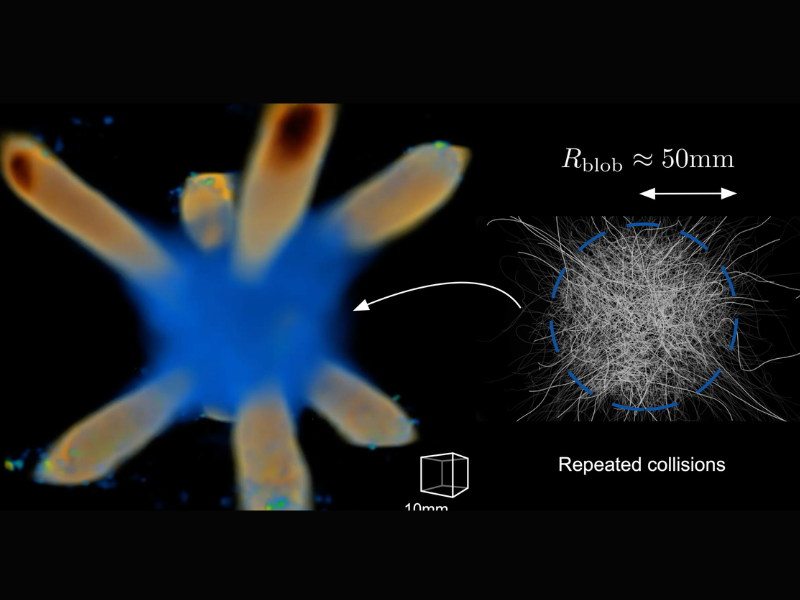
An isolated blob of turbulence is created by the repeated collision of eight vortex rings. (Left) Contained turbulence is illustrated by the breakdown of the blob’s energy into the mean flow (yellow) and fluctuating (blue) components. (Right) Inside the chaotic blob, highly erratic tracer particle trajectories are shown. Credit: Matsuzawa et al.
According to a recent paper published in Nature Physics, researchers at the University of Chicago have made substantial strides in the management and control of turbulence, a complicated phenomenon characterized by chaotic fluctuations in flow velocity and pressure. The team devised a revolutionary technique to solve a long-standing problem of producing an isolated turbulent blob within a tranquil environment.
Takumi Matsuzawa and William Irvine’s team of researchers wanted to accurately control the characteristics of turbulence and confine it to a particular area. Their innovation has created fresh opportunities for experimental studies that were previously challenging to conduct. Physics researchers may now investigate the dynamics and behavior of turbulence in ways that were before impractical by successfully producing an isolated blob of turbulence.
Understanding the motion of conserved quantities
The interplay between turbulent and non-turbulent flows at their interface is one of the main issues the researchers want to solve. Understanding the movement of conserved quantities, such as energy and impulse, over this interface may provide insight into the fundamental properties of turbulence. The occurrence of several turbulence kinds that depend on the combinations of conserved quantities also interests scholars.
The concept of eddies, which are swirling motions inside a fluid that diverge from its normal flow, served as the foundation for the researchers’ strategy. Eddies are frequently compared to turbulent currents or vortices.
The team’s approach entails assembling eddies one at a time to create turbulence, much like building with Legos. In their studies, the eddies were represented by vortexes, more precisely, smoke rings. It is possible for vortex rings to move autonomously and without being significantly impacted by material limits.
Matsuzawa’s experienceabout turbulence
Matsuzawa shot sets of eight vortex ring into a water-filled tank from its eight corners to produce the lone blob of turbulence. Due to vortex reconnections, when a single set of vortex rings is fired, they frequently separate and divert. However, the scientists were able to create a restricted state of turbulence and effectively isolate it from the surrounding flow by repeatedly firing the sets of vortex rings.
The characteristics of the various vortex rings dictate the characteristics of the turbulent blob. The radius of the circles controls the blob’s size, while the crew’s energy transported controls the severity of the inner turbulence.
The researchers claim that merging helical loops might incorporate other conserved characteristics into the turbulence, such as angular impulse and helicity, which could offer a further understanding of its dynamics.
With these innovative design ideas, turbulence can now be localized, positioned, and controlled, giving researchers an invaluable tool for understanding its underlying principles. Research into the evolution, degradation, and memory of turbulence is made possible by the capacity to control and study it in a controlled laboratory environment.
The focus of the researchers
The researchers want to learn more about how turbulence emerges naturally and how it preserves specific properties despite alterations in its initial vortical structures by adjusting the input and merging various vortex loops.
In summary, the most recent research by the University of Chicago scientists constitutes a significant development in the study of turbulence. Future research that might answer open-ended inquiries regarding the nature and behavior of turbulence is made possible by their method for isolating a blob of turbulence within a tranquil environment.
Further research and understanding of this complicated phenomenon will result from the capacity to regulate and alter turbulence experimentally.
To study superconducting materials in their “normal,” non-superconducting state, scientists usually switch off superconductivity by exposing the material to a magnetic field, left. SLAC scientists discovered that turning off superconductivity with a flash of light, right produces a normal state with very similar fundamental physics that is also unstable and can host brief flashes of room-temperature superconductivity. These results open a new path toward producing room-temperature superconductivity that’s stable enough for practical devices. Credit: Greg Stewart/SLAC National Accelerator Laboratory
Room-temperature superconductivity
Researchers find that triggering superconductivity with a flash of light requires the same fundamental physics at work in the more stable states needed for devices, opening up a new path toward creating room-temperature superconductivity.
Researchers can learn more about a system by jolting it into a somewhat unstable state– scientists call this “out of equilibrium”– and after that, watching what occurs as it settles back down right into a more stable state, just like people can learn more about themselves by stepping out of their comfort zones.
A look into Superconductivity
Experiments with the superconducting material yttrium barium copper oxide, or YBCO, have shown that under particular conditions, smacking it out of equilibrium with a laser pulse enables it to superconduct– conduct electrical current with no loss– much closer to room temperature than scientists expected. Scientists have worked on room-temperature superconductors for over three decades, which may be a significant breakthrough.
However, do observations of this unstable state have any relevance to how high-temperature superconductors might function in real life, where applications such as power lines, maglev trains, particle accelerators, and medical equipment require their stability?
A recent research study published in Science Advances suggests that the solution is yes.
According to Jun-Sik Lee, a staff researcher at the Department of Energy’s SLAC National Accelerator Laboratory, individuals thought that although this sort of study was useful, it could have been more promising for future applications. Jung-Sik Lee is also the leader of the international research crew that conducted the study.
“Now we have revealed that the fundamental physics of these unstable states are extremely comparable to those of stable ones. This opens up substantial opportunities, including the possibility that other materials could also be pushed into a transient superconducting state with light. It is a fascinating state that we can not see any other way.”
YBCO is a copper oxide compound, likewise known as cuprate. It is a member of a family of materials found in 1986 that conduct electricity with no resistance at temperatures much greater than researchers had previously considered possible.
Like conventional superconductors, which had been found more than 70 years earlier, YBCO changes from a normal to a superconducting state when cooled below a certain transition temperature. Then, electrons pair and develop a condensate– a kind of electron soup– that easily conducts electricity. Researchers have a solid theory of how this happens in old-style superconductors, yet there is still no agreement about exactly how it works in unconventional ones like YBCO.
One way to dive into the issue is to research the normal state of YBCO, which is plenty weird in its own right. The normal state has a variety of complex, interwoven phases of matter, each with the potential to aid or hinder the transition to superconductivity, that jolt for dominance and often overlap. In a few of those phases, electrons appear to acknowledge each other and act collectively as if they were dragging each other.
It’s a genuine tangle, and scientists wish that understanding it better will clarify how and why these materials become superconducting at temperatures much higher than the theoretical limit predicted for conventional superconductors.
Particle normal states
It is not easy to look into these fascinating normal states at the warm temperatures where they occur, so scientists generally cool their YBCO samples to the point where they end up being superconducting, then turn off the superconductivity to restore the normal state.
The switching is usually done by exposing the material to a magnetic field. This is the preferred approach because it leaves the material in a stable configuration– the type you would need to create a practical device.
Lee stated that superconductivity can likewise be turned off with a pulse of light. This produces a normal state that’s unbalanced– out of equilibrium– where intriguing things can happen from a scientific viewpoint. However, the truth that it’s unstable has made researchers wary of thinking that anything they learn there can likewise be applied to stable materials like the ones required for practical applications.
Waves that stay still
In this study, Lee and his collaborators compared switching approaches– magnetic fields and light pulses– by concentrating on how they influence a peculiar phase of matter referred to as charge density waves, or CDWs, that appear in superconducting materials. CDWs are wavelike patterns of higher and reduced electron density. However, unlike ocean waves, they do not move around.
Two-dimensional CDWs were found in 2012; in 2015, Lee and his collaborators found a new 3D type of CDW. Both kinds are intimately linked with high-temperature superconductivity, and they can work as markers of the transition factor where superconductivity switches on or off.
To compare what CDWs seem like in YBCO when their superconductivity is turned off with light versus magnetism, the research study team did experiments at 3 X-ray light sources.
Properties Of The Undisturbed Material
Initially, they measured the properties of the undisturbed material, including its charge density waves, at SLAC’s Stanford Synchrotron Radiation Lightsource (SSRL).
After that, samples of the material were subjected to high magnetic fields at the SACLA synchrotron facility in Japan as well as to laser light at the Pohang Accelerator Laboratory’s X-ray free-electron laser (PAL-XFEL) in Korea so that changes in their CDWs could be measured.
According to SLAC staff researcher and study co-author Sanghoon Song, these experiments demonstrated that exposing the samples to magnetism or light generated similar 3D patterns of CDWs. Although exactly how and why this occurs is still not comprehended, he claimed, the results show that the states induced by either approach have the same fundamental physics. Furthermore, they suggest that laser light could be a good way to produce and discover transient states that could be stabilized for practical applications, including room-temperature superconductivity.
Scientists from the Pohang Accelerator Laboratory and Pohang University of Science and Technology in Korea; Tohoku University, RIKEN SPring-8 Center and Japan Synchrotron Radiation Research Institute in Japan; as well as Max Planck Institute for Solid State Research in Germany likewise added to this job, which the DOE Office of Science funded. SSRL is a DOE Office of Science user facility.
Read The Original Article onScitech Daily.
Read More CRISPR Test On Monkeys And No Off-target Mutations
Espresso coffee is a popular beverage brewed by grinding roasted coffee beans into grains and then forcing hot water at high pressure through a bed of coffee grains to dissolve the soluble content of the coffee and produce espresso. However, recent research has found that more finely ground coffee beans make weaker espresso, which is a counterintuitive result.
This phenomenon is due to regions within the coffee bed where less or no coffee is extracted, and this uneven extraction is more noticeable when coffee is ground more finely. To investigate the role of uneven coffee extraction, researchers from the University of Huddersfield conducted a study published in the Physics of Fluids journal.
They split the coffee bed into two regions to examine if uneven flow results in weaker espresso. They found that one of the regions had more tightly packed coffee than the other, causing an initial disparity in flow resistance because the water flows more quickly through more tightly packed grains. The extraction of coffee decreased the flow resistance further, as coffee grains lose about 20% to 25% of their mass during the process.
Researchers’ observation of coffee extraction flow
The researchers observed that flow and extraction widened the initial disparity in flow between the two regions, leading to a positive feedback loop, in which more flow led to more extraction, which reduced resistance and led to more flow. They also found that uneven flow across different parts of the coffee bed always occurred, which is essential as the taste of the coffee depends on the level of extraction.
In this figure, Q is the rate of flow, epsilon is the porosity (which increases as coffee is extracted), and c is the concentration of dissolved coffee (a measure of the strength of the espresso). Credit: W.T. Lee, A. Smith, and A. Arshad
Too little extraction results in underdeveloped coffee, which tastes like smoky water, while too much extraction makes the coffee taste very bitter. Therefore, understanding the origin of uneven extraction and avoiding or preventing it could lead to better brews and substantial financial savings by using coffee more efficiently.
The researchers’ next step is to make the model more realistic to gain more detailed insights into this phenomenon and consider changes to how espresso coffee is brewed to reduce the amount of uneven extraction.
Rocky Mountain pumped-storage hydtroele3ctric power plant is owned by Oglethorpe Power Corp. Source – Thomson200. Public Domain
Pumped storage hydropower (PSH), a type of hydroelectric energy storage, is rapidly gaining popularity worldwide as a new technology. Unlike the traditional image of hydroelectric power, which is associated with massive dams such as the Hoover Dam or the Three Gorges Dam, PSH is more environmentally friendly and does not displace communities or damage ecosystems.
Global Energy Monitor recently released a study indicating a shift in the hydroelectric power industry. Instead of the traditional large dams, there is a fast-growing interest in a new technology called pumped storage hydropower, which leverages the gravitational properties of water.
Switzerland’s launch next month of a powerful pumped-storage hydroelectric plant is unlikely to help avoid problems this winter – Copyright AFP/File William WEST
Is it a lake or a battery?
PSH is a form of hydroelectricity that stores energy using two water reservoirs at different elevations. It generates power as water flows from the higher reservoir to the lower one, passing through a turbine. Additionally, it requires electricity to pump the water back up to the higher reservoir for later use. The upper reservoir effectively functions as a large storage battery by storing energy that can be released as needed.
To elaborate on the definition of Pumped Storage Hydropower, there are two types of systems: open-loop and closed-loop. In an open-loop PSH system, the reservoirs have a direct connection to a natural body of water, which allows for a continuous flow of water.
On the other hand, in a closed-loop PSH system, the reservoirs are not connected to an outside body of water, which means the water used for energy generation is recycled between the upper and lower reservoirs.
Both the open-loop and closed-loop systems involve two reservoirs positioned at different elevations. During times of excess electricity generation, the surplus power is used to pump water from the lower reservoir to the upper reservoir, thereby storing the energy. This stored energy can be retrieved later during peak demand periods by allowing the water to flow back down from the upper reservoir through a turbine, which generates electricity.
As the world shifts towards using more variable renewable energy sources like solar and wind, the need for energy storage solutions is becoming increasingly important. Pumped storage is an important part of this transition, as it allows excess electricity to be stored and released when needed.
According to modeling by IRENA, the International Renewable Energy Agency, it’s estimated that around 420 GW of total installed pumped storage hydropower will be required to meet the climate goals outlined in the Paris Agreement by 2050.
Read The Original Article Digital Journal.
Read more:The Flint Water Crisis Underscores The Impact Of Social Networks.
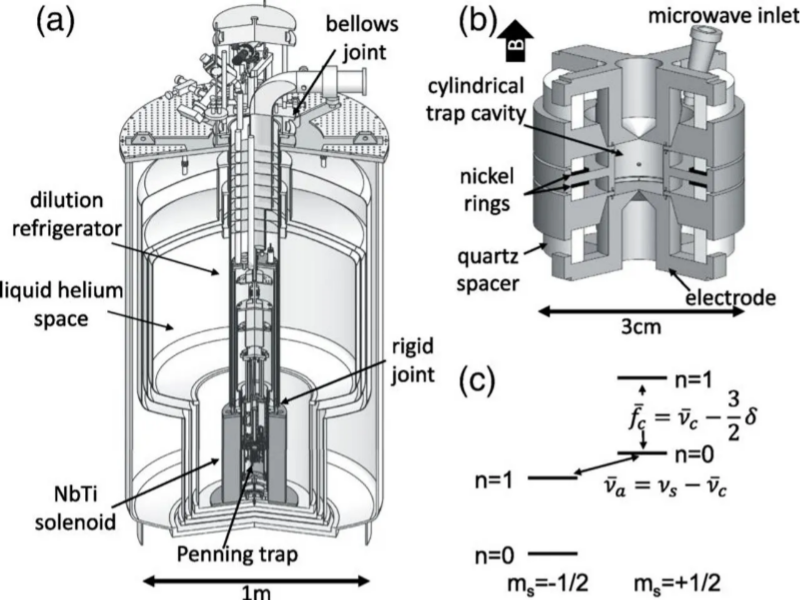
Measurement of magnetic Moment of the electron: (a) Cryogenic system supports a 50 mK electron trap upon a 4.2 K solenoid to provide a very stable B. (b) Silver electrodes of a cylindrical Penning trap. (c) Quantum spin and cyclotron energy levels were used for measurement. Credit: Physical Review Letters (2023). DOI: 10.1103/PhysRevLett.130.071801
Physicists from Havard University and Northwestern college have worked out a new measurement of electron magnetic moment. The experiment is considered to be the most accurate measurement of this property of an electron. In addition, the result was a combined effort of both teams consequently resulting in published article in Physical Review Letters.
The magnetic moment of the electron
The magnetic moment of an electron is called the electron magnetic dipole moment. This originates from its electric as well as spin proprieties. For all the elementary properties that have been previously measured, the Magnetic moment is the most accurate. This measurement is the most precise experiment ever performed in science.
Gauging the magnetic moment of an electron to more precise values is extremely important for experimentalists and theoretical physicists. Physicists think that at some time, such measurements will help to finish the standard model of physics. Thus, for this experiment, the research group has tested to a precision two times that of any other previous work. The last best attempt was 14 years back.
Physicists utilize the magnetic moment of electrons to test the standard model of physics. You may consider the role of the standard model similar to that of the periodic table in chemistry. Hence, physicists analyse interactions between them and additionally virtual particles that pop in and out in vacuum chambers. Such research involves establishing the collision of magnetic moment and g-factor. And afterwards, compare them to what is illustrated in the standard model of particle physics.
The Map of Particle Physics – The Standard Model Explained. Credit: Domain of Science, youtube.
Quantum Jumps
The research consists of suspending a single electron in a Penning trap with an electromagnetic field at 5 T. Moreover, the chamber was then cooled to virtually absolute zero degrees Kelvin. Measurements were taken of what the group describes as “quantum jumps” of the electrons. Such jumps occur at the transition of energy levels within the atom.
After that, by utilizing an electromagnetic field gradient, they can carry out quantum nondemolition detection. In brief, this last technique is a method to determine quantum jumps without changing the quantum state. Doing so reduces the uncertainty of the measurement of the magnetic moment. The result was a measurement of the magnetic moment somewhat more precise. It is worth mentioning that it is higher than previously accomplished: 0.13 fractions of 1 trillion.
The new measurements are anticipated to impact the research of standard models in the future.
Sources: Physical Review Letters (2023). DOI: 10.1103/PhysRevLett.130.071801 and PHYS.
Read more: Quantum Algorithm converse time in the dynamics of electron
Researchers from the Tsukuba Research Center for Energy Products Science at the University of Tsukuba demonstrated a simple method to create ionic liquid microdroplets that function as flexible, long-lasting, and pneumatically tunable lasers. Unlike existing “droplet lasers” that can not operate under an environment, this new development may enable lasers that could be utilized in everyday settings.
Lotus impact
Lotus plants are prized for their charm and have a fantastic self-cleaning property. Rather than flattening on the surface of a lotus leaf, water droplets will create near-perfect spheres and also roll off, taking dust with them. This “lotus impact” is caused by microscopic bumps in the leaf.
Currently, a group of scientists at the University of Tsukuba have taken advantage of an artificial lotus effect to produce liquid droplets that can act like lasers while staying stable for approximately a month. Currently available “droplet lasers” can not be used under ambient conditions since they will just evaporate unless enclosed inside a container.
In this current study, an ionic liquid known as 1-ethyl-3-methylimidazolium tetrafluoroborate (EMIBF4) was blended with a dye that permits it to become a laser. This liquid was chosen due to the fact that it evaporates very gradually and has a relatively enormous surface tension.
After that, a quartz substrate is coated with small fluorinated silica nanoparticles to create the surface repel liquids. When the EMIBF4 is deposited on it from a pipette, the tiny droplets remain almost entirely spherical. The scientists showed that the droplet might stay steady for 1 month at least.
“The wanted morphological and optical properties of the droplet were predicted by mathematical calculations to stay even when exposed to gas convection,” says first-writer Teacher Hiroshi Yamagishi.
The shape and stability against evaporation enable the droplet to keep an optical resonance when excited with a laser pumping source. Blowing nitrogen gas could shift the laser peaks in the variety of 645 to 662 nm by slightly deforming the droplet forms.
“This is, to our understanding, the first liquid laser oscillator which is reversibly tunable by the gas convections,” states Teacher Yamagishi.
The laser
The laser droplet can also be utilized as an extremely sensitive humidity sensor or airflow detector. The scientists then employed a commercial inkjet printing apparatus equipped with a printer head that might work with a viscous liquid. The printed arrays of laser droplets functioned without the need for further treatment.
The findings of this study recommend that the production is highly scalable and straightforward to perform so that it could be readily applied to produce affordable sensor or optical communication devices. This research may lead to new air movement detectors or less expensive fiber-optics communications.
A team of scientists from the University of Cambridge, along with researchers from the United States, Israel, and Austria, have developed a theory that could generate high-energy “quantum light” to study new properties of matter at the atomic level.
They have reported their findings in the journal Nature Physics. While classic physics can explain the world we see around us, the laws of quantum physics take over when we observe things at the atomic scale. The team’s theory describes a new state of light that has controlled quantum properties up to X-ray frequencies, which could be used to study quantum fluctuations at the micro and nanoscale.
Lead author Dr. Andrea Pizzi, currently based at Harvard University, collaborated with researchers from the Technion-Israel Institute of Technology, MIT, and the University of Vienna.
Quantum fluctuations and quantum light
According to Pizzi, the presence of quantum fluctuations makes quantum light challenging to observe, but it also makes it more fascinating. By controlling the state of quantum light, new possibilities in microscopy and quantum computation could be created.
Current methods for generating light involve using solid lasers, which energize electrons and release excess energy as light. It has been assumed that the emitters are independent, resulting in featureless quantum fluctuations. However, Pizzi’s team aimed to investigate a system where the emitters are correlated, meaning that the state of one particle is linked to the state of another. In this scenario, the output light behaves differently, and the quantum fluctuations become more structured and potentially useful.
How to solve this problem?
To solve the several-body problem and develop manageable quantum light using correlated emitters and a strong laser, the scientists utilized theoretical analysis and computer simulations based on quantum physics.
The concept, developed by Pizzi and Gorlach, produces high-energy output light that can be used to engineer the quantum-optical framework of X-rays. After refining equations, the researchers found a single compact equation that describes the link between the output light and input correlations.
Moving forward, they aim to work with experimentalists to validate their predictions and explore many-body systems as a resource for generating quantum light beyond the current setup.
We use cookies on our website to give you the most relevant experience by remembering your preferences and repeat visits. By clicking “Accept All”, you consent to the use of ALL the cookies. However, you may visit "Cookie Settings" to provide a controlled consent.
This website uses cookies to improve your experience while you navigate through the website. Out of these, the cookies that are categorized as necessary are stored on your browser as they are essential for the working of basic functionalities of the website. We also use third-party cookies that help us analyze and understand how you use this website. These cookies will be stored in your browser only with your consent. You also have the option to opt-out of these cookies. But opting out of some of these cookies may affect your browsing experience.
Necessary cookies are absolutely essential for the website to function properly. These cookies ensure basic functionalities and security features of the website, anonymously.
Cookie
Duration
Description
cookielawinfo-checkbox-analytics
11 months
This cookie is set by GDPR Cookie Consent plugin. The cookie is used to store the user consent for the cookies in the category "Analytics".
cookielawinfo-checkbox-functional
11 months
The cookie is set by GDPR cookie consent to record the user consent for the cookies in the category "Functional".
cookielawinfo-checkbox-necessary
11 months
This cookie is set by GDPR Cookie Consent plugin. The cookies is used to store the user consent for the cookies in the category "Necessary".
cookielawinfo-checkbox-others
11 months
This cookie is set by GDPR Cookie Consent plugin. The cookie is used to store the user consent for the cookies in the category "Other.
cookielawinfo-checkbox-performance
11 months
This cookie is set by GDPR Cookie Consent plugin. The cookie is used to store the user consent for the cookies in the category "Performance".
viewed_cookie_policy
11 months
The cookie is set by the GDPR Cookie Consent plugin and is used to store whether or not user has consented to the use of cookies. It does not store any personal data.
Functional cookies help to perform certain functionalities like sharing the content of the website on social media platforms, collect feedbacks, and other third-party features.
Performance cookies are used to understand and analyze the key performance indexes of the website which helps in delivering a better user experience for the visitors.
Analytical cookies are used to understand how visitors interact with the website. These cookies help provide information on metrics the number of visitors, bounce rate, traffic source, etc.
Advertisement cookies are used to provide visitors with relevant ads and marketing campaigns. These cookies track visitors across websites and collect information to provide customized ads.