Category: Physics

  • MIT Experiment Proves Einstein Was Wrong About Quantum Physics

    MIT Experiment Proves Einstein Was Wrong About Quantum Physics

    Image Credit: Pixabay

    Major tech breakthroughs often stem from basic questions. MIT researchers have used modern tools to recreate a landmark physics experiment, showing that Einstein’s take on quantum physics was incorrect—a key step forward for quantum technology.

    Young’s Experiment Unveiled Light’s Dual Nature, but Quantum Mechanics Took It Further

    In 1801, Thomas Young’s double-slit experiment demonstrated that light behaves like a wave. But with the rise of quantum mechanics, it revealed a deeper mystery: light acts as both a wave and a particle—but never at the same time.

    When light passes through two slits, it forms wave-like interference patterns. Yet, if we try to observe which slit it goes through, those patterns vanish, and light behaves like a particle instead. This strange duality is a key concept in quantum mechanics, known as the “complementarity” principle.

    Einstein vs. Bohr: A Historic Showdown Over the Nature of Light

    The 1927 debate between Albert Einstein and Niels Bohr is one of the most iconic philosophical clashes in physics. Einstein suggested that as a photon passes through a slit, it would exert a tiny force—similar to a bird brushing past branches—that could be detected. If measured, this might reveal both the wave and particle nature of light at once.

    Bohr disagreed, arguing that any attempt to track the photon’s path would disrupt the interference pattern, due to the uncertainty principle. For decades, the debate remained unresolved because the tools needed to test it didn’t yet exist.

    MIT’s Quantum Test: Free-Floating Atoms Confirm Light’s Duality Limits

    At MIT, Wolfgang Ketterle’s team cooled over 10,000 atoms to near absolute zero, arranging them into a crystal-like lattice where each atom acted as a tiny slit. By tracking how single photons scattered, they could test whether light behaved as a wave or a particle.

    The most striking part of their experiment was removing the “spring” mechanism—Einstein’s idea of detecting photon impact. They switched off the laser trap, letting the atoms float freely. Yet even then, wave and particle behavior never appeared at the same time, confirming Bohr’s stance.

    MIT Uncovers How Atomic Motion Shapes Light’s Quantum Behavior

    MIT’s key discovery was the role of atomic “fuzziness.” When atoms are loosely confined, they more easily reveal the photon’s path, making light act like a particle. When tightly confined, wave behavior takes over.

    This insight is crucial for advancing quantum technologies. Devices like quantum computers and communication systems depend on managing these core behaviors—and MIT’s experiment offers a clearer path to that control.

    This experiment goes beyond theory. As quantum technologies advance, precisely controlling core quantum behaviors is vital for future innovations. Specifically, it can lead to:

    • More stable qubits in quantum computing
    • Improved sensitivity in quantum sensors
    • Stronger security in quantum communication

    Each of these breakthroughs depends on a deeper understanding of how light and matter behave at the quantum level.

    A Century Later, Quantum Breakthroughs Echo Lessons for Science—and Software

    It’s fitting that 2025 is the UN’s “International Year of Quantum Science and Technology.” This experiment, marking 100 years of quantum mechanics, achieved a level of precision unimaginable in Einstein and Bohr’s time.

    For software developers, it’s a powerful reminder: just as quantum tech depends on mastering fundamental physics, solid software rests on a deep understanding of core principles.

    The findings reaffirm that, contrary to Einstein’s famous quote, “God does not play dice,” the universe truly is probabilistic. Most importantly, they show how curiosity and constant questioning drive scientific breakthroughs.


    Read the original article on: Medium

    Read more: A Quantum Twist: Scientists Create “Hot” Schrödinger’s Cat States

  • Unexplained Radio Signals Under Antarctic Ice Challenge Physics Norms

    Unexplained Radio Signals Under Antarctic Ice Challenge Physics Norms

    The unusual radio signals were first detected nearly ten years ago by a special experiment designed to detect radio waves caused by cosmic rays hitting the atmosphere. 
    Stephanie Wissel / Penn State

    It sounds like something out of science fiction, but scientists have picked up puzzling radio signals originating beneath Antarctica’s ice sheet—signals that don’t quite align with our current understanding of particle physics.

    ANITA’s Unexpected Discovery

    These strange pulses were initially detected between 2016 and 2018 by NASA’s Antarctic Impulsive Transient Antenna (ANITA), a high-altitude experiment designed to detect cosmic phenomena. Since their discovery, researchers have been working to decipher their origin. A recent study published in Physical Review Letters now offers a fresh angle on the ongoing mystery.

    ANITA consists of 24 radio antennas suspended from a balloon flying 40 kilometers (25 miles) above the Antarctic continent. It monitors radio waves entering Earth’s atmosphere, and Antarctica provides an ideal observation point thanks to minimal radio noise.

    Typically, ANITA picks up radio waves coming from above. But the unusual events in 2016 and 2018 had signals emerging from deep below the ice. For these radio waves to reach ANITA, they would have had to travel through thousands of kilometers of dense rock—something that should have blocked or absorbed them completely.

    Neutrinos No Longer the Leading Theory

    “We still don’t have a clear explanation for these anomalies, but it’s unlikely they were caused by neutrinos,” explained Stephanie Wissel, a physics professor and ANITA team member.

    Neutrinos—extremely light, neutral subatomic particles—were the main suspects at first. They rarely interact with matter and are known to pass through entire planets undisturbed. These elusive particles are commonly emitted by cosmic phenomena such as supernovae or the sun.

    Despite their elusive nature, even a single neutrino can reveal important details about distant cosmic events. ANITA was specifically designed to detect neutrino-induced radio emissions, especially those generated by interactions with Antarctic ice.

    When tau neutrinos collide with ice, they can produce tau leptons, which in turn generate bursts of secondary particles and unique radio signals called “air showers.” These signals appear like trails of sparks moving in a single direction, according to Wissel.

    Anomalous Signals Defy Expected Patterns

    By analyzing such patterns, scientists can often trace the source of a neutrino. However, the anomalous signals didn’t match known neutrino signatures and couldn’t be linked to any clear origin. The team used models and simulations to rule out more conventional explanations.

    Researchers also looked for similar signals in data from other observatories—like IceCube and the Pierre Auger Observatory—but none of them had detected anything comparable to what ANITA found.

    As a result, neutrinos are no longer considered the most plausible explanation. The radio signals remain classified as “anomalous,” and researchers are now looking ahead to more advanced instruments. One promising option is the upcoming Payload for Ultrahigh Energy Observations (PUEO), which may help unlock the mystery.


    Read the original article on: New Atlas

    Read more: The World’s First Nuclear Explosion Created a Rare Form of Matter

  • The World’s First Nuclear Explosion Created a Rare Form of Matter

    The World’s First Nuclear Explosion Created a Rare Form of Matter

    Credit: Depositphotos

    Eighty years ago, at 5:29 a.m. on July 16, 1945, a momentous and devastating event unfolded in the New Mexico desert. That morning, the U.S. Army conducted the Trinity test—the world’s first detonation of a nuclear bomb—using a plutonium-based implosion device nicknamed “the Gadget.” This unprecedented explosion marked the dawn of the nuclear age and altered the course of warfare permanently.

    The Physical Impact of the Explosion

    The bomb unleashed energy equivalent to 21 kilotons of TNT, obliterating the 30-meter (98-foot) test tower and miles of copper wiring used to monitor the blast. The intense heat and pressure fused the tower remnants, copper wires, asphalt, and desert sand into a green, glass-like material that came to be known as trinitite—a newly formed mineral born from atomic fire.

    Years later, scientists found an extraordinary surprise inside a piece of that trinitite: a quasicrystal, a previously unimaginable form of matter with atomic arrangements unlike those in conventional crystals.

    Extreme Environments and the Formation of Quasicrystals

    Quasicrystals form under conditions of extreme pressure and heat—environments rarely found on Earth, explained geophysicist Terry Wallace of Los Alamos National Laboratory in a 2021 interview. Such conditions typically occur only during highly energetic events, like nuclear explosions.

    The sample of red trinitite that contained the quasicrystal. (Bindi et al., PNAS, 2021)

    Unlike traditional crystals, which have repeating atomic patterns, quasicrystals feature structured yet non-repeating atomic arrangements. When the concept of quasicrystals emerged in 1984, scientists were skeptical. Crystals were thought to exist only as either ordered or disordered structures—nothing in between. But this assumption was shattered when quasicrystals were later synthesized in laboratories and discovered in nature, including inside meteorites formed under extreme thermodynamic shocks.

    The Search for Quasicrystals in Red Trinitite

    With that knowledge, geologist Luca Bindi of the University of Florence and his team turned their attention to trinitite. However, they didn’t examine the common green variety. Knowing that quasicrystals often incorporate metals, they focused instead on red trinitite—a rarer form colored by vaporized copper wires fused into the mineral during the explosion.

    Using advanced methods like scanning electron microscopy and X-ray diffraction, the researchers studied six small samples of red trinitite. In one, they found what they were looking for: a microscopic 20-sided grain composed of silicon, copper, calcium, and iron—exhibiting five-fold rotational symmetry, something impossible in ordinary crystals. This quasicrystal was a byproduct of nuclear devastation, born unintentionally during the Trinity test.

    This quasicrystal is stunning in its complexity, though we still don’t understand exactly how it formed,” Wallace remarked in 2021, when the team published their findings. “But eventually, someone will uncover a thermodynamic explanation—and that insight may deepen our understanding of nuclear blasts.

    New Avenues for Quasicrystal Science

    This discovery represents the oldest man-made quasicrystal on record and points to other possible natural mechanisms of formation. For instance, lightning strikes that create fulgurites or high-velocity meteorite impacts might also generate such exotic structures.

    The implications go beyond scientific curiosity. Analyzing quasicrystals formed in nuclear detonations could enhance nuclear forensics, helping experts detect and interpret illicit nuclear tests. Unlike radioactive debris, which decays over time, quasicrystals could offer a permanent signature of such events.

    To evaluate another nation’s nuclear capabilities, we need a detailed understanding of their test history,” Wallace noted. “While we usually rely on radioactive gases and particles, those traces fade. But quasicrystals formed during a nuclear blast can last forever—and may reveal entirely new information.


    Read the original article on: Science Alert

    Read more: DeepMind Has Taught an AI to Control Nuclear Fusion

  • Collider Experiment Recreates Early Universe’s Extreme Conditions

    Collider Experiment Recreates Early Universe’s Extreme Conditions

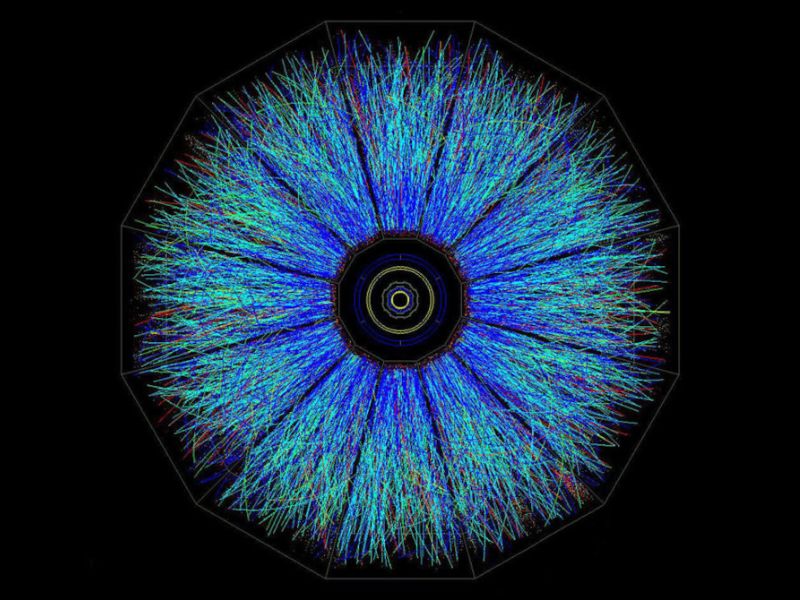
    Collisions captured by the STAR detector at the RHIC. (Brookhaven National Laboratory)

    A group of scientists has made significant strides in exploring how some of the Universe’s most massive particles behave under extreme conditions resembling those just after the Big Bang.

    New Insights into Fundamental Forces

    Their findings, published in Physics Reports, shed light on the basic forces that helped shape the early Universe and continue to influence its evolution.

    The study, led by researchers from the University of Barcelona, the Indian Institute of Technology, and Texas A&M University, focuses on particles made up of heavy quarks — key components of some of the heaviest particles known.

    Charm and Bottom Hadrons as Probes of Extreme Matter

    These particles, called charm and bottom hadrons, serve as rare tools for investigating matter in conditions that are nearly impossible to replicate naturally on Earth.

    To simulate such conditions, scientists use powerful particle accelerators like the Large Hadron Collider (LHC) and the Relativistic Heavy Ion Collider (RHIC), smashing atomic nuclei together at velocities approaching the speed of light.

    Timeline of the expansion of the universe, where space is represented schematically at each time by circular sections. On the left, the dramatic expansion of inflation; at the centre, the expansion accelerates. (NASA/WMAP Science Team)

    These high-energy collisions create temperatures that soar to over 1,000 times hotter than the Sun’s core, momentarily forming quark-gluon plasma — a high-energy mixture of elementary particles that existed only microseconds after the Big Bang.

    Transition from Plasma to Structured Matter

    As this plasma cools, it transitions into hadronic matter — a state made up of more familiar particles like protons and neutrons, along with other forms like baryons and mesons. Studying this shift helps researchers better understand how the chaotic particle soup of the early Universe evolved into structured matter.

    A section of RHIC at Brookhaven National Laboratory (BNL) in United States. (Z22)

    Heavy quarks are particularly useful in this context because their large mass slows them down, making them interact with surrounding matter in distinctive ways. This allows them to serve as sensitive probes of the hot, dense environments created in collisions.

    A Simple Analogy for Complex Interactions

    To visualize this, imagine dropping a heavy object into a busy swimming pool — even after the initial splash, the object continues to move and interact with the water and swimmers. Likewise, heavy particles in nuclear collisions keep interacting with nearby particles well after the most turbulent phase has ended.

    While earlier studies mainly focused on the early, ultra-hot phase of quark-gluon plasma, this new research emphasizes the importance of the cooling period that follows. It shows how this phase plays a key role in influencing particle behavior and what experimentalists ultimately detect.

    The team specifically studied how D and B mesons — which contain charm and bottom quarks — interact with lighter particles during the transition from plasma to hadronic matter.

    These interactions influence observable factors such as particle flow and energy loss, offering crucial insights into the behavior of matter under intense conditions.

    Building the Roadmap to Our Universe’s Origins

    Understanding how heavy particles behave in hot, dense environments is critical for mapping the properties of the early Universe and the forces that governed its evolution. These findings also support the development of future lower-energy experiments, such as those planned at CERN’s Super Proton Synchrotron and the upcoming FAIR facility in Germany.

    Ultimately, this research moves us closer to answering profound questions about the origins of the Universe and the forces that continue to shape it. By recreating the most extreme states of matter, scientists are uncovering the building blocks of reality itsel.


    Read the original article on: Science Alert

    Read more: Scientists State The Laws of Physics May Be Changing

  • Only Certain Uranium Can Fuel Weapons. Here’s What Enrichment Involves

    Only Certain Uranium Can Fuel Weapons. Here’s What Enrichment Involves

    When people hear "uranium," they often picture mushroom clouds, Cold War tensions, or glowing green rods straight out of science fiction.
    Image Credit: Deposiphotos

    When people hear “uranium,” they often picture mushroom clouds, Cold War tensions, or glowing green rods straight out of science fiction.

    But uranium is more than just a symbol of nuclear threat—it’s a relatively common element with vital uses in energy production, medical treatments, and global politics.

    The element returned to international focus in June 2025, after U.S. military strikes targeted Iranian facilities suspected of storing highly enriched uranium—sparking renewed debate over nuclear proliferation.

    News reports frequently cite Iran’s uranium being enriched to 60%, but what does that percentage actually signify?

    As a biochemist, I’m keen to help clear up the confusion surrounding this frequently misunderstood element.

    A Naturally Radioactive Element with Powerful Energy Potential

    Uranium, number 92 on the periodic table, is a radioactive metal that naturally breaks down over time, releasing energy—a process known as radioactivity. This trait is shared with other elements like thorium and radium.

    First identified in 1789 by German chemist Martin Heinrich Klaproth, uranium was named after the recently discovered planet Uranus. Its true potential, however, wasn’t realized until the 20th century, when scientists learned that uranium atoms could undergo nuclear fission—a reaction in which an atom’s nucleus splits into smaller parts, releasing a significant amount of energy.

    Uranium is surprisingly widespread in nature, found in rocks, soil, water, and even trace amounts in plants and animals. The bulk of usable uranium is extracted from the Earth’s crust and then refined to increase the concentration of its most fissionable isotope: uranium-235.

    A Unique Isotope with the Same Identity but a Different Mass

    Uranium-235 is one of several isotopes of uranium—variations of the same element that differ slightly in mass. Think of it like apples from the same tree: some are larger, some smaller, but all are still apples. In the same way, isotopes share the same chemical identity but have different weights.

    Naturally occurring uranium is mostly made up of uranium-238, with only about 0.7% consisting of uranium-235—the isotope most effective for sustaining nuclear fission. Because of this, uranium must be enriched to increase the concentration of uranium-235.

    This enrichment process makes uranium more suitable for use in nuclear reactors or weapons, since the natural form doesn’t contain enough uranium-235 to be efficient. Typically, enrichment involves three main steps.

    Centrifuges spin the uranium to separate out its isotopes.

    How Spinning Gas Distinguishes Uranium-235 from Uranium-238

    The process begins by converting uranium into a gas known as uranium hexafluoride. Next, this gas is fed into a high-speed centrifuge—a device that spins rapidly. Since uranium-235 is slightly lighter than uranium-238, it doesn’t move outward as quickly during the spinning process, allowing the two isotopes to be separated.

    It’s a bit like using a salad spinner to dry lettuce—the separation happens gradually. A single spin doesn’t do much, so the gas passes through a series of centrifuges to steadily increase the concentration of uranium-235.

    For nuclear power plants, uranium is usually enriched to about 3% to 5%, which is sufficient to produce electricity. When enrichment reaches 20%, it’s classified as highly enriched uranium. Once it hits 90% or more, it becomes weapons-grade—suitable for use in nuclear weapons.

    The enrichment level depends on the proportion of uranium-235 to uranium-238. (Wikimedia Commons)

    Weapons-grade uranium is effective in nuclear weapons because it can support a rapid, uncontrolled chain reaction, releasing far more energy than other isotopes.

    Although uranium is often in the news for its military applications, it also serves important roles in everyday life. At low enrichment levels, it generates nearly 10% of the world’s electricity.

    Powering Homes and Advancing Medical Treatments

    In the United States, many nuclear power plants use uranium fuel to produce clean, carbon-free energy. Beyond power generation, uranium is also used in certain cancer treatments and diagnostic imaging tools in medicine.

    Enriched uranium is used for nuclear power. (Raimond Spekking/Wikimedia CommonsCC BY-SA)

    In naval engineering, enriched uranium fuels nuclear-powered submarines and aircraft carriers, enabling them to run quietly and efficiently for extended periods without refueling.

    Uranium represents a powerful duality. Mined from ancient geological formations, it holds the potential to either power entire cities or obliterate them. It’s not just a symbol from Cold War history or science fiction—it’s a very real and influential force in our world today, shaping everything from global politics and warfare to cancer treatments and clean energy production.

    Ultimately, the true power of uranium lies not just in its energy, but in the choices humanity makes about how to harness it.


    Read the original article on: Science Alert

    Read more: New AI Weather Model Surpasses Leading Global Forecasting Systems

  • New Magnetic Phenomenon May Pave the Way for Ultrafast Memory Chips

    New Magnetic Phenomenon May Pave the Way for Ultrafast Memory Chips

    Spiral magnetic order (light blue arrows) on the triangular lattice of NiI2 (black spheres represent Ni atoms) enables electrically switchable p-wave magnetism (white jagged lines)
    Image courtesy of the researchers

    Scientists at the Massachusetts Institute of Technology have uncovered a completely new type of magnetism in a custom-designed crystalline material, which they’ve termed p-wave magnetism.

    Potential for Energy-Efficient Memory Technology

    This finding holds great promise, as it offers a novel way to manipulate electron spins — a key step toward creating faster and more energy-efficient spintronic memory technologies, potentially replacing traditional electronics.

    To understand the context, conventional ferromagnets feature atoms with electrons aligned in the same spin direction. In contrast, antiferromagnets (like some alloys and oxides) display alternating electron spins that cancel each other out, preventing large-scale magnetization.

    In their experiments with an ultra-thin crystal of nickel iodide, the researchers observed something quite different: the nickel atoms’ spins formed a spiral configuration across the crystal lattice. Remarkably, this spiral could twist in either direction and be flipped using a small electric field generated by circularly polarized light.

    Implications for Next-Generation Devices

    This behavior opens up exciting possibilities for next-gen components like computer memory chips. “By directing spin currents, you can achieve interesting effects in devices — for instance, flipping magnetic domains that serve as bits of data,” said researcher Riccardo Comin, co-author of the Nature paper published last month. “Spintronic technologies are far more efficient than conventional ones because they shift spins instead of charges. That greatly reduces heat generation, which is why today’s computers get warm.”

    Spintronics is a cutting-edge field that aims to harness the direction of electron spins for storing and processing data — much like binary code in current electronic systems. If you’re unfamiliar, it’s worth thinking of it as replacing the flow of electricity with the flow of spin.

    Spintronics: The Technology Revolution You’ve Probably Never Heard Of

    According to researcher Qian Song, this new magnetic state requires only a minimal electric field to control. “P-wave magnets could potentially reduce energy use by a factor of 100,000. That’s an enormous improvement,” she noted.

    However, practical application is still a ways off. Researchers observed the phenomenon at an extremely low temperature — around 60 kelvins (−213 °C or −351 °F).For this to be useful in real-world devices, scientists will need to identify materials that demonstrate p-wave magnetism at room temperature. Still, this discovery gives researchers a clear target moving forward.


    Read the original article on: New Atlas

    Read more: Photonic Processor may Streamline 6G Signal Processing

  • The Nuclear Company Secures $46M To Develop Major Reactor Facilities

    The Nuclear Company Secures $46M To Develop Major Reactor Facilities

    Credit: Pixabay

    The Nuclear Company is embracing a traditional strategy for constructing new nuclear reactors. Instead of creating a brand-new design or focusing on mass production of smaller models, the company plans to build a series of reactors based on proven, existing designs.

    Nuclear Startup Secures $46.3 Million in Series A Funding, Eyes $51.3 Million Goal

    The startup, which was founded two years ago, revealed its Series A funding round last month, with participation from CIV, Goldcrest Capital, MCJ Collective, True Ventures, and Wonder Ventures. While it initially withheld the fundraising total, TechCrunch has now confirmed through an SEC filing that the company raised $46.3 million out of a targeted $51.3 million for the round.

    Three serial entrepreneurs—Jonathan Webb, former CEO of AppHarvest; Kiran Bhatraju, CEO of Arcadia; and Patrick Maloney, CEO of CIV—established The Nuclear Company in 2023. The startup is focusing on locations that already possess the necessary permits or licenses to operate. According to filings with the Nuclear Regulatory Commission for combined operating licenses and early site permits, fewer than a dozen sites meet this criterion.

    At the more advanced sites nearing construction, each location has the potential to host reactors generating over 1 gigawatt of power. The Nuclear Company plans to develop a total of 6 gigawatts in its initial fleet of reactors.

    Data Centers Driving Surge in U.S. Electricity Consumption

    The funding round comes as tech companies and utilities grapple with securing enough electricity to power data centers. According to Grid Strategies, U.S. electricity demand will rise nearly 16% by 2029, after years of relatively flat usage. A major contributor to this surge is the data center industry, which could see its energy consumption quadruple by the decade’s end.

    Amid concerns over potential power shortages, tech giants are increasingly partnering with nuclear startups and developers. Google is collaborating with Kairos to deploy 500 megawatts of small modular reactors (SMRs), while Amazon took part in a significant $700 million funding round for X-energy’s SMR initiatives. Meta has requested proposals for up to 4 gigawatts of new generation capacity, and Microsoft is teaming up with Constellation Energy to help restart a reactor at Three Mile Island.

    However, nuclear power is encountering several challenges, both anticipated and unforeseen. One expected hurdle is competition from solar energy. Tech firms and data center operators have been actively acquiring capacity from solar farms, often through large-scale agreements. These solar installations are typically coupled with large battery systems to deliver round-the-clock power. The appeal lies in their low cost and relatively quick development timelines, with new projects often completed in about 18 months.

    Nuclear Power Faces Financial Setback as Proposed Bill Seeks to End Inflation Reduction Act Subsidies

    Nuclear power may soon encounter additional financial challenges. This week, the House Ways and Means Committee released a draft of a reconciliation bill that would eliminate the subsidies for nuclear power that were provided under the Inflation Reduction Act. Currently, nuclear power plants are eligible for tax credits of up to $15 per megawatt-hour.

    Most new nuclear power plants, including those planned by The Nuclear Company, are not expected to begin operation until the early 2030s. With projections for the next five years differing significantly, large nuclear plants coming online a decade from now might find themselves facing financial uncertainty.


    Read the original article on: TechCrunch

    Read more: New Fuel Transforms US Nuclear Reactor From Regular To Premium

  • Watch: New Structures Shrink Instead of Stretching When Pulled

    Watch: New Structures Shrink Instead of Stretching When Pulled

    Mechanics and geometry created this object, which shrinks when stretched
    Image courtesy of the researchers

    Researchers in the Netherlands have developed innovative mechanical structures that, surprisingly, contract — or more precisely, snap inward — rather than expand when pulled.

    The Science Behind the Phenomenon

    While it may sound counterintuitive, this unexpected behavior is the result of a creative approach that combines geometry and mechanics, devised by scientists at the AMOLF physics institute. The concept may help address unwanted instabilities in various applications.

    “This type of behavior — which we’re calling ‘countersnapping’ — has never been observed experimentally before,” said Bas Overvelde, lead researcher of the Soft Robotic Matter group. “It has the potential to revolutionize how we design everything from medical robotic devices to earthquake-resistant buildings.”

    You can see the structure in action in the video below.

    These structures shrink when pulled: Counter-snapping instabilities

    Fascinating, right? The countersnapping effect, recently described in the journal PNAS, emerges from the design and assembly of mechanical structures that leverage geometric nonlinearities. The main idea is to create systems with self-intersecting force–displacement relationships — meaning they suddenly contract under increasing tension, or require more force unexpectedly when stretched.

    Building the Structures

    To achieve this, the team combined three different types of nonlinear mechanical building blocks — each with a specific force-extension behavior — into a network. In the demonstrated example, the components were 3D printed.

    Specially shaped parts that combine to create this unique phenomenon
    Image courtesy of the researchers / AMOLF

    These countersnapping structures offer several remarkable mechanical properties:

    • Unidirectional stick–slip motion: Unlike regular snapping, which results in back-and-forth motion under cyclic loading, countersnapping produces incremental movement in a single direction.
    • Switchable stiffness: The structure can shift between different stiffness levels at a specific point, maintaining the same extension and applied force.This design lets users alter the resistance to deformation without changing the system’s size or load.
    • Passive resonance avoidance: Because users can change the stiffness without affecting equilibrium, the structure automatically shifts its natural vibration frequency — helping protect it against harmful vibrations at certain frequencies.
    • Sequential stiffness switching: When users arrange multiple countersnapping units side-by-side (in parallel), they can adjust the stiffness of each unit one at a time.
    • Instantaneous collective switching: When connected end-to-end (in series), all units can switch simultaneously — like a chain reaction.
    When these parts are configured as shown they shrink when stretched
    Image courtesy of the researchers / AMOLF

    The researchers see potential for this technology in protective equipment and prosthetics that switch between soft and rigid states (similar to motorcycle safety gear), vibration damping in buildings and aircraft, and even in soft medical robots that navigate the body safely by advancing forward without slipping backward.


    Read the original article on: New Atlas

    Read more: Tiny self-Powered Robot Breaks Speed, Agility Record with Simple Design

  • Revolutionary Gravity Finding Moves Us Nearer To A Theory Of Everything

    Revolutionary Gravity Finding Moves Us Nearer To A Theory Of Everything

    A novel approach to understanding gravity may help bridge the long-standing divide between gravity and quantum mechanics. Physicists Mikko Partanen and Jukka Tulkki from Aalto University in Finland have proposed a new perspective on gravity that they claim aligns with the Standard Model of particle physics, which explains the Universe's other three fundamental forces: the strong, weak, and electromagnetic forces.
    Credit: Pixabay

    A novel approach to understanding gravity may help bridge the long-standing divide between gravity and quantum mechanics. Physicists Mikko Partanen and Jukka Tulkki from Aalto University in Finland have proposed a new perspective on gravity that they claim aligns with the Standard Model of particle physics, which explains the Universe’s other three fundamental forces: the strong, weak, and electromagnetic forces.

    While it doesn’t yet amount to a full theory of quantum gravity, it could be an important step in that direction.

    “If this ultimately leads to a comprehensive quantum field theory of gravity, it could one day provide solutions to complex problems like black holes singularity and the origins of the Big Bang Partanen says.

    The Elusive Quest for a Unified Theory

    A unified framework that explains all the fundamental forces in nature is often referred to as the Theory of Everything. Several fundamental questions in physics remain unresolved—for instance, current models still can’t explain why the observable Universe contains more matter than antimatter.

    Gravity remains the biggest obstacle to forming a clear and unified understanding of how the Universe works. As the fourth and weakest fundamental force, it doesn’t integrate smoothly with the other three. Quantum theory effectively explains the behavior of matter at extremely small scales—like atoms and subatomic particles—but falls short at larger scales, where gravity becomes dominant.

    On the other hand, classical physics and general relativity accurately describe gravity on cosmic scales but fail to account for quantum phenomena. Despite their incompatibility, both frameworks successfully describe aspects of the Universe, suggesting to scientists that a deeper unifying theory must exist to reconcile the two.

    Gradual Progress Toward a Unified Theory

    Given how difficult the problem is, it’s unlikely to solve in one breakthrough; instead, progress will probably unfold through a series of gradual but meaningful advances. One such step, taken by Partanen and Tulkki explains, involves framing gravity within the concept of a gauge—a fundamental idea in quantum field theory used to describe how particles behave within a given field.

    An electromagnetic field is a common example of a gauge field—and the same applies to a gravitational field.

    The electromagnetic field is the most well-known gauge field,” Tulkki explains. “When electrically charged particles interact, they do so through this field, which serves as the corresponding gauge.”

    In a similar way, when particles possess energy, their interactions—by virtue of that energy—occur via the gravitational field.”

    Credit: A diagram demonstrating the flat space-time of the quantum field and the curved field expected for quantum gravity. (Mikko Partanen and Jukka Tulkki/Aalto University)

    Integrating Gravity with the Standard Model

    The  Standard Model is a gauge theory that characterizes the strong, weak, and electromagnetic interactions and is defined by particular symmetries. To align gravity theory more closely with the Standard Model, Partanen and Tulkki aimed to incorporate these symmetries into a gauge-based framework for gravity. Their published findings appear encouraging.

    Our framework brings gravity’s gauge theory into closer alignment with the gauge theories in the Standard Model than traditional gravity gauge approaches,” the authors note in their paper.

    While this work is still far from achieving a complete theory of quantum gravity, it offers a promising path forward that could play a key role in addressing one of physics’ most challenging questions.

    With that in mind, Partanen and Tulkki encourage other researchers to contribute to the ongoing development of the theory. The current paper establishes a solid foundation, but advancing it further will demand significant theoretical work and rigorous testing.

    A comprehensive understanding of how unified gravity affects field theories,” the authors emphasize, “will only emerge through extensive future research.”


    Read the original article on: Sciencealert

    Read more: Abandoned Mines May Be Repurposed as Gravity-Powered Batteries

  • Physicists Discover a New Way to Measure Time

    Physicists Discover a New Way to Measure Time

    (Loren Zemlicka/Moment/Getty Images)

    While in our everyday lives measuring time is simply a matter of counting the seconds between the past and the present, things work quite differently in the quantum world. At microscopic scales, events don’t follow a predictable order, and the “now” often blurs with the “before,” rendering conventional stopwatches useless in certain contexts.

    An Innovative Approach Using Quantum Clouds

    A study published in 2022 by scientists from Uppsala University in Sweden proposed an innovative approach to this dilemma: using the characteristics of quantum clouds themselves — more specifically, the behavior of atoms in highly energized states known as Rydberg states — as a new way to mark time, without the need for a fixed starting point.

    Rydberg atoms are like expanded versions of normal atoms, with extremely energized electrons orbiting far from the nucleus. Although scientists often use lasers to excite electrons into these high-energy states, what’s interesting here is how these electrons behave when overlapped — creating unique interference patterns, similar to ripples formed when several stones are thrown into a pond at once.

    Visualization of a Rydberg atom. (Berndthaller/CC BY-SA 4.0/Wikimedia Commons)

    These patterns, known as Rydberg wave packets, evolve predictably over time. By analyzing the interference, researchers were able to identify temporal “fingerprints” that don’t depend on an initial moment. This allows them, for example, to state that four nanoseconds have passed simply by observing the formed pattern — no conventional “clock” needed.

    Electrons moving when nudged into a Rydberg state are less like beads sliding about on a tiny abacus, and more like an evening at the roulette table, where every roll and jump of the ball is squeezed into a single game of chance. (graphics.vp/Canva)

    Tests with Helium and Accurate Measurements

    In the experiments, scientists used laser-excited helium atoms and compared the results with theoretical models to confirm the accuracy of these patterns as time markers. According to physicist Marta Berholts, who led the study, the main advantage of this method is precisely that it doesn’t require starting a count from zero — you simply observe the interference pattern to know how much time has passed.

    This new method could be particularly useful in studies involving ultrafast spectroscopy, where events happen in such tiny fractions of time that traditional methods become unfeasible. With this technique, it’s possible to record occurrences lasting only 1.7 trillionths of a second.

    Researchers believe they can expand this type of ‘quantum clock’ by using different elements or adjusting the laser pulses, creating a kind of temporal catalog adaptable to a variety of experimental conditions.


    Read the original article on: Science Alert

    Read more: New Measurements of Double Magic Atom Reveal Surprise