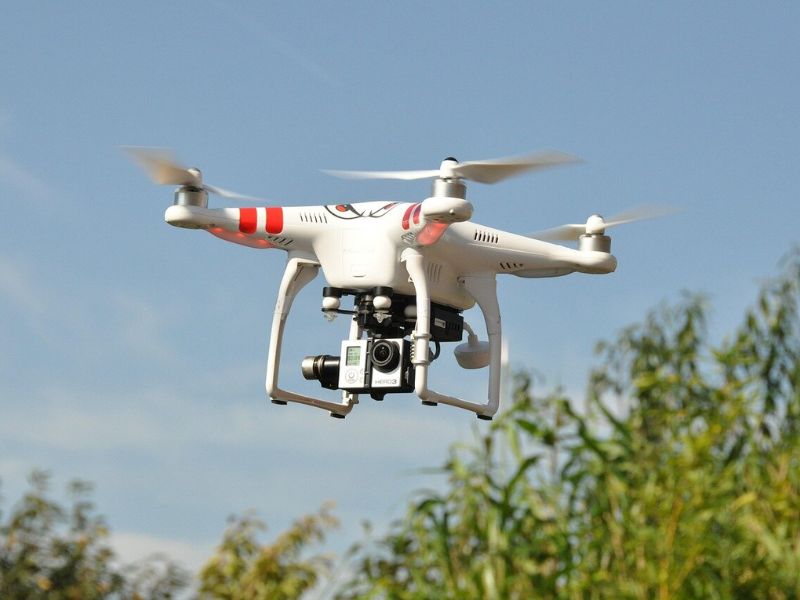

Scientists report that intelligent drones and unmanned aerial systems (UAS) are quickly advancing from experimental tools into critical infrastructure for disaster response, healthcare delivery, agriculture, logistics, archaeology, environmental monitoring, and many other fields essential to human progress.
The study, published in the International Journal of Cognitive Computing in Engineering, highlights that drone technology is on the brink of major advances across many fields, with the potential to greatly enhance quality of life globally.
The authors explain that next-generation drones will offer significantly improved endurance, including longer flight distances, extended operating times, and greater robustness. These capabilities will allow drones to carry out prolonged missions such as long-range medical or commercial deliveries and large-scale surveillance in both urban areas and forested regions.
Advances in artificial intelligence and machine learning are speeding up this shift, enabling drones to handle complex tasks with minimal human input. Recent developments allow drones to identify objects, navigate efficiently, and avoid obstacles on their own.
The researchers add that as sensor technologies like LiDAR, multispectral imaging, and advanced inertial measurement units continue to improve, drones will gain a stronger ability to perceive their environments, making them increasingly valuable for applications such as mapping, surveying, and agriculture.

Charting the Future of Autonomous Drone Navigation
The study uses a three-phase research framework to evaluate the current capabilities of drone technology and outline a roadmap for future advances in a field that has become increasingly vital in the age of digitization, artificial intelligence, and machine learning.
To bridge theory and practical application, the researchers—based at the University of Sharjah in the United Arab Emirates, Université Constantine 2 in Algeria, and Taylor’s University in Malaysia—concentrate on the mathematical models that support autonomous navigation in unmanned aerial vehicles (UAVs).
They present optimization-based path-loss models that account for terrain and environmental factors and benchmark these against existing state-of-the-art methods to measure their performance and effectiveness.
The study also examines the core concepts and mathematical underpinnings of autonomous navigation, introduces an optimization model for predicting path loss, compares leading modern models, and reviews the most advanced algorithms and techniques in UAV research.
It analyzes a wide range of optimization approaches—such as genetic algorithms, particle swarm optimization, ant colony optimization, and reinforcement learning—that allow drones to calculate efficient flight paths, minimize energy use, and avoid obstacles that could hinder or jeopardize missions.
The authors emphasize that recent progress in unmanned aerial systems and artificial intelligence has accelerated research across many areas, including human–drone interaction, autonomous navigation, security, object detection, urban air mobility, energy-efficient design, environmental monitoring, archaeology, wildlife conservation, medical deliveries, disaster response, and precision agriculture.
Push for Stricter Regulations and Ethical Protections
The authors note that as drone technology rapidly advances, countries will need to update and strengthen regulations governing its use. They highlight that regulatory bodies will address issues such as privacy and airspace management to ensure safe, accountable, and reliable drone operations.
They predict that future innovation will focus on developing specialized drones tailored to industry needs. Advances in battery life and energy efficiency will increase drone flight frequency and enable longer missions, enhancing their practical utility.
The researchers also stress that nations must prioritize drone security and counter-drone measures, which are becoming increasingly important as drone use expands and the risk of illegal or harmful activities grows. In densely populated areas, they add, greater attention should be paid to sustainability concerns, including reducing noise and emissions.
The authors explain that drones are set to play a major role in the global Internet of Things (IoT) ecosystem, leveraging 5G and 6G networks for real-time data transfer and communication. Rising public interest in urban air mobility (UAM), which uses passenger drones for transport, has also driven efforts to create safe and efficient UAM systems.
At the same time, they caution about the ethical challenges that come with these advances. High-tech drones equipped with sensitive sensors and cameras can capture personal or confidential information without consent, raising serious ethical concerns.
The researchers also highlight environmental impacts. Drone flights can disturb wildlife, particularly bird habitats, affecting migration and nesting patterns, and contributing to noise pollution. Additionally, large-scale production of lithium batteries for drones generates electronic waste. They emphasize the need to balance technological progress with ecological stewardship to protect biodiversity and ensure environmental sustainability.
Bridging Theory and Practice
The study significantly advances drone research by connecting “theoretical path loss models with practical UAV applications,” providing a foundation for real-world deployment in areas like wildlife monitoring, disaster response, and precision agriculture.
The authors add that “future drones will feature greater range and endurance, broadening their use across multiple industries.”
The authors contend that ongoing technological advancements will drive the creation of specialized drones tailored to specific industrial requirements, which current models cannot fully meet. Progress is expected across both commercial and industrial drone applications.
Looking ahead, the study emphasizes the development of energy-efficient drones that extend flight times, alongside enhanced security measures to prevent unauthorized drone use. Quieter, more environmentally friendly drones will see greater adoption, particularly in urban areas. As urban air mobility (UAM) approaches reality, integration with IoT and 5G networks will support real-time data exchange.
In conclusion, the authors state that the future of drone technology will be defined by automation, versatility, safety, and environmental responsibility. As drones reshape industries and everyday life, their evolution will remain closely linked to technological innovation and societal demands.
Read the original article on: Tech Xplore
Read more: Engineers Build Intelligent Robodog Equipped with AI