
USC researchers have created a wearable system that allows for more natural and emotionally rich interactions in shared virtual environments, expanding opportunities in remote work, education, healthcare, and more.
Restoring the Power of Touch in a Digital World
Touch is essential to human communication and connection, helping build trust, regulate stress, and form emotional bonds from infancy through adulthood. Yet in today’s digital world, where many interactions happen through screens, physical contact is often absent.
To address this, researchers at the USC Viterbi School of Engineering have created a wearable haptic system that allows users to share and feel physical gestures—like handshakes, pats, and squeezes—in virtual reality, even across long distances.They detailed their work in a paper published on the arXiv preprint server.
Wearable Devices Bring Realistic Touch to Virtual Interaction
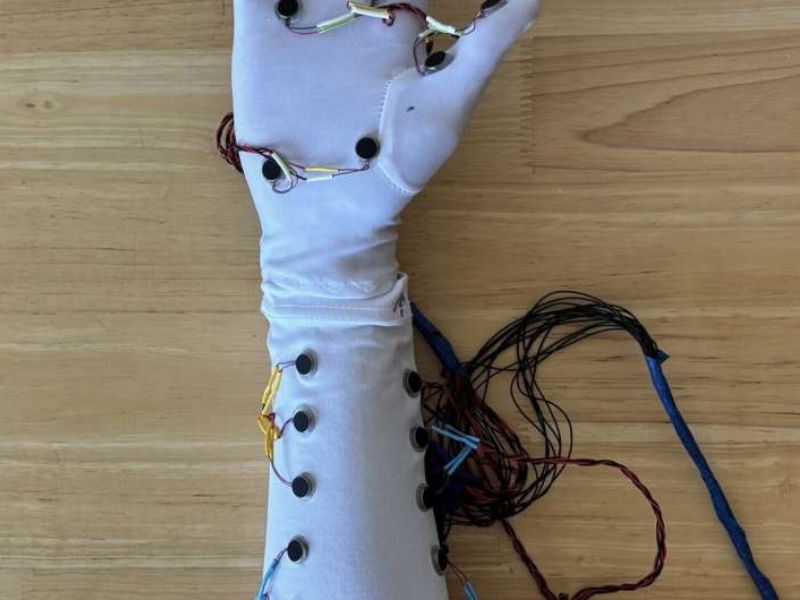
The system features gloves and sleeves equipped with small vibration motors that mimic pressure and motion, enabling users to engage with both virtual objects and each other through realistic touch feedback.
A user study, also presented at the IEEE World Haptics Conference, found that participants felt more connected and engaged when they could physically feel virtual gestures.
“Even as people spend more time socializing online, we’re seeing increased rates of depression, anxiety, and what’s known as ‘touch starvation,‘” said Heather Culbertson, associate professor at USC Viterbi and lead author of the study. “Virtual interactions are here to stay—but we need to make them better mirror the emotional benefits of real-life experiences.“

The system allows up to 16 users to connect at once, each represented by a full-body 3D avatar that mimics their real-world movements in a shared virtual space. Unlike video calls, users can move freely, interact with each other, and engage with virtual objects—such as passing items or collaborating on tasks.
“This project came from a simple but powerful human need—to feel close to those we miss,” said Premankur Banerjee, a PhD student in Heather Culbertson’s Haptics Robotics and Virtual Interaction Lab and the study’s lead author.
Making Long-Distance Communication Feel Close
“After spending over five years away from my own family, this work became personal. It’s not just about creating a sense of presence, but about bringing back the feeling of physical closeness in long-distance communication,” he said.
To recreate touch, users wear gloves and armbands with vibration motors that simulate motion and pressure, allowing them to feel gestures and interactions in VR.
Tests showed that participants experienced a stronger sense of connection and presence with tactile feedback. The study also examined how gesture speed and vibration type affect emotional and sensory perception, offering insights for designing more immersive touch-based experiences.
Merging Science and Emotion in Communication Technology
“Building this kind of technology demands collaboration across disciplines,” said Culbertson. “Our team integrates computer science, engineering, neuroscience, psychology, and social science to develop tools that are not just technically effective, but also enable emotionally rich social interaction.“
The global move toward online communication—accelerated by the COVID-19 pandemic—has offered great convenience but also led to unintended effects. Despite being more digitally connected than ever, many people, especially younger generations, continue to struggle with loneliness, anxiety, and depression.
“Platforms like Zoom and FaceTime help us stay visually and verbally connected, but they lack the physical interaction that humans naturally need,” said Heather Culbertson.
She emphasized that while this technology can’t replace real-life contact, it can meaningfully enhance social interaction when being together in person isn’t possible.
Enhancing Care, Collaboration, and Closeness Across Distances
In hospitals and long-term care settings, the system could help patients and loved ones share comforting physical gestures across distances. In remote work or learning environments, it enables more immersive, collaborative engagement. For families and friends separated by travel or deployment, it helps restore a deeper sense of closeness.
“Touch is essential to human well-being. While technology can’t fully replicate it, bringing tactile experiences into virtual spaces is an important step toward more emotionally connected digital communication,” Culbertson said.
Read the original article on: Techxplore