
There’s a subtle boundary between mathematics and art—and it seems materials science and paper art share one as well.
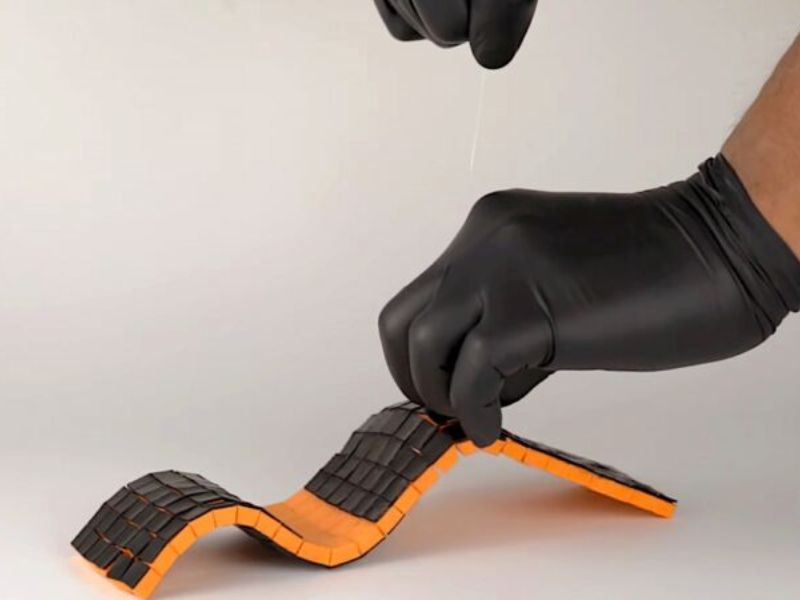
At first look, the flat, tiled grid created by MIT researchers appears unremarkable.A single pull of the string transforms the grid into its designed 3D form.
Inspired by kirigami, the new material could serve in medical devices, foldable robots, and Mars habitats.
The material was introduced in a recent paper published in ACM Transactions on Graphics.
From 3D Design to Kirigami-Inspired Flat Grids
The researchers created an algorithm that turns a 3D form into a flat grid of quadrilateral tiles. This approach mirrors kirigami techniques, where artists make precise cuts to embed specific behaviors and properties into the material.

The researchers used an auxetic mechanism—a structure that thickens when stretched and thins when compressed, as the authors explain in an MIT News article.
The algorithm then identifies the most efficient “rope path,” reducing friction while linking lifting points across the surface so the grid forms the intended 3D shape with a single, gentle pull.
Simple and Automated Drive System
“The key advantage of our method is the drive system’s simplicity,” says Akib Zaman, lead author and MIT PhD student. “Once the design is entered, the algorithm automatically takes care of the rest.”
After simulations, the team applied the technique to medical devices and igloo-style structures.
The algorithm works with any fabrication method, allowing the team to create a foldable, human-sized plywood chair strong enough to support a person.
The researchers note that larger architectural applications will present “scale-specific engineering challenges.” Being new and user-friendly, the team is exploring solutions while building smaller structures using the same method.
“I hope this technique enables people to design many different kinds of deployable structures,” Zaman says.
The team also has bigger plans: they are working toward developing a self-deploying system so the structures can unfold on their own, without assistance from humans or robots.
Read the original article on: Zap
Read more:Cornell’s Robot Jellyfish and Worm run on a Hydraulic Fluid Battery