Tag: Ammonia

  • MIT’s Method Produces Ammonia Underground with Zero Energy

    MIT’s Method Produces Ammonia Underground with Zero Energy

    Ammonia holds great promise as a future fuel source, but current production methods make it a major contributor to environmental pollution. Researchers at MIT have now developed a groundbreaking technique that uses Earth's natural heat and minerals to produce ammonia in a cleaner, more sustainable way.
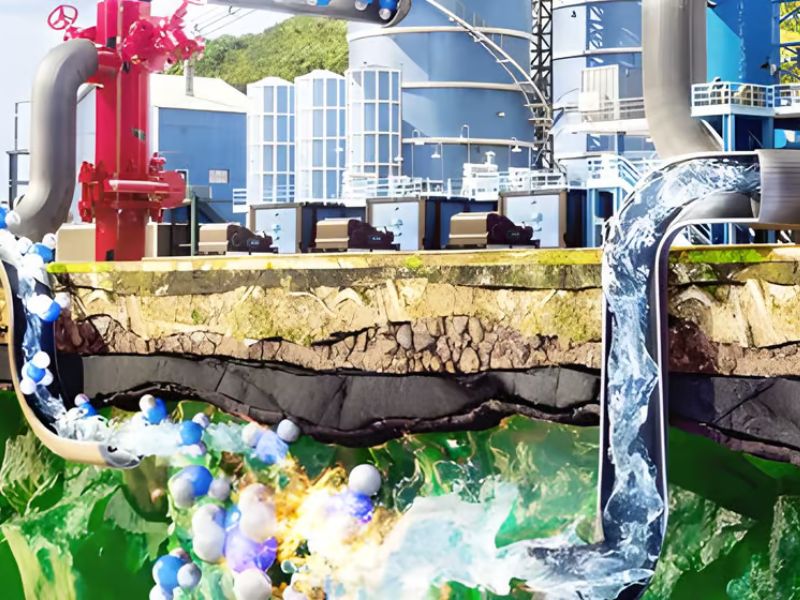
    An illustration of what a full-scale ammonia-production plant based on the new research could look like
    Iwnetim Abate and Yifan Gao

    Ammonia holds great promise as a future fuel source, but current production methods make it a major contributor to environmental pollution. Researchers at MIT have now developed a groundbreaking technique that uses Earth’s natural heat and minerals to produce ammonia in a cleaner, more sustainable way.

    Currently, ammonia ranks as the second-most produced chemical globally, with about 80% of it used in agricultural fertilizers. However, traditional ammonia production consumes roughly 2% of the world’s fossil fuel energy and accounts for approximately 1% of global manmade greenhouse gas emissions. To put this into perspective, each ton of ammonia produced emits about 2.4 tons of carbon dioxide (CO2).

    Despite these environmental challenges, ammonia—a compound of nitrogen and hydrogen—has significant potential in the energy sector. It can store over 20 times the energy by weight compared to lithium-ion batteries and can burn cleanly when managed properly. Developing greener methods to produce ammonia could significantly contribute to reducing carbon emissions while meeting energy demands.

    Advancements in Green Ammonia Production

    Progress in sustainable ammonia production has been accelerating. In 2022, three Danish energy companies launched the world’s first green ammonia plant, capable of producing 5,000 tons annually using only solar and wind energy. By 2026, Norway plans to introduce the first ammonia-powered container ship. Other innovations, such as zero-emission ammonia-electric semis and ammonia-powered tractors, further highlight the compound’s green potential.

    Building on this momentum, MIT researchers have now introduced a method to produce ammonia without external energy inputs or CO2 emissions, opening new possibilities for sustainable production.

    Inspiration from Nature

    The idea for the method came from a hydrogen-rich well in Mali, West Africa. Discovered in the 1980s, the well contained streams of hydrogen gas, later found to result from chemical reactions deep within the Earth’s crust between rocks and water.

    It was a eureka moment, said Iwnetim Abate, the study’s senior author. We realized that the Earth itself could act as a factory, using its natural heat and pressure to produce valuable chemicals like ammonia in a cleaner way.

    To test the concept, Abate’s team designed a model system that injected nitrogen-enriched water into synthetic iron-rich minerals, replicating conditions found beneath the Earth’s surface. This process successfully produced ammonia without releasing CO2 or requiring external energy.

    When the researchers replaced the synthetic iron with olivine, a naturally occurring iron-rich mineral, they added a copper catalyst and increased the temperature to 300°C (572°F), simulating conditions miles underground. The nitrogen in the water reacted with the iron, generating hydrogen, which then combined with nitrogen to produce ammonia. This process yielded approximately 1.8 kg (4 lbs) of ammonia per ton of olivine.

    These minerals are abundant worldwide, making this method adaptable on a global scale,Abate explained. However, he acknowledged that significant challenges remain, particularly in drilling deep into the Earth and managing the interactions between injected fluids, produced gases, and the surrounding bedrock.

    Future Prospects for Green Ammonia

    Despite these complexities, Abate is optimistic about the technology’s potential. His team hopes to test the system in real-world conditions within the next year or two and believes it could even utilize nitrogen from wastewater as an input.

    This is a major breakthrough for sustainable development, said Geoffrey Ellis, a geologist with the U.S. Geological Survey who was not involved in the study. Although further work is needed to validate the method at pilot and commercial scales, this concept is transformative. Engineering a system that optimizes the natural process of nitrate reduction by iron is an ingenious approach likely to inspire further innovations.

    The research team has filed a patent for their technique, marking a significant step toward scaling this innovative method and advancing green ammonia production.


    Read the original article on: New Atlas

    Read more: Virginia’s Fusion Power Plant: Advancing Toward Unlimited Energy

  • Portable Device Revolutionizes Ammonia Production with Eco-Friendly Innovation

    Portable Device Revolutionizes Ammonia Production with Eco-Friendly Innovation

    A new portable device, developed by researchers from Stanford University and King Fahd University of Petroleum and Minerals, promises to revolutionize ammonia production by eliminating the need for the energy-intensive Haber-Bosch process. This groundbreaking invention produces ammonia using only air, at room temperature and normal atmospheric pressure.
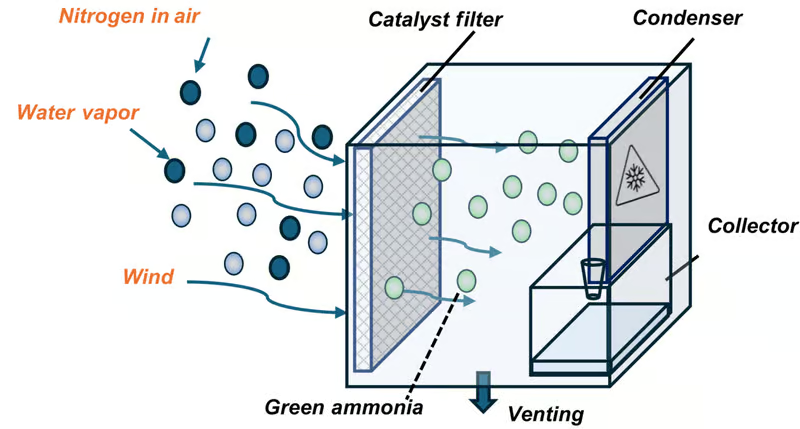
    Without additional heat, pressure, or electricity, this contraption is quietly producing ammonia from thin air at the Stanford University campus

    Xiaowei Song, Chanbasha Basheer, Jinheng Xu, Richard N. Zare

    A new portable device, developed by researchers from Stanford University and King Fahd University of Petroleum and Minerals, promises to revolutionize ammonia production by eliminating the need for the energy-intensive Haber-Bosch process. This groundbreaking invention produces ammonia using only air, at room temperature and normal atmospheric pressure.

    Significant Environmental Impact on the Horizon

    If successfully commercialized on a global scale, this technology could significantly reduce the environmental impact of ammonia production. Ammonia is essential for applications like fertilizers and energy storage, but its current production methods consume about 2% of the world’s energy and generate roughly 1.2% of global carbon dioxide emissions. The widely used Haber-Bosch process relies on fossil fuels, operating at high temperatures and pressures, making it a major contributor to greenhouse gas emissions.

    In a study published in Science Advances, the researchers detailed their device’s capability to produce ammonia outside laboratory conditions. The system utilizes a catalyst-coated mesh that extracts nitrogen from the air and hydrogen from atmospheric water vapor. As wind passes through the mesh, the device generates ammonia at a concentration suitable for hydroponic fertilizers—all without requiring high heat or pressure.

    Thanks to the innovative catalyst, the ammonia production device is both inexpensive and portable
    Xiaowei Song, Chanbasha Basheer, Jinheng Xu, Richard N. Zare

    This innovation represents a major step toward decentralized and sustainable agriculture,” explained Stanford professor Richard Zare, the study’s senior author. The device not only minimizes emissions from production but could also eliminate the need for ammonia storage and transportation, further reducing its carbon footprint. Researchers report that the process is cost-effective, providing a practical solution for local agricultural needs.

    The Catalyst Mesh Behind the Breakthrough

    Central to this advancement is the mesh developed by the research team, which combines magnetite with a Nafion polymer. When air flows through the mesh, nitrogen and water vapor react to form ammonia in usable quantities, sometimes in under an hour. The researchers believe this method could significantly cut fossil fuel reliance across various industries.

    While the technology is still two to three years from commercial availability, the team is optimistic about scaling up production by enlarging the mesh and integrating it with a microporous stone filter. “Green ammonia is a transformative step in sustainability,” Zare emphasized. “If scaled economically, it has the potential to drastically reduce fossil fuel dependency in multiple sectors.”

    With this and other advancements in sustainable ammonia production, the industry may soon see substantial reductions in its massive energy consumption and associated emissions.


    Read the original article on: New Atlas

    Read more: First U.S. Onshore Wave Energy Project Receives Green Light

  • Discovering Ammonia’s Potential as a Fuel

    Discovering Ammonia’s Potential as a Fuel

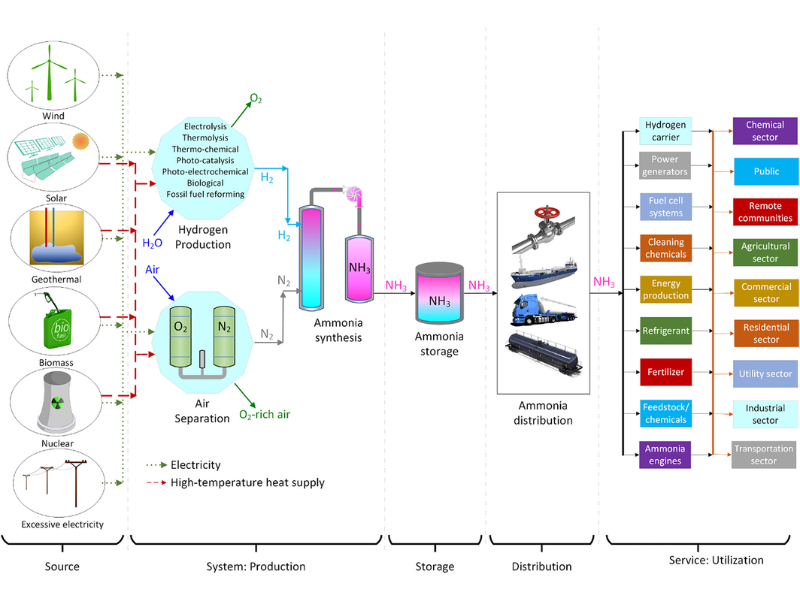
    An economic cycle of ammonia from production to utilization. Credit: Wiley Online Library.

    As the world strives to reduce its dependence on fossil fuels and make the transition to cleaner, more sustainable energy sources, alternative fuels have been at the forefront of innovation. Among these alternatives, ammonia, a common industrial chemical, has been gaining attention as a promising fuel.

    In this publication, we will endeavour to explore the various applications and potential uses of ammonia as a fuel, as well as storage modes and distribution options, applications, advantages, disadvantages, combustion challenges and solutions, and future prospects. In addition, some key solutions to the potential challenges in utilising ammonia for practical applications are discussed and addressed.

    Facts about the production and use of ammonia

    Ammonia (NH3) is a colourless, pungent gas composed of nitrogen and hydrogen used in agriculture, refrigeration and cleaning. It is a chemical that is widely manufactured globally, with more than 75% of production going to agriculture as a fertiliser. Ammonia is gaining prominence due to its potential as a carbon-free fuel, with projects all over the world for energy production and other applications.

    Its versatility makes it a promising solution in the alternative fuels scenario, especially due to its compatibility with renewable resources. The many advantages of using ammonia as a clean alternative are highlighted:

    • Production flexibility: ammonia can be produced using conventional or renewable resources.
    • Storage and transport of hydrogen: it has potential as a means of storing and transporting hydrogen.
    • Safety: Transporting ammonia is safer than transporting hydrogen.
    • High hydrogen content: in its liquefied form, ammonia contains approximately 48 per cent more hydrogen by volume than pure hydrogen.
    • Carbon-free: The use of ammonia results in zero carbon dioxide emissions.
    • Versatile applications: It can be used in a wide range of applications, including as a fuel, working fluid, refrigerant, hydrogen carrier, fertiliser, raw material, chemical, cleaning agent and much more.
    • Detectability: ammonia’s characteristic odour makes it easy to detect leaks.
    • Fuel candidate: It is a strong candidate for use in engines, gas turbines, power generators and burners, requiring relatively minor modifications.

    Ammonia as a clean fuel for combustion

    Although ammonia has historically had uses in refrigeration systems, in the production of fertilisers, cleaning products and disinfectants, it is now attracting the attention of researchers, scientists, engineers and technologists. This is due to its characteristic of being carbon-free, making it a potential fuel for reducing CO2 emissions. Ammonia can play a crucial role in solving challenges related to the storage, transport and distribution of hydrogen, taking advantage of existing infrastructure.

    In the last decade, attempts to utilise ammonia in internal combustion engines and gas turbines have increased considerably. The many important advantages of ammonia as a potential fuel can be listed as follows:

    • It contains no carbon and is environmentally benign.
    • It has three hydrogen atoms and can potentially be used as a hydrogen carrier.
    • Its production, storage, transport and distribution are much easier and less complicated than many other fuels.
    • It is cost-effective and economically viable for applications.
    • It can be considered a potential substitute for petrol, diesel and paraffin.
    • It can be considered for all combustion systems, from engines to gas turbines.
    • It could be a potential fuel solution for clean energy production in remote areas.

    Challenges of ammonia combustion

    It is important to emphasise that ammonia, when used for combustion, has some side effects, just as all medicines have some side effects. These side effects (called challenges) can be listed as follows:

    • High ignition temperature
    • Low flame speed
    • Slow chemical kinetics

    Since there are more and more research efforts to minimise the impacts and improve the combustion performance, it is necessary to provide some key solutions to overcome the problems.

    https://www.youtube.com/watch?v=Pcm4fCDQ4dY
    Chinese state-owned manufacturer GAC Group, which is half-owned by Toyota Motor Corporation, has developed the world’s first ammonia-powered engine for passenger cars.

    In conclusion, the various applications of ammonia as a fuel underline its potential to reshape the energy landscape. As technology and infrastructure continue to advance, ammonia’s role in providing clean and sustainable energy solutions is set to increase.

    Adopting ammonia as a fuel source is not only an environmentally responsible choice, but also a step towards reducing our dependence on fossil fuels and mitigating climate change. The journey towards a cleaner and more sustainable future includes ammonia as a fuel, demonstrating that even a common chemical compound can hold the promise of a greener tomorrow.


    Journal information: Online library Wiley.

    Read more: Public Support Hydrogen and Biofuels to Decarbonize Global Shipping.