Tag: Battery

  • A Remarkable Sodium-Ion Battery Built Around a Core of “Wood.”

    A Remarkable Sodium-Ion Battery Built Around a Core of “Wood.”

    Researchers at Germany’s Fraunhofer Institute for Ceramic Technologies and Systems (IKTS) have created a new kind of sodium-ion battery that relies on lignin as a core electrode material.
    Image Credits:A pouch cell is used to test the battery’s electrode materials
    Fraunhofer IKTS

    Researchers at Germany’s Fraunhofer Institute for Ceramic Technologies and Systems (IKTS) have created a new kind of sodium-ion battery that relies on lignin as a core electrode material.

    Lignin is a naturally occurring polymer in trees that binds wood fibers together and provides structural strength. In the paper-making industry, manufacturers largely treat it as a low-value byproduct and typically burn it for energy. The team saw a chance to turn this waste into an affordable, safe battery material.

    From Wood Waste to Working Anodes

    This study advances wood-based materials toward practical use by heating lignin into hard carbon for the battery’s anode.
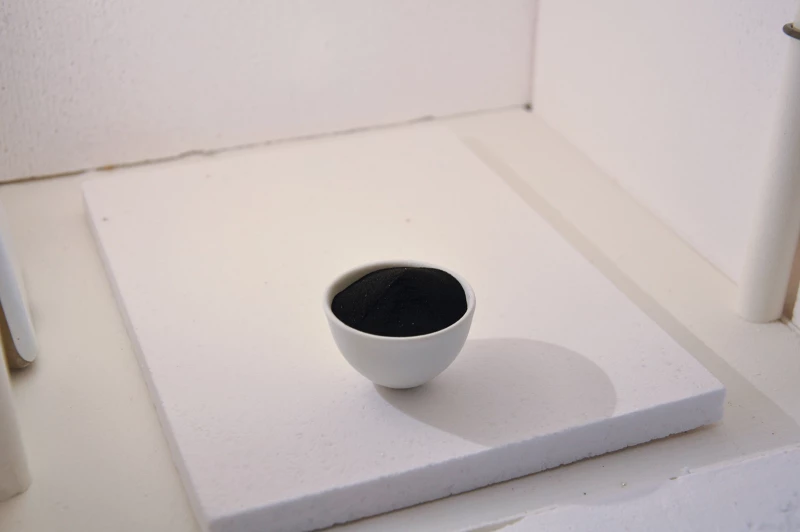
    Image Credits:Hard carbon, obtained from lignin, forms the basis for the electrode of the battery
    Fraunhofer IKTS

    One of lignin’s biggest strengths is how easy it is to obtain.People can source it locally in many regions worldwide. For this project, the team collected lignin from the Thuringian Forest near the Fraunhofer IKTS facility, providing a far cheaper, more accessible alternative to costly, mining-dependent metals like lithium, cobalt, and nickel.

    “Our goal is to remove critical metals from the battery value chain. “We’re aiming to reduce or even eliminate fluorine in electrodes and electrolytes, but our main focus is turning locally sourced, high-quality lignin into high-performance electrodes for sodium-ion batteries,” says Lukas Medenbach of Fraunhofer IKTS.

    Using lignin in batteries also lowers carbon emissions, since the material is no longer burned as waste. In addition, sodium-ion batteries made this way are safer and much easier to recycle than lithium-based alternatives.

    Iron-Based Prussian Blue Analogs Power the Positive Electrode

    The battery’s positive electrode uses abundant, non-toxic iron-based Prussian Blue analogs—once known as pigments, now engineered to store sodium ions.

    Tests have shown that lignin-derived hard carbon performs well in sodium-ion storage and offers excellent cycle stability.

    Even after 100 charge–discharge cycles, the lab cell shows no meaningful performance loss. By the end of the project, we aim to demonstrate 200 cycles in a 1-Ah full cell,” Medenbach notes.

    Researchers are still developing lignin-based sodium-ion batteries, which suit stationary storage and low-power vehicles like microcars and forklifts, where fast charging isn’t critical.


    Read the original article on: Newatlas
    Read more:AI Wearable Helps Stroke Survivors Speak Again

  • Battery Charging Fuels Lithium Recycling Breakthrough

    Battery Charging Fuels Lithium Recycling Breakthrough

    Lithium may not be the fictional “Spice” from Dune, but this shiny, highly reactive metal is just as crucial in the real world. Its exceptional ability to store electricity makes it indispensable for moving away from fossil fuels and toward a cleaner, low-carbon economy powered by renewable energy.
    Image Credits:The recharge-to-recycle process harvests usable lithium from discarded EV batteries, so it can find use in new ones
    Depositphotos

    Lithium may not be the fictional “Spice” from Dune, but this shiny, highly reactive metal is just as crucial in the real world. Its exceptional ability to store electricity makes it indispensable for moving away from fossil fuels and toward a cleaner, low-carbon economy powered by renewable energy.

    Today, about 87% of global lithium is used for rechargeable batteries in power grids, EVs, and electronics. Beyond batteries, lithium also plays an important role in other industries. Natural Resources Canada says it strengthens glass, boosts heat and corrosion resistance, and cuts energy use in production.

    Given lithium’s importance, why does attention need to be paid to something called “black mass”?

    Despite the name, black mass is the fine powder left after recycling lithium-ion batteries, and recovering lithium from it is vital because mining new lithium is costly and environmentally harmful. Recycling spent batteries is therefore critical to meeting demand while limiting ecological harm.

    Until now, lithium recovery relied on corrosive acids or energy-intensive smelting. A new method from Rice University, detailed by Yuge Feng in Joule, offers a cleaner, more efficient electrochemical approach.

    Rather than burning or chemically dissolving the black mass, the researchers essentially “recharge” the cathode materials within it, causing them to release lithium. Combined with simple processes like water splitting, the method produces high-purity lithium hydroxide suitable for making new batteries. The approach requires only electricity, water, and battery waste—eliminating the need for harsh chemicals and significantly reducing environmental impact.

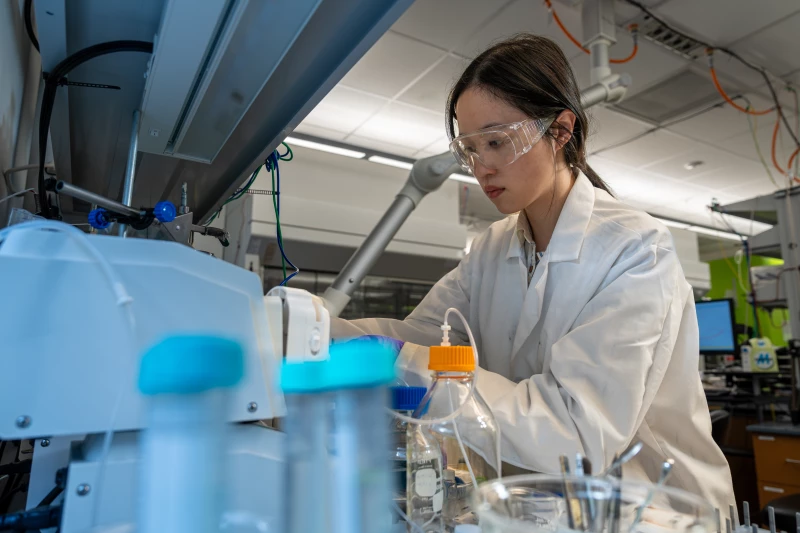
    Image Credits:Yuge Feng, first author of a paper on the study, and a graduate student at Rice University
    Jorge Vidal/Rice University

    The Rice University team’s process proved remarkably effective, producing lithium hydroxide with purity exceeding 99%. It also demonstrated exceptional energy efficiency, operating steadily for more than 1,000 continuous hours while recycling over 50 grams of black mass.

    So how did this novel lithium recovery method come about?

    We started with a simple idea,” explains Sibani Lisa Biswal, co-corresponding author of the study. “If charging a battery removes lithium from a cathode, why not harness that same reaction for recycling?

    In a conventional battery, lithium ions leave the cathode—the electrode that gains electrons—during charging. In the Rice system, lithium ions pass through a thin cation-exchange membrane into flowing water. At a secondary electrode, a straightforward water-splitting reaction generates hydroxide ions, which then bond with lithium to form lithium hydroxide.

    By combining this chemistry with a compact electrochemical reactor, we can selectively extract lithium and produce the precise compound battery manufacturers need,” says Biswal, chair of Rice’s Department of Chemical and Biomolecular Engineering and the William M. McCardell Professor of Chemical Engineering.

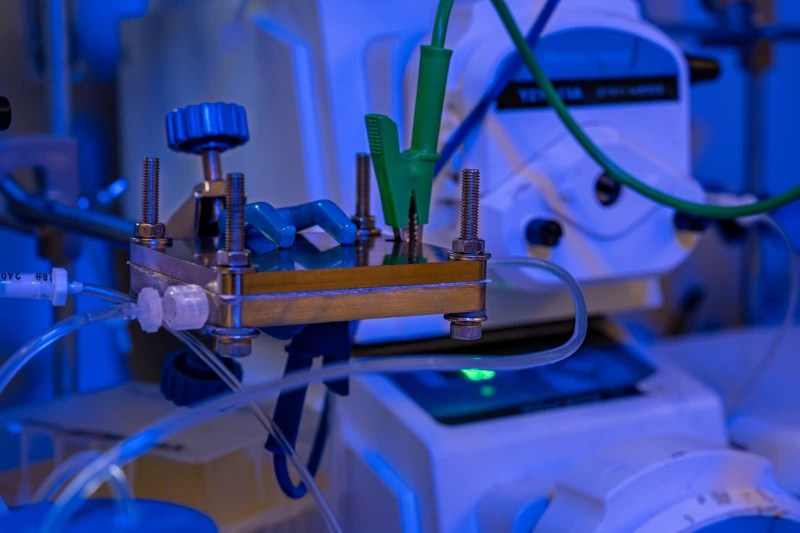
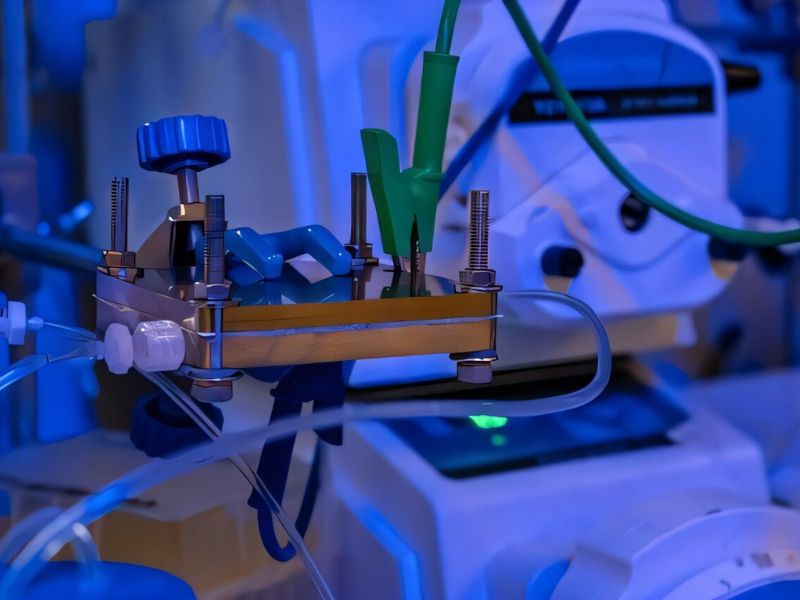
    Image Credits:The electrochemical cell set-up in the Rice University lab
    Jorge Vidal/Rice University

    New Atlas has reported on fast, low-cost lithium extraction and robotic EV battery recycling. The Rice University method advances this further, working with various battery chemistries like LFP, LMO, and NMC.

    Co-author Haotian Wang says producing high-purity lithium hydroxide directly shortens the path to battery production, cutting steps, waste, and strengthening the supply chain. Wang is an associate professor of chemical and biomolecular engineering.

    We’ve simplified and cleaned up lithium extraction to cut both energy use and emissions,” adds Biswal. “The next challenge is clear—improving concentration. Solving that will further enhance sustainability.


    Read the original article on: Newatlas
    Read more:Scientists Develop the Inaugural Model of Artificial Brain Tissue

  • Cornell’s Robot Jellyfish and Worm run on a Hydraulic Fluid Battery

    Cornell’s Robot Jellyfish and Worm run on a Hydraulic Fluid Battery

    Researchers at Cornell University on Monday unveiled two bio-inspired robots powered by a hydraulic fluid battery. The redox flow battery (RFB) mimics biological processes by releasing electrolytic fluids that generate energy through chemical reactions.
    Image Credits:Cornell University

    Researchers at Cornell University on Monday unveiled two bio-inspired robots powered by a hydraulic fluid battery. The redox flow battery (RFB) mimics biological processes by releasing electrolytic fluids that generate energy through chemical reactions.

    The showcased robots—a modular worm and a jellyfish—were developed by Cornell Engineering labs. Their batteries use “embodied energy,” integrating power sources into the robot’s structure to lower weight and cost.

    Innovative Hydraulic Fluid Battery Reduces Robot Weight

    Mechanical and aerospace engineering Professor Rob Shepherd explained, “Many robots are hydraulically powered, but we’re the first to use hydraulic fluid as the battery. This cuts the robot’s overall weight, since the battery both powers the system and provides the force for movement.”

    Image Credits:Cornell University

    Besides enhancing speed and mobility, the battery technology extended the robot jellyfish’s operational time to 90 minutes. The robot builds on technology previously used by the university in a lionfish-inspired robot. When that system debuted in 2019, researchers called its circulating liquid “robot blood,” making the battery akin to a robot heart.

    The jellyfish’s RFB includes a tendon that pushes the robot upward when flexed into a bell shape, while relaxing causes it to sink. Video footage shows the robot moving through water with lifelike, jellyfish-like motions.

    Image Credits:Cornell University

    Modular Design Enables Flexible Worm Movement

    The worm, on the other hand, is made of modular segments, resembling those used in larger snake robots. Each segment houses a motor and a tendon actuator that contracts and expands to produce movement.

    The researchers point out that moving from water to land posed unique challenges, primarily because underwater robots don’t need a rigid skeleton.

    This mirrors how life evolved on land,” Shepherd explains. “It begins with fish, then progresses to a simple organism supported by the ground. The worm is simple, yet it possesses greater degrees of freedom.


    Read the original article on: Techcrunch

    Read more:Man Survives 100 Days with Artificial Titanium Heart in Successful Trial

  • New Reactor Recycles Battery Waste into Lithium Feedstock

    New Reactor Recycles Battery Waste into Lithium Feedstock

    As electric vehicle use rises worldwide, discarded battery packs are rapidly turning into a significant waste source. Lithium is expensive to extract, and most existing recycling techniques consume substantial energy and chemicals, typically yielding lithium carbonate that still requires additional processing to become reusable lithium hydroxide.
    A photo of the electrochemical cell set-up in the Rice lab. Image Credits: Jorge Vidal / Rice University

    As electric vehicle use rises worldwide, discarded battery packs are rapidly turning into a significant waste source. Lithium is expensive to extract, and most existing recycling techniques consume substantial energy and chemicals, typically yielding lithium carbonate that still requires additional processing to become reusable lithium hydroxide.

    Instead of smelting or leaching shredded battery material (“black mass”) with harsh acids, engineers at Rice University have devised a cleaner method: they electrochemically “recharge” the spent cathode material, prompting lithium ions to move into water, where they react with hydroxide to form high-purity lithium hydroxide.

    “We posed a simple question: if charging a battery extracts lithium from a cathode, why not use that same process for recycling?” said Sibani Lisa Biswal, chair of Rice’s Department of Chemical and Biomolecular Engineering and the William M. McCardell Professor of Chemical Engineering. “By combining that chemistry with a compact electrochemical reactor, we can recover lithium cleanly and generate the exact salt manufacturers need.”

    Electrochemical Recycling of Lithium from Spent Cathodes

    In a functioning battery, charging draws lithium ions out of the cathode. Rice’s system applies this mechanism to spent cathodes such as lithium iron phosphate. As the reaction starts, lithium ions pass through a thin cation-exchange membrane into flowing water. At the counter electrode, water splitting produces hydroxide. The lithium and hydroxide then merge in the water stream, forming lithium hydroxide without the use of strong acids or additional reagents.

    The work, published recently in Joule, showcases a zero-gap membrane-electrode reactor that runs solely on electricity, water, and battery waste.

    Image Credits: Joule (2025). DOI: 10.1016/j.joule.2025.102197

    In certain operating modes, the method used just 103 kilojoules of energy per kilogram of black mass—roughly ten times less than typical acid-leaching approaches, even before their extra processing steps are considered. The researchers also scaled their reactor to 20 square centimeters, completed a 1,000-hour durability test, and treated 57 grams of industrial black mass.

    “Producing high-purity lithium hydroxide directly streamlines the route back into new batteries,” said Haotian Wang, associate professor of chemical and biomolecular engineering and co-corresponding author with Biswal. “It cuts down processing steps, reduces waste, and strengthens the supply chain.”

    High-Purity, Energy-Efficient Lithium Recovery Across Multiple Cathodes

    The method yielded lithium hydroxide at over 99% purity—suitable for immediate use in battery production. It was also highly energy-efficient, requiring only 103 kilojoules of energy per kilogram of waste in one mode and 536 kilojoules in another. Over 1,000 hours of continuous operation, the system remained stable and scalable, achieving an average lithium recovery rate of nearly 90%.

    The technique proved effective with several cathode chemistries, including lithium iron phosphate, lithium manganese oxide, and nickel–manganese–cobalt materials. Notably, the team also demonstrated roll-to-roll processing of whole lithium iron phosphate electrodes straight from aluminum foil, eliminating the need for scraping or other pretreatment.

    “The roll-to-roll demonstration shows how this technology could integrate seamlessly into automated battery-disassembly lines,” Wang said. “You feed in the electrode, power the reactor with low-carbon electricity, and collect battery-grade lithium hydroxide on the other end.”

    The team’s next steps include scaling the system with larger-area stacks, increasing black-mass loading, and creating more selective, hydrophobic membranes to maintain high efficiency at elevated lithium-hydroxide concentrations. They also view downstream processing—concentrating and crystallizing the lithium hydroxide—as a major opportunity to further reduce energy use and emissions.

    “We’ve made lithium extraction cleaner and more straightforward,” Biswal said. “Now the next bottleneck is obvious. Solve the concentration challenge, and sustainability improves even more.”


    Read the original article on: Tech Xplore

    Read more: AI-Enabled Technology Can Autonomously Tackle Oil Fires on Ships

  • Battery-Free Earbuds Improve Sleep and Remove Charging Hassles

    Battery-Free Earbuds Improve Sleep and Remove Charging Hassles

    A UK company claims to have found a better solution for blocking nighttime noise and improving sleep. Somni says its sleep earbuds are the tiniest available and never require charging.I’m intrigued to see if this ambitious crowdfunded product delivers on its promise.
    Image Credits:The SomniBuds use patent-pending tech to deliver audio to your ears without any electronics inside the diminutive buds
    Somni

    A UK company claims to have found a better solution for blocking nighttime noise and improving sleep. Somni says its sleep earbuds are the tiniest available and never require charging.I’m intrigued to see if this ambitious crowdfunded product delivers on its promise.

    SomniBuds use a thin pad placed under your pillow, mattress, or headboard (within 2–3 feet). The pad connects to your phone or tablet via Bluetooth and sends sound to the earbuds through a magnetic field.

    Battery-Free Design with Patent-Pending Magnetic Audio Technology

    The earbuds have no batteries or built-in electronics. The company says each SomniBud contains a sensitive magnetic speaker diaphragm in an acoustic chamber, with no coil or electronics. It’s mechanically driven by the voice coil field from the SomniMat, similar to how a speaker cone operates.” This forms the basis of the product’s patent-pending technology.

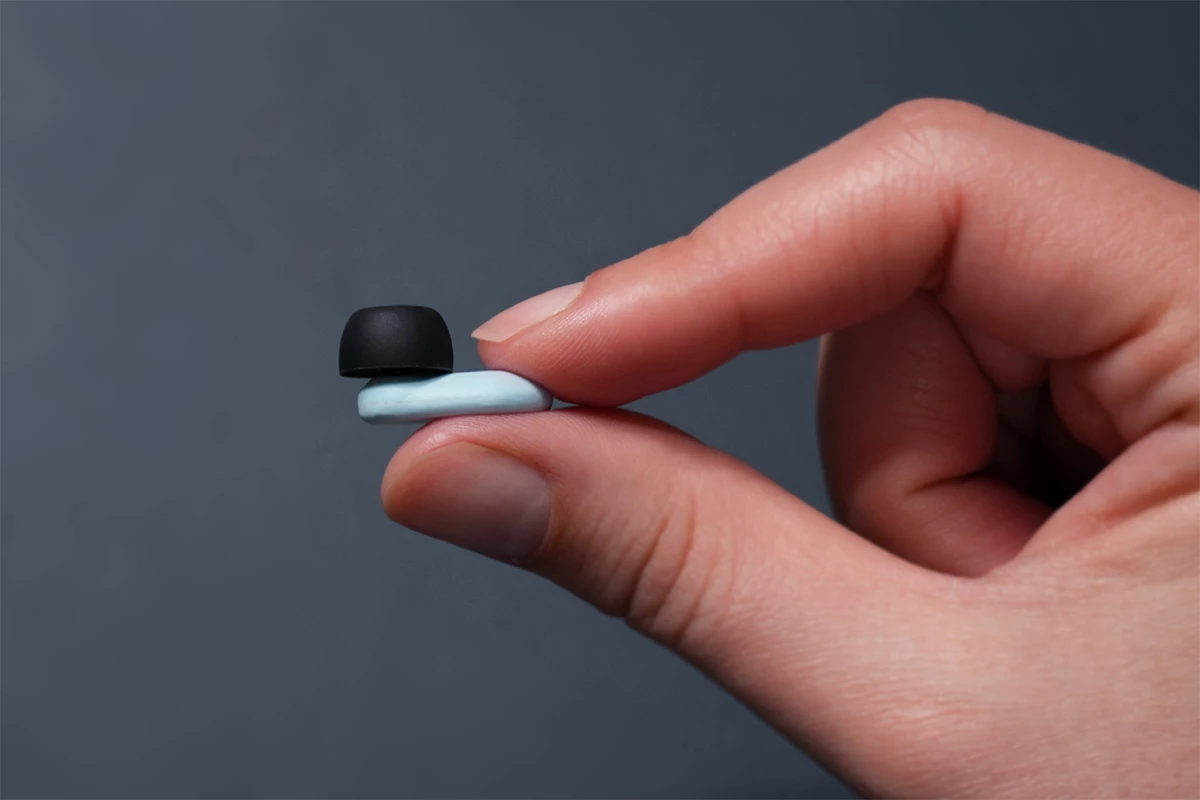
    This eliminates the need for batteries and charging while making the earbuds significantly smaller. Each bud is 3 mm thick, slim enough to stay comfortable for side-sleeping.

    Image Credits:The SomniBuds use foam ear tips to deliver a precise fit and passively block noise while you sleep
    Somni

    Somni explains that the slim, flexible post inside the foam ear tip allows it to compress as your ear canal shifts during sleep, preventing any hard components from pressing uncomfortably against your ear.

    Thanks to their tiny size, the buds fit securely and form a tight seal that passively blocks sound. Without active noise cancellation, Somni says the buds still block up to 37 dB of noise, enough to mask disturbances at low volume.

    Image Credits:At just 3 mm thick, the SomniBuds are designed to fit snugly inside your ear canal so you can comfortably sleep on your side
    Somni

    In addition to the earbuds, the setup includes two other components: a placemat-sized pad that houses the magnetic coil typically found inside earbuds, and a brick-shaped power supply with a Bluetooth receiver that plugs into a wall socket.

    Image Credits:The SomniBuds kit includes a pair of battery-less buds, a power brick and Bluetooth receiver, and a mat that goes under your pillow or bedsheet
    Somni

    Somni says its earbuds provide clear audio within the mat’s range, though only in mono. They don’t work well outside of bed, as the volume drops the farther you move from the mat. In short, Somni designed them exclusively for sleep, not to replace regular audio devices.

    I’d be especially curious for my partner to try them to see if they help soften my relentless snoring—since nothing else we’ve tested has been both effective and comfortable.

    Pricing and Kickstarter Discounts

    A single-bud kit normally retails for US$300 but currently sells for $231 on Somni’s Kickstarter. The DuoMat bundle, letting a partner listen simultaneously, costs $251.

    Somni plans to begin global shipping in December. As with any crowdfunded project, risks exist, but orders should ship by year-end if all proceeds smoothly.

    You can explore the SomniBuds campaign on Kickstarter.


    Read the original article on: New Atlas

    Read more:The MOTIF Hand: A Step Forward in Robotic Hand Technology

  • World’s Largest Sand Battery Goes Online in Finland

    World’s Largest Sand Battery Goes Online in Finland

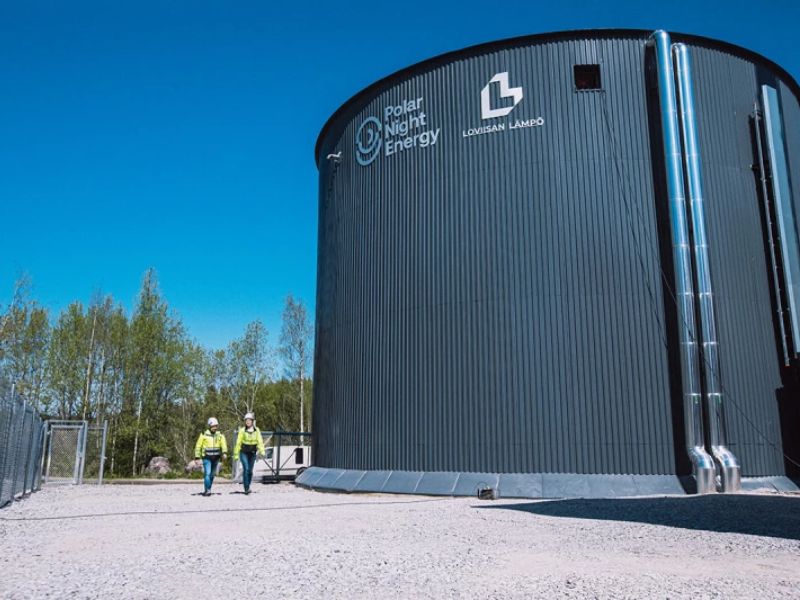
    With its 100-MWh capacity, Pornainen’s sand battery is the largest in the world
    Polar Night Energy

    Finland has just switched on an industrial-scale sand battery in the southern town of Pornainen, where it will replace an aging woodchip plant as the main source of heating for the municipality. Expected to cut local heating-related carbon emissions by up to 70%, the facility now holds the title of the largest sand battery in the world.

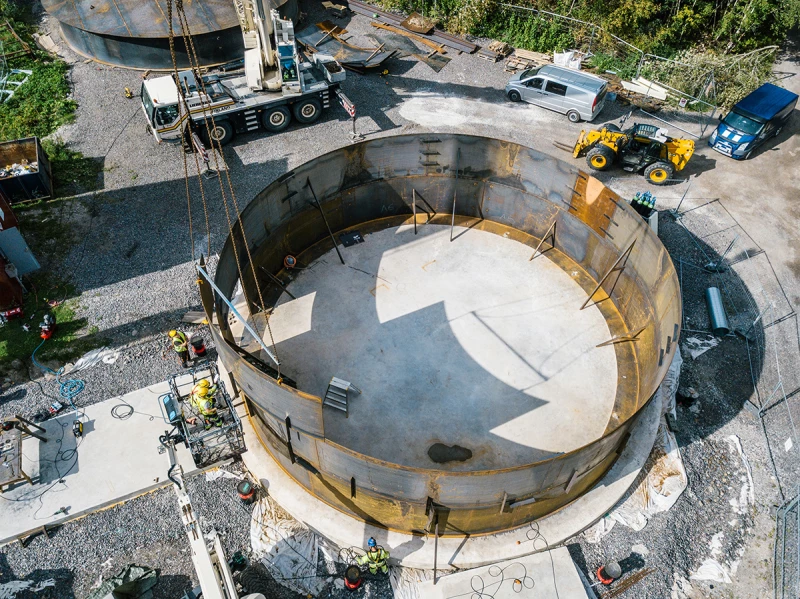
    Built by the Finnish company Polar Night Energy – the same firm that developed the world’s first commercial sand battery a few years back – the system measures around 42 ft (13 m) tall and 50 ft (15 m) wide. It can store up to 100 MWh of thermal energy with a round-trip efficiency of 90%. That’s roughly 10 times the capacity of the original prototype, enough to provide the town with a full week of heating.

    A Solution for Energy Storage Challenges

    Thermal Energy Storage (TES) like this is especially valuable in countries such as Finland, which rely heavily on intermittent solar and wind power while facing fluctuating seasonal energy demands. The sand battery absorbs surplus electricity when it’s cheap and plentiful, storing heat that can remain viable for months. This stored energy can then be tapped during peak demand to stabilize the grid.

    World’s Largest Sand Battery

    How the Sand Battery Works

    The system uses excess renewable electricity to heat sand inside a large, insulated silo through a closed-loop air pipe system, reaching temperatures of up to 1,112 ºF (600 ºC). The sand retains this heat for extended periods. When needed, cooler air is pushed through the silo, absorbing the stored heat and reaching temperatures of around 752 ºF (400 ºC). That hot air can then generate steam for industry or heat water for municipal heating through a heat exchanger.

    The enormous battery measures 42 ft in height and 50 ft in diameter
    Polar Night Energy

    Unlike traditional batteries, this setup doesn’t supply electricity directly. However, Polar Night Energy is exploring ways to convert the stored thermal energy back into power, potentially through steam turbines.

    What Is a Sand Battery? Polar Night Energy’s Sand-based Thermal Energy Storage Explained

    Already Delivering Results

    Though officially launched this week, the battery has been running since June and has already outperformed efficiency expectations during its initial optimization phase. Key buildings in Pornainen, including the town hall, are now heated by this system.

    This sand battery is capable of reducing carbon emissions from Pornainen’s local heating network by as much as 70%
    Polar Night Energy

    Looking ahead, the giant sand battery is expected to play a pivotal role in helping Pornainen reach carbon neutrality, while serving as a model for other municipalities in similar climates to adopt this large-scale, sustainable technology.


    Read the original article on: New Atlas

    Read more: Finland Powers Up World’s Largest Sand Battery with Promising Economics

  • China Debuts Fully Autonomous Robot that Swaps its Own Battery

    China Debuts Fully Autonomous Robot that Swaps its Own Battery

    Image Credits: Cnnbrasi

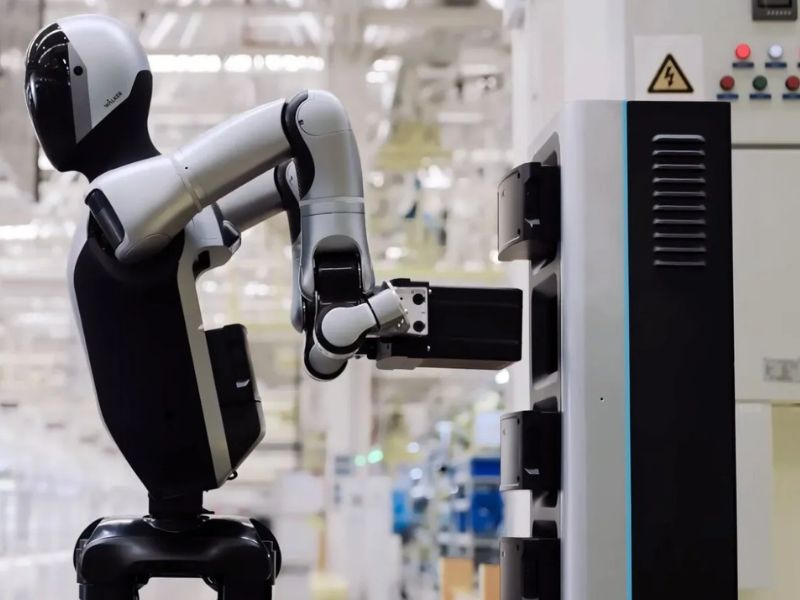
    China has made a major advancement in the tech race by developing a humanoid robot capable of operating 24/7 with full autonomy and managing its own energy supply. Named Walker S2, the prototype created by UBTech Robotics is seen as a significant breakthrough in global innovation.

    Robot Uses Built-In USB-Like Device for Power Replacement

    During the battery replacement process, the humanoid robot can utilize multiple devices integrated into its system, each featuring a design similar to that of USB flash drives.

    To accomplish this, the robot evaluates the energy requirements of any upcoming tasks.

    Throughout the development phase, the team implemented a technology called UBTech Robotics, which uses an advanced program resembling a superintelligent brain to enable autonomy and self-regulation.

    Collaborative Intelligence

    This system allows Walker S2 to operate across various production lines, guided by decisions from a network of other robots that coordinate the software’s capabilities.

    According to a report by U.S. firm Moody’s, the debut of the fully autonomous prototype propels China to a leading role in the global robotics industry.

    The report emphasizes China’s unique combination of cutting-edge AI and cost-effective tech manufacturing. Another article on the topic also notes that nearly half of the world’s humanoid robot development companies are now based in China.


    Read the original article on: Cnnbrasil

    Read more: See how a Long Hug can Surprisingly Boost your Health

  • Sodium-iron Battery Startup To Challenge Li-ion For Extended Storage

    Sodium-iron Battery Startup To Challenge Li-ion For Extended Storage

    Manufacturing partner, Horien, in Switzerland has so far been producing sodium metal chloride batteries in factories like this, but will also take on production of Inlyte’s sodium-iron batteries
    Inlyte Energy

    For years, lithium-ion batteries have been the go-to solution for long-term energy storage, but their production and maintenance costs remain high. A California-based startup, Inlyte, aims to provide a scalable alternative with its sodium-iron battery technology and is preparing to produce cells to demonstrate its potential.

    The History and Evolution of Sodium-Iron Batteries

    The concept of sodium-iron batteries has been around for decades. In the 1970s, Beta Research, a UK-based company, pioneered the technology for use in electric vehicles. However, it never gained traction, and lithium-ion batteries eventually became the dominant technology. Years later, Stanford graduate Antonio Baclig pursued sodium metal halide battery designs as part of his quest to develop a utility-scale energy storage solution, founding his own company to bring it to market.

    Inlyte took note of Beta Research’s work and acquired both its team and facilities. In 2023, the startup secured $8 million in seed funding to fuel its plans. Now, with a partnership with Horien Salt Battery Solutions, Inlyte is scaling up sodium-iron battery production in the U.S. to bring long-duration storage solutions to the market.

    Inlyte hopes to commercialize its sodium iron batteries for long-duration energy storage in the US in 2027
    Inlyte Energy

    The primary advantage of sodium-iron batteries lies in their composition: using two widely available materials, these batteries could cost as little as $35 per kWh when produced at scale. This is a significant reduction compared to the $139 per kWh cost of lithium-ion batteries.

    Durability and Safety of Sodium-Iron Batteries

    Sodium-iron batteries are also robust, capable of operating in any climate, safe to transport, and carry minimal fire risks. They offer between 6 to 24 hours of energy storage, far exceeding the typical 4 hours provided by lithium-ion batteries.

    Inlyte has already demonstrated its cells’ ability to endure over 700 cycles without losing energy capacity and estimates a lifespan of at least 7,000 cycles, or about 20 years. This could pose a serious challenge to lithium-ion storage systems, such as Tesla’s Megapack.

    Future Plans for U.S. Manufacturing

    Through its collaboration with Horien, Inlyte aims to open its first U.S.-based battery factory by 2027. The company has been testing its technology at a pilot plant in the UK, and leveraging Horien’s manufacturing expertise could expedite its efforts to commercialize and attract customers in the near future.


    Read the original article on: New Atlas

    Read more: Portable Device Revolutionizes Ammonia Production with Eco-Friendly Innovation

  • Tiny Nuclear Battery Could Power Devices For Decades

    Tiny Nuclear Battery Could Power Devices For Decades

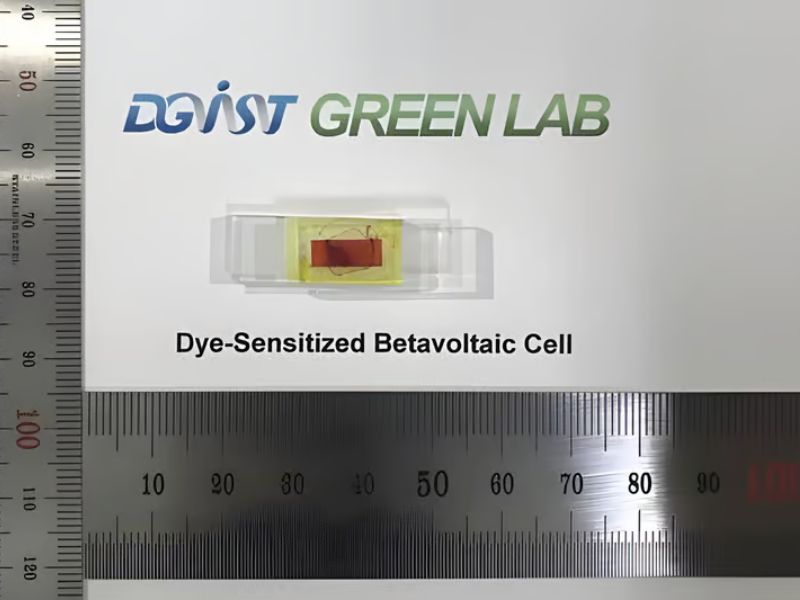
    A small dye-sensitized betavoltaic cell has radiocarbon on both the cathode and anode to increase its energy-conversion efficiency
    Su-Il In

    Researchers at the Daegu Gyeongbuk Institute of Science & Technology in South Korea have developed a nuclear battery capable of converting radiation directly into electricity for decades — all without the usual dangers associated with nuclear radiation.

    How the Betavoltaic Cell Works

    Known as a dye-sensitized betavoltaic cell, this battery harnesses beta particles, which are simply high-energy electrons. The key to its operation lies in carbon-14, a radioactive isotope that emits beta particles. These particles interact with a titanium dioxide semiconductor coated with a ruthenium-based dye, causing electrons to be knocked loose from the dye and generating an electric current.

    The half-life of carbon-14 is around 5,730 years, meaning the battery could potentially retain 50% of its original output after nearly six millennia. However, practical power output would likely decline much sooner as materials degrade over such long periods.

    The prototype boasts a power density of 20.75 nanowatts per square centimeter per millicurie at 2.86% efficiency. In simpler terms, this isn’t much. Roughly the size of an aspirin, it produces about 0.4% of the power needed to run a basic pocket calculator. You’d need around 240 of these tiny nuclear batteries to power a times table refresher.

    Practical Uses for the Battery

    Despite this, the battery generates enough energy to power medical devices like pacemakers or remote environmental sensors. It could also supply power to RFID tags, microchips, or even trickle charge capacitors for devices that require a quick burst of energy. This technology is still in its early stages but holds promise for various low-power applications.

    A graph showing carbon-14 half-life
    New Atlas

    Although many might associate nuclear radiation with danger, the researchers assure that this battery design is actually quite safe. The beta particles emitted by carbon-14 are already naturally present in many substances, including the human body. Shielding for this battery can be as simple as a thin piece of aluminum foil, or even paper, which effectively blocks the beta particles. In fact, these solid-state, non-flammable batteries might even be safer than lithium-ion batteries, which are prone to overheating, leaking, and explosions.

    Atomic batteries aren’t new, though. The first radioisotope battery, developed in 1954 by the US Atomic Energy Commission, used strontium-90 as the radioactive source and worked similarly to today’s betavoltaic cells.

    Space Missions and Recent Advances

    In the 1960s, Radioisotope Thermoelectric Generators (RTGs) began being used in space missions, converting energy from alpha-emitting isotopes like plutonium-238 into electricity. The first mission using RTGs was the US Navy’s Transit 4A satellite, which played a key role in the early stages of satellite navigation and modern GPS.

    More recently, Betavolt introduced a 3-volt diamond nuclear battery using nickel-63 and a diamond semiconductor, utilizing the same beta particle concept to power devices for 50 years. Another company, Arkenlight, has been working on carbon-14 diamonds to produce atomic battery power, and their technology is steadily advancing.

    While atomic batteries have been around for a while, recent advances in materials, efficiency, and safety are finally making them viable for practical, everyday uses without the need for nuclear reactors.


    Read the original article on: New Atlas

    Read more: World’s First 18650-Sized Potassium-Ion Battery Aims to Tackle Lithium Shortage

  • Scientists Unveil Battery Powered by Nuclear Waste

    Scientists Unveil Battery Powered by Nuclear Waste

    Nuclear energy produces minimal greenhouse gas emissions but presents challenges due to radioactive waste.
    Credit: Pixabay

    Nuclear energy produces minimal greenhouse gas emissions but presents challenges due to radioactive waste.

    A recent study explores a potential solution: using this waste to power microelectronics.

    Researchers in the U.S. harnessed ambient gamma radiation from nuclear waste to generate enough energy to run microchips. While currently limited to small sensors, the team believes the technology could be scaled up.

    We’re taking something regarded as waste and transforming it into value,” says nuclear engineer Raymond Cao from Ohio State University.

    Nuclear power currently supplies about 10% of global energy needs. If its waste can be repurposed effectively, the technology may become an even more attractive alternative to fossil fuels.

    Nuclear batteries, which convert radioactive decay into electricity, have been under development for decades, but the technology has yet to reach practical viability.

    Two-Step Energy Conversion in a Compact Prototype

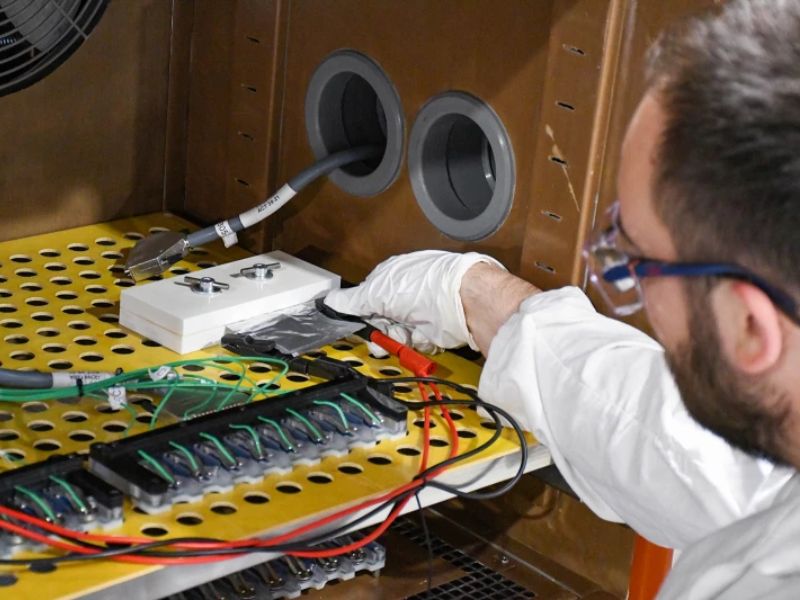
    In this approach, energy production occurred in two steps: scintillator crystals first transformed radiation into light, which was then converted into electricity by solar cells. The prototype battery had a compact size of approximately 4 cubic centimeters (0.24 cubic inches).

    During testing with two radioactive sources—cesium-137 and cobalt-60, both common byproducts of nuclear fission—the battery produced 288 nanowatts and 1.5 microwatts, respectively.

    The experimental battery combined scintillator crystals with solar cells. (Oksuz et al., Optical Materials: X, 2025)

    This represents a significant breakthrough in power output,” says Ibrahim Oksuz, an aerospace engineer at Ohio State University.

    This two-step process is still in its early stages, but the next goal is to scale up and generate higher power outputs.”

    Targeted Deployment and Potential Applications

    These batteries would primarily be deployed near nuclear waste facilities rather than for public use. However, they hold promise for powering low-maintenance sensors and monitoring devices.

    According to the researchers, the battery is safe to handle and does not pose an environmental hazard. However, questions remain about its long-term durability once installed.

    The radiation resistance of both the scintillator and the photovoltaic cell is a crucial factor and should be a primary focus for future research,” the team notes.

    The technology could also be adapted for environments with natural gamma radiation, such as space. While significant improvements are still needed, the researchers are confident in the viability of the concept.

    During the study, the team also identified how the arrangement of scintillator crystals and solar cells influences energy conversion and output—insights that will inform future developments.

    The nuclear battery concept has great potential,” says Oksuz.

    There’s still plenty of room for refinement, but I believe this approach will eventually establish itself as a key player in both energy production and sensor technology.”


    Read the original article on: Science Alert

    Read more: Scientists Discover Mysterious Nuclear “Bump” Challenging Existing Physics Models