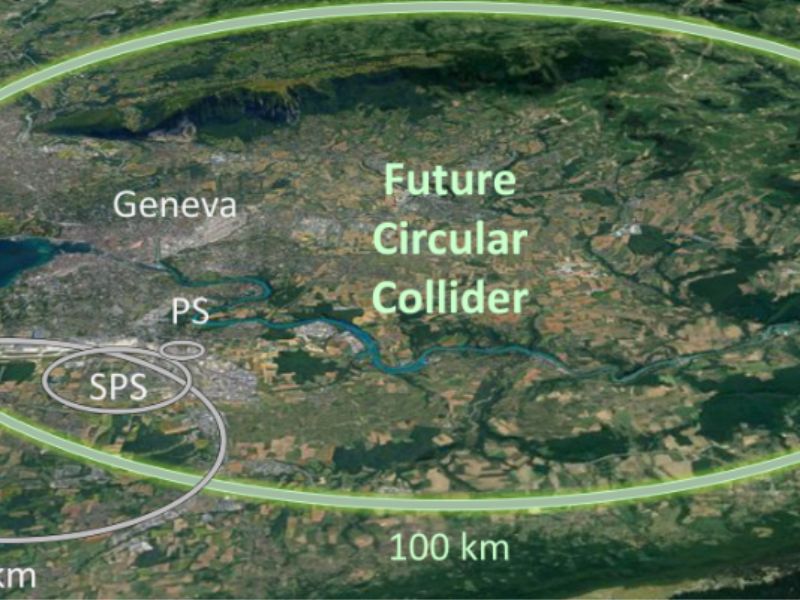
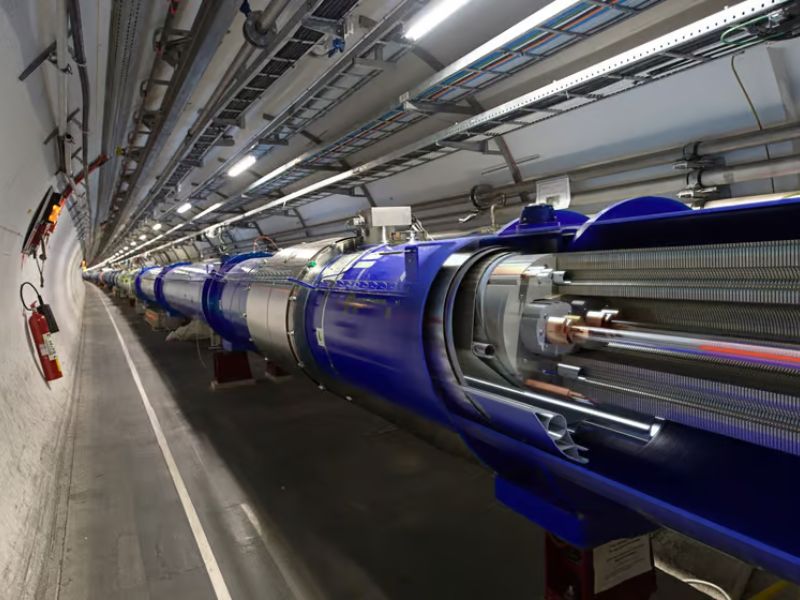
Future Circular Collider would triple the LHC’s size.
CERN confirmed no technical barriers to building the $17 billion Future Circular Collider (FCC). Director Fabiola Gianotti stressed its importance for Europe’s physics leadership amid rising competition from China. A feasibility study supports a 91-km (56-mile) tunnel under the French-Swiss border, over three times longer than the LHC, which confirmed the Higgs boson.
With the LHC set to retire by 2041, CERN is planning ahead. Gianotti highlighted that “no technical showstopper” had been found. Catherine Biscarat of Toulouse University’s L2IT lab called the FCC “rich in possibilities,” essential for advancing research on the universe’s origins and the Higgs boson’s role.
However, concerns remain. The FCC’s estimated $16.9 billion cost has drawn skepticism, particularly from Germany, CERN’s largest contributor. CERN spokesperson Arnaud Marsollier reassured that up to 80% of expenses could be covered by existing budgets.
The record-sized collider would smash particles at energies that could reveal new physics.
Locals and environmental groups have also voiced opposition. French dairy farmer Thierry Perrillat fears losing five hectares of his land, comparing the situation to “David and Goliath.” Environmental organizations criticize the project’s electricity consumption, climate impact, and scale.
Local Concerns Grow Over FCC’s Impact on Land and Resources
In Marcellaz, near a proposed surface site, activist Thierry Lemmel questioned whether the project justified such a large investment given its uncertain results. Some residents, like Kevin Mugnier, felt “stunned” after learning how the FCC could affect their property.
Others see benefits. Ferney-Voltaire’s mayor, Daniel Raphoz, supports the project, citing job creation and the potential to use CERN’s excess energy for heating. He warned that if Europe does not proceed, China will, risking European scientific decline.
Hundreds of feet underground, the FCC would straddle the French-Swiss border.
CERN’s member states must decide by 2028 whether to fund the FCC, a project that could redefine the future of particle physics.
Timepix3 was originally designed for particle detection for giant accelerators like the one at CERN CERN
Transitioning from colossal 26 km (16 miles) particle accelerators to operating rooms for brain surgeries, a particle detector initially engineered by physicists at CERN is now employed by researchers in Germany to enhance the precision and safety of brain tumor treatments.
Eliminating tumors in the head and neck region may seem straightforward: administer appropriate chemicals or deliver sufficiently potent radiation. However, the challenge lies in eradicating cancer cells while preserving the patient’s well-being.
Leveraging Ion Beams for Tumor Treatment
An efficient method for treating such tumors involves utilizing ion beams. By accelerating charged particles to speeds reaching three quarters of the speed of light, they can penetrate living tissue up to a foot deep. To safeguard healthy cells, the conventional approach entails moving the ion projector along a curved path with the tumor positioned at the focal point. Consequently, the tumor receives continuous bombardment while minimizing exposure to healthy tissue.
Preparing a patient for ion beam therapy CERN
The conventional method is effective but not flawless, especially in brain tumor cases. There’s a risk of exposing nearby healthy cells to secondary radiation from the ion beam, leading to potential memory loss, optic nerve damage, and other complications.
To mitigate this risk, X-ray computed tomography (CT) scans are employed to precisely pinpoint the tumor’s location for treatment planning. However, pre-operative scans may be inaccurate due to brain movement within the skull.
Utilizing Advanced Imaging Technology to Enhance Treatment Accuracy
To address this challenge, researchers from the German National Center for Tumor Diseases (NCT), the German Cancer Research Center (DKFZ), and the Heidelberg Ion Beam Therapy Center (HIT) at Heidelberg University Hospital have employed a new imaging device developed by Czech company ADVACAM. This device incorporates the Timepix3 pixel detector technology originally developed at CERN.
The Timepix3 chip CERN
Crafted to function with both semiconductor and gas-filled detectors, the Timepix3 is a versatile integrated circuit capable of processing sparse detection data and delivering high-resolution outputs swiftly. This enables ADVACAM to utilize secondary radiation from the ion beam to update tissue maps, employing the radiation as a tracking signal.
“Our cameras can capture every charged particle emitted from the patient’s body,” explained Lukáš Marek from ADVACAM. “It’s akin to observing billiard balls scatter after a shot. If the ball trajectory aligns with the CT image, we confirm accurate targeting. Otherwise, it indicates a deviation from the ‘map,’ prompting the need for treatment reevaluation.”
Enhancing Tumor Targeting Precision while Minimizing Patient Radiation Exposure
The objective is to refine tumor targeting while minimizing unintended radiation exposure to the patient by delivering elevated radiation levels precisely to the tumor.
Currently, the detector necessitates treatment interruption for re-planning. However, future phases of the program will enable real-time beam path corrections.
“When we initiated the development of pixel detectors for the LHC, our primary goal was to detect and image each particle interaction, aiding physicists in unraveling Nature’s mysteries at high energies,” remarked Michael Campbell, Spokesperson of the Medipix Collaborations.
“The Timepix detectors, developed by the multidisciplinary Medipix Collaborations, aim to extend this technology to new domains. This application exemplifies the unforeseen potential of the technology.”
Physicists have found evidence of rare X particles in the quark-gluon plasma produced in the Large Hadron Collider (LHC) at CERN. The findings could redefine the kinds of particles that were abundant in the early universe. Credit: CERN
In the initial millionths of a second after the Big Bang, our universe was an agitated pull of subatomic particles, trillion-degree plasma of quarks and gluons– elementary particles that were briefly interacting with each other on countless combinations before cooling down and settling into more stable configurations to make the neutrons and also protons of the matter we know today.
In the turmoil prior to cooling down, a fraction of these quarks and gluons collided randomly to form short-term “X” particles, so named for their enigmatic, unknown structures. Today, X particles are exceptionally rare, though physicists have actually theorized that they may be developed in particle accelerators with quark coalescence, where high-energy collisions can create comparable flashes of quark-gluon plasma.
Now physicists at MIT’s Laboratory for Nuclear Science and somewhere else have discovered proof of X particles in the quark-gluon plasma created in the Large Hadron Collider (LHC) at CERN, the European Organization for Nuclear Research, based near Geneva, Switzerland.
A bright beginning
The group utilized machine-learning techniques to sort through more than 13 billion heavy-ion collisions, each of which generated tens of thousands of charged particles. Amid this ultra-dense, high-energy particle soup, the researchers were able to tease out approximately 100 X particles, of a type referred to as X (3872 ), named for the particle’s approximated mass.
The outcomes, published today in Physical Review Letters, mark the first time scientists have found X particles in quark-gluon plasma– an atmosphere that they hope will illuminate the particles’ as-yet-unknown structure.
” This is just the start of the story,” states lead author Yen-Jie Lee, the Class of 1958 Career Development Associate Professor of Physics at MIT. “We’ve shown we can find a signal. In the next few years, we wish to utilize the quark-gluon plasma to probe the X particle’s internal structure, which could change our view of what kind of material the universe should create.”
The research’s co-authors are members of the CMS Collaboration, an international team of scientists that runs and collects data from the Compact Muon Solenoid, one of the LHC’s particle detectors.
Particles in the plasma
The basic building blocks of matter are the neutron and also proton. Each of them is made from three firmly bound quarks.
” For years we had thought that for some reason, nature had chosen to produce particles made only from two or three quarks,” Lee states.
Just recently have physicists started to see signs of exotic “tetraquarks”– particles made from a rare combination of four quarks. Scientists believe that X (3872) is either a compact tetraquark or a completely new sort of molecule made from not atoms but two freely bound mesons– subatomic particles that themselves are made from 2 quarks.
X (3872) was very first found in 2003 by the Belle experiment, a particle collider in Japan that collides high-energy electrons and positrons. Within this environment, nonetheless, the rare particles decayed too rapidly for researchers to analyze their structure in detail. It has actually been hypothesized that X (3872) and also other exotic particles may be much better illuminated in quark-gluon plasma.
” In theory, there are numerous quarks and gluons in the plasma that the manufacturing of X particles need to be enhanced,” Lee states. “However, people thought it would be too hard to look for them because there are so many other particles created in this quark soup.”
‘Really a signal’
In their brand-new research study, Lee and his colleagues searched for signs of X particles within the quark-gluon plasma created by heavy-ion collisions in CERN’s Large Hadron Collider. They based their evaluation on the LHC’s 2018 dataset, that included over 13 billion lead-ion collisions, each of which launched quarks and gluons that spread and merged to create more than a quadrillion short-lived particles before cooling down and decaying.
” After the quark-gluon plasma forms and cools down, there are so many particles produced, the background is staggering,” Lee claims. “So we had to beat down this background to ensure that we could eventually see the X particles in our data.”
To do this, the group utilized a machine-learning algorithm which they trained to pick out degeneration patterns characteristics of X particles. Right after particles form in quark-gluon plasma, they quickly decompose into “daughter” particles that spread away. For X particles, this decay pattern, or angular circulation, stands out from all various other particles.
The scientists, led by MIT postdoc Jing Wang, identified key variables that detail the shape of the X particle decay pattern. They trained a machine-learning algorithm to acknowledge these variables. Afterward, they fed the formula actual data from the LHC’s collision experiments. The algorithm had the ability to sift with the incredibly dense and noisy dataset to select the crucial variables that were likely a result of decaying X particles.
” We managed to reduce the background by orders of magnitude to see the signal,” states Wang.
The scientists zoomed in on the signals and they observed a peak at a particular mass, indicating the presence of X (3872) particles, about 100 in all.
” It’s practically unimaginable that we can tease out these 100 particles from this huge dataset,” claims Lee, who together with Wang ran several checks to verify their observation.
” Every evening I would ask myself, is this actually a signal or not?” Wang recalls. “In the end, the data said yes!”
In the next year or two, the researchers intend to collect much more data, which should help to elucidate the X particle’s structure. If the particle is a securely bound tetraquark, it must decay much more gradually than if it were a loosely bound molecule. Since the team revealed that X particles can be identified in quark-gluon plasma, they prepare to probe this particle with quark-gluon plasma in much more detail, to determine the X particle’s structure.
” Presently our data follows both because we do not have an enough statistics yet. In the following few years we’ll take far more data so we can separate these 2 scenarios,” Lee claims. “That will expand our view of the kinds of particles that were created generously in the early universe.”
Related “MIT Magnet Allows Path to Commercial Fusion Power”
Reference: “Evidence for X(3872) in Pb-Pb Collisions and Studies of its Prompt Production at vsNN=5.02 TeV” by A. M. Sirunyan et al. (CMS Collaboration), 22 December 2021, Physical Review Letters. DOI: 10.1103/PhysRevLett.128.032001
We use cookies on our website to give you the most relevant experience by remembering your preferences and repeat visits. By clicking “Accept All”, you consent to the use of ALL the cookies. However, you may visit "Cookie Settings" to provide a controlled consent.
This website uses cookies to improve your experience while you navigate through the website. Out of these, the cookies that are categorized as necessary are stored on your browser as they are essential for the working of basic functionalities of the website. We also use third-party cookies that help us analyze and understand how you use this website. These cookies will be stored in your browser only with your consent. You also have the option to opt-out of these cookies. But opting out of some of these cookies may affect your browsing experience.
Necessary cookies are absolutely essential for the website to function properly. These cookies ensure basic functionalities and security features of the website, anonymously.
Cookie
Duration
Description
cookielawinfo-checkbox-analytics
11 months
This cookie is set by GDPR Cookie Consent plugin. The cookie is used to store the user consent for the cookies in the category "Analytics".
cookielawinfo-checkbox-functional
11 months
The cookie is set by GDPR cookie consent to record the user consent for the cookies in the category "Functional".
cookielawinfo-checkbox-necessary
11 months
This cookie is set by GDPR Cookie Consent plugin. The cookies is used to store the user consent for the cookies in the category "Necessary".
cookielawinfo-checkbox-others
11 months
This cookie is set by GDPR Cookie Consent plugin. The cookie is used to store the user consent for the cookies in the category "Other.
cookielawinfo-checkbox-performance
11 months
This cookie is set by GDPR Cookie Consent plugin. The cookie is used to store the user consent for the cookies in the category "Performance".
viewed_cookie_policy
11 months
The cookie is set by the GDPR Cookie Consent plugin and is used to store whether or not user has consented to the use of cookies. It does not store any personal data.
Functional cookies help to perform certain functionalities like sharing the content of the website on social media platforms, collect feedbacks, and other third-party features.
Performance cookies are used to understand and analyze the key performance indexes of the website which helps in delivering a better user experience for the visitors.
Analytical cookies are used to understand how visitors interact with the website. These cookies help provide information on metrics the number of visitors, bounce rate, traffic source, etc.
Advertisement cookies are used to provide visitors with relevant ads and marketing campaigns. These cookies track visitors across websites and collect information to provide customized ads.