
Art by Gabriel Diaz Yanten
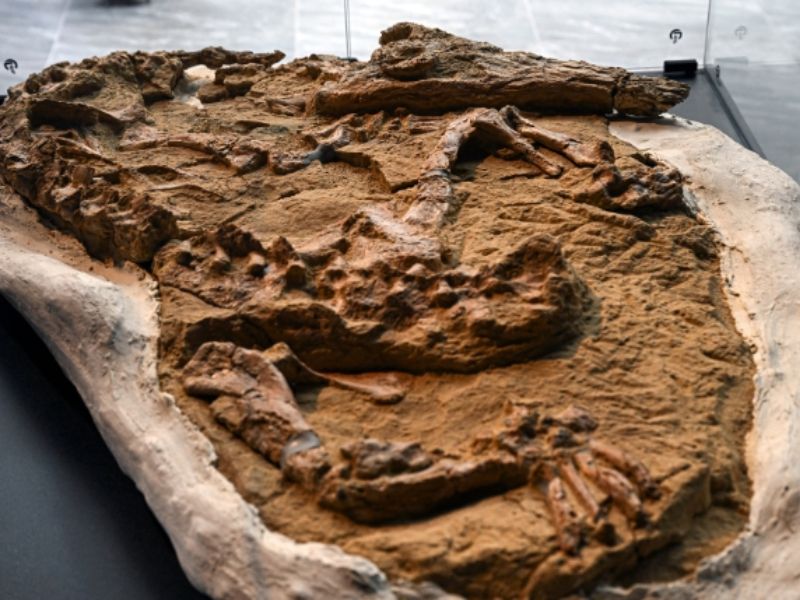
Scientists have uncovered an exceptionally well-preserved skeleton of a massive crocodile relative in South America, offering an unprecedented glimpse into its anatomy and behavior. Around 70 million years ago, this formidable predator prowled the land, hunting prey that included medium-sized dinosaurs.
An international research team, led by Argentina’s Museo Argentino de Ciencias Naturales (MACN), has identified the new species, which lived alongside dinosaurs, giant snakes, turtles, early birds, and small mammals shortly before the asteroid impact that ended the Cretaceous. Found near El Calafate in Argentina, the nearly complete skeleton—including its skull and jaws—provides the clearest evidence yet of the peirosaurids, an extinct group of crocodyliforms.
Introducing Kostensuchus atrox
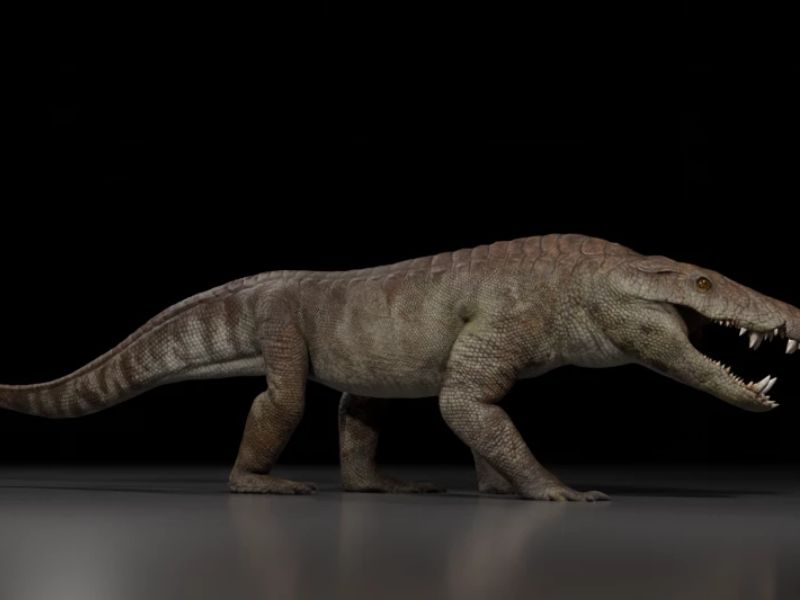
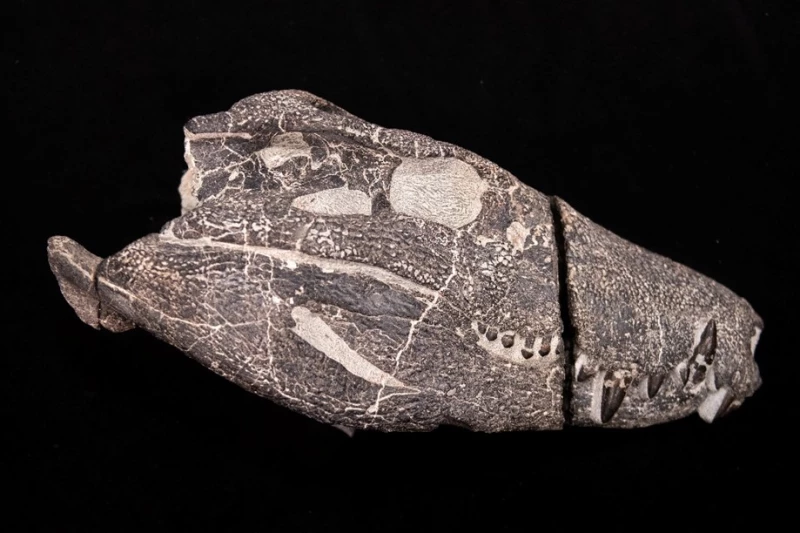
The researchers named the species Kostensuchus atrox, describing it as a powerful terrestrial predator that grew up to 3.5 meters (11.5 feet) long and weighed about 250 kilograms (551 pounds). Its deep, compact skull supported strong jaw muscles, while its sharp, serrated teeth—twice as large as those of earlier crocodyliforms—were adapted for cutting flesh rather than gripping. These traits identify it as a “hypercarnivore,” an animal that relied almost entirely on meat.
Gabriel Diaz Yanten
The name combines cultural and mythological roots: Kosten comes from the Aonikenk (Tehuelche) word for the fierce Patagonian wind, suchus is taken from Souchos, the Greek name for the crocodile-headed Egyptian god Sebek, and atrox translates as “harsh” in Greek. Importantly, Kostensuchus is not only a new species but also a new genus, expanding its significance in the evolutionary record.
A Rare Glimpse at Peirosaurids
Peirosaurids, close relatives of modern crocodiles, thrived only during the Cretaceous in South America, Africa, and Madagascar. Until now, researchers had identified most only from fragmented jaws or isolated teeth, which prevented them from fully understanding their appearance. This specimen preserves a skull and forelimbs, making it the most complete of its kind ever discovered.
“Broad-snouted peirosaurids appear to be closely related, but their incomplete fossils have made it difficult to place them in evolutionary analyses,” the researchers explained. “The remarkably preserved skull of Kostensuchus allows us to understand this morphological group for the first time and to explore its relationships with other crocodyliforms.”
Comparisons with other species suggest K. atrox was a predator highly suited to land hunting. Unlike today’s crocodiles, which ambush and drown their prey, this species had the build and dentition to confront animals directly, tearing through skin and muscle. Its strong shoulders and reinforced skull point to an active lifestyle, enabling it to subdue struggling prey—often dinosaurs, both herbivores and smaller carnivores, also found in the same fossil layers.
An Apex Predator’s Role
The discovery, made in the Maastrichtian Chorrillo Formation, enriches the picture of Patagonia’s ecosystems at the close of the Cretaceous. Although dinosaurs dominated visually, crocodyliforms like K. atrox likely shared the role of apex predator, competing for similar prey.
“This fossil greatly expands our knowledge of broad-snouted peirosaurids, previously known only from fragmentary remains in South America and Madagascar,” the scientists noted. “Kostensuchus belongs to a group of robust peirosaurids that lived across Gondwana near the end of the Cretaceous. Its anatomy also clarifies similarities and differences with baurusuchids, another crocodyliform lineage that independently evolved into apex predators.”
A Vanished Branch of Evolution
Crocodyliforms once occupied a wide variety of ecological roles, from specialized carnivores like K. atrox to fish-eaters and even plant-consumers. Peirosaurids represent one branch of this evolutionary tree that disappeared with the non-avian dinosaurs 66 million years ago. Modern crocodiles, alligators, and gharials are the last surviving remnants of this once diverse group.
This newly described specimen not only sets a reference point for comparing future fossil finds but also reveals how ancient crocs were diversifying into large, specialized meat-eaters shortly before their sudden extinction.
Read the original article on: New Atlas
Read more: Lion Brothers Set a Record with a Daring Swim Across a Crocodile River