Tag: Dolphins

  • Dolphins Create Their Own “Names” That May Carry Hidden Information

    Dolphins Create Their Own “Names” That May Carry Hidden Information

    Credit: Depositphotos

    Just like humans, many animals rely on social interactions to survive and thrive. As a result, effective communication between individuals is essential.

    Highly social species tend to develop more complex communication systems. Think of chimpanzees using gestures and vocalizations, or elephants exchanging information through touch and low-frequency calls.

    Bottlenose dolphins live in complex social structures, where each individual maintains a small group of close companions and a broader network of more distant acquaintances — a social pattern not unlike our own. To sustain this balance, dolphins heavily depend on social interactions.

    Researchers have long known that these dolphins use unique “signature whistles” to identify themselves to others. However, a recent study suggests that these sounds may carry more than just identity information.

    Dolphins live in complex societies where communication is important. (Ekaterina Ovsyanikova)

    A Unique, Yet Flexible Sound


    Dolphins communicate using various sounds, including burst pulses and whistles. These whistles are generally divided into two types: signature whistles, which are unique to each individual, and non-signature whistles.

    Dolphins develop their signature whistles at a young age and retain them throughout their lives. These whistles have distinct frequency patterns that act like a vocal name.

    During interactions with others, up to 30% of a dolphin’s whistles may consist of its signature whistle. Despite being individualized, these sounds often vary slightly. This led researchers to investigate the balance between stability and variation — and whether this combination might transmit additional information beyond identity.

    Studying the Sounds


    Between 2017 and 2018, a team of researchers recorded sounds from a group of Indo-Pacific bottlenose dolphins (Tursiops aduncus) near Tangalooma Island Resort, off Moreton Island near Brisbane, Australia.

    They recorded numerous instances of the same dolphins producing their signature whistles and also analyzed data collected from the same group 15 years earlier.

    They found that while the frequency patterns were remarkably stable, the whistles did exhibit some variation — and this variation remained consistent over time. This suggests that although these patterns communicate identity, they likely also convey other information, such as emotional states or context.

    An example of the variability in signature whistle renditions produced by a single animal. Dolphins can be individually identified by their dorsal fins. (Ekaterina Ovsyanikova)

    Although the sample size was small, the study indicated that males showed more variability in their signature whistles than females — possibly due to differences in social roles and interaction styles.

    The researchers also identified a whistle similar to a signature type that was shared by several dolphins — supporting previous findings that groups may have shared whistles alongside their individual ones.

    Whistles That Work Like Faces


    So, what does all of this mean?

    First, signature whistles may be more versatile than previously believed. Their frequency patterns — and possibly their structure — seem to encode additional information.

    Secondly, while signature whistles are learned individual “labels” similar to human names, they may function more like “auditory faces” in the way they transmit information.

    Humans convey identity through the fixed features of our faces, but we also communicate emotions and context through changing facial expressions. In a similar way, signature whistles combine stable and variable elements to deliver a broader message.

    Like human faces, dolphin signature whistles may convey a stable identity alongside other information. (Ekaterina Ovsyanikova)

    When the World Goes Quiet


    Understanding how dolphins communicate helps us grasp the challenges they face in oceans increasingly impacted by human activity.

    One such challenge is ocean noise pollution — a growing concern for marine bioacoustics researchers, though not often top of mind for the general public.

    When we think about noise, we usually consider how it affects humans. For us, a noisy environment can be irritating and stressful, but we can still function.

    For dolphins, however, loud ship noise would be like the world suddenly going blurry. Imagine trying to navigate life, make friends, avoid danger, and maintain social connections — all without being able to recognize faces or see expressions.

    If we think of dolphins’ signature whistles as the auditory equivalent of human faces, we may begin to better see — and hear — the world from a dolphin’s perspective.


    Read the original article on: Scince Alert

    Read more: Google AI May Be Close to “Speaking Dolphin” with New DolphinGemma Model
  • Dolphins in Gulf Found Contaminated with Fentanyl

    Dolphins in Gulf Found Contaminated with Fentanyl

    Credit: Pixabay

    Recent research has detected fentanyl and other drugs in dozens of dolphins in the Gulf of Mexico, just months after cocaine was found in sharks off the coast of South America. This finding highlights the growing problem of pharmaceuticals infiltrating marine environments.

    Pharmaceuticals have emerged as micropollutants and are becoming a global concern, with their presence reported in freshwater ecosystems, rivers, and oceans worldwide,” says Dara Orbach, a mammologist at Texas A&M University-Corpus Christi (TAMU-CC).

    Unexpected Discovery During Routine Tests

    In 2020, TAMU-CC researchers conducting routine hormone level tests on common bottlenose dolphins (Tursiops truncatus) unexpectedly found traces of various pharmaceuticals in the cetaceans’ fat tissue.

    Biologist Anya Ocampos and her team analyzed tissue samples from 89 dolphins, detecting fentanyl in 24 samples, including all six post-mortem dolphins. They also found sedatives like meprobamate and muscle relaxants like carisoprodol in the dolphins’ blubber.

    Dolphin tissue sample collection method. (Ocampos et al., iScience, 2024)

    Because dolphins do not drink seawater, these apex predators likely absorbed the chemicals through their diet or skin. Alarmingly, researchers collected some drug-contaminated samples from living dolphins as far back as 2013, suggesting that this issue has been ongoing.

    Dolphins as Bioindicators of Marine Health

    Orbach explains that researchers often use dolphins as bioindicators of ecosystem health in contamination research because their lipid-rich blubber stores contaminants and allows relatively non-invasive sampling in live animals.

    One concerning case involved a dolphin found dead in Baffin Bay, South Texas, within a year of the largest liquid fentanyl drug bust in U.S. history in the adjacent county. Furthermore, 40% of the pharmaceutical detections came from dolphins in the Mississippi area, indicating that this is a long-standing issue in marine environments.

    Researchers have found that more than a quarter of the world’s rivers contain pharmaceutical levels higher than what is considered safe for aquatic life, and these pollutants contribute to contamination in oceans.

    Adding to an Overwhelming List of Stressors

    Although the ecological impact of trace pharmaceuticals remains unclear, their presence adds to broader human-induced stressors like plastic pollution, chemical spills, and climate change. In 2021, Gulf of Mexico dolphins still faced health and reproductive issues from the 2010 BP Deepwater Horizon oil spill.

    Chronic exposure to multiple environmental stressors weakens the immune systems of dolphins and whales, affecting their health, reproduction, and survival.

    Researchers have not yet fully understood the chronic exposure to pharmaceuticals and their cumulative effects on marine mammals.

    Their presence in three dolphin populations across the Gulf highlights the urgent need for large-scale studies to assess the extent and sources of this contamination,” urges Orbach.


    Read the original article on: Science Alert

    Read more: A New Remarkable Ability Found in Dolphins

  • A New Remarkable Ability Found in Dolphins

    A New Remarkable Ability Found in Dolphins

    Research indicates that in addition to their impressive sonar system, dolphins develop an extra sensory ability in the region where their baby whiskers once existed as they mature. This newfound sense may assist them in navigation and locating concealed food sources.
    Once thought to be vestigal, tiny pits on the snouts of dolphins have turned out to be an important part of how they sense the world. Credit: Pixaobay

    Research indicates that in addition to their impressive sonar system, dolphins develop an extra sensory ability in the region where their baby whiskers once existed as they mature. This newfound sense may assist them in navigation and locating concealed food sources.

    The echolocation capability of dolphins, often referred to as their sonar ability, is renowned in the animal kingdom. This accuracy is so remarkable that these marine mammals, categorized as whales, can discern between a golf ball and a ping-pong ball underwater by assessing the densities of the two objects. However, their remarkable abilities don’t stop there.

    They also possess eyes that enable them to see in two directions simultaneously, skin capable of secreting an antibacterial gel for protection against parasites and barnacles, the ability to achieve speeds of up to 30 mph, and the unique capability of resting by turning off half of their brains at a time. A 2019 study highlighted their extraordinary immune systems, providing immunity against antibiotic-resistant bacteria. In a recent study from the University of Rostock in Germany, dolphins showcase yet another remarkable skill: the ability to sense weak electric fields.

    Small Pits Left by Shedding Whiskers in Young Bottlenose Dolphins Resemble Structures Used by Sharks for Electrical Field Detection

    Examining the small pits left after young bottlenose dolphins shed their initial whiskers, the researchers noticed similarities with structures that enable sharks to detect electrical fields.

    They trained two dolphins at the Nuremberg Zoo to recognize and respond when exposed to an electrical current just above their snouts. One dolphin demonstrated the ability to sense signals as low as 5.5 microvolts/cm, while the other displayed even greater sensitivity, detecting a current measuring 2.4 microvolts/cm. The responsiveness of the dolphins to pulsed electrical currents, resembling those emitted by the fish they prey upon, suggests their adaptation to hunting hidden fish in sediment. Unlike sharks, which can detect fish electrical fields up to 70 cm away, dolphins use their sensitivity to locate fish in the last few centimeters before capturing them, as explained by study co-author Guido Dehnhardt.

    Additionally, the scientists posit that the electroreception ability, possessed by dolphins, may aid in their navigation using the Earth’s magnetic field. They suggest that this capability could also account for occasional instances of dolphins getting stranded on beaches, possibly linked to fluctuations in the Earth’s magnetic field.


    Read the original article on: New Atlas

    Read more: Chimpanzees’ Wild Menopausal Traits Challenge Human Evolution Theories.

  • France faces Pressure to Protect Dolphins From Trawlers

    France faces Pressure to Protect Dolphins From Trawlers

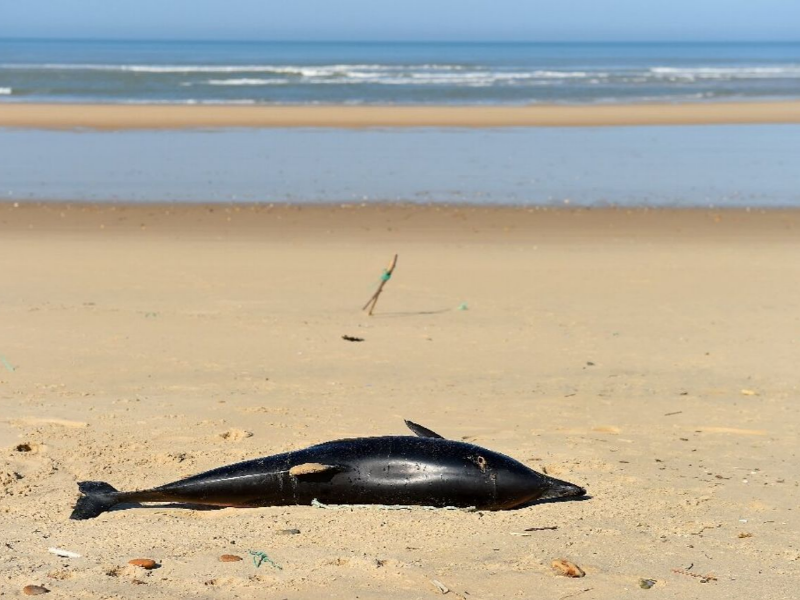
    Scientists believe many more dolphins die at sea than wash ashore.
    Scientists believe many more dolphins die at sea than wash ashore.

    Dolphins located on the French coast are haunted by man throughout the year. To protect this species, Brussels counsel concerned with a sustainable agenda warns France´s Administration. On Wednesday, Allain Bougrain-Dubourg, chief of the League for the Protection of Birds (LPO), said that he might meet with Emmanuel Macron and discuss the matter. He also stated that it is now necessary for us to make every effort to safeguard dolphins from abuse or even the threat of extinction. “This sad situation is unacceptable considering that it is preventable,” Bougrain-Dubourg added. People concerned with dangerous fishing practices, which involve deep-sea and sea-bed trawling, ought to be suspended for several weeks in the Bay of Biscay, which lies between France and Spain.

    A higher rate of dead dolphins is observed now, along their February-March coastal eating season, which brings them near to fishing boats seeking their nourishment, small fishes.At the moment we do not have many updates related to the topic”especially very early,” Pelagis said this month. Over the entire of 2022, 669 dolphins washed up, below 1,299 in 2020. Scientists consider that more than 80% of dead dolphins sink or decompose in the ocean rather than cleaning ashore, which points to the actual number of fatalities reaching up to 11,000 per year.According to Pelagis, the majority of the dolphins that have been found washed up on shore displayed indications of being caught in fishing equipment. The LPO specifically pointed out that the dolphins had cuts on their tail fins and distinct markings from nets on their skin.

    Half-Solutions

    A scientific group called CIEM, which is responsible for monitoring the North Atlantic environment, has called for a halt to fishing activities due to inappropriate fishing methods. However, this proposal has faced significant resistance from industrial fishermen. After being under pressure for months from the European Board and Pro-Dolphin people, the Government just addressed a few solutions without stopping the whole practice. The proposed solutions include implementing a program with voluntary observers on fishing boats, the use of satellite technology control, and equipping trawlers with cameras or devices that drive the dolphins away or sound detect them. France´s state said that a “large-scale experiment” is now working, in which multiple fishing boats have been equipped with the tools to assess their efficacy. However, the LPO revealed that France’s Administration works with a “half-solution that will change nothing and cost us precious time”.

    The Ambiental conservationist group said the repellent devices “produce big exclusion areas in dolphins’ feeding areas that cause them to flee from necessary alimentation. The Government is not completely ruling out the possibility of implementing temporary bans on fishing, but they suggest that any such bans should be limited in time and space. They plan to try out this approach in the Bay of Biscay during the winter of 2024-2025, but only if they cannot find effective ways to reduce the number of dolphins accidentally caught in fishing nets.


    Read the original article on PHYS.

    Read more: Daily Multivitamins May Improve Cognition and Protect Against Mental Health Decline.

  • Dolphins Are Screaming Because of Underwater Drilling Noise, Scientists Say

    Dolphins Are Screaming Because of Underwater Drilling Noise, Scientists Say

    Can’t Hear You

    Have you ever struggled to be listened over the noise of street construction? That makes you not all also distinct from dolphins, heartbreaking new research suggests.

    Released lately in the journal Current Biology, a recent paper out of the Dolphin Research Center in the Florida Keys studied a pair of dolphins named Delta and Reese, who the aquatic biologists outfitted with recording tags to identify how their communication changed in response to distinct loud sounds that they piped into their pool by speakers.

    In the wild and in captivity, dolphins interact with each other through a range of sonic tricks, including echolocation and also those adorable clicks and whistles humans love a lot. When introduced to sounds akin to the type of loud drilling done by the military, oil, and also shipping industries in the experiment, the pair would lengthen their calls and also make them louder to try to be listened over the sound. In short: they were shouting, or screaming, to be listened to by one another– and often, they weren’t successful.

    Louder Now

    Unsurprisingly, louder sounds corresponded to Reese and Delta having even more difficulty communicating. The research study discovered that they were only successfully able to communicate 62.5 percent of the time at the loudest sounds.

    It was unexpected to observe how much the success rate dropped,” Pernille Sørensen, a biologist and Ph.D. candidate out of the University of Bristol in England that cowrote the Present Biology paper, informed the New York Times of the experiment.

    While researchers have observed dolphins in the wild seeming to alter their habits in response to humans, such as an Australian research study that in 2006 connected lower rates of dolphin sightings to greater numbers of dolphin-watching tourist boats, until this research, no one had documented their response to what the scientists call “anthropogenic noise.

    As Oregon State College behavioral ecologist Mauricio Cantor told the NYT, “it’s usually complicated to do these types of studies in the wild,” hence the captivity research study.

    What’s possibly even more tear-jerking regarding this research study is that Delta and Reese were obviously thrilled to participate.

    “They’ve constantly been the most motivated animals,” Sørenson informed the NYT. “They were actually excited regarding doing the task.”


    Read the original article on Futurism.

    Read more: Testing Attention Changing Capabilities in Kids and Chimpanzees.