Tag: Electrons

  • The Quantum Breakthrough: Researchers Discover a Novel Method to Manipulate Electrons

    The Quantum Breakthrough: Researchers Discover a Novel Method to Manipulate Electrons

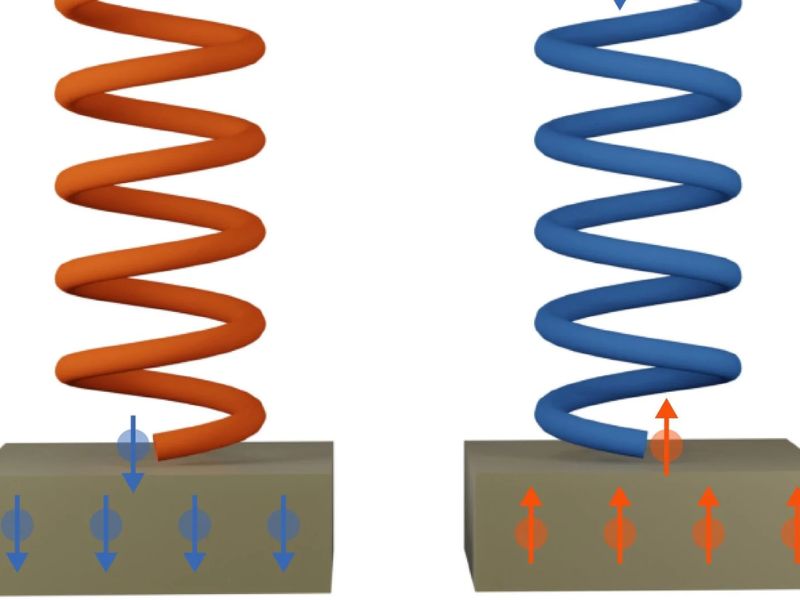
    Filtering spin with a helix. Credit: Angela Wittmann

    Electrons are primarily known for their negative charge, which drives electric currents, but they also possess spin—a magnetic property with vast potential for advancing data storage technology. However, effectively controlling electron spin remains a challenge.

    Harnessing Spin Through Ferromagnetic Materials and Chiral Molecules

    One common method to align electron spin involves passing an electric current through a ferromagnetic material, such as iron. This process polarizes the electrons’ spin in alignment with the material’s magnetic field.

    Alternatively, researchers have been exploring chiral molecules—structures that lack a superimposable mirror image, like helices—to achieve spin polarization. Studies suggest these molecules can induce spin polarization at levels comparable to ferromagnetic materials, around 60–70%. Despite promising results, this approach remains a topic of debate in the scientific community.

    Confirming Chiral-Induced Spin Selectivity (CISS)

    A research team at Johannes Gutenberg University Mainz (JGU) has now confirmed the existence of chiral-induced spin selectivity (CISS). Instead of passing an electric charge directly through chiral molecules, the team created a hybrid system, coating a thin gold film with chiral molecules. Although most of the current flowed through the gold, the presence of chiral molecules altered the gold’s electronic state.

    The researchers examined how spin current converted into charge current. In pure gold films, about 3% of spin current transforms into charge, regardless of the electron’s spin orientation. However, in the gold-chiral molecule hybrid system, the conversion rate varied significantly based on the molecule’s handedness.

    Ashish Moharana, PhD student in the research group of Professor Angela Wittmann, in front of the experimental setup. Credit: Shaktiranjan Mohanty

    When right-handed chiral molecules coated the gold surface, electrons with spin-up converted more efficiently into charge than those with spin-down. The opposite effect occurred with left-handed molecules. This demonstrated that spin-to-charge conversion depends on molecular chirality.

    Directional Influence of Spin and Chirality

    The effect also proved to be vectorial, as explained by Professor Angela Wittmann of JGU. If the helical structure of the chiral molecule pointed upward, the spin current conversion occurred only when the electron spin was aligned in the same or directly opposite direction. If the spin orientation deviated from this alignment, the effect vanished.

    “These findings contribute significantly to the recognition of spin selectivity and the role chiral molecules play in influencing electron spin,” Wittmann concluded. This breakthrough enhances understanding of spintronics and could pave the way for innovative applications in quantum computing and data storage.


    Read Original Article: Scitechdaily

    Read More: Largest Study to Date Finds Decreased Brain Function in Younger Cannabis Users
  • Highly Energetic Electrons Hit Earth from an Unusual Nearby Source

    Highly Energetic Electrons Hit Earth from an Unusual Nearby Source

    Astrophysicists have detected the highest-energy electrons ever recorded, raining down on Earth from a mysterious nearby source. These cosmic rays carry trillions of times the energy of visible light, suggesting they originate from a powerful source relatively close to our solar system.
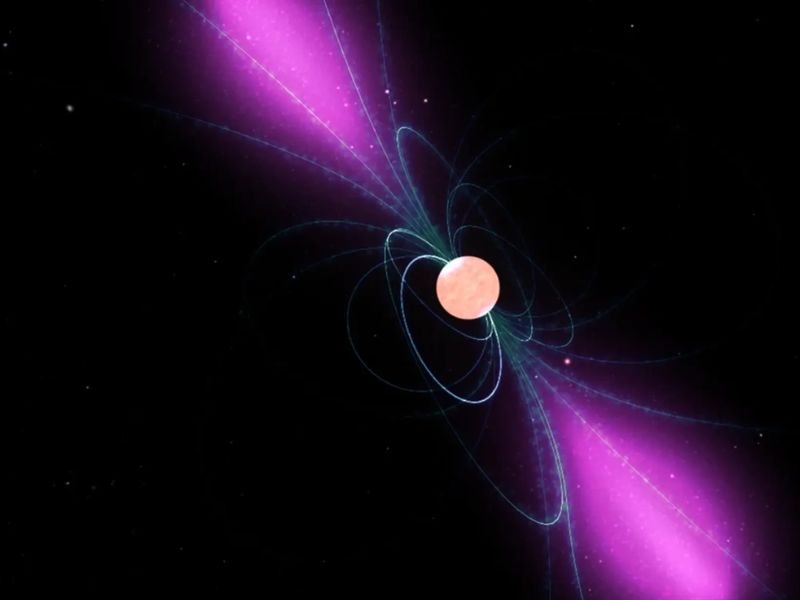
    NASA/Goddard Space Flight Center Conceptual Image Lab

    Astrophysicists have detected the highest-energy electrons ever recorded, raining down on Earth from a mysterious nearby source. These cosmic rays carry trillions of times the energy of visible light, suggesting they originate from a powerful source relatively close to our solar system.

    Earth is constantly bombarded by cosmic radiation, primarily from our Sun. However, other sources, such as quasars, supernovae, and gamma-ray bursts, can also emit particles with extremely high energy. Now, scientists have identified the highest-energy electrons ever seen coming from space.

    Energy is measured in electronvolts (eV), where 1 eV is the kinetic energy gained by a single electron when accelerated by one volt. Most cosmic ray electrons carry energies in the range of a few hundred gigaelectronvolts (GeV), but the newly detected electrons reach an extraordinary 40 teraelectronvolts (TeV) — that’s trillions of eV.

    This discovery came from a team analyzing 10 years of data from the HESS Observatory in Namibia. The facility detects cosmic rays by observing how they interact with the Earth’s atmosphere, triggering a shower of secondary particles. The composition of these showers reveals information about the original particle.

    New Algorithms Reveal High-Energy Electrons Up to 40 TeV in Cosmic Rays

    The HESS observatory watches the skies in Namibia
    Sabine Gloaguen

    Electrons and positrons account for about 1% of cosmic rays, making them hard to detect. Using new algorithms, researchers filtered high-energy electrons from the HESS dataset, revealing particles with energies up to 40 TeV.

    Determining the source of these cosmic ray electrons is challenging. As they travel through magnetic fields in space, their paths become distorted, making it difficult to trace their origins. While pinpointing a direction is nearly impossible, astronomers can estimate the distance traveled. The longer these particles travel, the more energy they lose. Therefore, electrons with energies below 1 TeV likely originated from distant objects, while those at the higher end of the spectrum must have come from a closer source.

    The team concluded that these high-energy electrons likely came from a source within a few thousand light-years of our solar system, which is quite close in cosmic terms. The most probable source, they suggest, is a pulsar — a type of neutron star that emits beams of electromagnetic radiation from its poles. It could be a single pulsar, or perhaps several within that distance.


    Read Original Article: New Atlas

    Read More: Scitke