Tag: Exoplanet

  • JWST Verifies Coldest Exoplanet Found Around A Dead Star

    JWST Verifies Coldest Exoplanet Found Around A Dead Star

    In 2020, astronomers discovered WD 1856+534 b, a gas giant about 81 light-years from Earth. With about six times Jupiter’s mass, this “super-Jupiter” became the first known exoplanet to transit a white dwarf.
    Credit: Pixabay

    In 2020, astronomers discovered WD 1856+534 b, a gas giant about 81 light-years from Earth. With about six times Jupiter’s mass, this “super-Jupiter” became the first known exoplanet to transit a white dwarf.

    JWST Observations Confirm WD 1856+534 b as the Coldest Exoplanet Ever Detected

    In a recent study, an international team of astronomers reported their observations of the exoplanet WD 1856+534 b using the James Webb Space Telescope  Mid-Infrared Instrument (MIRI). They confirm that it is the coldest exoplanet ever detected.

    Acording to the research was led by  Mary Anne Limbach an Assistant Research Scientist in the Department of Astronomy at the University of Michigan, Ann Arbor, with collaborators from institutions including MIT’s Kavli Institute, Johns Hopkins University Applied Physics Lab, University of Victoria, University of Texas at Austin, CIERA, Centre for Astrophysics at the University of Southern Queensland, NSF NOIRLab, and the Gemini Observatory.

    The team conducted the observations as part of the JWST Cycle 3 General Observation (GO) program, which aimed to directly study the planet using Webb’s advanced infrared imaging and spectroscopic tools.

    This aligns with one of JWST’s core goals: to analyze exoplanets through the  Direct Imaging Method. This technique captures reflected light from a planet and analyzes it with spectrometers to identify chemicals.

    Credit: Direct Imaging consists of blocking the light of stars to detect light reflected by orbiting planets. (Marois et al., Nature, 2010)

    JWST’s Role in Detecting Biosignatures Beyond Our Solar System

    This approach helps astronomers detect possible biosignatures like oxygen, methane, and water, and understand a planet’s composition and formation.

    Powerful telescopes like JWST could eventually reveal the first evidence of life beyond our Solar System.

    Therefore, emission spectra from exoplanets can also provide valuable information about their chemical makeup and migration patterns.

    However, researchers note that a host star’s brightness often drowns out an exoplanet’s light.

    Consequently, direct imaging has mostly targeted large planets—such as gas giants—with wide orbits or very hot atmospheres. So far, scientists have not directly observed any rocky (terrestrial) exoplanets in close orbits around their stars.

    So far, scientists haven’t found any exoplanets with emission spectra below 275 K—similar to Earth’s temperature. White dwarf stars offer a rare chance to find and study these colder planets. As the researchers highlighted:

    “The faint luminosity of white dwarfs greatly lessens the contrast issues that usually complicate direct detection around main-sequence stars. As the remnants of stars like the Sun, white dwarfs give us a glimpse into the future of planetary systems after stellar death. Studying how planets interact with and endure the post-main-sequence phase is key to understanding orbital stability, dynamical migration, and the potential for planetary engulfment.”

    Moreover, studying planetary systems around white dwarfs can help determine if planets can survive this advanced stage of stellar evolution and whether habitable conditions could persist around stellar remnants.

    Limbach and Team Use JWST’s MIRI to Confirm WD 1856+534 b

    Astronomers and astrobiologists are eager to explore these questions using Webb’s advanced capabilities. For their research, Limbach and her team confirmed the existence of WD 1856+534 b by employing the Infrared (IR) excess method with data from JWST’s Mid-Infrared Instrument (MIRI).

    This method enabled the team to determine the mass of WD 1856+534 b and assess its atmospheric temperature. Their analysis showed an average temperature of 186 K (-87 °C; -125 °F), making it the coldest exoplanet ever discovered.

    They also confirmed that the planet’s mass is no more than six times that of Jupiter, compared to earlier estimates of 13.8 Jupiter masses.

    Their findings provide the first direct evidence that planets can survive and migrate into close orbits within the habitable zones of white dwarfs.

    The team is eager for upcoming observations of WD 1856 b by the JWST, set for 2025. These additional observations may help identify more planets and determine if WD 1856 b was disturbed into its current orbit.

    Moreover, results from earlier observations made by Webb’s Near-Infrared Spectrograph (NIRSpec) during Cycle 1 will be released soon, offering an initial analysis of the planet’s atmosphere.


    Read the original article on: Sciencealert

    Read more: Hubble Space Telescope Detects Water Vapor in Atmosphere of Small Exoplanet
  • James Webb Telescope Discovers Water Vapor, Sulfur Dioxide, and Sand Clouds on Nearby Exoplanet

    James Webb Telescope Discovers Water Vapor, Sulfur Dioxide, and Sand Clouds on Nearby Exoplanet

    Webb spots exoplanet elements
    Credit: BGR

    A team of European astronomers, including researchers from KU Leuven’s Institute of Astronomy, utilized the James Webb Space Telescope for recent observations on the atmosphere of the nearby exoplanet WASP-107b. Peering deep into its cloudy atmosphere, they identified water vapor, sulfur dioxide, and even silicate sand clouds. These elements exist within a dynamic atmosphere that shows active material transport.

    Scientists globally are utilizing JWST’s Mid-Infrared Instrument (MIRI) for groundbreaking studies of exoplanets, such as WASP-107b. This unique gas planet orbits a slightly cooler, less massive star than our Sun, possessing a mass similar to Neptune but a much larger size, nearing that of Jupiter. This makes WASP-107b notably ‘fluffy’ compared to gas giants in our solar system, allowing astronomers to explore its atmosphere roughly 50 times deeper than that of Jupiter.

    Leveraging the exoplanet’s fluffiness, European astronomers delved deeply into its atmosphere, unraveling its intricate chemical composition. The lower density of its atmosphere enhances the visibility of signals or spectral features compared to denser atmospheres. Their recent Nature publication highlights the presence of water vapor, sulfur dioxide (SO2), and silicate clouds, notably lacking methane (CH4), a greenhouse gas.

    A dynamic atmosphere

    These findings offer crucial insights into the behavior and chemical makeup of this intriguing exoplanet. Firstly, the lack of methane suggests a potentially warm interior, providing an intriguing glimpse into how heat energy circulates within the planet’s atmosphere.

    Secondly, the detection of sulfur dioxide, typically associated with the smell of burnt matches, was an unexpected revelation. Earlier models had predicted its absence, yet newly developed climate models of WASP-107b’s atmosphere indicate that the exoplanet’s unique fluffiness supports the presence of sulfur dioxide.

    Despite its cooler host star emitting a relatively small amount of high-energy photons, the exoplanet’s airy nature allows these photons to penetrate deeply, enabling the necessary chemical reactions for sulfur dioxide formation.

    However, the observations don’t stop there. Both the spectral characteristics of sulfur dioxide and water vapor are notably reduced compared to what they would be in a scenario without clouds. Upper-atmosphere clouds partially mask the presence of water vapor and sulfur dioxide.

    While clouds have been suggested on other exoplanets, this marks the first instance where astronomers have definitively identified the chemical composition of these clouds. In this case, the clouds comprise tiny silicate particles, a familiar substance on Earth, primarily found as the main constituent of sand in various parts of the world.

    “JWST is transforming how we study exoplanets, offering unparalleled insights with exceptional speed,” stated Prof. Leen Decin of KU Leuven, the lead author. “The identification of sand, water, and sulfur dioxide clouds on this ‘fluffy’ exoplanet by JWST’s MIRI instrument is a pivotal breakthrough. It reshapes our comprehension of planetary origins and development, casting new illumination on our Solar System.”

    Webb spots exoplanet elements: Earth’s atmosphere

    Unlike Earth’s atmosphere, where low temperatures cause water to freeze, in gaseous planets with temperatures soaring around 1000 degrees Celsius, silicate particles can solidify, forming clouds.

    However, in the case of WASP-107b, with an outer atmosphere temperature around 500 degrees Celsius, conventional models predicted these silicate clouds to form deeper, where temperatures are much higher. Additionally, sand clouds at high altitudes precipitate. How, then, do these sand clouds persist at such heights?

    According to Dr. Michiel Min, the lead author, “The presence of these sand clouds high in the atmosphere implies that the sand raindrops vaporize in deeper, extremely hot layers, and the resulting silicate vapor efficiently ascends, where it recondenses to form silicate clouds again. This parallels Earth’s water vapor and cloud cycle but with droplets composed of sand.” This continuous process of evaporation and condensation via vertical transport maintains the enduring existence of sand clouds in WASP-107b’s atmosphere.

    This groundbreaking study not only illuminates the exotic environment of WASP-107b but also pushes the boundaries of our comprehension of exoplanetary atmospheres. It signifies a significant leap in exploring exoplanets, uncovering the intricate interplay of elements and climatic conditions on these distant worlds.

    “JWST allows for a comprehensive study of the atmosphere of an exoplanet that has no equivalent in our Solar System. We are uncovering new worlds!” expressed Dr. Achrène Dyrek, the lead author at CEA Paris.

    Webb spots exoplanet elements: Design and development of the MIRI instrument

    Thanks to funding provided by the Belgian federal science policy office BELSPO through the ESA PRODEX program, Belgian engineers and scientists have played a pivotal role in designing and developing the MIRI instrument. This involvement included contributions from the Centre Spatial de Liege (CSL), Thales Alenia Space in Charleroi, and OIP Sensor Systems in Oudenaarde.

    At KU Leuven’s Institute of Astronomy, instrument scientists extensively tested the MIRI instrument in specialized chambers, simulating the space environment, within laboratories in the UK, NASA Goddard, and NASA Johnson Space Centers.

    “With collaborators across Europe and the United States, we’ve been involved in constructing and testing the MIRI instrument for nearly two decades. Witnessing our instrument unveil the atmosphere of this fascinating exoplanet is truly gratifying,” remarked instrument specialist Dr. Bart Vandenbussche from KU Leuven.

    “This research consolidates findings from numerous independent analyses of JWST observations and represents the culmination of years of effort not just in building the MIRI instrument but also in calibrating and analyzing the observational data obtained through MIRI,” added Dr. Jeroen Bouwman from the Max-Planck-Institut für Astronomie in Germany.


    Read the original article on sciencedaily.

    Read more: Use of Cosmetic Ingredients for Battery Protection.

  • Kepler Discovers a New System of 7 Planets

    Kepler Discovers a New System of 7 Planets

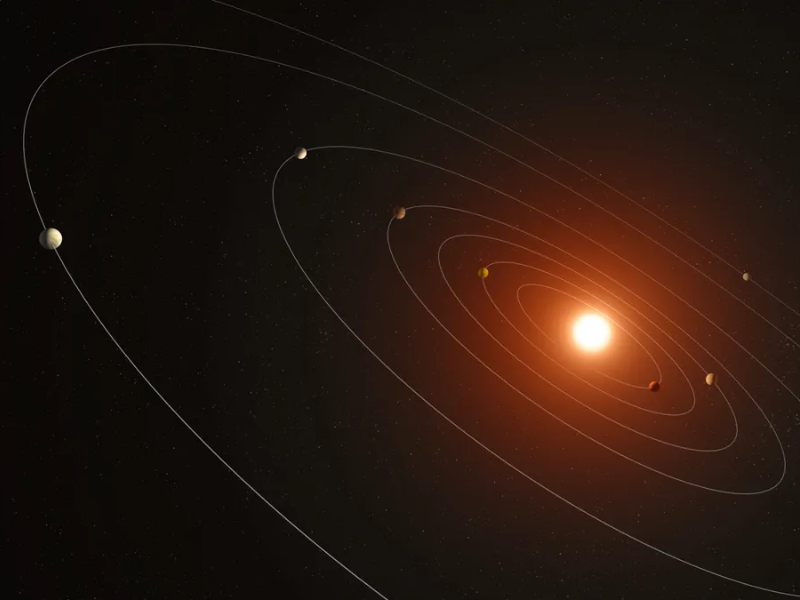
    Seven Sweltering Worlds – A Glimpse of the Kepler-385 System. Credit: NASA/Daniel Rutter

    NASA’s Kepler missions have concluded, but astronomers persist in refining their data, leading to remarkable discoveries in exoplanets. Among these findings is identifying the hottest seven-planet system, facilitated by meticulous data analysis.

    A Fiery Star at the Center: Kepler-385

    At the heart of this extraordinary system is Kepler-385, a star surpassing our Sun in size by approximately 10 percent and radiating a scorching heat that is 5 percent higher.

    In stark contrast to the expansive orbits in our own Solar System, these exoplanets hug their star, basking in an intense influx of light.

    Seven Planets nearby

    The first two exoplanets in this system have orbital periods of 10 and 15 days, respectively, and possess radii only slightly larger than Earth’s. These rocky worlds, if they include an atmosphere, likely have a thin one.

    The remaining five planets are more giant, falling short of being classified as giant planets. These super-Earths boast a radius twice that of our planet and are enveloped in a dense atmosphere.

    A Milestone in Exoplanet Research

    Professor Jason Rowe of Bishop’s University remarks, “Our revision to the Kepler Exoplanet catalog provides the first true uniform analysis of exoplanet properties. Improvements in characterizing planetary and stellar attributes have opened the door for an in-depth exploration of exoplanetary systems, allowing us to draw parallels with our Solar System and delve into the intricacies of specific systems like Kepler-385.”

    A Unique Planetary Arrangement

    All seven planets orbit well within the inner boundary of the habitable zone, yet they are too hot to sustain life as we know it. Nevertheless, astronomers are captivated by the planetary configuration of this septet.

    Notably, the innermost two and the outermost three planets exhibit a resonance in their orbits, with their rotational periods finely synchronized, yielding a captivating sonification.

    A Breakthrough in Orbital Understanding

    Professor Eric Ford from Penn State underscores the significance of this discovery, saying, “Our new result is a more direct and model-independent demonstration that systems with more transiting planets have more circular orbits.” This finding highlights the relationship between the number of transiting planets and orbital eccentricities.

    Kepler’s Enduring Legacy

    The catalog of planet candidates unveiled by Kepler remains unrivaled in its size and uniformity, representing a valuable resource for exoplanetary research. While current observatories continue to advance, these researchers emphasize that Kepler’s data remains the gold standard for investigating exoplanets.

    Jack Lissauer, a research scientist at NASA’s Ames Research Center in California’s Silicon Valley and lead author of the paper presenting the new catalog, sums it up, “We’ve assembled the most accurate list of Kepler planet candidates and their properties to date. NASA’s Kepler mission has discovered most known exoplanets, and this new catalog will enable astronomers to learn more about their characteristics.”


    Read the original article on IFL Science.

    Read more: James Webb’s Carbon Discovery on Europa Bolsters the Case for Potential Life.

  • NASA’s TESS Mission has Detected a Small Exoplanet Resembling Neptune in Size

    NASA’s TESS Mission has Detected a Small Exoplanet Resembling Neptune in Size

    By employing NASA's Transiting Exoplanet Survey Satellite (TESS), a group of astronomers from around the world has detected a fresh, substantial, and compact exoplanet. This recently discovered extraterrestrial planet, named TOI-332 b, ranks among the most densely-packed Neptune-sized planets ever observed. The discovery is detailed in a paper released on August 23 and available on the arXiv pre-print server.
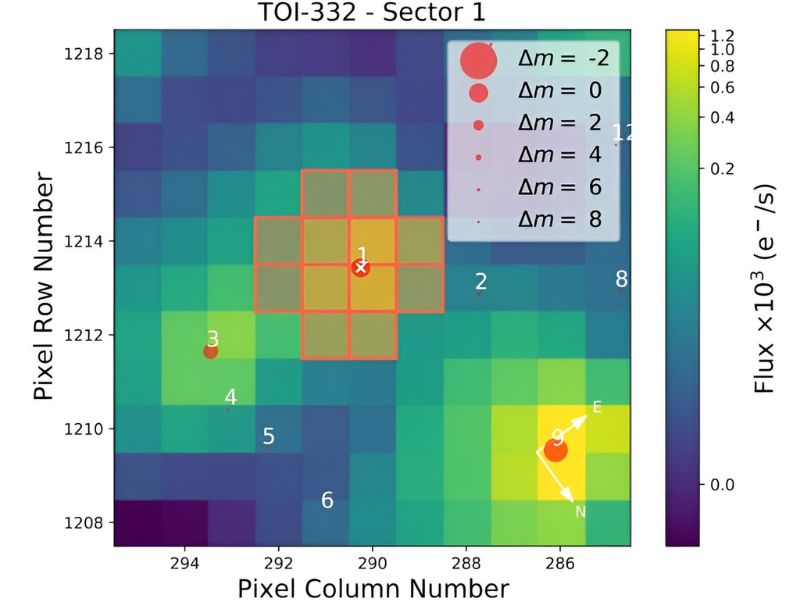
    The Target Pixel File (TPF) for TOI-332 (marked as a white cross) from TESS S1. Credit: Osborn et al., 2023.

    By employing NASA’s Transiting Exoplanet Survey Satellite (TESS), a group of astronomers from around the world has detected a fresh, substantial, and compact exoplanet. This recently discovered extraterrestrial planet, named TOI-332 b, ranks among the most densely-packed Neptune-sized planets ever observed. The discovery is detailed in a paper released on August 23 and available on the arXiv pre-print server.

    Hunting Exoplanets Among Sun’s Neighbors

    In fact, TESS, NASA’s Transiting Exoplanet Survey Satellite, is currently engaged in a mission to survey approximately 200,000 of the sun’s nearest and brightest stars, with the primary objective of detecting exoplanets that transit across these stars. To date, the mission has successfully identified nearly 6,800 potential exoplanets, referred to as TESS Objects of Interest (TOI), with 379 of them confirmed.

    A team of astronomers, led by Ares Osborn from the University of Warwick, UK, has now substantiated the exoplanetary status of another TOI that was monitored by TESS. They discerned a transit signal within the light curve of a K-dwarf star known as TOI-332, or TIC 139285832. The planetary nature of this signal was corroborated through subsequent ground-based observations.

    In their research paper, the astronomers detailed the TESS observations of the TOI-332 system (TIC 139285832), which occurred during TESS Sectors 1 (July 25—Aug 22, 2018) and 2 (August 22—September 20, 2018). These observations involved a 30-minute cadence in the full-frame images (FFIs).

    A High-Density Exoplanet with Extreme Characteristics

    TOI-332 b, the newfound exoplanet, possesses a radius approximately 3.2 times that of Earth and an unusually substantial mass equivalent to 57.2 times that of Earth. This results in an exceedingly high density of approximately 9.6 grams per cubic centimeter. TOI-332 b orbits its host star every 18.65 hours at a close distance of 0.016 astronomical units (AU). The equilibrium temperature on the surface of TOI-332 b was calculated to be approximately 1,871 Kelvin.

    However, based on these observations, the astronomers have classified TOI-332 b as an ultra-short period (USP) Neptune-sized exoplanet. Notably, it resides within what is known as the “Neptunian desert,” an area in parameter space characterized by the combination of radius, mass, and orbital period where such planets have been rarely observed. This desert encompasses planets with radii ranging from 2 to 9 times that of Earth, masses spanning from 10 to 250 times that of Earth, and orbital periods shorter than five days.

    TOI-332 b’s Unusual Composition Challenges Established Planet Formation Theories

    The researchers have also suggested that TOI-332 b’s interior composition is likely dominated by refractory materials, potentially resembling terrestrial planets more closely. However, they believe it may possess a minimal hydrogen-helium envelope, a feature that challenges existing planetary formation theories.

    To conclude, turning to TOI-332’s host star, it has a spectral type of K0V and is estimated to be approximately five billion years old. Situated at a distance of about 726.5 light-years from Earth, this star is roughly 12% smaller and less massive than our sun. The effective temperature of TOI-332 was determined to be 5,251 Kelvin.


    Read the original article on: Phys Org

    Read more:  Recent Image Unveils the Mysteries Surrounding the Formation of Planets