Why use an ordinary robot when you could deploy a robotic coyote? That’s the idea behind the U.S. Army Engineer Research and Development Center’s (ERDC) project—a cybernetic prairie predator designed to keep airfields free of dangerous wildlife.
Airfields constantly face the challenge of birds and other wildlife, which can seriously endanger aircraft and operations. Birds are especially hazardous—they can be sucked into engines, hit windshields, or damage control surfaces. The threat is so significant that the U.S. Civil Air Administration once developed a “chicken gun” to launch bird carcasses at aircraft to simulate real-life bird strikes.
Unconventional Tactics to Keep Wildlife at Bay
Beyond birds, animals like rabbits and deer also pose risks by wandering onto runways or damaging equipment through digging, nesting, foraging, or even urinating. To keep wildlife at bay, airfields have tried everything from drones and trained birds of prey to dogs, flashing lights, and gas-powered cannons.
Now, the ERDC is collaborating with wildlife biologists Dr. Stephen Hammond and Dr. Jacob Jung, along with the USDA’s National Wildlife Research Center (NWRC), to create robotic coyotes for the task.
Why use coyotes? Anyone who’s lived near a pack knows that most animals instinctively steer clear to avoid becoming prey.
Engineering a Smarter Wildlife Deterrent
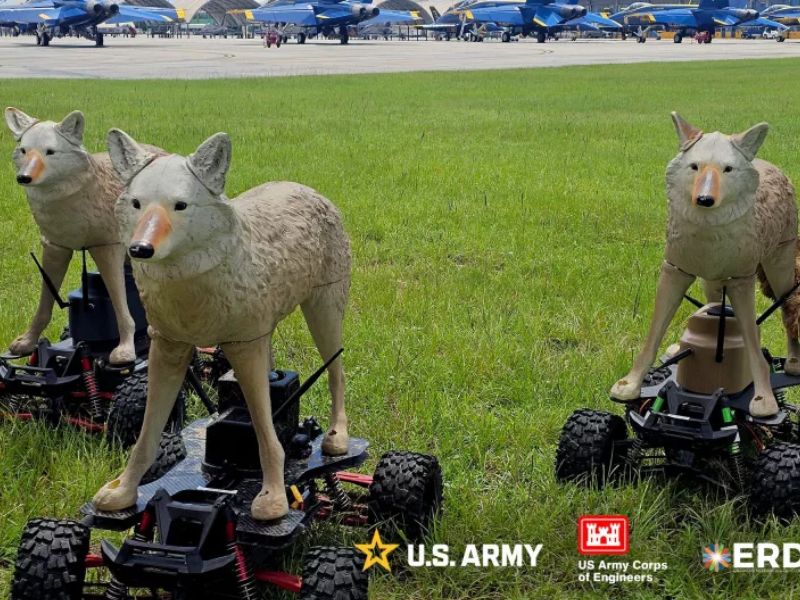
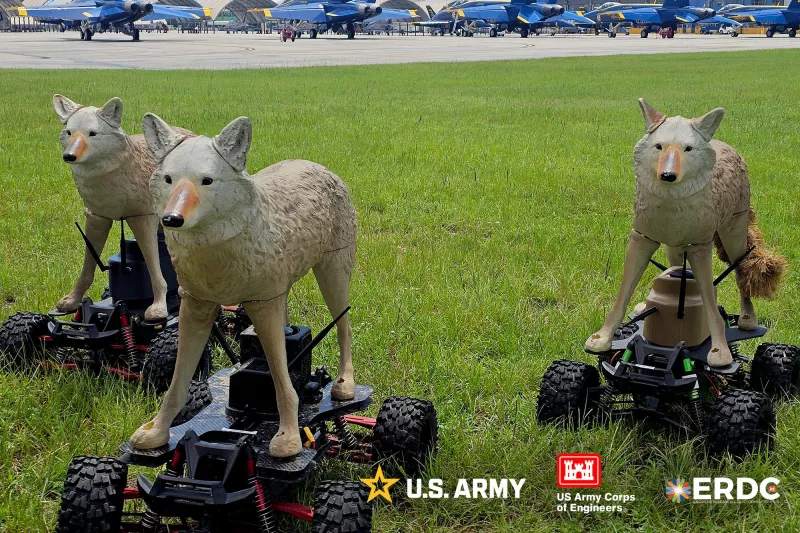
After five years of development, the project produced the “Coyote Rovers,” which originally used Boston Dynamics’ Spot robots. However, these were too slow to scare off wildlife. Engineers switched to faster four-wheeled Traxxas X-Maxx RC cars, capable of hitting 20 mph (32 km/h). They mounted plastic coyote figures on top—striking a balance between cute and intimidating—at a cost of around $3,000 each.
These robo-coyotes have been tested at several military airfields, including Naval Air Station Pensacola in Florida, Fort Campbell in Tennessee, and NAS Whiting Field. While the prototypes may look like simple RC cars with coyote props, the long-term plan includes advanced features: pre-programmed routes, terrain adaptability, self-charging, multi-day autonomous operation, and even species recognition to tailor deterrence strategies.
Of course, how these robot coyotes would handle robotic roadrunners remains a mystery—especially if it involves mastering catapults, giant magnets, rocket boosters, explosives, or painting convincing tunnel entrances on solid rock.
Read the original article on: New Atlas
Read more:Researchers Flag 4,200 Harmful Plastic Chemicals, Urge Safer Alternatives