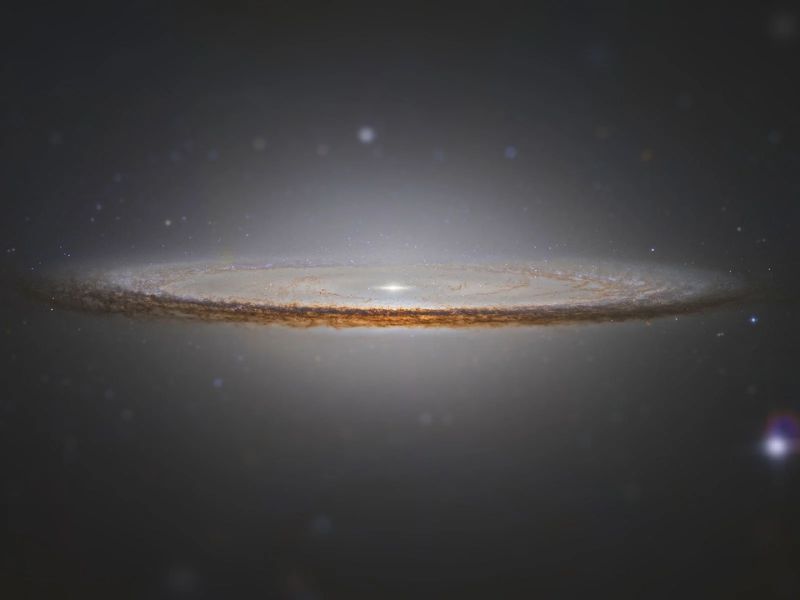
To celebrate 35 years of discoveries, the Hubble Space Telescope has released a newly enhanced image of one of the sky’s most captivating galaxies: the Sombrero Galaxy.
A Hat in the Sky: The Sombrero Galaxy’s Unique Appearance
Also known as Messier 104, this celestial wonder lies about 31 million light-years from Earth in the constellation Virgo. What sets it apart is its unusual appearance — a glowing central bulge encircled by a dark, dusty ring that gives it the look of a wide-brimmed hat seen nearly edge-on from Earth.
Astronomers classify it as a peculiar galaxy, as it blends features of both spiral and elliptical galaxies. Its structure defies simple categorization, placing it somewhere between these two common types.
Its standout visual feature is the thick band of dust that encircles its edges, defining its shape and enhancing its resemblance to a sombrero. Originally captured by Hubble in 2003, that iconic image became one of the telescope’s most popular. Now, scientists have revisited the photo using advanced image-processing techniques, uncovering finer details within the galaxy and more faint stars in the background.
Despite its brilliance and star-filled core, the Sombrero Galaxy doesn’t form stars at a high rate — only about the equivalent of one new Sun per year. Slightly larger than our own Milky Way, its tilted orientation and bright nucleus make it a challenging object to study.
Insights from JWST: Dust and a Supermassive Black Hole
Newer observations from the James Webb Space Telescope (JWST) in mid-infrared light have revealed dense patches of dust circling its outer edges and confirmed the presence of a supermassive black hole at its center — weighing in at about 9 billion times the mass of our Sun.
The dust ring belongs to the galaxy’s spiral arms, while the glowing bulge at its heart more closely resembles what is typically seen in elliptical galaxies. This hybrid of features continues to intrigue scientists.
Thanks to its dramatic appearance and mystery, the Sombrero Galaxy remains a favorite among astronomers and space enthusiasts around the world — a true cosmic masterpiece.
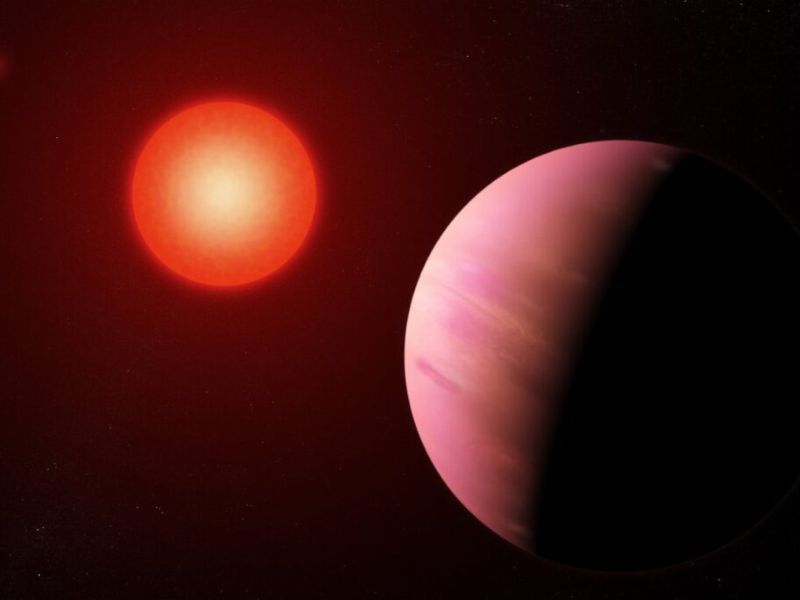
An artist’s impression of the exoplanet Enaiposha and its star, Orkaria. (ESO/L. Calçada)An artist’s impression of the exoplanet Enaiposha and its star, Orkaria. (ESO/L. Calçada)
An object initially thought to be a typical planet found in our galaxy has turned out to be entirely unique.
A Super-Venus Exoplanet
Enaiposha, also known as GJ 1214 b, is an exoplanet with a hazy atmosphere orbiting a red dwarf star roughly 47 light-years away from Earth. While it was once compared to a mini-Neptune, recent data from the James Webb Space Telescope (JWST) suggests it is more like a much larger version of Venus.
This discovery has led astronomers to introduce a new category called ‘Super-Venus,’ making Enaiposha the first known planet of its kind.
Enaiposha is one of the most researched exoplanets, having been discovered in 2009. It has a mass and size between that of Earth and Neptune, and follow-up observations revealed a thick atmosphere.
A size comparison between Earth (left), Enaiposha (middle), and Neptune (right). (Aldaron/Wikimedia Commons, CC BY-SA 3.0)
Super-Earths and Mini-Neptunes: Common Exoplanet Types
Exoplanets in this mass range typically fall into two categories. Super-Earths are terrestrial planets larger than Earth and typically have hydrogen-rich atmospheres, if they have one at all. In contrast, mini-Neptunes are also similar in size but have very different compositions, often with denser hydrogen and helium-rich atmospheres, possibly containing liquid oceans. Mini-Neptunes are the most abundant type among the 5,800 confirmed exoplanets, although we have no direct analogs in our Solar System.
Both Super-Earths and mini-Neptunes are of particular interest to scientists because, under the right conditions, they could potentially support life. Enaiposha is of particular interest due to its proximity to Earth, making it an ideal candidate for further study despite its inhospitable environment due to its close orbit around its star, Orkaria.
An artist’s impression of what Enaiposha might look like shrouded by thick clouds of steam. (NASA/JPL-Caltech/R. Hurt)
Although the planet is too hot for habitation, its proximity allows astronomers to study it in detail, providing valuable insights into other similar exoplanets. However, Enaiposha presents challenges due to its thick atmosphere, making it difficult to observe clearly. A 2023 study using data from JWST and Hubble revealed that the exoplanet may have a water-rich atmosphere with vaporized metals.
An artist’s impression of Enaiposha orbiting Orkaria. (ESO/L. Calçada)
New research, led by astronomers Everett Schlawin and Kazumasa Ohno, has uncovered further unexpected findings. By analyzing transit data for Enaiposha, the team discovered that as the planet passed in front of its star, the starlight passing through its atmosphere showed signs of carbon dioxide, much like Venus, though the signal was faint.
Theories and Models: Explaining Enaiposha’s Atmosphere
To confirm this, the team conducted theoretical modeling and found that the best explanation is that Enaiposha’s atmosphere is dominated by metals at lower altitudes, with only small amounts of hydrogen. At higher altitudes, the atmosphere is hazy with aerosols and carbon dioxide. This led to the idea of a ‘Super-Venus’—a hot world with a dense, carbon-rich atmosphere that obscures the view.
However, the faint CO2 signal means further research is necessary to validate the findings, as this new theory challenges conventional understanding of sub-Neptunes. The researchers emphasize the need for high-precision follow-up observations to confirm the presence of a metal-dominated atmosphere and refine our understanding of these planets’ interior structure and evolution.
In the realm of galaxies, our minds often conjure images of luminous spiral formations teeming with stars and cosmic gases. However, a distinct category known as low-surface-brightness galaxies challenges this conventional perception. These galaxies, characterized by sparse stars and unconventional appearances, typically harbor more dark matter and predominantly consist of gas, with few discernible stars.
Accidental Discovery with the Green Bank Telescope
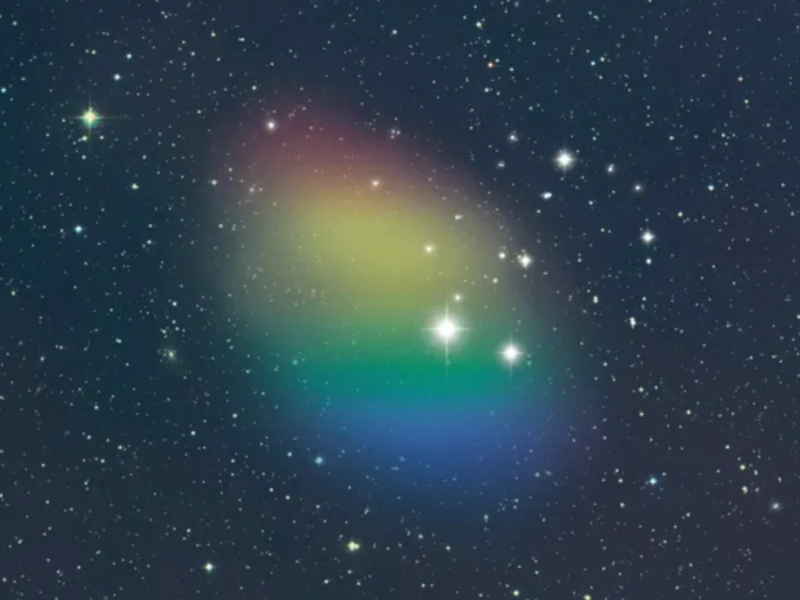
During a comprehensive survey of 350 low-surface-brightness galaxies utilizing the Green Bank Telescope (GBT), astronomers serendipitously stumbled upon an extraordinary specimen. Positioned 270 million light-years away, J0613+52 stands out for its apparent absence of stars, presenting as a vast, rotating mass of gas.
Karen O’Neil, senior scientist of the Green Bank Observatory, elaborated on the unexpected finding: “The GBT was accidentally pointed to the wrong coordinates and found this object. It’s a galaxy made only out of gas — it has no visible stars. Stars could be there, we just can’t see them.”
An Anomaly in Galactic Composition
The research team, employing multiple telescopes to scrutinize the properties of the 350 galaxies, encountered this singular celestial entity. Unlike typical galaxies where gas acts as the precursor for star formation, J0613+52 defies expectations. Despite its rich gas content, the galaxy appears devoid of the dense gas concentrations necessary for gravitational forces to initiate star birth. Moreover, its isolation from other galaxies negates external triggers for star formation.
Karen O’Neil further noted, “J0613+52 appears to be both undisturbed and underdeveloped. This could be our first discovery of a nearby galaxy made up of primordial gas.”
The Quest for Answers and Future Observations
The enigmatic nature of this gas-dominated galaxy prompts researchers to delve deeper. While acknowledging the need for extensive optical observations to identify potential stars within J0613+52, astronomers emphasize the significance of discovering more analogous objects using radio observatories.
“A full sky survey by an extremely sensitive instrument like the Green Bank Telescope could uncover more of these objects,” O’Neil suggested, emphasizing the importance of further exploration to unravel the mysteries concealed within galaxies that challenge our conventional understanding of cosmic compositions.
A recent analysis of images captured by the Hubble Space Telescope (HST) has unveiled an intriguing find within the Sombrero Galaxy. Conducted by Elio Quiroga Rodriguez from the Mid Atlantic University in Spain, this discovery sheds light on a previously unnoticed galaxy that harbors an active galactic nucleus (AGN). The findings were detailed in a research paper released on August 11 via the arXiv pre-print server.
Active Galactic Nuclei: A Brief Overview
Active Galactic Nuclei, or AGNs, denote compact regions positioned at a galaxy’s center, radiating more luminosity than its surrounding galactic light. These AGNs are characterized by their high energy output, attributed to either the presence of a black hole or significant star formation activities within the core of the galaxy.
AGNs are traditionally classified into two primary groups based on the features of their emission lines. Type 1 AGNs exhibit broad and narrow emission lines, whereas Type 2 AGNs display narrow emission lines. Interestingly, some AGNs have been observed transitioning between different spectral types, giving rise to the term “changing-look” (CL) AGNs.
The Sombrero Galaxy: Messier 104
Situated at approximately 31 million light years between the Virgo and Corvus constellations, the Sombrero Galaxy (Messier 104 or NGC 4594) is an unbarred spiral galaxy. Boasting a substantial mass of around 800 billion solar masses, it ranks among the most massive entities within the Virgo galaxy cluster. Furthermore, the Sombrero Galaxy is home to an intricate system of globular clusters.
Elio Quiroga Rodriguez delved into HST images of the Sombrero Galaxy, specifically focusing on a particular entity within its halo. Previously labeled as a candidate for a globular cluster, this object may be a barred spiral galaxy categorized as SBc, housing an AGN at its core.
Rodriguez observed the object at coordinates 12:40:07.829-11:36:47.38 (in j2000), measuring approximately four arcseconds in diameter while studying HST images accessible through the HST Legacy website. Leveraging VO tools, he identified the object as an SBc galaxy with an AGN of the Seyfert type.
Images of the newfound galaxy. Credit: Elio Quiroga Rodriguez (2023).
Characteristics of the Iris Galaxy
The object, cataloged as PSO J190.0326-11.6132 in the Pan-STARRS1 data archive, was subjected to detailed examination using the Aladin Sky Atlas RGB. Rodriguez’s analysis unveiled a galaxy featuring a prominent central arm, nucleus, and potentially two spiral arms adorned with young, hot stars and dust. He proposes that this newfound galaxy should be christened, the “Iris Galaxy.”
The Iris Galaxy possesses a radial velocity of 1,359 km/s. If gravitationally tied to the Sombrero Galaxy, it might be its satellite, sporting an angular size of roughly 1,000 light years. Nonetheless, if the Iris Galaxy isn’t linked to the Sombrero Galaxy, its distance could be around 65 million light years, accompanied by an angular size of approximately 71,000.
Emission Luminosity and AGN Classification
Based on a distance assumption of 65 million light years, the X-ray emission luminosity of the Iris Galaxy is estimated at 18 tredecillion erg/s. This high luminosity suggests the presence of an active galactic nucleus. Further observations are necessary to ascertain whether the AGN is Type 1 or Type 2.
In conclusion, the meticulous analysis of HST images has led to the discovery of the Iris Galaxy, a previously unnoticed barred spiral galaxy with an active galactic nucleus at its core within the Sombrero Galaxy’s halo. This finding underscores the dynamic and diverse nature of galaxies within our universe.
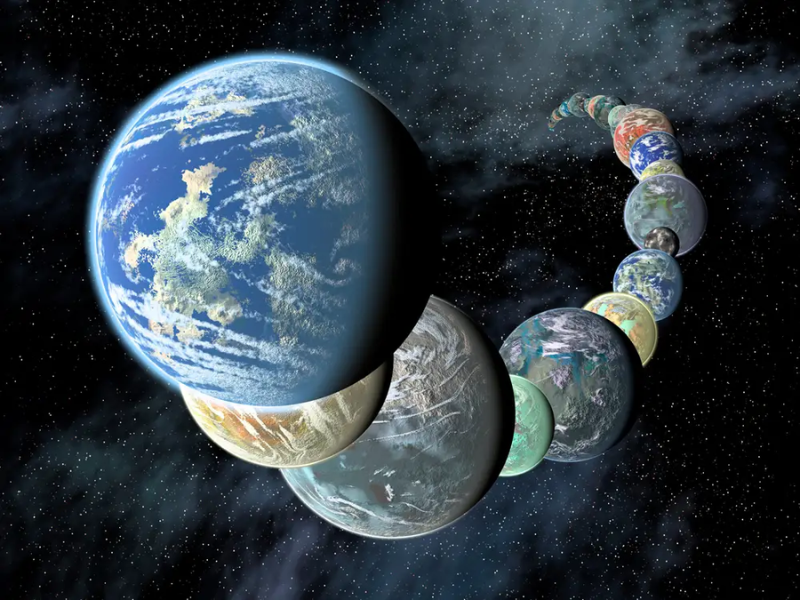
Maybe you believe that one Earth is sufficient. However, what if the number was in the billions? According to a recent research study, the number of Earth-like planets in our Milky Way galaxy can approach 6 billion.
Astronomers at the College of British Columbia (UBC) examined information from NASA’s Kepler project and also came to a startling conclusion. From 2009 to 2018, the Kepler planet-hunting satellite gathered information on 200,000 stars.
The researchers’ criterion for picking such a planet added that it had to be rocky, around the same dimension as Earth, and orbiting a star like our Sun. This planet had to be in the habitable area of its star, where the conditions would be ideal for the existence of water and life. Michelle Kunimoto, a UBC researcher that formerly identified 17 recent planets (“ exoplanets“) outside our Solar System, stated that their calculations “set an upper limit of 0.18 Earth-like planets per G-type star.” In other words, there are roughly 5 worlds for every Sun.
Kunimoto used a method known as ‘forward modeling’ to undertake the research study, which permitted her to overcome the problem that Earth-like planets are hard to detect due to their tiny size and orbital distance from their star.
“I began by simulating the complete populace of exoplanets around the stars Kepler searched,” expounded the scientist in UBC’s press release. “I marked each planet as ‘spotted’ or ‘missed’ depending on how probably it was my planet search algorithm would have discovered them. Then, I compared the spotted planets to my actual catalog of planets. If the simulation developed a close match, then the first population was likely a great representation of the actual populace of planets orbiting those stars.”
While the researchers came up with an astounding number of hypothetical Earths, this doesn´t necessarily mean the number of such planets exists or whether they have life resemble to ours. However, this recent estimate increases the likelihood that comparable worlds exist.
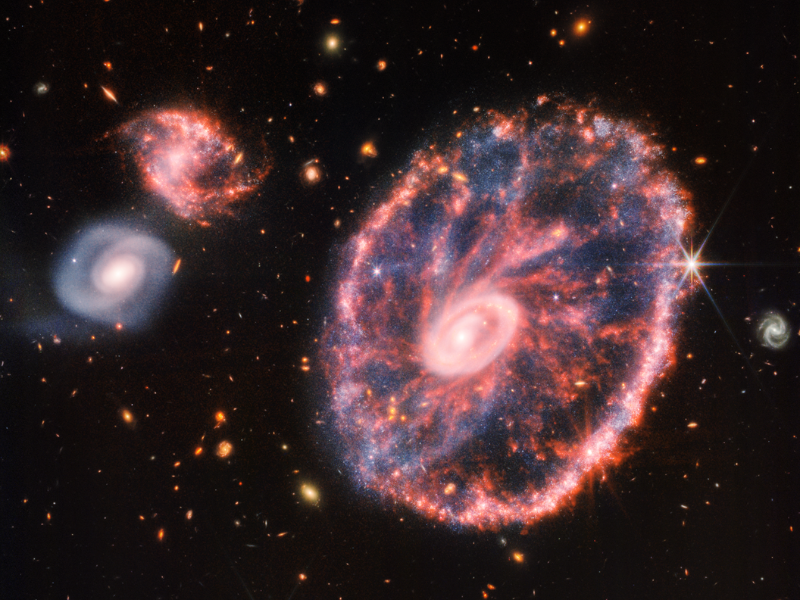
Image of the Cartwheel Galaxy and its companion galaxies is a composite from Jame Webb’s Near-Infrared Camera (NIRCam) and Mid-Infrared Instrument (MIRI). MIRI data is colored red while NIRCam data is colored blue, orange, and yellow. Credit: NASA, ESA, CSA, STScI
The space telescope’s powerful infrared gaze offers a new sight of just how the galaxy has changed throughout billions of years.
The James Webb Space Telescope, belonging to NASA, has gazed into the disarray of the Cartwheel Galaxy, revealing fresh insights into star formation and the central black hole of the galaxy. Using its potent infrared detection capability, the Webb telescope produced an intricate image of the Cartwheel galaxy, along with two smaller companion galaxies, set against a backdrop of many other galaxies. This picture delivers a new view of how the Cartwheel Galaxy has evolved over billions of years.
The Cartwheel Galaxy is a peculiar sight, located in the Sculptor constellation and situated roughly 500 million light-years away. The wagon-wheel-like appearance of the Cartwheel Galaxy is the outcome of a violent event – a high-velocity crash between a big spiral galaxy and a smaller galaxy that is not visible in this image. Galactic-scale impacts typically trigger a series of smaller events between the involved galaxies, and the Cartwheel Galaxy is not exempt from this phenomenon.
Image from Jame Webb’s Mid-Infrared Instrument (MIRI) shows a group of galaxies, including a large, distorted ring-shaped galaxy, known as the Cartwheel, that is composed of a bright inner ring and an active outer ring. While this outer ring has a lot of star formation, the dusty area in between reveals many stars and star clusters. Credit: NASA, ESA, CSA, STScI, Webb ERO Production Team
The impact most significantly impacted the galaxy’s shape and structure. The Cartwheel Galaxy sports two rings– a bright internal ring and a surrounding, vibrant ring. These two rings expand outwards from the center of the impact, like ripples in a pool after a stone falls into it. As a result of these distinguishing characteristics, astronomers call this a “ring galaxy,” a construct less common than spiral galaxies like our Milky Way.
The luminous nucleus of the Cartwheel Galaxy is distinguished by an exceptional concentration of high-temperature dust, and the most intense sections are the locations of enormous, recently-formed clusters of stars. In contrast, the outer ring of the galaxy has been expanding for approximately 440 million years and is predominantly characterized by the formation of new stars and supernovas. As this ring increases, it smashes into surrounding gas and gives start to star formation.
Before this, other telescopes, such as the Hubble Space Telescope, also studied the Cartwheel Galaxy. However, due to the substantial amount of dust obstructing the view, this stunning galaxy has remained shrouded in mystery.
With its potential to identify infrared light, Webb now gives us a better understanding of the nature of the cartwheel galaxy. The Near-Infrared Camera (NIRCam), Webb’s main imager, searches in the near-infrared spectrum from 0.6 to 5 microns, observing essential wavelengths of light that can expose even more stars than observed in visible light. Young stars, which are mainly forming in the outer ring, are less obscured by dust when viewed in infrared light.
The NIRCam data in this image is represented using shades of blue, orange, and yellow. The galaxy exhibits several distinctive blue dots that correspond to either individual stars or clusters of stars forming in pockets. Furthermore, the NIRCam illustrates a contrast between the smooth distribution or shape of the previous generations of stars and the dense concentration of dust in the nucleus, in comparison to the uneven, patchy forms that correspond to the younger population of stars situated beyond it.
However, understanding finer details concerning the galaxy’s dust calls for Webb’s Mid-Infrared Instrument (MIRI). MIRI data is colored red in this composite picture. The Cartwheel Galaxy regions that are abundant in hydrocarbons and other chemical substances, as well as silicate dust akin to the dust found on our planet, are emphasized in the Webb telescope image. These regions are arranged in a set of spiral spokes that serve as the galaxy’s structural support. While these spokes were present in earlier Hubble observations from 2018, they are much more prominent in the Webb image.
Webb’s monitorings highlight that the Cartwheel is in a highly transitory phase. The galaxy, which was supposedly a typical spiral galaxy like the Milky Way before its impact, will remain to change. While Webb provides a snapshot of the present state of the Cartwheel, it additionally offers an understanding of what occurred to this galaxy in the past and how it will progress in the future.
The James Webb Space Telescope is the foremost space science observatory in the world. The James Webb Space Telescope, a collaborative effort between NASA, the European Space Agency (ESA), and the Canadian Space Agency, aims to unravel enigmas in our solar system, explore distant exoplanets orbiting other stars, and investigate the hidden structures and beginnings of our universe and humanity’s position within it.
We use cookies on our website to give you the most relevant experience by remembering your preferences and repeat visits. By clicking “Accept All”, you consent to the use of ALL the cookies. However, you may visit "Cookie Settings" to provide a controlled consent.
This website uses cookies to improve your experience while you navigate through the website. Out of these, the cookies that are categorized as necessary are stored on your browser as they are essential for the working of basic functionalities of the website. We also use third-party cookies that help us analyze and understand how you use this website. These cookies will be stored in your browser only with your consent. You also have the option to opt-out of these cookies. But opting out of some of these cookies may affect your browsing experience.
Necessary cookies are absolutely essential for the website to function properly. These cookies ensure basic functionalities and security features of the website, anonymously.
Cookie
Duration
Description
cookielawinfo-checkbox-analytics
11 months
This cookie is set by GDPR Cookie Consent plugin. The cookie is used to store the user consent for the cookies in the category "Analytics".
cookielawinfo-checkbox-functional
11 months
The cookie is set by GDPR cookie consent to record the user consent for the cookies in the category "Functional".
cookielawinfo-checkbox-necessary
11 months
This cookie is set by GDPR Cookie Consent plugin. The cookies is used to store the user consent for the cookies in the category "Necessary".
cookielawinfo-checkbox-others
11 months
This cookie is set by GDPR Cookie Consent plugin. The cookie is used to store the user consent for the cookies in the category "Other.
cookielawinfo-checkbox-performance
11 months
This cookie is set by GDPR Cookie Consent plugin. The cookie is used to store the user consent for the cookies in the category "Performance".
viewed_cookie_policy
11 months
The cookie is set by the GDPR Cookie Consent plugin and is used to store whether or not user has consented to the use of cookies. It does not store any personal data.
Functional cookies help to perform certain functionalities like sharing the content of the website on social media platforms, collect feedbacks, and other third-party features.
Performance cookies are used to understand and analyze the key performance indexes of the website which helps in delivering a better user experience for the visitors.
Analytical cookies are used to understand how visitors interact with the website. These cookies help provide information on metrics the number of visitors, bounce rate, traffic source, etc.
Advertisement cookies are used to provide visitors with relevant ads and marketing campaigns. These cookies track visitors across websites and collect information to provide customized ads.