In a Moonshots podcast interview, Harvard Medical School genetics professor David Sinclair discussed a once-unthinkable breakthrough — restoring youth to animal cells and tissues. He said human clinical trials are set to start soon.
In the discussion, the scientist noted that experiments on mice and green monkeys showed strong potential for substantially reversing aging.
“We’ve successfully reversed aging in mice and monkeys, and human trials will start next year,” Sinclair stated.
AI and Gene Therapy
He said AI and gene therapies drive this breakthrough, promising major gains in health and longevity. Sinclair aims to make these treatments widely available, calling them “a turning point in preventative and regenerative medicine.”
In his conversation with podcast host Peter Diamandis, Sinclair acknowledged that the concept of “reprogramming” adult cells to regain youthful traits was initially met with doubt. However, he and his team succeeded in selectively activating specific genes known as Yamanaka factors, effectively rejuvenating tissues.
Additionally, a 2020 study demonstrated that gene therapy could reactivate genes typically found only in embryos, enabling the treatment of conditions like blindness caused by optic nerve damage.
“This isn’t science fiction—we do this regularly in my lab,” Sinclair remarked.
Rejuvenation Results
Animals involved in the research showed clear reductions in biological age and significant physical recovery. In mice, just four weeks of treatment with a molecular cocktail produced signs of rejuvenation, while monkeys exhibited noticeable optic nerve regeneration.
“We can actually track optic nerve rejuvenation, and the data shows it aging in reverse.”
The team also discovered that aging is largely driven by changes in the epigenome, rather than just cellular deterioration:
“The epigenome is the real issue because aging stems from the loss of instructions that tell cells how to function,” Sinclair explained.
Their work demonstrated that these instructions could be restored—without cloning. “We found a safe way to reset the epigenome without needing to be reborn,” he said.
Following the animal studies, the team is preparing to move on to human trials. Sinclair stated that testing will begin next year, initially targeting individuals with eye conditions like glaucoma and ischemic optic neuropathy, as the eye is easily accessible and allows for clear measurement of outcomes.
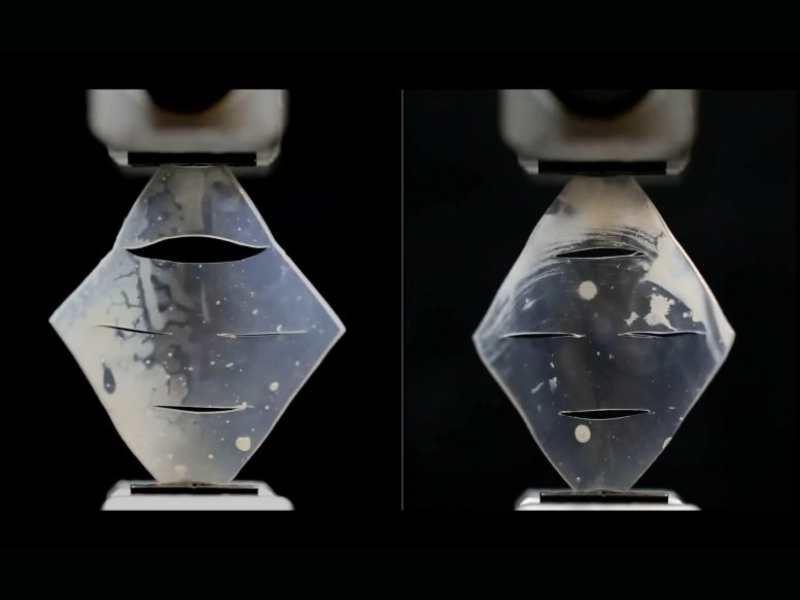
SEAS researchers have devised a multiscale strategy enabling particle-reinforced rubber to withstand high loads and deter crack propagation over multiple uses. In the image above, cracks expand in the left sample, whereas cracks in the right sample, crafted from the multiscale material, remain unchanged after 350,000 cycles. Credit: Suo Group/Harvard SEAS
Researchers at the Harvard John A. Paulson School of Engineering and Applied Sciences (SEAS) have significantly enhanced the fatigue threshold of particle-reinforced rubber, introducing a novel multiscale approach that enables the material to withstand high loads and resist crack propagation through repeated usage. This breakthrough promises to extend the lifespan of rubber products like tires and aims to mitigate pollution caused by the shedding of rubber particles during their use.
Enhancing Particle-Reinforced Rubbers
Natural rubber latex exhibits softness and elasticity. To enhance its properties for various applications such as tires, hoses, and dampeners, rubbers are reinforced with rigid particles like carbon black and silica. While these particles significantly improve rubber stiffness, they do little to enhance resistance to crack growth under cyclic stretching, known as the fatigue threshold.
Since the 1950s, the fatigue threshold of particle-reinforced rubbers has seen minimal improvement. This limitation means that despite advancements in tire technology to improve wear resistance and reduce fuel consumption, small cracks can still release substantial amounts of rubber particles into the environment, contributing to air pollution and environmental degradation.
Novel Discoveries in Rubber Engineering
In previous research led by Zhigang Suo, Allen E., and Marilyn M. Puckett, Professor of Mechanics and Materials at SEAS, the team successfully increased the fatigue threshold of rubbers by elongating polymer chains and enhancing entanglements. However, the question remained: How would this approach fare with particle-reinforced rubbers?
Surprisingly, when silica particles were added to the highly entangled rubber, the fatigue threshold increased by a factor of ten, contrary to the expected outcome based on existing literature.
According to Jason Steck, a graduate student at SEAS and co-first author of the study, this unexpected result was a significant revelation. The material developed by the Harvard team features long and highly entangled polymer chains coupled with clustered silica particles covalently bonded to these chains. This unique combination effectively redistributes stress around cracks across two distinct length scales, preventing propagation within the material.
Implications and Future Prospects
The team substantiated their approach by subjecting a material sample with a deliberately introduced crack to tens of thousands of stretches, demonstrating that the crack remained stable without propagating.
Zhigang Suo emphasized the broader implications of their findings, stating that the multiscale stress deconcentration approach opens avenues for developing high-performance elastomeric materials with applications ranging from reducing polymer pollution to constructing advanced soft machines.
Yakov Kutsovsky, an Expert in Residence at the Harvard Office of Technology Development and co-author of the paper, highlighted the potential applicability of these design principles across various industries, including tire manufacturing, industrial rubber goods, and emerging fields such as wearable devices.
Harvard Medical School researchers have made a groundbreaking discovery, revealing that the skin bacterium Staphylococcus aureus can directly induce itching by interacting with nerve cells. The study, published in the journal Cell and based on experiments with mice and human cells, provides crucial insights into the longstanding puzzle of itchiness.
The research explains why persistent itching is often associated with skin disorders like eczema and atopic dermatitis. In these conditions, the imbalance of skin microorganisms allows S. aureus to thrive, challenging the previous belief that itchiness in these disorders resulted from skin inflammation.
Unraveling the Itch-Inducing Mechanism of S. aureus and Potential Treatment Breakthroughs
The study identified a novel mechanism, showing that S. aureus independently causes itch by initiating a molecular chain reaction leading to the urge to scratch. Senior author Isaac Chiu noted that this discovery could pave the way for new treatments, as experiments demonstrated that an FDA-approved anti-clotting medicine successfully interrupted the itch-scratch cycle, relieving symptoms and minimizing skin damage.
Credit: Harvard Medical School
The results have the potential to guide the development of oral medications and topical creams for addressing persistent itch associated with various conditions linked to an imbalance in the skin microbiome, such as atopic dermatitis, prurigo nodularis, and psoriasis.
The frequent scratching characteristic of these conditions can lead to skin damage and intensify inflammation.
“For individuals dealing with chronic skin conditions, itch can be highly incapacitating. It’s noteworthy that many of these patients harbor on their skin the very microorganism we’ve demonstrated, for the first time, can trigger itch,” explained Liwen Deng, the first author of the study and a postdoctoral research fellow in the Chiu Lab.
V8’s Activation of PAR1 in Skin Neurons
The analysis revealed that V8 induces itch by activating a protein known as PAR1, present on skin neurons originating in the spinal cord, responsible for transmitting various signals like touch, heat, pain, and itch from the skin to the brain. Under normal circumstances, PAR1 remains inactive, but upon contact with specific enzymes, including V8, it becomes activated. The study demonstrated that V8 precisely cleaves one end of the PAR1 protein, awakening it. Experiments in mice demonstrated that once activated, PAR1 initiates a signal interpreted by the brain as an itch. When the experiments were replicated using lab dishes containing human neurons, they also responded to V8.
Interestingly, the experiments indicated that exposure to bacteria did not prompt the itch-inducing activity typically associated with immune cells related to skin allergies, such as mast cells and basophils. Furthermore, inflammatory chemicals like interleukins and white cells, activated during allergic reactions and often elevated in skin diseases and certain neurological disorders, did not play a role in triggering itch.
Liwen Deng remarked, “When we initiated the study, it was unclear whether the itch was a result of inflammation or not. We show that these factors can be separated, indicating that inflammation is not a prerequisite for the microbe to induce itch, although the itch does exacerbate skin inflammation.”
Breaking the Itch-Scratch Cycle
Given that PAR1, the protein activated by S. aureus, plays a role in blood clotting, researchers sought to determine whether an already approved anti-clotting drug that inhibits PAR1 could alleviate itch. Indeed, it did.
Mice experiencing itchiness due to S. aureus exposure exhibited rapid improvement when treated with the anti-clotting drug. Their inclination to scratch significantly diminished, along with the reduction in skin damage caused by scratching.
Furthermore, after receiving PAR1 blockers, the mice no longer displayed abnormal itch in response to harmless stimuli.
The PAR1 blocker, already utilized in humans to prevent blood clots, holds promise for repurposing as an anti-itch medication. The researchers suggest that the active ingredient in the drug could serve as the foundation for topical creams targeting itch.
A pressing question for future research is whether microbes other than S. aureus can also instigate itch
“We know that many microbes, including fungi, viruses, and bacteria, are associated with itch, but how they induce itch remains unclear,” noted Chiu.
Additionally, the study prompts a broader inquiry: Why would a microbe induce itch? From an evolutionary standpoint, what benefits does the bacterium gain?
One speculation is that pathogens might exploit itch and other neural reflexes for their advantage. For instance, prior research has demonstrated that the TB bacterium directly activates vagal neurons to induce coughing, potentially facilitating its spread from one host to another.
Deng remarked, “It’s a speculation at this point, but the itch-scratch cycle could benefit the microbes and enable their spread to distant body sites and to uninfected hosts. Why do we itch and scratch? Does it help us, or does it help the microbe? That’s something that we could follow up on in the future.”
We use cookies on our website to give you the most relevant experience by remembering your preferences and repeat visits. By clicking “Accept All”, you consent to the use of ALL the cookies. However, you may visit "Cookie Settings" to provide a controlled consent.
This website uses cookies to improve your experience while you navigate through the website. Out of these, the cookies that are categorized as necessary are stored on your browser as they are essential for the working of basic functionalities of the website. We also use third-party cookies that help us analyze and understand how you use this website. These cookies will be stored in your browser only with your consent. You also have the option to opt-out of these cookies. But opting out of some of these cookies may affect your browsing experience.
Necessary cookies are absolutely essential for the website to function properly. These cookies ensure basic functionalities and security features of the website, anonymously.
Cookie
Duration
Description
cookielawinfo-checkbox-analytics
11 months
This cookie is set by GDPR Cookie Consent plugin. The cookie is used to store the user consent for the cookies in the category "Analytics".
cookielawinfo-checkbox-functional
11 months
The cookie is set by GDPR cookie consent to record the user consent for the cookies in the category "Functional".
cookielawinfo-checkbox-necessary
11 months
This cookie is set by GDPR Cookie Consent plugin. The cookies is used to store the user consent for the cookies in the category "Necessary".
cookielawinfo-checkbox-others
11 months
This cookie is set by GDPR Cookie Consent plugin. The cookie is used to store the user consent for the cookies in the category "Other.
cookielawinfo-checkbox-performance
11 months
This cookie is set by GDPR Cookie Consent plugin. The cookie is used to store the user consent for the cookies in the category "Performance".
viewed_cookie_policy
11 months
The cookie is set by the GDPR Cookie Consent plugin and is used to store whether or not user has consented to the use of cookies. It does not store any personal data.
Functional cookies help to perform certain functionalities like sharing the content of the website on social media platforms, collect feedbacks, and other third-party features.
Performance cookies are used to understand and analyze the key performance indexes of the website which helps in delivering a better user experience for the visitors.
Analytical cookies are used to understand how visitors interact with the website. These cookies help provide information on metrics the number of visitors, bounce rate, traffic source, etc.
Advertisement cookies are used to provide visitors with relevant ads and marketing campaigns. These cookies track visitors across websites and collect information to provide customized ads.