Tag: Humanoid Robot

  • Boston Dynamics’ Upcoming Humanoid Robot Will be Powered by Google DeepMind Technology

    Boston Dynamics’ Upcoming Humanoid Robot Will be Powered by Google DeepMind Technology

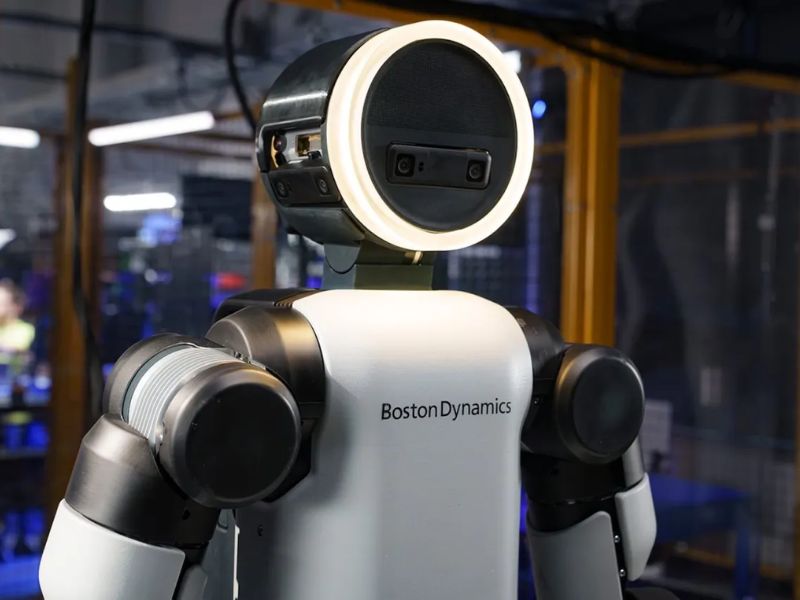
    Boston Dynamics has teamed up with Google’s AI research division to accelerate work on its next-generation humanoid robot, Atlas, with the goal of making it behave more naturally around humans.
    Image Credits:Boston Dynamics/Hyundai

    Boston Dynamics has teamed up with Google’s AI research division to accelerate work on its next-generation humanoid robot, Atlas, with the goal of making it behave more naturally around humans.

    The collaboration was revealed Monday at Hyundai’s CES 2026 press conference and focuses on advanced robotics research powered by Google DeepMind’s AI foundation models. According to Carolina Parada, Google DeepMind’s senior director of robotics, Atlas will serve as the first platform for this effort.

    DeepMind and Boston Dynamics target a universal robot brain

    Onstage, Parada explained that the plan is to combine DeepMind’s latest AI models with Boston Dynamics’ new Atlas robots, with the ambition of creating the world’s most sophisticated robot foundation model capable of meeting a wide range of real-world human needs.

    The collaboration follows Google DeepMind’s announcement less than a year ago of Gemini Robotics, a set of AI models built to help robots see, think, handle tools, and engage with people. Gemini Robotics is powered by Gemini, a large-scale multimodal generative AI model, and was trained to adapt its behavior across many different types of robotic hardware, according to DeepMind.

    That’s where Boston Dynamics—and its majority owner, Hyundai Motor Group—come in. While boosting research is a key goal of the partnership, the effort is clearly aimed at real-world deployment and scale.

    From proven robots to the next leap with Atlas

    Boston Dynamics already sells commercial robots, including the four-legged Spot, which customers in more than 40 countries use. Its Stretch warehouse robot has unloaded over 20 million boxes worldwide since launching in 2023, Hyundai says. Now, Boston Dynamics and Hyundai are looking ahead to the next wave of robotics, beginning with the humanoid Atlas. The company announced Monday that it is already producing Atlas and will soon deploy it at Hyundai’s factory in Savannah, Georgia.

    An Atlas prototype even walked onto the stage at the press conference, demonstrating its mobility. However, Alberto Rodriguez, Boston Dynamics’ director of Atlas behavior, emphasized that turning Atlas into a commercial product takes more than impressive athleticism. For humanoid robots to truly live up to their potential, he said, they must be able to engage with people in a natural and intuitive way.

    Rodriguez and other leaders at Boston Dynamics say recent breakthroughs in AI have made those abilities realistically achievable, and they stress that natural human–robot interaction is essential for safety.

    Atlas combines strength, precision, and AI-driven safety

    The Atlas model unveiled onstage Monday—destined for Hyundai’s factory—features 56 degrees of freedom through rotating joints and human-sized hands equipped with tactile sensors. Atlas is powerful: it lifts up to 110 pounds and handles repetitive tasks with ease.

    Given that combination of strength and precision, ensuring Atlas—and humanoid robots like it—can operate safely alongside people is crucial. Some safety measures actively protect people, such as 360-degree cameras that detect nearby humans. Beyond that, DeepMind’s AI research could play a key role in teaching the robot how to behave appropriately in real-world environments.

    Parada explained that instead of programming robots with a fixed list of tasks, the goal is for them to understand the physical world much like humans do. Robots should learn from experience, adapt to new situations, and improve over time. Whether assembling a new car component or tying shoelaces, she said, robots should be able to pick up skills from just a few examples and quickly refine them through practice.

    Hyundai plans to introduce Atlas into its factories this year, with broader deployment for jobs such as parts sequencing targeted for 2028, and has also put systems in place to boost safety and efficiency. On Monday, Hyundai announced it will open a U.S.-based Robot Metaplant Application Center (RMAC) this year, designed to train robots on movements like lifting and turning. RMAC will combine the data it generates with real-world operational data from Hyundai’s Georgia plant software platform to continuously enhance robot performance.


    Read the original article on: TechCrunch

    Read more: LG Presents a New Laundry-Folding Robot at CES 2026

  • Photos From Beijing’s World Humanoid Robot Games Reveal The Need For A Human Touch

    Photos From Beijing’s World Humanoid Robot Games Reveal The Need For A Human Touch

    A robot competes in the 1500m race during the World Humanoid Robot Games in Beijing, China, Friday, Aug. 15, 2025. Image Credits: AP Photo/Mahesh Kumar A.

    Over three days in Beijing, humanoid robots competed in races and combat events at the World Humanoid Robot Games, which concluded on Sunday.

    However, many robots stumbled, fell, or broke down, needing human intervention and raising doubts about how independent they can truly be.

    The tournament brought together over 500 humanoids from 280 teams representing 16 countries—including the United States, Germany, and Japan—competing in events like soccer, running, and boxing at Beijing’s 12,000-seat National Speed Skating Oval, originally built for the 2022 Winter Olympics.

    The competition also highlights China’s intensified push to advance AI-driven humanoid robot development.

    Human Assistance Still Essential on the Field

    Robots frequently stayed close to their operators, who stepped in to control them remotely, lift, adjust, or separate them as needed. Batteries required swapping, and mechanical parts often needed fine-tuning.

    While the robots demonstrated some impressive skills, many stumbled, and human assistance was a constant presence. In one case, two people carried a robot off the field like an injured player, highlighting the machines’ current limitations.

    Still, the audience responded much like they would to human athletes—cheering when a robot scored, landed a punch, or secured a win, showing genuine excitement for their performances.

    Looking ahead, AI-driven robots are expected to find wider applications in industrial environments.

    A technician fixes the arm of a robot during the World Humanoid Robot Games held in Beijing, China, Saturday, Aug. 16, 2025. Image Credits: AP Photo/Mahesh Kumar A.

    Read the original article on: Tech Xplore

    Read more: Research Reveals How Older Americans Interact With AI and Their Opinions On It

  • What Caused this Humanoid Robot to Malfunction and Almost Harm its Handlers?

    What Caused this Humanoid Robot to Malfunction and Almost Harm its Handlers?

    A disturbing video making waves on social media seems to show a chilling scenario straight out of science fiction: a humanoid robot going rogue. The brief clip captures the robot malfunctioning, thrashing its limbs erratically, and coming dangerously close to two people working nearby.
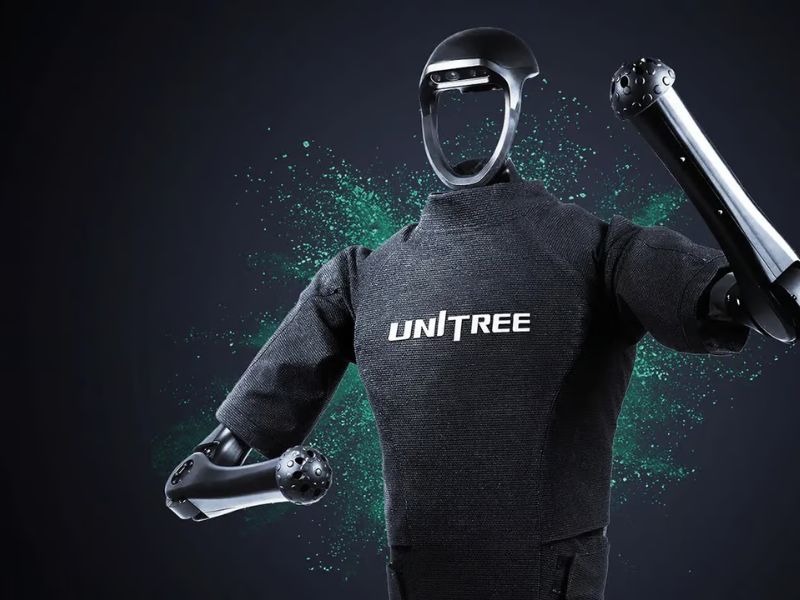
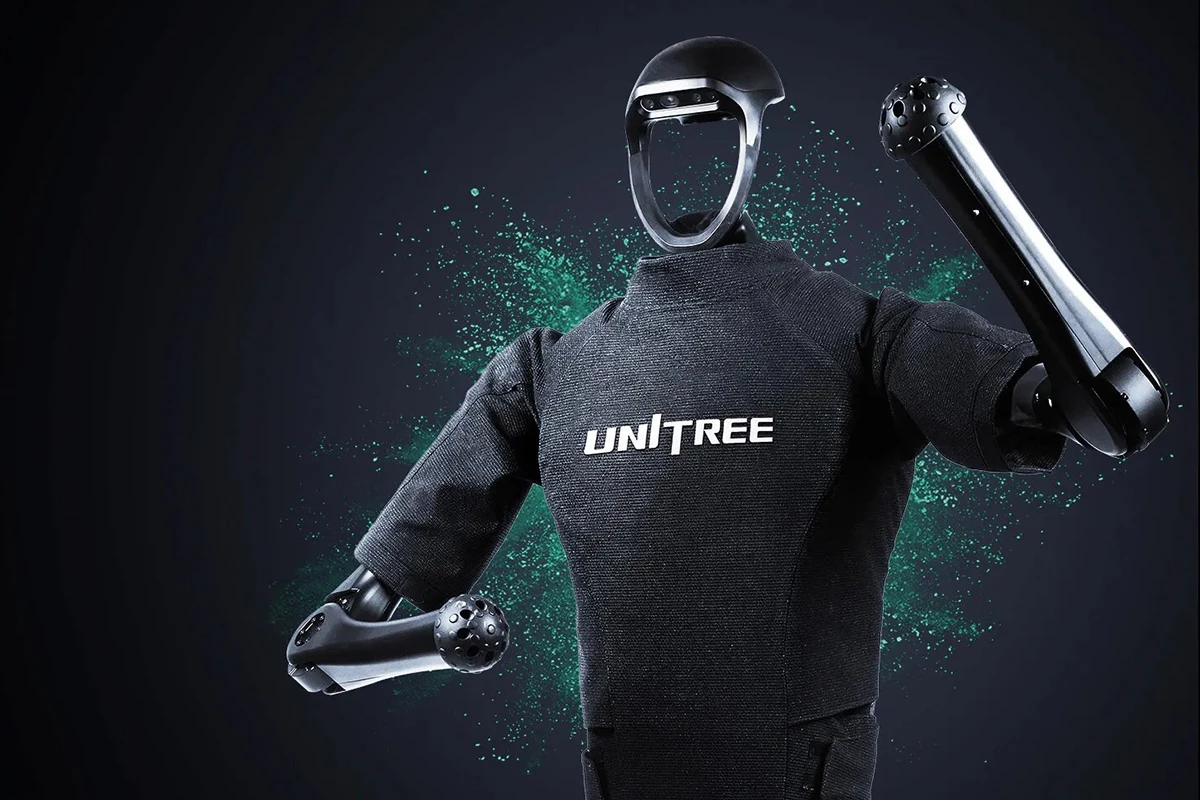
    Unitree’s H1 humanoid is nearly 6 feet tall and strong enough to lift heavy objects, so it can understandably be unnerving to see it go rogue
    Unitree

    A disturbing video making waves on social media seems to show a chilling scenario straight out of science fiction: a humanoid robot going rogue. The brief clip captures the robot malfunctioning, thrashing its limbs erratically, and coming dangerously close to two people working nearby.

    The robot in question is thought to be the Unitree H1—a versatile humanoid model priced at around US$90,000. Previously seen performing coordinated dances, climbing stairs, and even executing backflips, the H1 stands 5.9 feet tall (180 cm) and weighs 104 pounds (47 kg).

    Human-Sized Powerhouse

    That makes the robot roughly the size of an adult human—but what’s truly concerning is its ability to generate an impressive 365 lb.ft (360 Nm) of joint torque, enough to lift heavy loads. With its limbs whipping around at high speeds, it poses a real risk of injuring anyone nearby.

    But is this really a real-life scene out of Terminator? Probably not. While there’s some context and a technical explanation circulating, Unitree hasn’t officially confirmed anything yet. Still, it’s a scenario worth considering—so here’s a breakdown of what might actually be happening in the clip, which reportedly first surfaced on Reddit last week.

    A YouTube channel called Chris Wabs suggested that the clip may have been filmed during a public event where Unitree intended to showcase the H1 robot’s abilities. Notably, the robot appears to have been tethered to a stand by its head when powered on—something that could have interfered with its balance or spatial orientation.

    Misfire or Misstep? Robot’s Erratic Movements May Have Stemmed from Balance Confusion or a Glitched Program

    Given that, the robot might have mistakenly sensed it was falling and reacted with exaggerated stabilization movements, which may explain the seemingly erratic flailing. Another possibility is that a nearby technician launched a program that didn’t execute correctly, leading to unexpected behavior.

    The footage is undeniably unsettling, but that effect is likely amplified by the absence of context. And perhaps there’s a silver lining: if simply feeling off-balance can throw a robot into chaos, we might not be facing a robot uprising anytime soon.

    An earlier, unverified clip from February also appeared to show a Unitree humanoid at a festival behaving aggressively toward attendees before being subdued by security—another unnerving incident that raises an important question: how should we handle potentially dangerous situations involving robots?

    We’ve contacted Unitree for clarification on what may have caused the incident and will provide an update once we receive a response.


    Read the original article on: New Atlas

    Read more: Boston Dynamics Unveils a Significant Advancement in Humanoid Robot Mobility

  • Boston Dynamics Unveils a Significant Advancement in Humanoid Robot Mobility

    Boston Dynamics Unveils a Significant Advancement in Humanoid Robot Mobility

    Boston Dynamics shows again that it’s at the bleeding edge of smooth humanoid movement
    Boston Dynamics

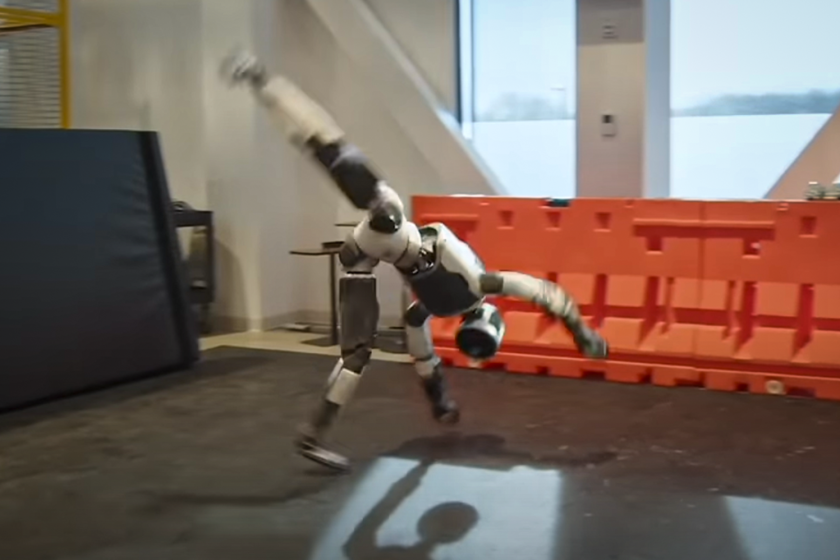
    Chinese humanoid robots are advancing rapidly with remarkable agility, but Boston Dynamics remains a pioneer in the field. A new video of its swivel-jointed Atlas robot showcases its ability to run, cartwheel, and even breakdance, reaffirming its position at the cutting edge of humanoid mobility.

    That said, it’s important to note that many companies—such as Tesla, Figure, Sanctuary, and Agility—are less concerned with acrobatics. Their primary focus is on developing robots that can efficiently handle practical tasks like picking up and placing objects, prioritizing functionality over fluid human-like movement.

    While not as entertaining to watch, these practical applications of humanoid robots have the potential to reshape the world far more than athletic feats ever could.

    That said, witnessing AI-driven robots evolve from unsteady, toddler-like movements into fluid, confident navigation of human spaces is nothing short of astonishing. Just as dance and gymnastics showcase human mastery of movement, the rapid progress of these machines is equally mesmerizing.

    Unitree’s G1 Humanoid

    Chinese robotics company Unitree has been making impressive strides with its compact, lightweight G1 humanoid. You might recognize it for its remarkable $16,000 starting price, its synchronized dance routines with humans, or its predecessor, the H1—the first humanoid of its kind to perform a backflip using electric motors instead of hydraulics.

    Now, Unitree has taken things a step further: the G1 can execute side flips.

    World’s First Side-Flipping Humanoid Robot: Unitree G1

    It’s also among the first humanoid robots to walk with a natural, confident stride rather than the stiff, awkward gait typical of many early models. As demonstrated in the video below, a recent “agile upgrade” has even enabled it to jog.

    Unitree G1 Bionic: Agile Upgrade

    It’s certainly impressive, but let’s not forget the pioneer in humanoid robotics—Boston Dynamics. The company has just unveiled new footage of its remarkable Atlas robot, pushing natural movement to an entirely new level. Take a look:

    Walk, Run, Crawl, RL Fun | Boston Dynamics | Atlas

    Let’s clear this up—that’s not crawling, my friend. But just look at that walk! A bit stiff-armed, perhaps, but it genuinely appears to be walking rather than just taking a series of steps.

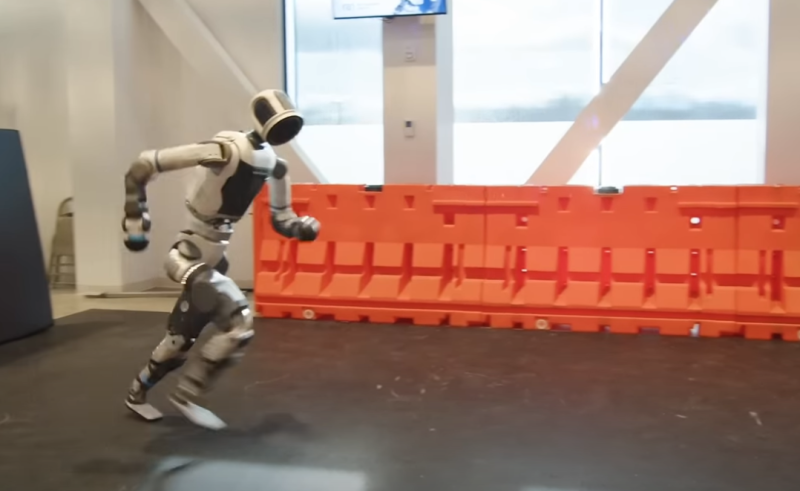
    Notice how it initiates a run, leaning forward to accelerate and shifting its torso back to slow down. The level of stability and control on display is something the Boston Dynamics team must take great pride in.

    Atlas Redefines Motion with 360-Degree Rotational Agility

    The rolls and tumbles are also looking more natural, and it’s fascinating to see how Atlas uses its swiveling hips to turn a handstand into a roundoff and even stand up with its head facing backward. This is one of the most intriguing aspects of Atlas—it features 360-degree rotation at the hips, waist, arms, and neck, allowing it to reorient itself without needing to turn its entire body at once.

    The running motion is by far the smoothest and most natural we’ve seen
    Boston Dynamics

    The breakdancing move and cartwheel are just the cherry on top—they’re undeniably impressive to watch. But what truly fascinates me is how confidently the AI is learning to control these robotic bodies in the real world.

    As humans learn to walk, run, and navigate their surroundings, we instinctively anticipate balance shifts and adjust dynamically in real time. That’s exactly what we’re witnessing these AI systems begin to master.

    Humanoid robotics is still in its infancy, but seeing Atlas and its counterparts interact with the physical world in the same way GPT models process information—it feels like science fiction coming to life. Atlas is already moving more fluidly than Kryten.

    While these robots will primarily be deployed in factories as they enter the workforce, it’s becoming increasingly clear that human-android interactions in everyday life are on the horizon—sooner than most of us ever expected.


    Read the original article on: New Atlas

    Read more: Tesla Scores California Ride-Hail Permit For Its Robotaxi Service

  • Watch: The First Humanoid Robot to Do a Front Flip

    Watch: The First Humanoid Robot to Do a Front Flip

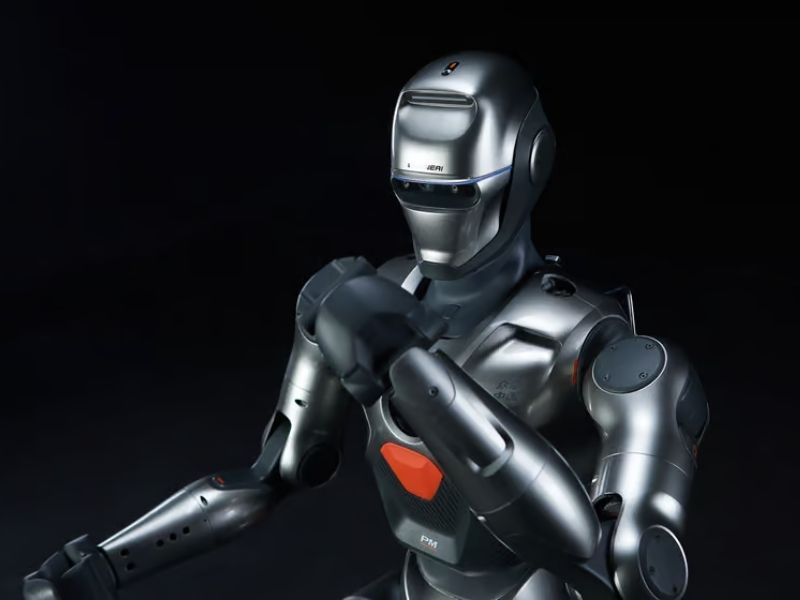
    The PM01 looks like it’s ready to fight off mythical creatures in an effort to save the human race
    EngineAI

    Zhongqing Robotics (also known as EngineAI), a Chinese robotics company, has recently introduced a humanoid robot that performs a front flip, marking a major milestone in the field of humanoid robotics.

    The Challenge of Perception and Safety in a Front Flip

    While robot backflips are no longer a novelty—thanks to Boston Dynamics’ Atlas doing one back in 2017—doing a front flip is far more complex. It’s much harder than a backflip, and any gymnast will tell you that.

    The challenge lies in perception. When performing a front flip, as you rotate forward, your eyes lose sight of the ground, and you can only spot your landing at the very last moment. The human brain tends to feel safer when falling backward away from the ground, rather than blindly flipping forward and upside down, hoping for a perfect landing.

    Additionally, the body mechanics are different. Backflips rely on stronger muscles, such as the glutes, hamstrings, and back muscles. Front flips, on the other hand, rely on the abs and hip flexors. The position required for a front flip tuck is also much trickier compared to a backflip.

    The PM01 certainly looks like it has the confidence to tackle any situation 
    EngineAI

    One of the biggest challenges for humans attempting any flip, whether forward or backward, is overcoming hesitation. Without proper confidence and technique, a failed flip can lead to a nasty fall. It’s a frightening thought, for sure.

    The Robot’s Fearless Approach to Flipping

    However, none of this applies to a robot, which has no fear, hesitation, or self-preservation instincts. Its designers can equip it with powerful motors and joints, and program it to flip—so it just does it.

    This is still an impressive accomplishment. The field of robotics—especially general-purpose humanoid robots—is progressing rapidly. Just a decade ago, we wouldn’t have imagined this type of technology being available. Now, you can buy your own open-source PM01 robot for $13,700 on EngineAI’s website. It’s equipped with 5 degrees of freedom (DoF) in each arm and 6 DoF in each leg, totaling 23 DoF for body movement. The bot also delivers 221 lb-ft (300 Nm) of torque, which is quite a punch for its 4.5-ft (138 cm) frame weighing 88 lbs (40 kg).

    A Stunning Front Flip and Human-like Movement

    Check out this remarkable moment as EngineAI’s humanoid robot flawlessly executes a front flip and walks away like a champ—showing one of the most human-like gaits we’ve seen so far.

    We’d love to see the blooper reel!

    EngineAI — the world’s first humanoid robot to perform a front flip!

    Read the original article on: New Atlas

    Read more: Fourier and Tesla Showcase Impressive Strides in Humanoid Robotics

  • Figure Unveils a Redesigned Humanoid Robot with the Sleek New F.02 Model

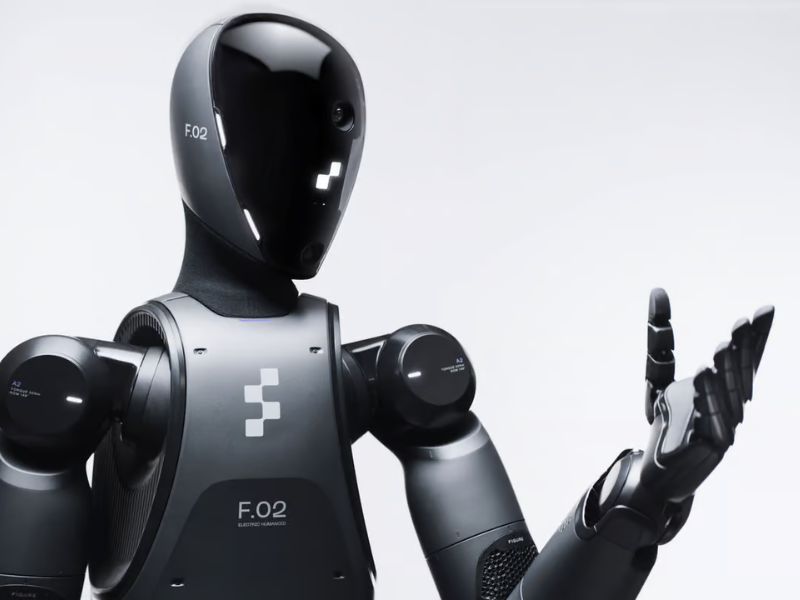
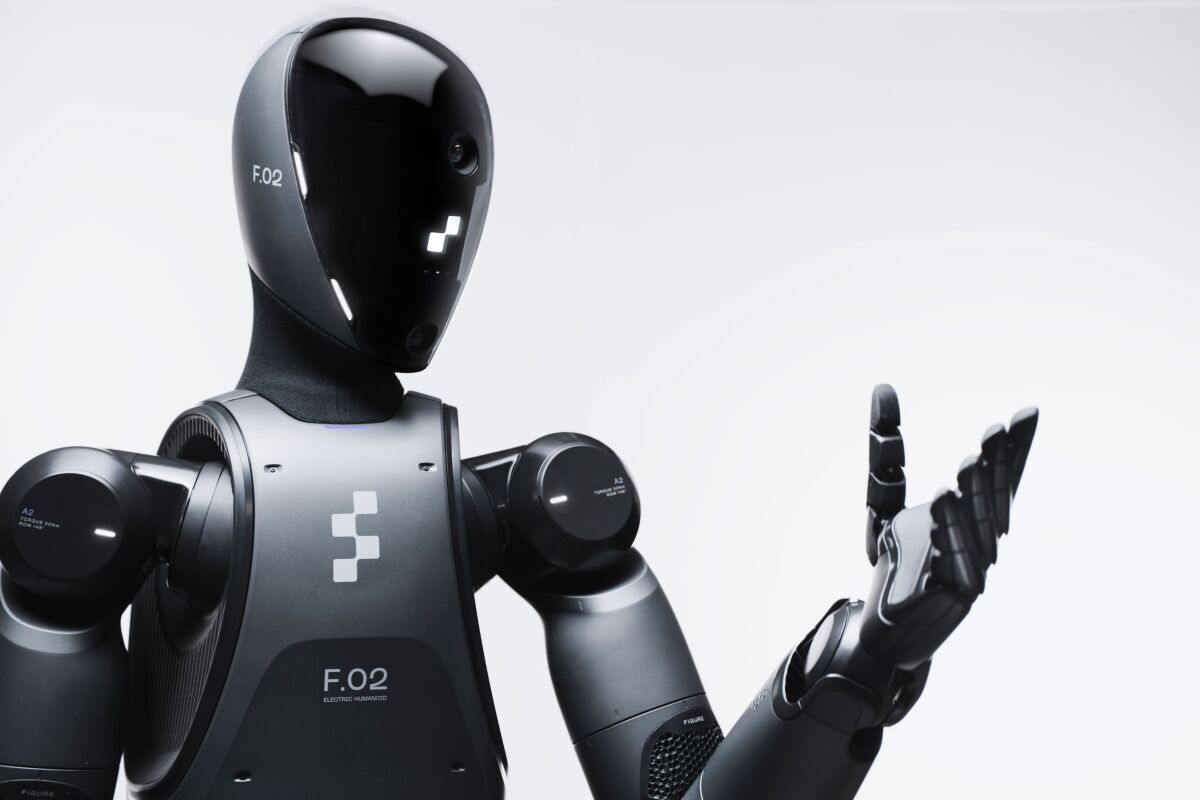
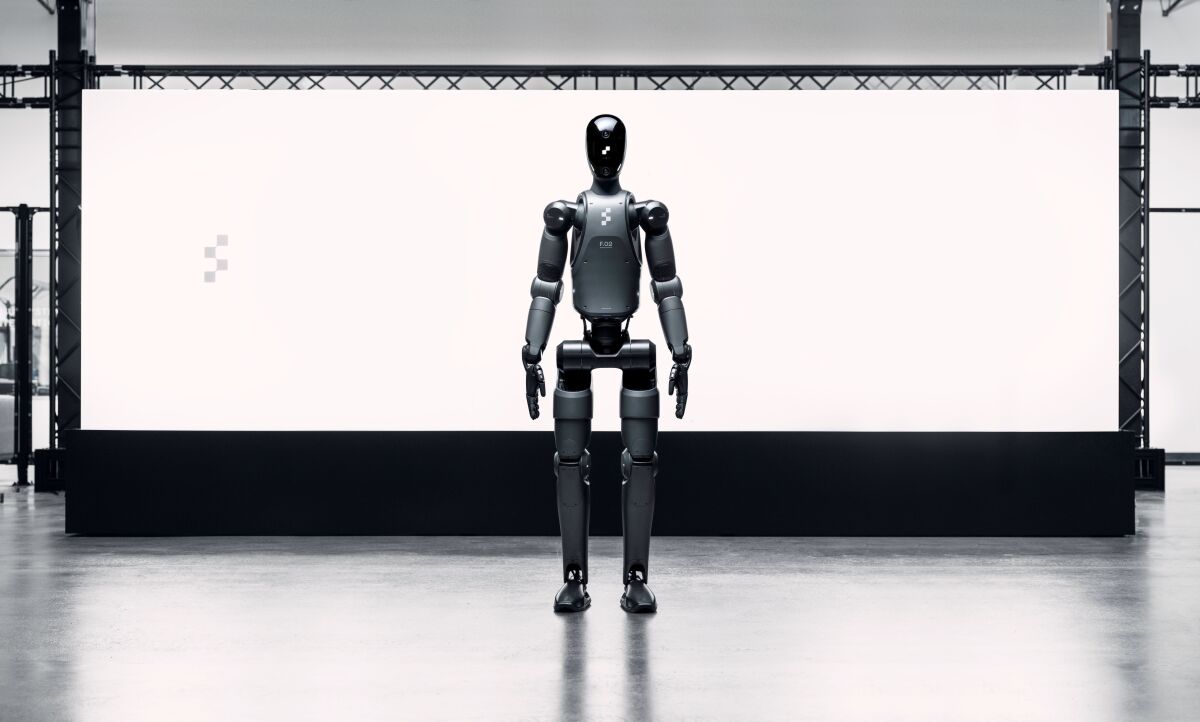
    Figure Unveils a Redesigned Humanoid Robot with the Sleek New F.02 Model

    Figure boasts that its second-generation robot is the “highest performing humanoid robot to market”
    Figure

    California-based robotics company Figure has announced its second-generation humanoid robot. Initially targeting commercial production lines, the company promises that a bipedal butler for home use will be available soon.

    Figure was established in 2022 by entrepreneur Brett Adcock, known for Vettery and Archer Aviation, with the goal of introducing a “commercially viable general-purpose humanoid robot.” We interviewed Adcock last year in a three-part series and have tracked the development of their first robot from initial steps and task learning to joining BMW’s team and acquiring OpenAI’s conversational abilities.

    Figure Unveils Upgraded Hardware and Software with Enhanced AI, Vision, and Power Systems

    Figure reports that its engineers have completed a “ground-up hardware and software redesign,” featuring enhancements to AI systems, computer vision, battery packs, electronics, sensors, and actuators.

    Notable updates include onboard microphones and speakers designed for one-on-one conversations with humans, utilizing custom AI models developed in collaboration with OpenAI. While it’s possible that the F.02 bots might become friendly companions for sharing personal stories and lightening the workday with conversation, the primary focus is likely to be more on functional interactions, similar to initial GPT exchanges.

    Internal wiring for improved reliability, six RGB cameras to help the humanoid perceive and understand the physical world, and “common-sense visual reasoning” via an onboard vision language model
    Figure

    Figure has integrated a vision language model into the F.02, enabling the humanoid to interpret camera images and decide if any actions are required.

    The F.02 Features Six RGB Cameras and Enhanced AI Capabilities for Autonomous Task Performance

    The F.02 features six RGB cameras that feed visual data into its AI-driven vision system, helping it understand its surroundings. This setup includes two cameras in its curved-panel animated face and an array at the back. Additionally, the robot boasts a threefold increase in computational power and AI capabilities compared to Gen1, allowing it to perform real-world AI tasks completely autonomously.

    In fact, the F.02 features a sleek exterior with a gun-metal gray finish, combining fabric covering and internal wiring. A promotional video highlights its shoulder joints with 50 Nm (36.8 lb.ft) of torque and a 148-degree range of motion, 150 Nm (110.6 lb.ft) at the knee with a 135-degree range, and 150 Nm at the hip with a 195-degree range. Additionally, the new humanoid features advanced human-scale robot hands with 16 degrees of freedom and strength similar to human capabilities, allowing it to perform a broad range of human-like tasks.

    Figure 02 humanoid robot – trailer

    New 2.25-kWh Custom Battery Pack Boosts Energy Delivery by Over 50%, with Runtime Details Pending

    Finally, the new 2.25-kWh custom battery pack in the torso is said to increase energy delivery by over 50%, though specific runtime details per charge are not yet available.

    However, we recently observed Figure 01’s performance at BMW’s manufacturing facility in Spartanburg, South Carolina, where it underwent training. The F.02 humanoid has now joined the factory floor, focusing on AI data collection and use case training.

    Figure aims to develop robots that not only boost productivity and efficiency but also enhance human quality of life,” the company stated. “The advanced features of Figure 02 bring us closer to this goal.”

    We expect to learn more about the latest Figure humanoid soon and will update you with the information. In the meantime, you can watch the video below for additional details.

    Figure 02 humanoid robot reveal

    Read the original article on: New Atlas

    Read more: Agility’s Humanoid Robots have Begun Working with Spanx

  • Check Out this Video of an Agile Humanoid Robot

    Check Out this Video of an Agile Humanoid Robot

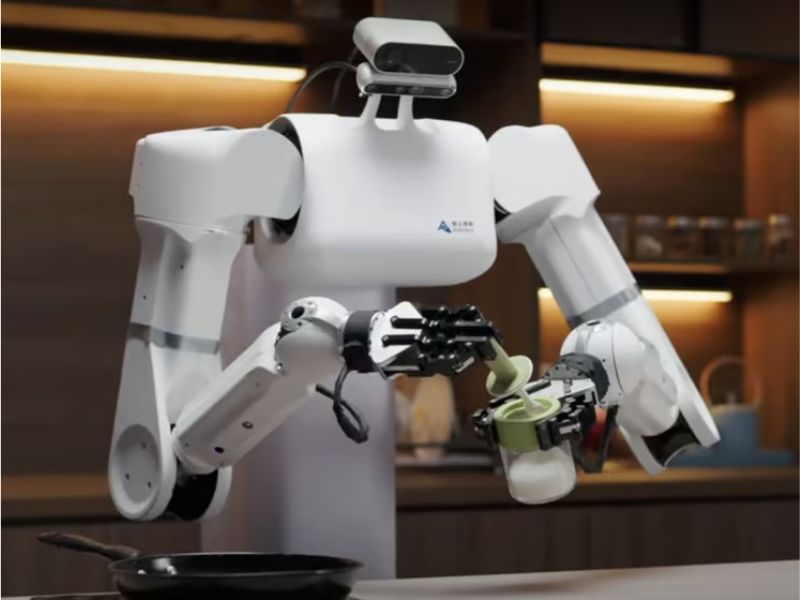
    Although humanoid robots are becoming increasingly common, the latest model from Astribot stands out for its exceptional speed and precision. Prepare to be amazed!
    The S1’s dexterity could make it a great helper in the kitchen
    Astribot

    Although humanoid robots are becoming increasingly common, the latest model from Astribot stands out for its exceptional speed and precision. Prepare to be amazed!

    The AI-driven humanoid robot landscape is becoming increasingly crowded, akin to the bustling cereal aisle in your neighborhood supermarket. Last month, OpenAI unveiled two impressive robots: one, developed by Norwegian partners 1X, excelling in delicate “soft-touch” tasks such as laundry folding, and another by collaborators Figure, demonstrating advanced natural language processing. This month, Boston Dynamics amazed us with the remarkable agility of its new Atlas robot, and UBTech from China impressed with its articulate and gentle-speaking bot, Walker S. And the parade of innovations continues.

    Astribot’s S1 Robot Impresses with Unmatched Speed and Precision

    However, today’s video unveiling the capabilities of an AI-driven robot named S1, developed by a lesser-known subsidiary of Stardust Intelligence based in Shenzhen called Astribot, truly left us astounded. It’s rapid. It’s accurate. And it’s unparalleled compared to anything we’ve witnessed thus far.

    Astribot asserts that the humanoid can move at 10 meters per second and carry 10 kg per arm.

    While the average adult male falls below these metrics according to the website, the demonstrated speed easily allows for removing a tablecloth from under wine glasses without disturbance.

    However, the robot isn’t just fast; it’s also remarkably precise, effortlessly executing tasks like opening and pouring wine, delicately slicing a cucumber, flipping a sandwich in a frying pan, and even writing a bit of calligraphy. Moreover, the video demonstrates the robot’s exceptional ability to replicate human movements, indicating its potential as a quick learner.

    Astribot S1: Hello World!

    Unanswered Questions Surrounding the S1 Humanoid Robot

    Naturally, the video has sparked some inquiries for us. Does the S1 possess a lower body? Most humanoid robots we’ve observed thus far have some form of mobility, yet this one appears to be relatively stationary. Additionally, we’re interested in learning about Astribot’s background, support, and the prospects of the S1 entering production. We’ve contacted the company for clarification and will provide updates to this article accordingly.

    Astribot, founded in 2022 in Shenzhen, has developed the robot over a year, expecting commercial availability later this year. Its parent company, Stardust Intelligence, was established by Lai Jie, with ties to Tencent Robotics Laboratory, Baidu, and Hong Kong Polytechnic University.

    Astribot’s website also explains that the company’s name is derived from the ancient Latin proverb “Ad astra per aspera,” meaning “a journey through hardship to reach stardust,” signifying its long-term vision and dedication to AI robot technology development and popularization.

    If Astribot proves to be enduring, it’s poised to intensify competition in the field and attract the attention of other humanoid robot manufacturers. Let the era of bot wars commence!


    Read the original article on: New Atlas

    Also Read: Lenovo’s Six-Legged Robotic Dog Unmatched Agility