Samsung’s venture capital arm is reportedly planning to invest in California-based medical device startup Exo in a funding round that could reach $100 million, according to Bloomberg sources.
The round is led by Sands Capital, Bold Capital, and Qubit Health Capital, with Qubit’s chairman, Imar Ishrak, expected to join Exo’s board.
Exo Innovates Handheld AI-Powered Medical Imaging Devices for Ultrasound Diagnostics
Founded in 2015, Exo develops handheld medical imaging devices that combine AI, medical imaging, and silicon technology for ultrasound exams such as lung scans and echocardiograms. The device connects to a smartphone, allowing medical professionals to scan patients, document findings, and share reports through a single app.
To date, the company has secured over $320 million in funding from investors such as RA Capital Management, BlackRock, Sands Capital, Intel, Sony, and Avidity Partners. Its latest funding round was a $220 million Series C in 2021.
According to the report, Exo is also currently negotiating a partnership with Samsung Medison Co., a manufacturer of ultrasound diagnostic and digital X-ray devices. Additionally, this collaboration could enhance their combined expertise in medical imaging technology.
Exo, Samsung, Sands Capital, Bold Capital, and Qubit Health did not immediately respond to requests for comment.
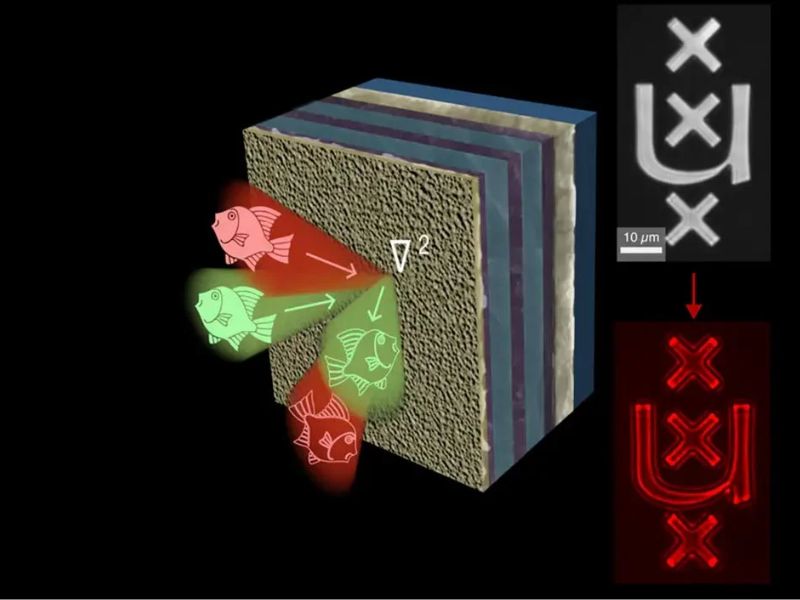
Using a clever device consisting of multiple thin layers, the physicists manage to output the edges of incoming images. Credit: UvA
Researchers at the University of Amsterdam’s Institute of Physics, led by Jorik van de Groep, have introduced a groundbreaking method for edge detection that combines exceptional speed with minimal energy use. Their work, published in ACS Photonics, showcases a significant advancement in imaging technology.
Harnessing Light for Computing
With rising demands for computing power, energy consumption has become a critical issue. Traditional hardware often fails to match the growing needs of modern software, pushing researchers to explore alternative methods that are both faster and more energy-efficient. One promising solution is optical analog computing, a process that leverages light to perform mathematical operations before an image is even captured.
Unlike conventional systems, optical analog computing operates without electrical power, making it highly energy-efficient. Moreover, because these operations occur at the speed of light, the process is nearly instantaneous. This innovation has the potential to revolutionize data processing, offering faster and more sustainable solutions for industries reliant on high-speed imaging.
Pioneering Edge Detection
In collaboration with industrial partners WITec and SCIL Imprint Solutions, the research team concentrated on edge detection—a critical function in image processing used to identify abrupt brightness changes that mark object boundaries. This technique is especially vital for applications like autonomous vehicles.
To achieve this, the researchers developed a simple yet highly effective stack of thin films for optical analog computing. Their method demonstrated remarkable precision, detecting edges of objects as small as 1 micrometer.
“The design of the layer stack is incredibly simple compared to the complex optical coatings currently considered state-of-the-art,” explained Bernardo Dias, first author of the study. “Despite this simplicity, our device achieves one of the largest numerical apertures ever recorded, enabling edge detection on extremely small targets.”
Advancing Microscopic Imaging
Another advantage of this method is its compatibility with various light sources, such as lamps, LEDs, and lasers, making it adaptable to existing technologies. The results indicate significant potential for high-resolution microscopy. The device can even highlight edges of transparent objects—such as cells—that are invisible to standard bright-field microscopes, making it ideal for biological applications.
Looking ahead, the researchers plan to develop switchable devices for optical analog computing, allowing users to toggle mathematical operations on and off or switch between different functions. This next step could further expand the versatility of this cutting-edge technology.
We use cookies on our website to give you the most relevant experience by remembering your preferences and repeat visits. By clicking “Accept All”, you consent to the use of ALL the cookies. However, you may visit "Cookie Settings" to provide a controlled consent.
This website uses cookies to improve your experience while you navigate through the website. Out of these, the cookies that are categorized as necessary are stored on your browser as they are essential for the working of basic functionalities of the website. We also use third-party cookies that help us analyze and understand how you use this website. These cookies will be stored in your browser only with your consent. You also have the option to opt-out of these cookies. But opting out of some of these cookies may affect your browsing experience.
Necessary cookies are absolutely essential for the website to function properly. These cookies ensure basic functionalities and security features of the website, anonymously.
Cookie
Duration
Description
cookielawinfo-checkbox-analytics
11 months
This cookie is set by GDPR Cookie Consent plugin. The cookie is used to store the user consent for the cookies in the category "Analytics".
cookielawinfo-checkbox-functional
11 months
The cookie is set by GDPR cookie consent to record the user consent for the cookies in the category "Functional".
cookielawinfo-checkbox-necessary
11 months
This cookie is set by GDPR Cookie Consent plugin. The cookies is used to store the user consent for the cookies in the category "Necessary".
cookielawinfo-checkbox-others
11 months
This cookie is set by GDPR Cookie Consent plugin. The cookie is used to store the user consent for the cookies in the category "Other.
cookielawinfo-checkbox-performance
11 months
This cookie is set by GDPR Cookie Consent plugin. The cookie is used to store the user consent for the cookies in the category "Performance".
viewed_cookie_policy
11 months
The cookie is set by the GDPR Cookie Consent plugin and is used to store whether or not user has consented to the use of cookies. It does not store any personal data.
Functional cookies help to perform certain functionalities like sharing the content of the website on social media platforms, collect feedbacks, and other third-party features.
Performance cookies are used to understand and analyze the key performance indexes of the website which helps in delivering a better user experience for the visitors.
Analytical cookies are used to understand how visitors interact with the website. These cookies help provide information on metrics the number of visitors, bounce rate, traffic source, etc.
Advertisement cookies are used to provide visitors with relevant ads and marketing campaigns. These cookies track visitors across websites and collect information to provide customized ads.