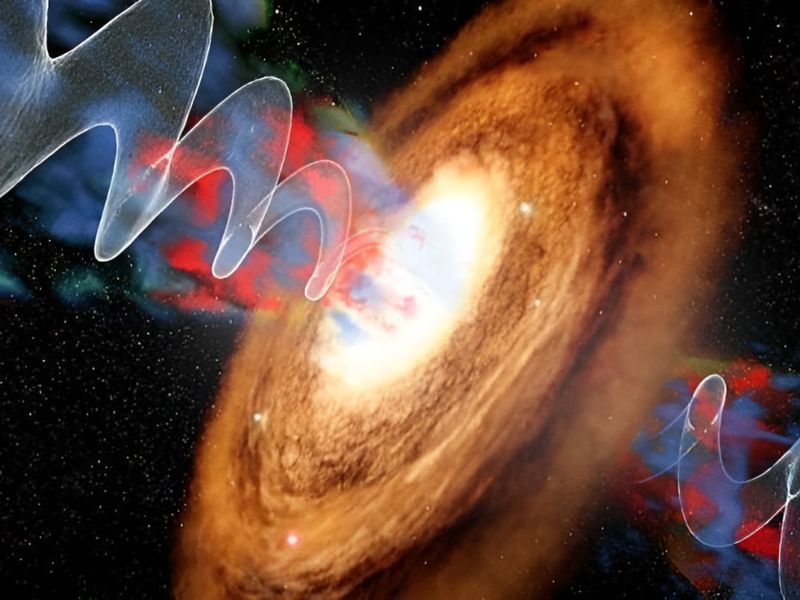
Image Credits:This artist’s rendering illustrates a precessing jet erupting from the supermassive black hole at the cente
Using the W. M. Keck Observatory astronomers in Hawaiʻi discovered the largest stream of superheated gas from a nearby galaxy, showing a supermassive black hole can affect its galaxy far beyond the core.
The discovery highlights galaxy VV 340a, where massive gas streams extend up to 20,000 light-years—farther than ever recorded. The study, led by UC Irvine and Caltech/IPAC, is published in Science.
KCWI Maps Black Hole’s Far-Reaching Gas
Using the Keck Cosmic Web Imager on Keck II, scientists traced cooler gas extending beyond the galaxy’s disk, forming a spear-like structure that records prolonged activity from its central supermassive black hole.
“The Keck data let us see the full scale of this phenomenon,” said lead author Justin Kader, UC Irvine. “The gas we observe reaches the farthest distances from the black hole, revealing the longest timescales. Without these observations, we couldn’t measure how powerful or persistent this outflow truly is.”
KCWI data were key to measuring the expelled material and its impact on the galaxy’s evolution. The team confirmed that it indeed can.
Multi-Telescope Observations Paint Complete Picture of Galaxy
Researchers combined Keck optical data, Webb infrared observations, and Karl G. Jansky radio images. Jansky Very Large Array (VLA) to create a comprehensive view of the galaxy.
At VV 340a’s core, Webb detected highly energized coronal gas erupting from the black hole. Unlike typical coronal gas, it stretches thousands of parsecs, the largest ever observed.
VLA radio images revealed a pair of plasma jets from the black hole twisting into an S-shaped, helical pattern, a sign of jet precession, where a jet gradually wobbles over time.
“This is the first time we’ve observed a precessing, kiloparsec-scale radio jet driving such a massive outflow in a disk galaxy,” said Kader.
Jets Drive Gas Outflow, Suppressing Star Formation
Webb’s infrared data revealed the energetic core, while Keck showed it drives gas outward, expelling material at a rate equal to forming 20 suns per year and suppressing star formation.
Perhaps most striking is the location of this activity. Powerful precessing jets typically occur in old elliptical galaxies, not in young, merging spirals like VV 340a.
This finding challenges long-held ideas about the co-evolution of galaxies and their central black holes and suggests that similar events might even happen in galaxies like the Milky Way.
“There’s no clear evidence of anything like this in our galaxy, but this discovery shows we can’t rule it out,” said Kader. “It changes how we view the galaxy we live in.”
The team aims to conduct deeper, higher-resolution radio observations to see if a second supermassive black hole might be causing the jet’s wobble, potentially revealing a binary black hole system.
“We’re just beginning to see how common this activity is,” said Vivian U, Caltech/IPAC. “Keck and other instruments are opening a new window on galaxy evolution.”
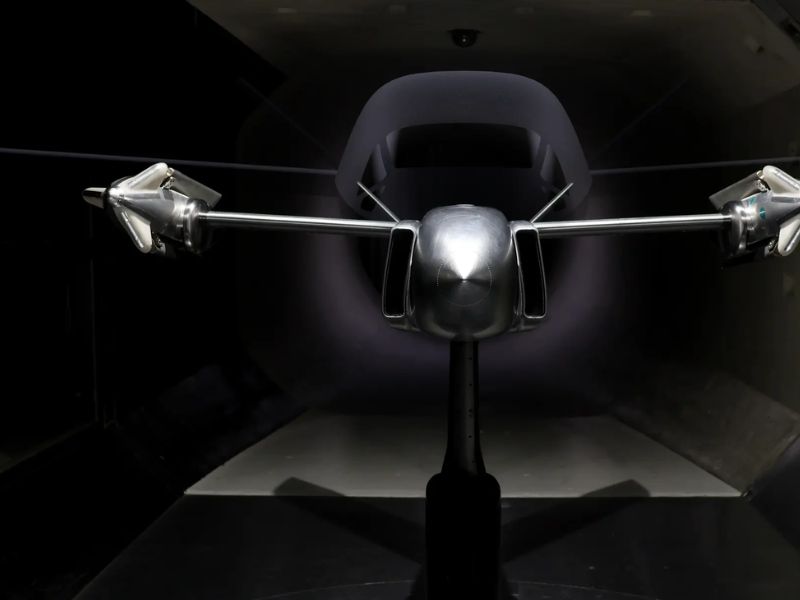
Bell has revealed a new image showcasing its innovative hybrid of helicopter and jet aircraft, offering a glimpse at the future of aviation. The model, used in wind tunnel tests, represents Bell’s entry into DARPA’s Speed and Runway Independent Technology (SPRINT) program.
Traditionally, helicopters excel in vertical takeoff and landing (VTOL) capabilities, especially in challenging terrain, but lack speed. Jet planes, on the other hand, deliver high speed but rely on runways or flat surfaces, even for STOVL models. DARPA’s SPRINT program aims to bridge this gap by developing an aircraft capable of rotorcraft-like VTOL and jet-speed horizontal flight.
Bell’s X-plane, a leading contender in the program, resembles a Bells Boeing Osprey with transformative features reminiscent of a high-tech gadget. After takeoff, its rotor nacelles tilt forward for horizontal flight. Unlike conventional designs, its rotor blades fold into the nacelles to reduce drag, allowing the jet engines to take over seamlessly.
First Look at Bell’s X-Plane: Folding Rotor Tests and Streamlined Design Unveiled
Artist’s concept of the new X-planes in flight Bell
The folding rotor mechanism underwent successful testing in 2023 at the Holloman High-Speed Test Track in New Mexico, followed by wind tunnel trials at Wichita State University’s NIAR, revealing the X-plane’s streamlined hull, thin wings, V-shaped tail, and nacelles with folding rotors shielded by aerodynamic fairings.
Bell’s technology demonstrator, a pilot-optional craft, will cruise at up to 450 knots (518 mph), with a 200-nautical-mile range, 30,000-foot ceiling, and 5,000-pound payload capacity—enough to carry a small vehicle.
Designed to enhance speed, range, survivability, and maneuverability, the aircraft will particularly benefit special forces in the Indo-Pacific. “This groundbreaking Stop/Fold system will revolutionize vertical lift aircraft,” said Jason Hurst, Bell’s Executive VP of Engineering.
Fusion could create more energy than any other process that could be produced on Earth. Credit: Shutterstock
There has been significant excitement about recent results from the Joint European Torus (JET) facility in the UK, suggesting that the dream of nuclear fusion power is inching closer to reality. We know that fusion works– it is the process that powers the Sun, offering heat and light to the Earth. For years, it has been difficult to transition from scientific laboratory experiments to sustained power production.
The central goal of fusion is to merge atomic nuclei to produce a different, heavier nucleus– dispensing energy in the process. This is unlike nuclear fission, in which a heavy nucleus such as uranium is split into smaller ones while also releasing energy.
Significant trouble has been the process of fusing light atoms, isotopes of hydrogen, or helium. As they are electrically billed, repulsing each other, they resist fusing unless nuclei are moving fast enough to get physically really near each other– demanding extreme conditions. The Sun accomplishes this at its core thanks to its enormous gravitational fields and its significant volume.
One approach utilized in laboratories on Earth is “inertial confinement,” wherein a little fusion fuel pellet about one-tenth of a centimeter in diameter is heated and compressed from the outside utilizing laser energy.
The methodology
Over the last few years, some encouraging development on this technique has been made, perhaps most especially by the National Ignition Facility in the US, where a 1.3 million Joules (a measure of energy) fusion return was reported last year. While this produced ten quadrillion Watts of power, it just lasted for a fraction (90 trillionths) of a second.
A different technique, “magnetic confinement,” has been deployed more broadly in laboratories worldwide and is believed to be among the most promising routes to materializing fusion power stations in the future.
It entails using fusion fuel held in the form of a hot plasma– a cloud of charged particles– confined by powerful magnetic fields. When creating the conditions for fusion reactions to occur, the confinement system requires keeping the fuel at an adequate temperature and density and for enough time.
Herein lies a substantial part of the challenge. The small amount of fusion fuel (usually just a few grams) requires to be heated to huge temperatures, of the order of 10 times hotter than the center of the Sun (150 million°C). Furthermore, this needs to occur while preserving confinement in a magnetic cage to sustain an energy output.
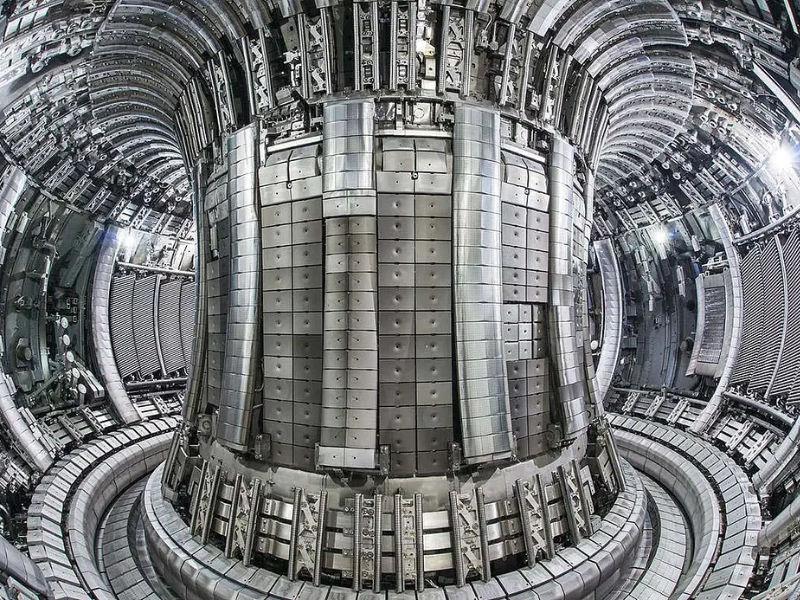
Numerous machines can be utilized to try to retain this magnetic confinement of the plasma. However, the most successful to date is the so-called “tokamak” design, which uses a torus (doughnut shape) and intricate magnetic fields to confine the plasma, as employed at the JET facility.
Internal view of the JET tokamak. Credit: Euro fusion.
Small Step or Big Leap?
The recent results mark an actual stepping stone in the mission for fusion power. Overall, the 59 million Joules of energy generated over a 5 second period provided an average fusion power of around 11 million Watts.
While this is only sufficient to heat approximately 60 kettles, it is nonetheless impressive– producing an energy output 2.5 times the latest record, established back in 1997 (also at the JET facility, reaching 22 million Joules).
The success at JET is the pinnacle in years of planning and a very experienced team of committed scientists and engineers. JET is presently the biggest tokamak globally and the only device that can use both deuterium and tritium fuel (both isotopes of hydrogen).
The design of the machine, utilizing copper magnets that heat up quickly, means that it can just operate with plasma bursts of approximately a few seconds. Superconducting magnets will be needed to make the step to much longer sustained high-power operations.
The progress
Thankfully, this is the case at the ITER facility, presently being constructed in the south of France as part of an international effort including 35 countries, which is now 80% complete. For that reason, the recent outcomes have offered tremendous confidence in the engineering design and physics performance for the ITER machine design, in addition to a magnetic confinement device, which is designed to generate 500 million Watts of fusion power.
Other important difficulties remain. These consist of developing appropriately durable materials capable of withstanding the intense pressure within the machine, handling the substantial power exhaust, and, most notably, producing economically competitive energy with various other forms of energy manufacturing.
Accomplishing remarkable power outputs and sustaining them for more than a brief amount of time has been the major challenge in fusion for decades. Without this ultimately being solved, a possible fusion powerplant can not be made to work. The JET results represent a substantial landmark, albeit just marking a step along the way.
The large leap will come with scaling up of the present fusion achievements in succeeding fusion systems, such as ITER, in demonstration power plants beyond this. Furthermore, this must be possible in the near future, planning for operation by the 2050s or perhaps a little earlier.
There is a great deal at stake. Fusion generates even more energy per gram of fuel than any other procedure that could be attained on Earth. Some of the major advantages of fusion are that the products of the process are helium and neutrons (particles that compose the atomic nucleus, together with protons)– no co2 or other greenhouse gases are released.
The raw fuels are deuterium, which can be located in seawater, and lithium, which is also abundant in large salt flats. The prospective fusion energy released from the lithium contained in one laptop battery and a bathtub of water is estimated to be equivalent to about 40 metric tons of coal.
Fusion does generate some radioactivity in the materials making up the reactor. This is not expected to be anywhere near as long-lived or extreme as the radioactive waste produced by nuclear fission– making it possibly a much safer and much more acceptable choice than traditional nuclear power.
Ultimately, Rome was not built in a day. Various other elements of human ingenuity, such as aviation, have historically taken significant amounts of time to progress to fruition. That means steps along the way that make progress are hugely important and need to be commemorated appropriately.
Fusion is creeping inexorably forward, and we are getting closer and closer to reaching that once distant dream of commercial fusion power. One day, it will give a near-infinite supply of low-carbon power for many future generations to come. While it is not there yet, it is coming.
Read the original article on Tech Xplore.
Read more: China’s “Artificial Sun” has Just Broken a New World Record.
We use cookies on our website to give you the most relevant experience by remembering your preferences and repeat visits. By clicking “Accept All”, you consent to the use of ALL the cookies. However, you may visit "Cookie Settings" to provide a controlled consent.
This website uses cookies to improve your experience while you navigate through the website. Out of these, the cookies that are categorized as necessary are stored on your browser as they are essential for the working of basic functionalities of the website. We also use third-party cookies that help us analyze and understand how you use this website. These cookies will be stored in your browser only with your consent. You also have the option to opt-out of these cookies. But opting out of some of these cookies may affect your browsing experience.
Necessary cookies are absolutely essential for the website to function properly. These cookies ensure basic functionalities and security features of the website, anonymously.
Cookie
Duration
Description
cookielawinfo-checkbox-analytics
11 months
This cookie is set by GDPR Cookie Consent plugin. The cookie is used to store the user consent for the cookies in the category "Analytics".
cookielawinfo-checkbox-functional
11 months
The cookie is set by GDPR cookie consent to record the user consent for the cookies in the category "Functional".
cookielawinfo-checkbox-necessary
11 months
This cookie is set by GDPR Cookie Consent plugin. The cookies is used to store the user consent for the cookies in the category "Necessary".
cookielawinfo-checkbox-others
11 months
This cookie is set by GDPR Cookie Consent plugin. The cookie is used to store the user consent for the cookies in the category "Other.
cookielawinfo-checkbox-performance
11 months
This cookie is set by GDPR Cookie Consent plugin. The cookie is used to store the user consent for the cookies in the category "Performance".
viewed_cookie_policy
11 months
The cookie is set by the GDPR Cookie Consent plugin and is used to store whether or not user has consented to the use of cookies. It does not store any personal data.
Functional cookies help to perform certain functionalities like sharing the content of the website on social media platforms, collect feedbacks, and other third-party features.
Performance cookies are used to understand and analyze the key performance indexes of the website which helps in delivering a better user experience for the visitors.
Analytical cookies are used to understand how visitors interact with the website. These cookies help provide information on metrics the number of visitors, bounce rate, traffic source, etc.
Advertisement cookies are used to provide visitors with relevant ads and marketing campaigns. These cookies track visitors across websites and collect information to provide customized ads.





.jpg)