Tag: Lasers

  • Lasers and Gold Nanoparticles Enable Crystal Growth for New Materials

    Lasers and Gold Nanoparticles Enable Crystal Growth for New Materials

    Michigan State University researchers have found a way to create crystals on demand, which are essential for technologies like solar panels, LED lighting, and medical imaging.
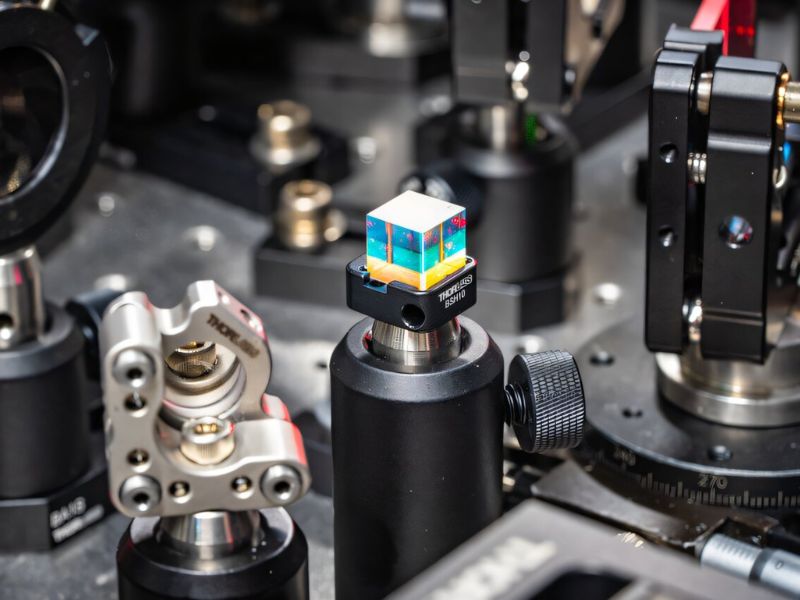
    A close-up of a beam-splitter cube found among the Harel Group’s laser instrumentation. Image Credits: Paul Henderson, Finn Gomez / College of Natural Science

    Michigan State University researchers have found a way to create crystals on demand, which are essential for technologies like solar panels, LED lighting, and medical imaging.

    A New Frontier in Material Science

    Published in ACS Nano, the breakthrough involved hitting gold nanoparticles with a single laser pulse.

    “We’re only starting to explore the possibilities. This marks a new era in material design and research,” said Elad Harel, associate professor of chemistry and senior author of the study.

    If you take a moment to look around, you’ll notice that crystals are at the heart of many technologies—from smoke detectors and TV displays to ultrasound machines and sonar systems. Their distinct optical and electrical properties make them central to modern innovation.

    But producing these crystals is no simple task.

    “With conventional growth methods, crystals may form unpredictably in both time and location, leading to inconsistent outcomes,” Harel explained.

    The Challenge of Precise Crystal Placement in Advanced Technologies

    As technology advances, it increasingly depends on precisely positioned, high-quality crystals—making this unpredictability a significant challenge for researchers.

    To address this issue, Harel turned to his lab’s area of expertise—lasers, especially ultra-fast ones.

    At MSU, Harel uses brief laser pulses to explore the hidden workings of nature, including a recent discovery that used these lasers to effectively “hear” biological processes.

    In their latest study, the researchers explored growing a class of crystals known as lead halide perovskites, which are vital components in LEDs, solar panels, and medical imaging.

    Instead of relying on the usual complex crystal-growing procedures or using a small “seed” crystal to initiate growth, Harel’s team directed their lasers at a minuscule, shimmering target—gold nanoparticles smaller than a thousandth the width of a human hair.

    By striking gold nanoparticles with ultrafast lasers, Elad Harel and his team were able to “draw” crystals. This breakthrough can help researchers accurately grow crystals when and where they’re needed. Image Credits: Paul Henderson, Finn Gomez / College of Natural Science

    Real-Time Crystal Drawing with Laser-Heated Nanoparticles

    The scientists discovered that the gold nanoparticles generated heat where the laser light hit, triggering crystallization. Using advanced high-speed microscopes, they were able to observe the process in real time.

    Much like a laser engraving designs into metal or wood, this technique allows researchers to “draw” crystals with precise control—potentially revolutionizing areas such as clean energy and quantum technology. The study also deepens our understanding of crystal formation, a complex area in chemistry.

    “With this approach, we can grow crystals at exact locations and times,” said Dr. Md Shahjahan, MSU research associate and lead author of the study. “It’s like having a front-row view of a crystal’s earliest moments under the microscope, with the ability to guide its growth.”

    With their gold nanoparticles taking center stage, Elad’s team is returning to the lab to pursue experiments with significant potential.

    These plans involve using multiple lasers of varying colors to “draw” more detailed crystal patterns and exploring the creation of entirely new materials that traditional methods can’t produce.

    “Now that we can ‘draw’ crystals with lasers, the next step is to create larger, more complex designs and evaluate how these crystals function in real-world devices,” Harel explained.


    Read the original article on: Phys.Org

    Read more: Scientists Were Amazed to Find a Marine Species that Can Destroy a Major Human Threat
  • Silver Foam and High-Power Lasers Create the World’s Brightest X-Ray

    Silver Foam and High-Power Lasers Create the World’s Brightest X-Ray

    A groundbreaking innovation at Lawrence Livermore National Laboratory (LLNL) has combined high-power lasers with an ultralight silver metal foam to create the brightest X-ray source ever recorded, boasting twice the intensity of anything previously achieved.
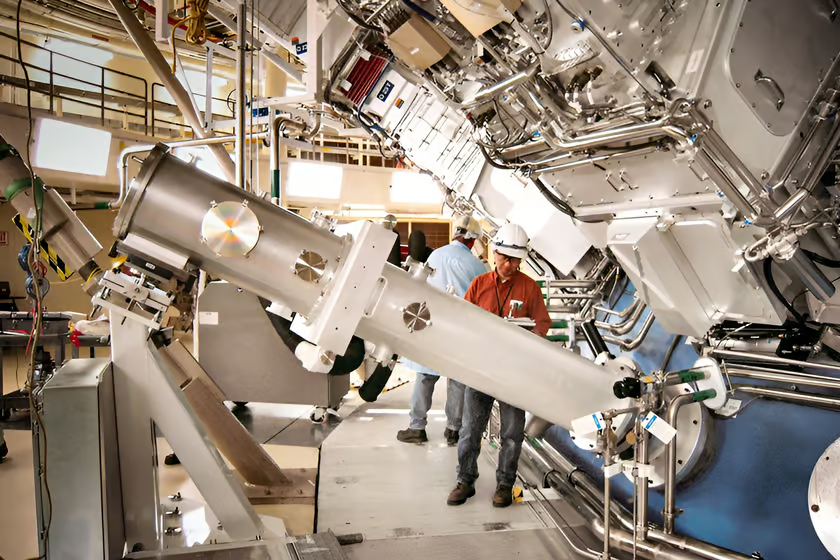
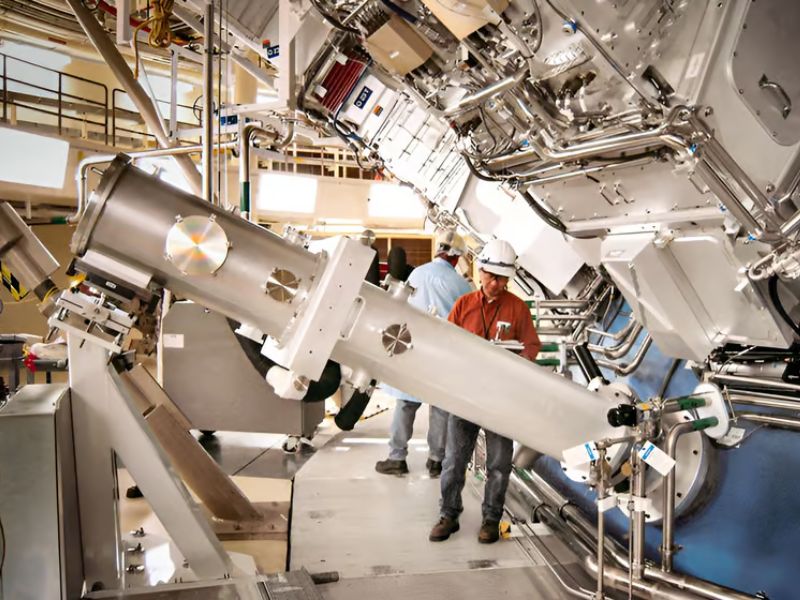
    An x-ray detector at the National Ignition Facility was used to measure the energy spectrum and intensity of x-ray bursts created in the experiments
    Lawrence Livermore National Laboratory

    A groundbreaking innovation at Lawrence Livermore National Laboratory (LLNL) has combined high-power lasers with an ultralight silver metal foam to create the brightest X-ray source ever recorded, boasting twice the intensity of anything previously achieved.

    Applications of Ultra-Bright X-Rays

    While ultra-bright X-rays may not be useful in everyday life, they play a crucial role in advanced research. Applications include studying the atomic-level structure of materials, observing chemical reactions in real-time, obtaining detailed images of biological samples, and analyzing complex molecules.

    These exceptionally bright X-rays are particularly important at facilities like LLNL, which leads cutting-edge research on nuclear fusion. Beyond scientific exploration, these studies have practical applications, such as developing fusion reactors and ensuring the safety and reliability of the United States’ nuclear weapons stockpile.

    The key advantage of these X-rays lies in their extremely high resolution, making them ideal for examining highly dense materials, such as the plasmas generated during inertial confinement fusion.In this process, high-energy laser beams bombard pellets of deuterium and tritium. Interestingly, researchers at the National Ignition Facility (NIF) use the same super-lasers designed for fusion research to produce this new ultra-bright X-ray light.

    Production of X Rays animated

    A New Approach to Generating X-Rays

    Traditionally, X-rays, like those used in dental offices, are generated by bombarding a metal target with an electron beam. However, this new system replaces the electron beam with a laser and uses a special metal target made of silver foam.

    Researchers create this foam, shaping it into 4-mm-wide cylinders using silver nanowires suspended in a special mold.After undergoing a supercritical drying process to remove the solution, the result is a metal foam with just one-thousandth the density of regular silver—about the same density as air.

    Why Use “Fluffy” Silver?

    The highly porous structure of the silver foam allows heat to flow much faster through it. As a result, the entire cylinder can heat uniformly in just 1.5 billionths of a second.

    The outcome is an X-ray source with energy exceeding 20,000 electron volts. While this might seem small on an everyday scale, it is extremely significant in the realm of nuclear physics.

    The new ultra-bright X-Ray uses fusion-grade lasers and a silver metal foam
    Lawrence Livermore National Laboratory

    According to LLNL researchers, this new X-ray technology will not only deepen our understanding of fusion processes but also enable the study of the hot, bright metal plasmas produced, which exist far from thermal equilibrium.

    These results mean we need to rethink our assumptions about heat transport and how we calculate it in these particular metal plasmas, said Jeff Colvin, a scientist at LLNL.


    Read the orginal article on: New Atlas

    Read more:X-rays May Help Divert Hazardous Asteroids Heading toward Earth

  • Lasers Show Massive, 650-Square-Mile Maya Site Hidden Beneath Guatemalan Rainforest

    Lasers Show Massive, 650-Square-Mile Maya Site Hidden Beneath Guatemalan Rainforest

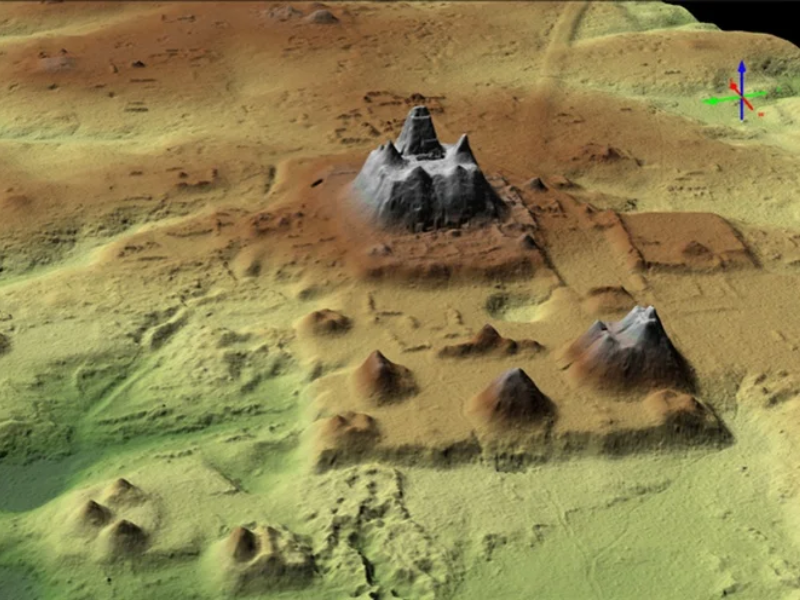
    A complex of Maya pyramids in Guatemala as seen via lidar. Credit: "LiDAR analyses in the contiguous Mirador-Calakmul Karst Basin, Guatemala: an introduction to new perspectives on regional early Maya socioeconomic and political organization," by Richard D. Hansen et al., in Ancient Mesoamerica, Published online by Cambridge University Press December 5, 2022
    A complex of Maya pyramids in Guatemala as seen via lidar. Credit: “LiDAR analyses in the contiguous Mirador-Calakmul Karst Basin, Guatemala: an introduction to new perspectives on regional early Maya socioeconomic and political organization,” by Richard D. Hansen et al., in Ancient Mesoamerica, Published online by Cambridge University Press December 5, 2022

    Geologists in northern Guatemala have discovered a large Maya site that stretches roughly 650 square miles (1,700 square kilometres) and dates to the Middle and Late Preclassic time (approximately 1000 B.C. to 250 B.C.).

    The findings were the outcome of an aerial survey that scientists conducted through airplanes utilizing lidar (light detection and also ranging), in which lasers are beamed out, and also the reflected light is utilized to create aerial images of a landscape. The innovation is especially beneficial in areas such as the rain forests of Guatemala’s Mirador-Calakmul Karst Basin, where lasers could penetrate the thick tree canopy.

    Utilizing information from the scans, the group identified greater than 1,000 settlements dotting the region, which were interconnected by 100 miles (160 kilometres) of causeways that the Maya likely traversed walking. They also spotted the remains of numerous large platforms and also pyramids, along with canals and reservoirs utilized for water collection, according to the research study, which was released Dec. 5th in the journal Ancient Mesoamerica.

    The landscape of the Maya region

    The lidar data reveal “for the first time a location that was integrated politically and economically, and never seen prior to in other areas in the Western Hemisphere,” research study co-author Carlos Morales-Aguilar, a postdoctoral fellow in the Division of Geography and the Environment at the College of Texas at Austin, informed Live Science in an e-mail. “We can currently see the whole landscape of the Maya region” in this part of Guatemala, he stated.

    So, what made this region so tempting that the Maya would wish to settle there in the first place?

    “For the Maya, the Mirador-Calakmul Karst Basin was the ‘Goldilocks Area,’” study co-author Ross Ensley, a geologist with the Institute for Geological Research Study of the Maya Lowlands in Houston, informed Live Science in an email.

    “The Maya settled in [this area] because it had the best mix of uplands for settlement and lowlands for agriculture. The uplands offered a source for limestone, their main building product, and dry land to live on. The lowlands are mainly seasonal swamps, or bajos, which offered space for wetland farming as well as organic-rich soil for use in terraced farming.”

    Scientists have previously utilized lidar to scan Maya sites in Guatemala. In 2015, an initiative known as the Mirador Basin Project conducted 2 large-scale surveys of the southern part of the basin, focusing on the ancient city of El Mirador. According to the study, that project resulted in the mapping of 658 square miles (1,703 square km) of this part of the country.

    Morales Aguiar’s explanation

    “When I produced the first bare-earth designs of the old city of El Mirador, I was blown away,” Morales-Aguilar said. “It was interesting to observe the huge number of reservoirs, monumental pyramids, terraces, residential areas, and small mounds for the first time.”

    Scientists wish lidar technology will help them explore areas of Guatemala that have remained a secret for centuries.

    “Lidar has been revolutionary for archaeology in this field, especially if it is covered in tropical forest where visibility is limited,” Marcello Canuto, supervisor of the Middle American Research Institute at Tulane College and an anthropologist who wasn’t involved in the study, told Live Science. “While surveying, we have a tendency to see a little part of the causeway, but lidar allows us to see things that are big and linear. This research allows us to see the region for the first time; the fact that we have this information is transformative.


    Read the original article on Scientific American.

    Read More: How Supermassive Fuel-Hungry Black Holes Feed off Intergalactic Gas