R Jacobson/NIST
If you’re the kind of person who needs your watch to be perfectly in sync down to the second, you’ll be thrilled to know that scientists have developed an atomic clock with record-breaking precision—accurate to within 5.5 x 10⁻¹⁹, meaning it would gain or lose just one second over a span of 57.6 billion years.
Two Decades of Research Behind a Breakthrough
This revolutionary timepiece was created by researchers at the U.S. National Institute of Standards and Technology (NIST) after two decades of work. Not only is it the most precise clock ever built, but it also surpasses the previous accuracy benchmark by 41% and offers 2.6 times greater stability than earlier models.
To put that into perspective, this clock could maintain time within a second for several times longer than the universe has existed.
How Ion Clocks Differ from Traditional Atomic Clocks
Unlike conventional atomic clocks, which rely on the oscillations of a single cesium atom, this device is a specific type of atomic clock known as an ion clock. It leverages the quantum properties of two electrically charged atoms, or ions, to achieve greater accuracy and reliability.
NIST
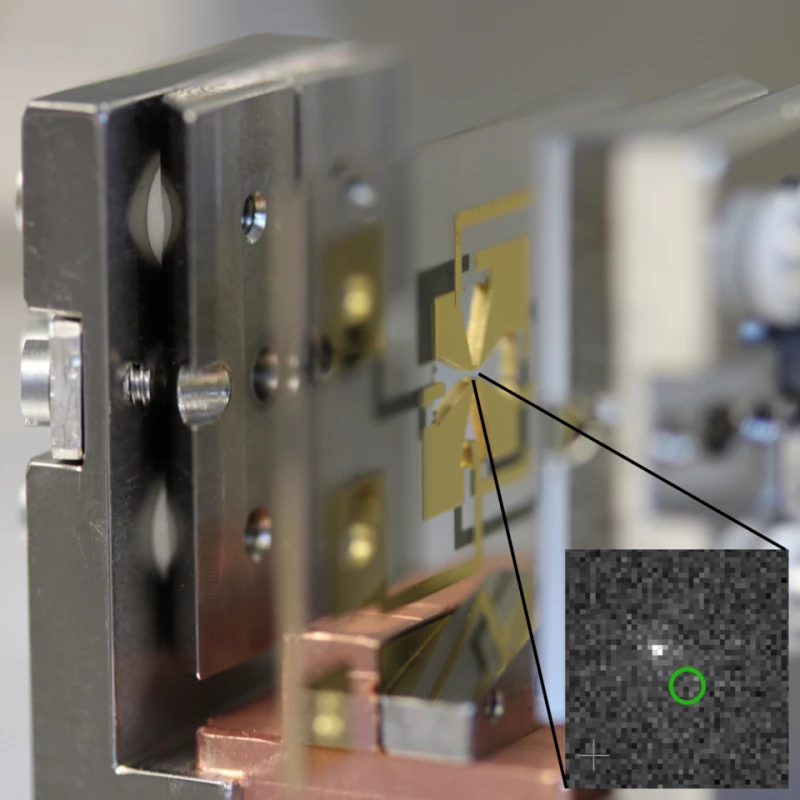
Specifically, the system uses an aluminum ion coupled with a magnesium ion, forming what’s called a quantum logic clock. The aluminum ion ticks with a highly stable, high-frequency signal—but it can’t be read directly using laser light. That’s where the magnesium ion comes in: the two ions are confined together in an ion trap and interact via electrostatic forces. This setup allows the magnesium ion to act as a translator, relaying timing information from the aluminum ion. It also assists in cooling the aluminum ion by transferring energy during laser manipulation.
R Jacobson/NIST
Maintaining this delicate system requires extremely low temperatures—just above absolute zero (around -273.15 °C or -459.67 °F). The team also introduced innovations such as thicker diamond wafers, a new gold coating for the electrodes, and a high-vacuum chamber to prevent hydrogen atoms from interfering. The laser system, essential for measuring time, had to be made ultra-stable using optical frequency combs—a technique involving interlocked lasers that produce highly precise frequencies.
In short, creating this clock was an intricate and demanding process.
More Than Just Precision: Real-World Applications
But its purpose extends well beyond breaking records. High-precision clocks are fundamental to modern life, enabling everything from GPS and telecommunications to the internet. The NIST team envisions broader scientific impacts, such as redefining the second based on optical frequencies, testing whether fundamental physical constants remain unchanged over time, mapping Earth’s gravitational variations through relativistic effects, enhancing quantum computing technologies, and enabling more compact and robust navigation systems.
It’s incredibly rewarding to work on the world’s most accurate clock,” said NIST physicist Mason Marshall. “At NIST, we have the opportunity to pursue long-term precision measurement projects that deepen our understanding of physics and the universe.
Read the original article on: New Atlas
Read more: SS Innovations Has Deployed More Than 100 Surgical Robots