Tag: Light and Heat

  • Self-Driven Bioinspired Crawler Vine Seeks Light and Heat

    Self-Driven Bioinspired Crawler Vine Seeks Light and Heat

    UNIVERSITY OF CALIFORNIA, SANTA BARBARA/IEEE
    Credit: IEEE Spectrum

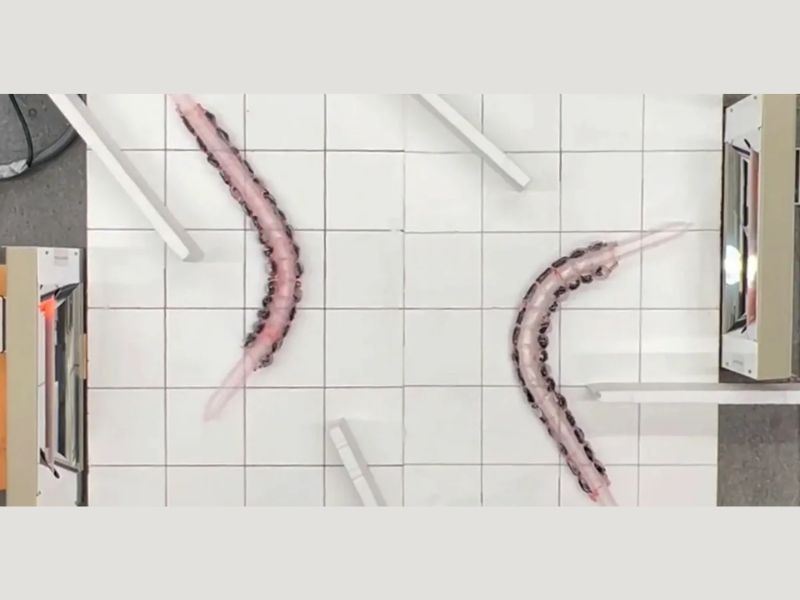
    Over a long period of evolution, vines honed the skill of finding light and growing toward it, ensuring their access to the sunlight needed for survival. Recently, scientists made a crawler robot inspired by vines capable of mimicking this behavior by moving toward light and heat sources. This innovation is detailed in a study from last month published in IEEE Robotics and Automation Letters.

    Shivani Deglurkar, a Ph.D. candidate in Mechanical and Aerospace Engineering at the University of California, San Diego, played a role in co-designing these automated “vines.” Due to their capacity to seek light and heat, the system doesn’t need an intricate centralized controller. The “vines” autonomously navigate toward a specified target. Additionally, even if some of the vines or roots are damaged or removed, the others continue to function seamlessly, as highlighted by Deglurkar.

    Though the technology is in its early stages, Deglurkar envisions its potential applications in solar tracking and possibly detecting and combating smoldering fires.

    It uses a novel actuator that contracts in the presence of light, causing it to gravitate towards the source. SHIVANI DEGLURKAR ET AL.

    The Photothermal Phase-change Series Actuator (PPSA)

    Deglurkar’s team crafted a unique actuator to enable the device to instinctively move toward heat and light. This innovative actuator, named Photothermal Phase-change Series Actuator (PPSA), utilizes a photo absorber in low-boiling-point fluid housed in numerous small pouches along the vine’s body.

    When illuminated, the PPSAs soak in light, warm up, swell with vapor, and shrink. Due to the pressure, they stretch by releasing material from their tips. Simultaneously, the PPSAs on the side facing the light contract, causing that part of the robot to shorten and guide it towards the light or heat source, as clarified by Deglurkar.

    Crafting Innovation for Instinctive Movement Toward Light and Heat

    The team conducted tests by positioning the system at various distances from an infrared light source. They verified that the device moves toward the source at close distances and that light intensity influences its effectiveness. More substantial light sources enable the device to bend more effectively towards the heat source.

    The PPSAs require approximately 90 seconds for a complete turn of the vine. Meanwhile, the device demonstrated the capability to maneuver around obstacles, driven by its natural inclination to search for light and heat sources.

    Charles Xiao, a Ph.D. candidate in Mechanical Engineering at the University of California, Santa Barbara, assisted in co-designing the vine. He expressed surprise at its responsiveness in meager lighting conditions. Xiao highlights that while sunlight is typically around 1000 W/m2, the robot demonstrated functionality at a fraction of solar intensity. This contrasts with similar systems that demand illumination exceeding that of a single Sun.

    Xiao emphasizes that the key advantage of the automated vine lies in its simplicity and cost-effectiveness. However, before introducing it to the market or deploying it in firefighting scenarios, further refinement is necessary. Xiao observes that the system responds slowly to light and heat signals and is not specifically designed for high-temperature applications.

    Subsequent prototypes must exhibit improved performance at high temperatures and possess the capability to detect fires for practical deployment. Therefore, Deglurkar outlines her team’s upcoming objectives, which involve refining the actuators to be more attuned to the wavelengths emitted by fires and enhancing their responsiveness with faster response times.


    Read the original article on: IEEE SPECTRUM

    Read more: Unveiling the Carnivorous Side of Fungi: Arthrobotrys Oligospora’s Predatory Lifestyle

  • Fluid Material Controls Light and Heat Passage in Windows

    Fluid Material Controls Light and Heat Passage in Windows

    Windows are essential for allowing both light and heat into a space, but there are situations where you may not want both simultaneously. Recently, engineers from North Carolina State University (NCSU) have created a novel material that enables windows to effortlessly transition between three distinct modes.
    Scientists have developed a new type of dynamic window that can switch between three modes, selectively blocking light and/or heat. Credit: Pixaobay

    Windows are essential for allowing both light and heat into a space, but there are situations where you may not want both simultaneously. Recently, engineers from North Carolina State University (NCSU) have created a novel material that enables windows to effortlessly transition between three distinct modes.

    The innovative dynamic windows have the capability to alternate between three distinct modes: a standard transparent mode that permits the entry of light and heat, a mode that obstructs heat while maintaining transparency to light, and a tinted mode that partially blocks light but not heat. This feature ensures that users are well-equipped to adapt to varying seasonal needs.

    Tungsten Oxide in Electrochromic Dynamic Windows

    The crucial element in this process is a substance known as tungsten oxide, a common component in electrochromic dynamic windows. Typically transparent, tungsten oxide darkens and restricts light when subjected to an electrical signal, making it suitable for windows that can adjust their tint as needed.

    However, in the recent research conducted by NCSU, scientists uncovered a remarkable additional capability. By introducing water, tungsten oxide transforms into tungsten oxide hydrate, introducing an additional setting when utilized in electrochromic windows.

    Tungsten Oxide Hydrate’s Phases in Action

    When in the off state, it maintains its transparency to both light and heat, making it an ideal choice for dreary winter days when maximizing both is essential. When introduced to some electrons and lithium ions, the material goes through a sequence of phases. Initially, it starts by blocking infrared light (felt as heat) while still remaining transparent to visible light.

    Eventually, as more electrons enter the material, it shifts into a dark phase where it obstructs both visible and infrared light, which is perfect for the summertime.

    The precise reason behind tungsten oxide hydrate’s behavior in this manner remains uncertain. However, the NCSU scientists have a working hypothesis. According to Jenelle Fortunato, the first author of the study, “The presence of water in the crystalline structure makes the structure less dense, so the structure is more resistant to deformation when lithium ions and electrons are injected into the material

    Understanding the “Cool” and “Dark” Phases of Tungsten Oxide Hydrate

    Our hypothesis is that, because tungsten oxide hydrate can accommodate more lithium ions than regular tungsten oxide before deforming, you get two modes. There’s a ‘cool’ mode, in which the injection of lithium ions and electrons impacts the optical properties but doesn’t cause structural change yet, absorbing infrared light. And then, after the structural change occurs, there’s a ‘dark’ mode that blocks both visible and infrared light.

    While there are numerous dynamic window technologies in progress, it’s not common to find a system with such a wide range of modes. When multiple modes are offered, they often necessitate bulkier configurations. However, in this instance, because only one material is needed, it should maintain the glass thickness and energy requirements at approximately the same level as traditional tungsten oxide windows.

    Delia Milliron, one of the co-corresponding authors of the study, stated, “The discovery of dual-band (infrared and visible) light control in a single material that’s already well-established in the smart windows community may expedite the development of commercial products with enhanced capabilities.”


    Read the original article on: New Atlas

    Read more: Transparent Solar Panels Windows of the Future