Tag: Magnetism

  • Magnetism Has Just Solved One of Quantum Tech’s Biggest Challenges

    Magnetism Has Just Solved One of Quantum Tech’s Biggest Challenges

    Credit: Pixabay

    Researchers have found a way to preserve quantum properties in 3D materials using magnetic confinement. By stabilizing excitons—energy-carrying quasiparticles—through the magnetic properties of chromium sulfide bromide, they address a major challenge in quantum technology.

    Quantum effects typically only work at small scales, making them hard to apply in real-world systems like quantum computers. However, Penn State and Columbia University physicists have developed a method to preserve these effects in 3D materials, offering a potential solution.

    “Maintaining the properties of 2D materials beyond the 2D limit is a tough challenge,” said Yinming Shao, Penn State assistant professor. These materials have great potential in flexible electronics, energy storage, and quantum technologies.

    The atomic lattice structure of the layered magnetic semiconductor chromium sulfide bromide (CrSBr) have magnetic moments, or spins, that align with each other and alternate on each layer.

    The team focused on excitons, which carry energy without an electrical charge. While excitons are stable in 2D materials like graphene, they are unstable in bulk materials like silicon. To solve this, the researchers turned to chromium sulfide bromide (CrSBr), which transforms into an antiferromagnetic state at low temperatures. This magnetic confinement keeps excitons in place, preserving their quantum properties in bulk materials.

    “This approach creates a single atomic layer without exfoliating it, while preserving a sharp interface,” said Shao.

    Experimental Validation of Magnetic Confinement

    Through optical spectroscopy, modeling, and calculations, the team confirmed that magnetic confinement worked consistently across different layers of the material. Their results were corroborated by a research group in Germany, who studied similar properties in magnetic semiconductors.

    “Our data aligned perfectly, which is remarkable since we used different crystal materials in different labs,” Shao explained.

    This breakthrough leverages magnetism, Van der Waals interactions, and excitons to achieve quantum confinement, opening new doors for advancing optical systems and quantum technologies. “Combining these aspects of physics was key to this discovery,” Shao concluded.


    Read Original Article: Scitechdaily

    Read More: Physicists Verify the Presence of a New Type of Magnetism

  • Scientists Have Verified the Existence of a Third Type of Magnetism

    Scientists Have Verified the Existence of a Third Type of Magnetism

    Scientists have recently developed and captured images of a new magnetic substance called altermagnetic material. Unlike some discoveries that take decades to materialize after being theorized, altermagnetism has quickly gained attention in the scientific community. In a new paper published in the peer-reviewed journal Nature, researchers demonstrate their ability to precisely tune these materials to create specific magnetism directions.
    GarryKillian//Getty Images

    Scientists have recently developed and captured images of a new magnetic substance called altermagnetic material. Unlike some discoveries that take decades to materialize after being theorized, altermagnetism has quickly gained attention in the scientific community. In a new paper published in the peer-reviewed journal Nature, researchers demonstrate their ability to precisely tune these materials to create specific magnetism directions.

    They’ve even confirmed a bold yet well-supported theory—that altermagnetism could merge ferromagnetism with antiferromagnetism, traditionally considered opposing forces. While this discovery may not affect everyday items like refrigerator magnets, it could be a breakthrough for those working on superconductors and topological materials at near-absolute zero temperatures, marking a significant advancement in these fields.

    Types of Magnetism

    Standard ferromagnetic materials (a term meaning “guiding iron“) operate by exerting a force on nearby objects made of iron or other magnetic elements and alloys. In contrast, antiferromagnetism describes how magnets interact subtly and almost imperceptibly with materials that don’t contain iron.

    Electromagnets—created by passing an electrical current through a coiled wire—function in a similar manner but with greater strength, relying on the electrical current. The Earth’s magnetic field, for instance, is partly due to its rotating, molten metal core, which behaves like an electromagnet.

    In an altermagnet, however, the direction of spin— which determines magnetism— can shift across the “grid” created by an ideal crystal. This is a material with perfectly organized crystal patterns, free from faults, directional changes, or other natural imperfections. For instance, many natural diamonds are ideal crystals, which contributes to their exceptional clarity. Metals can also form ideal crystals.

    Using Photoemission Electron Microscopy to Map Magnetism in Manganese Telluride

    In this experiment, the scientists employed polarized photoemission electron microscopy (PEEM) to reveal magnetic influences, mapping the entire grid structure of crystalline manganese telluride (MnTe). Their visual representation displayed the underlying crystal structure, with arrows on the grid indicating the magnetism directions at each point. The researchers were also able to manipulate the magnetic spin points.

    Earlier this year, researchers presented the first experimental evidence of altermagnetism, but without capturing the material in such detail.

    In that study, they used a momentum microscope focused on a specific area above the material to observe how its electrons were spinning, which is crucial to understanding magnetism. This latest work represents a significant step forward in imaging altermagnets in action.

    Nanomaterials are of great interest across many research fields. Quantum computers operate at this scale, though they are still far from being practical outside of highly controlled lab environments.

    Altermagnetic materials may also revolutionize spintronics, the study and optimization of solid-state devices—including solid-state drives (SSDs) in computers and smartphones—that utilize electron spin. While traditional ferromagnets serve their purpose, they aren’t perfect and can cause crosstalk, blurring separated bits of data.

    On the nanoscale, everything we store in our devices depends on the coordinated movement of electrons. If these materials can be improved, it could lead to higher efficiency, increased storage capacity within the same space, and reduced data loss during access. Additionally, as the scientists note in their paper, altermagnets could advance the development of practical superconductors and topological materials.


    Read the original article on: Popular Mechanics

    Read more: Researchers Uncover a Novel and Peculiar Pype of Magnetism

  • Using Magnetism to Induce Movement in Water Droplets

    Using Magnetism to Induce Movement in Water Droplets

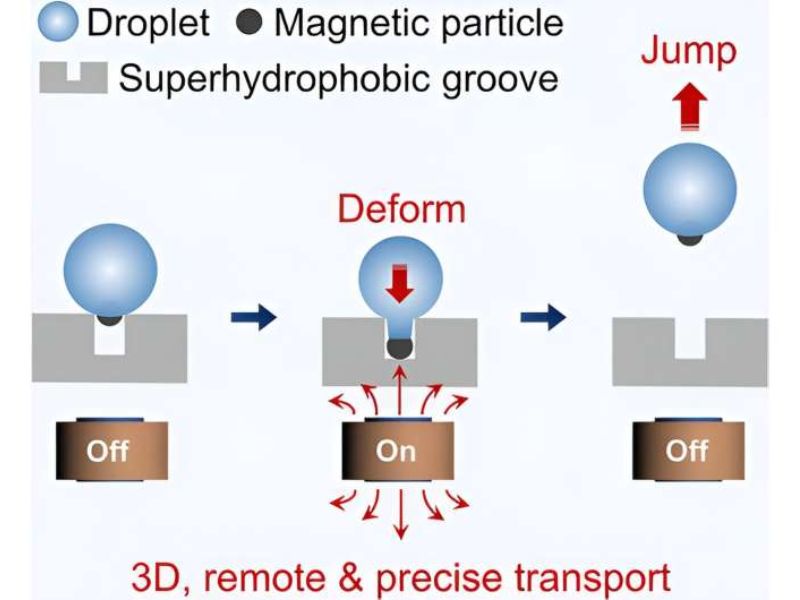
    A collaborative effort between material scientists from Sun Yat-sen University and Dalian University of Technology in China has demonstrated the ability to manipulate the movement of a single water droplet by incorporating a magnetic particle inside it and controlling an electromagnet's activation. This research was published in the journal ACS Nano.
    Credit: ACS Nano (2024). DOI: 10.1021/acsnano.3c11197

    A collaborative effort between material scientists from Sun Yat-sen University and Dalian University of Technology in China has demonstrated the ability to manipulate the movement of a single water droplet by incorporating a magnetic particle inside it and controlling an electromagnet’s activation. This research was published in the journal ACS Nano.

    The research team delved into the realm of on-demand droplet transportation as part of a broader investigation. In exploring methods to induce controlled movement in liquid droplets, specifically water, the researchers established various experimental setups.

    Crafting Grooves and Inserting Metal Pieces

    They carved small grooves on a flat surface, then applied a water-repellent varnish to facilitate droplet formation upon splashing. Once droplets formed, the team inserted minuscule pieces of metal into each droplet, where they remained held in place by surface tension. They positioned the entire setup over an array of electromagnets.

    However, upon activating the electromagnet, it attracted the bottom portion of the droplet downward into the groove, elongating it. Deactivating the electromagnet suddenly removed the downward force, causing the droplet to spring back to its original shape akin to a rubber band. However, due to the energy stored in the droplet, the recoiling motion propelled the droplet momentarily into the air before it rebounded.

    Utilizing this hopping method, the researchers discovered they could prompt a solitary droplet to ascend miniature stairs or traverse obstacles. They even experimented with filling the gap between two wires, resulting in a flashing light.

    To conclude, this technique holds potential for chemical transportation or mixing purposes, and may even find application in drug delivery systems. The researchers envision scaling down the approach for creating lab-on-a-chip technologies.


    Read the original article on: Phys Org

    Read more: Liquid Metals Could Be Used as Green Catalysts in Chemical Engineering Processes

  • A New Variant of Magnetism Promises More Powerful Memory Devices

    A New Variant of Magnetism Promises More Powerful Memory Devices

    Credit: Unsplash.

    New research has unveiled two or three types of magnetism, introducing the possibility of a highly sought-after magnetic property. While early compass users may have perceived magnets as mystical, the scientific understanding of magnetism has evolved. In addition to ferromagnetism and antiferromagnetism, a third type, altermagnetism, has been identified, challenging previous descriptions of magnetic behavior.

    Understanding Magnetism’s Complexity

    Magnetism arises from the spins of electrons rather than large-scale electric currents or changing fields. Electron spins, unlike planetary rotations, exhibit subatomic behaviors that contribute to magnetic moments.

    Although individual electron spins typically align randomly, in some instances, they synchronize to produce a significant magnetic field, as seen in ferromagnetic materials like iron.

    Antiferromagnetism and the Discovery of Altermagnetism

    Antiferromagnets, discovered in 1933, feature atoms with magnetic spins opposite their neighbors. However, their behavior is only apparent in an external magnetic field, leading to unique conductivity changes with potential applications.

    Altermagnets, a recent discovery, initially appear similar to antiferromagnets, with internal spins opposing neighboring spins. Yet, their rotational symmetry results in spin polarization, creating alternating bands. This characteristic bridges the properties of ferromagnets and antiferromagnets, promising enhanced magnetic memory recorders, particularly in spintronics.

    Applications in Spintronics and Beyond

    Spintronics, which utilizes electron spin states for information transfer, has long been researched with ferromagnets. However, their bulk magnetism poses scalability challenges. Antiferromagnets circumvent this issue but lack specific desired spin-dependent effects. Altermagnets offer a potential solution that balances the two traditional magnet types.

    Comparing ferromagnetism, antiferromagnetism, and altermagnetism, their respective natures were elucidated at different points in time. While ferromagnetism was understood earlier, antiferromagnetism and altermagnetism came into focus later. Although abstract, the distinction between translational and rotational symmetry is pivotal, particularly in delineating the disparities between antiferromagnetism and altermagnetism. Credit: Libor Šmejkal.

    Confirmation and Future Implications

    Recent research has confirmed the existence of altermagnetism in diverse materials, challenging prior notions and opening new avenues for exploration. Beyond magnetism, altermagnetism may shed light on superconductivity, offering fundamental insights with broad scientific implications.

    In conclusion, the discovery of altermagnetism highlights the complexity of magnetic phenomena and promises significant advancements in various fields, from electronics to materials science.


    Read the original article on Nature.

    Read more: Shattering the Temperature Barrier: The Quantum Leap of Quantum Ground State Acoustics in Modern Physics.

  • Researchers Uncover a Novel and Peculiar Pype of Magnetism

    Researchers Uncover a Novel and Peculiar Pype of Magnetism

    Researchers from ETH Zurich have identified a previously unseen type of magnetism. Experiments reveal that an artificially created material exhibits magnetism through a mechanism not observed before.
    Scientists have discovered a strange new form of magnetism
    Depositphotos

    Researchers from ETH Zurich have identified a previously unseen type of magnetism. Experiments reveal that an artificially created material exhibits magnetism through a mechanism not observed before.

    The widely recognized form of magnetism, known as ferromagnetism (the type that causes items to stick to your fridge), occurs when the spins of all electrons in a material align in the same direction. However, there are alternative forms, such as paramagnetism, a weaker version occurring when electron spins point in random directions.

    Discovery of Unconventional Magnetism in Moiré Materials

    In the recent investigation, ETH scientists identified an unconventional form of magnetism. The research focused on the magnetic characteristics of moiré materials, experimental substances created by layering two-dimensional sheets of molybdenum diselenide and tungsten disulfide. These materials possess a lattice structure capable of housing electrons.

    To discern the type of magnetism exhibited by these moiré materials, the team introduced electrons by applying an electrical current and gradually increasing the voltage. To gauge its magnetism, they directed a laser at the material and measured the intensity of light reflection for various polarizations. This process helps determine whether the electron spins align in the same direction (indicating ferromagnetism) or if they are oriented randomly (suggesting paramagnetism).

    The material in the new study started out with paramagnetism (left), which arises when the spins of the electrons (blue balls) all point in random directions. After a while the material exhibits kinetic ferromagnetism (right), where electrons pair up into doublons (red ball) which spread out to fill the lattice by causing the electrons’ spins to all align
    ETH Zurich

    At first, the material displayed paramagnetism, but with the gradual addition of electrons to the lattice, an abrupt and unexpected transformation took place, turning it into a ferromagnetic state. Interestingly, this shift precisely coincided with the lattice reaching a capacity beyond one electron per lattice site, eliminating the exchange interaction as the typical mechanism driving ferromagnetism.

    Ataç Imamoğlu, the lead author of the study, remarked, “This provided compelling evidence for a novel form of magnetism that defies explanation through the exchange interaction.”

    Emergence of Ferromagnetism through Doublon Formation and Kinetic Magnetism

    The research team put forth an alternative explanation: when more than one electron occupies the lattice sites, they form pairs known as “doublons,” which, through quantum tunneling, fill the entire lattice. During this process, the electrons minimize their kinetic energy by aligning their spins, resulting in the emergence of ferromagnetism. This form of “kinetic magnetism” has been theoretically predicted for many years but has not been observed in solid materials until now.

    The scientists intend to delve deeper into this phenomenon, exploring its characteristics, including whether it can be replicated at higher temperatures. It’s worth noting that, for this experiment, the material had to be cooled down to a fraction above absolute zero.


    Read the original article on: New Atlas

    Read more: Quest for Fractionalization in Condensed Matter Physics