Tag: Metal

  • New Heavy Metal Molecule May Unveil Secrets of Nuclear Waste Processes

    New Heavy Metal Molecule May Unveil Secrets of Nuclear Waste Processes

    Since its first synthesis in a post-WWII American lab in 1949, berkelium has stood out on the periodic table, defying quantum mechanics by adopting an extra positive charge that its relatives typically avoid.

    Now, scientists at Lawrence Berkeley National Laboratory—berkelium’s birthplace—have successfully bonded this elusive element with carbon, creating a rare organometallic complex. This breakthrough will allow for more detailed study of berkelium’s unique properties.

    Due to the challenges of producing and safely handling this heavy element, few chemists have had the chance to work with it. A single gram costs an astounding $27 million, though this experiment required only 0.3 milligrams of berkelium-249. Because heavy, radioactive elements are difficult to analyze on their own, forming an organometallic complex simplifies the process. These compounds, known for their high symmetry and strong covalent bonds with carbon, provide a clearer picture of an atom’s electronic structure.

    However, the resulting molecule is so reactive to air that only a handful of laboratories worldwide can handle it safely. This new compound, called “berkelocene,” mirrors the structure of ferrocene. Instead of an iron core, berkelium ions are sandwiched between two carbon rings, forming an organometallic complex. By studying this structure, researchers hope to gain deeper insights into berkelium and its potential behavior in nuclear waste materials.

    Decades of Progress in Actinide Carbon Bonding

    The X-ray structure of berkelocene shows a Bk(IV) ion sandwiched between two substituted cyclooctatetraene ligands. (Stefan Minasian/Berkeley Lab)

    For decades, chemists have sought to bind the 15 radioactive actinide elements into carbon-based structures. This effort began when uranium was stabilized in the thermodynamically favorable form of uranocene. By the 1970s, researchers had synthesized similar complexes—thorocene from thorium, protactinocene from protactinium, neptunocene from neptunium, and plutonocene from plutonium. More recently, even heavier actinides like americium and californium have been incorporated into organometallic structures.

    Yet, berkelium, element 97, had remained out of reach—until now.

    “This is the first time we’ve confirmed a chemical bond between berkelium and carbon,” explains Berkeley Lab chemist Stefan Minasian. “This discovery enhances our understanding of how berkelium and other actinides compare to their periodic table neighbors.”

    By stabilizing berkelium in this form, the team tested its electronic structure using ultraviolet-visible-near-infrared spectroscopy. Minasian notes that traditional periodic table predictions suggested berkelium would behave like terbium, a lanthanide. However, unlike its lanthanide counterpart, berkelium prefers a ‘+4’ charged state. This indicates that ionic bonds—similar to magnetic attraction—rather than stronger covalent bonds hold the organometallic molecule together.

    Single-crystal X-ray diffraction further revealed how berkelium is positioned within two carbon-hydrogen rings, confirming its bonding with carbon atoms.

    Understanding the behavior of heavier actinides like berkelium is crucial for addressing challenges in long-term nuclear waste storage and cleanup. As these unstable synthetic elements continue to accumulate, insights from such research may prove essential for managing their long-term impact.


    Read Original Article: Science Alert

    Read More: Abandoned Mines May Be Repurposed as Gravity-Powered Batteries

  • Wood and Metal Bonded Using Sound and 3D Printing

    Wood and Metal Bonded Using Sound and 3D Printing

    In Ultrasonic Joining, two materials like wood and metal are joined by heat produced from the friction of sound waves
    Wolf/TU Graz

    New Bonding Techniques Revolutionize Manufacturing

    Manufacturing could undergo a major transformation thanks to two new techniques developed by scientists in Austria to bond materials in an extremely strong way, eliminating the need for environmentally harmful adhesives.

    Although industrial adhesives effectively join components, they often rely on petroleum-based chemicals, which harm the environment. These adhesives require significant energy and resources to produce, release pollutants during their manufacture, and when discarded, can contaminate soil and water. Additionally, some substances used in adhesive production can be dangerous for workers handling them.

    Despite attempts to develop eco-friendly adhesives, such as plant-based or biodegradable options, researchers at Graz University of Technology (TU Graz) in Austria pursued a different strategy. They created two methods that effectively bond various woods with plastics, stainless steel, and titanium alloy.

    Addjoining: 3D Printing Bonds Materials at the Pore Level

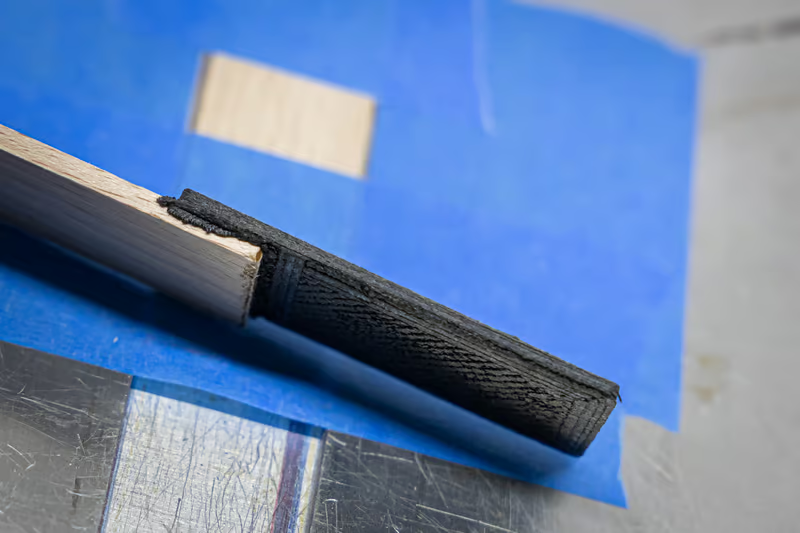
    The first technique, called “Addjoining,” used a 3D printing process to apply materials directly onto untreated wood so that the material penetrated the wood’s pores, forming a bond similar to that of an adhesive. The team then broke the bond to evaluate its strength.

    After the fracture, we found polymer in the wood pores and broken wood fibers in the polymer, suggesting that the fracture occurred in both the wood and the polymer, but not at the joint,” explains Gean Marcatto, who worked on the process as a postdoctoral researcher at TU Graz’s Institute of Materials Science, Joining and Forming.

    Enhancing 3D Printed Bonds with Laser Treatments

    The team believes that treating the wood with lasers to create more complex structures or larger pores could make these 3D-printed bonds even stronger, enhancing their ability to bond with other materials.Sergio Amancio, who led the research, says, We aimed to minimize the number of steps and avoid using chemicals. This technology is particularly beneficial for complex 3D geometries because it prints the components directly onto the surface in any required shape.

    The “Addjoining” technique 3D prints a material like the plastic composite seen here straight into the pores of an untreated piece of lumber
    Wolf/TU Graz

    Sound-based approach The second bonding technique developed was called “Ultrasonic Joining.” In this method, a tool called a sonotrode sent low-vibration, high-frequency waves through the junction of the wood and metal polymers, creating friction that generated enough heat to bond the materials together.

    This technique is particularly suitable for large components and 2D structures since it allows for a precisely localized bond,” says Awais Awan, co-author of the study.

    Applications for Green Bonding in Various Industries

    The researchers believe that the new green bonding techniques could find applications in the furniture, automotive, and aerospace industries.


    Read the original Article on: New Atlas

    Read more: The ISS Successfully Completed the First 3D Metal Printing in Space

  • Fluid-Like Electricity Flow: Low Quantum Noise in Strange Metal

    Fluid-Like Electricity Flow: Low Quantum Noise in Strange Metal

    The electrical current in this substance exhibits characteristics akin to the fluid dynamics of a liquid.
    Credit: Maxim Studio/Shutterstock

    Researchers have successfully constructed nanowires featuring a precise 1:2:2 ratio of ytterbium, rhodium, and silicon (YbRh2Si2), revealing an intriguing phase of matter known as the “strange metal.” This quantum material defies conventional expectations, particularly regarding the unique behavior exhibited when electricity is in play.

    Fluid-Like Motion of Electricity in Strange Metal Nanowires

    In typical electrical systems, electrons serve as carriers, transporting electrical energy from one point to another. However, the YbRh2Si2 nanowires are introducing a different narrative.

    Unlike conventional conductors, these nanowires showcase a fluid-like motion of electricity, challenging the traditional understanding of how charge moves.

    Unraveling the Mystery

    In a departure from the expected behavior of quasiparticles in solids, the YbRh2Si2 nanowires exhibit significantly lower shot noise than gold nanowires or the theoretical predictions for a quasiparticle system.

    This raises questions about the well-defined nature of quasiparticles or their potential absence, prompting a new vocabulary to describe the collective movement of charge.

    Heavy-Fermion System Insights

    Categorized as a heavy-fermion system, the peculiar behavior observed in YbRh2Si2 nanowires is anticipated to have broader implications. Researchers speculate on similar phenomena in diverse materials, urging a deeper exploration into the fundamental nature of electricity flow across various substances.

    The question arises: Are there universal principles governing charge behavior, irrespective of the microscopic building blocks within each material?

    Seeking Generic Patterns in Strange Metallicity

    The concept of “strange metallicity” appears in various physical systems, spanning copper-oxide superconductors with vastly different microscopic physics. The recurrent linear-in-temperature resistivity characteristic of strange metals prompts researchers to consider universal principles at play, transcending the differences in tiny structures.

    As investigations progress, researchers aim to unveil the deeper connections, potential consequences, and practical applications stemming from these groundbreaking insights.


    Read the original article on Science.

    Read more: Quantum Light’s Perception of Quantum Sound.