Tag: Mind

  • Robots With a Unified Mind: The Rise of Shared Intelligence

    Robots With a Unified Mind: The Rise of Shared Intelligence

    As automation rapidly progresses, robot collaboration has moved beyond science fiction. Picture a warehouse where dozens of machines move goods without crashing, a restaurant where robots deliver meals to the right tables, or a factory where robot teams instantly adapt their tasks to meet changing demand.
    Image Credits: Pixabay

    As automation rapidly progresses, robot collaboration has moved beyond science fiction. Picture a warehouse where dozens of machines move goods without crashing, a restaurant where robots deliver meals to the right tables, or a factory where robot teams instantly adapt their tasks to meet changing demand.

    Open-Source ROS2 Framework Brings Collaborative Robotics to Life

    This vision is becoming reality through an open-source framework built on ROS2, which enables multiple robots to collaborate intelligently, flexibly, and safely. The research was recently published in IEEE Access.

    Turning theory into practice requires studying how robots learn to navigate collectively. Successful collaboration depends on their capacity to communicate and make real-time decisions. The system incorporates three key elements:

    Autonomous navigation: Each robot computes the best routes using GPS-like algorithms adapted for dynamic environments. With simulation tools such as GAZEBO, they first train in virtual settings before operating in the real world. When faced with unexpected obstacles—like a fallen box—they immediately recalculate their route.

    Adaptable behavior: The system relies on “behavior trees,” which act like a dynamic set of instructions. For instance, if a robot gets stuck, it will first attempt to turn, then back up, and if the issue continues, it asks the central system for assistance. This method not only avoids collisions but also makes the system scalable—from just two robots in a lab to dozens in a factory.

    Computer vision and task allocation: Acting as the eyes and brain of the collaborative setup, this component ensures robots know both their position and their assigned tasks. It combines two key technologies: ArUco markers—similar to QR codes, small printed symbols placed in the environment that serve as reference points—and distributed cameras that track these markers, calculating each robot’s location with an accuracy of under 3 cm.

    It’s as though the robots maintain a continuously refreshed internal map. The second technology is smart task assignment: the system dispatches the nearest available robot, much like a courier selecting the quickest route. If one robot breaks down, another seamlessly takes over, ensuring operations continue without interruption.

    Scalable, intelligent, and ready for any industry. Image Credits: Francisco Yumbla/ESPOL

    Simulated Warehouses, Restaurants, and Labs Put Collaborative Robots to the Test

    To test the system, researchers simulated a variety of complex scenarios. Into industrial warehouses, robots transported packages between ArUco-marked stations while avoiding traffic jams. In restaurants, machines delivered meals to specific tables, coordinating to prevent collisions in tight hallways. In laboratories, diverse teams—including small robots and robotic arms—collaborated to carry out experiments.

    The results were impressive: robots located themselves with an average error margin of just 2.5 cm. The system also proved highly resilient—when one robot failed, another seamlessly took over its task within seconds.

    Scalability, often a challenge in robotics, was also demonstrated, as the framework functioned equally well with five robots as with 15, adapting smoothly to different environments.

    Because it is open-source and built on ROS2, a widely adopted platform, the system is accessible to any organization. Hospitals could program robots to deliver medications, logistics hubs could optimize package flow, and museums could deploy autonomous tour guides. At the same time, it reduces reliance on humans for repetitive duties, freeing staff for more strategic tasks.


    Read the original article on: Tech Xplore

    Read more: A Wheel-Legged Robot Moves with Improved Efficiency Across Different Types of Environments

  • Your Dog Seems To Sense What’s On Your Mind

    Your Dog Seems To Sense What’s On Your Mind

    Image Credits: Pixabay

    Your dog tilts its head when you cry, paces when you’re anxious, and shows up beside you during your toughest times. Coincidence? Hardly.

    After thousands of years of co-evolution, dogs have developed remarkable abilities to read our voices, faces, and even brain chemistry. Specialized areas in their brains respond to human speech, and making eye contact triggers a surge of oxytocin—the “love hormone”—wiring them to sense our emotions.

    This emotional awareness is rooted deep in their neurology. Like humans, dogs have specific brain regions attuned to vocal cues.  Brain imaging study show that their temporal cortex lights up when they hear voices, especially emotionally charged ones. Sounds like laughter, crying, or yelling trigger activity not only in their auditory cortex but also in the amygdala, the brain’s emotional center.

    Dogs are also surprisingly good at reading human faces. When they see images of people, their brains show heightened activity—especially when the face is familiar. One study found that a known human face activates both the emotional and reward centers in a dog’s brain, suggesting they interpret our expressions not in words, but through emotions.

    But dogs don’t just notice your emotions—they can absorb them too. This phenomenon, known as emotional contagion, is a basic form of empathy where one being reflects the emotional state of another.  A 2019 study showed that some dogs and their humans had synchronized heart rates during moments of stress, their heartbeats aligning in real time.

    This kind of empathy doesn’t rely on complex thought—it’s more instinctive, shaped by close relationships. Emotional bonding and learned responses likely prompt your dog to yawn when you do or whine when you’re upset—not any ability to literally read your mind.

    The Power Of Oxytocin

    One of the most fascinating findings in the human-dog bond is the chemical connection we share. When you and your dog engage in gentle eye contact, both of your oxytocin levels—the so-called “love hormone”—rise.

    In a study, owners who spent more time gazing into their dogs’ eyes had a noticeable boost in oxytocin afterward—and so did their dogs. This mutual oxytocin surge strengthens the emotional bond between you, similar to the bonding that happens between parents and infants.

    Remarkably, this effect appears to be exclusive to domesticated dogs. Even hand-raised wolves didn’t show the same hormonal response to human eye contact. As dogs evolved alongside humans, they developed this oxytocin feedback loop to forge emotional ties with us. So when your dog locks eyes with you, it’s not just adorable—it’s chemically connecting you both.

    Dogs impressively read our body language and facial expressions, in addition to making eye contact. Studies show they can even tell the difference between a smiling face and an angry one—just from photographs.

    Dogs have a subtle preference for using the right side of their brain when reading emotional signals, which makes them more likely to focus on the left side of a person’s face—similar to how humans and other primates interpret expressions.

    To understand how you’re feeling, dogs draw on several senses. A light, upbeat “Good boy!” paired with a calm stance gives off a very different vibe than a harsh tone and stiff posture. Impressively, dogs can even smell emotions. In a 2018 study, dogs exposed to sweat from frightened people showed higher stress levels than those that smelled sweat from happy individuals. In short, your stress has a scent that unsettles your dog, while your calm happiness can help soothe them.

    Born To Bond With Humans

    What made dogs so sensitive to human emotions? The key lies in their shared evolutionary path with us. Although their brains are smaller than those of their wild wolf ancestors, domestication may have rewired dogs’ brains to better handle social and emotional cues.

    Insights come from a Russian experiment with foxes, where those selectively bred for tameness developed more gray matter in brain areas tied to emotion and reward. This challenges the belief that domestication dulls intelligence—on the contrary, selecting for sociability can strengthen neural pathways involved in bonding.

    Over thousands of years living alongside people, dogs have developed brain systems highly attuned to human social signals. Despite having smaller brains than wolves, dogs’ brains may be specially adapted for forming close emotional ties with us.

    Dogs likely don’t understand the reasons behind your emotions or grasp that you have separate thoughts. Instead, they’re remarkably skilled at sensing what you’re feeling and responding appropriately.

    So while they might not truly “read minds,” dogs connect with us emotionally through behavior and expression. In today’s fast-paced world, that kind of intuitive connection goes beyond mere cuteness—it’s a powerful, evolved form of empathy that shows how friendship can cross the boundaries between species, even without words.


    Read the original article on: Phys.Org

    Read more: A Type of Fat in the Diet Interferes With the Body’s Cancer Defenses

  • Apple’s New Feature May Soon Let You Control Your IPhone With Your Mind

    Apple’s New Feature May Soon Let You Control Your IPhone With Your Mind

    According to a press release from New York-based startup Synchron, Apple is entering the brain-computer interface (BCI) space. The goal is to help individuals with limited mobility control iPhones, iPads, and the Vision Pro headset using thought-based commands.
    Credit: Pixabay

    According to a press release from New York-based startup Synchron, Apple is entering the brain-computer interface (BCI) space. The goal is to help individuals with limited mobility control iPhones, iPads, and the Vision Pro headset using thought-based commands.

    Revolutionizing Brain-Device Connections with Minimal Invasiveness

    Founded in 2016 by neurologist Dr. Tom Oxley, Synchron is a biomedical startup creating a less invasive method to connect devices to the brain, using a proprietary device that detects brain signals through blood vessels, unlike Neuralink, which requires open brain surgery. Bill Gates and Jeff Bezos back the company.

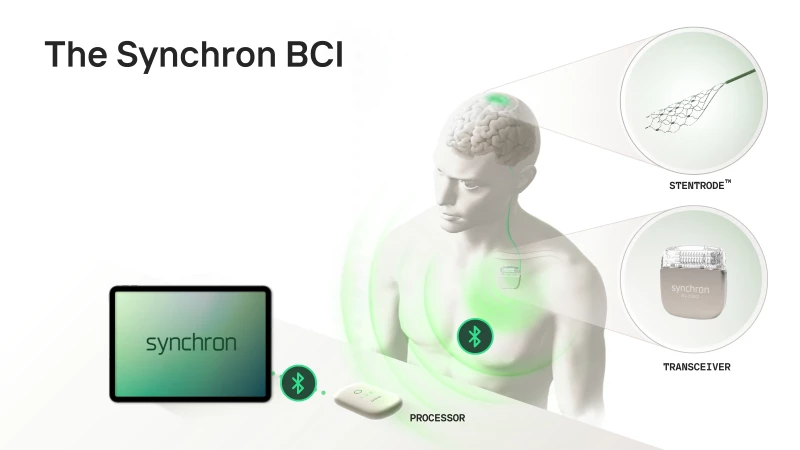
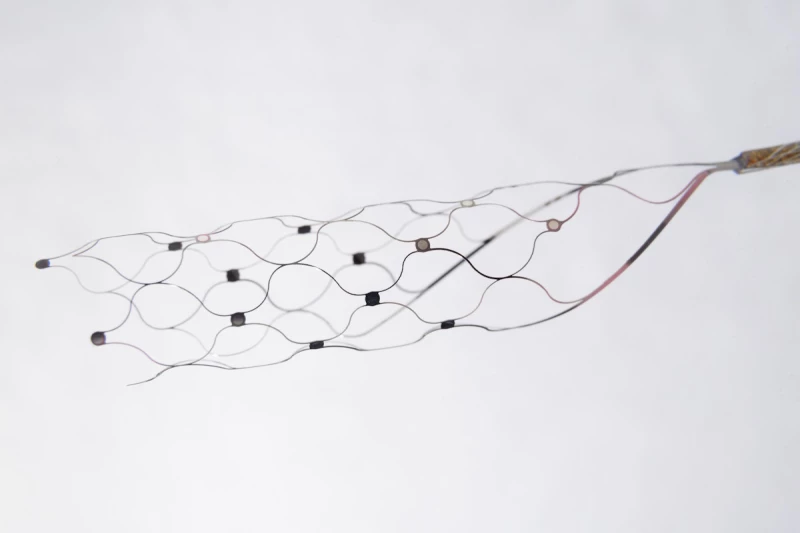
    Synchron embeds electrode sensors in a tube-shaped metal mesh called the ‘Stentrode. It picks up motor signals as it’s inserted through a blood vessel leading to the brain. The system sends signals to a small transmitter, which wirelessly relays them to a smartphone-sized processor. The processor interprets the signals in real time and converts them into commands for devices like an iPhone.

    Credit: The Synchron BCI consisting of a Stentrode threaded through a blood vessel, a wearable transceiver at its other end and a wireless processor to turn brain signals into commands for devices
    Synchron

    Breaking New Ground

    In July, an ALS patient in the U.S. used Synchron’s tech to operate an Apple Vision Pro headset, playing a card game, sending texts, and streaming video. Building on that, Apple now recognizes neural interfaces as a native input method, alongside touch, voice, and typing.

    Founded in 2016 by neurologist Dr. Tom Oxley, Synchron is a biomedical company exploring an endovascular method for linking devices to the human brain. Backed by Bill Gates and Jeff Bezos, the startup uses a proprietary device to detect brain signals without the need for open brain surgery, unlike the approach used by Elon Musk-fronted Neuralink’s.

    Credit: Synchron’s Stentrode hardware can be installed without opening up your skull – but you will still need to pop into an operation theater
    Synchron

    This makes Synchron the first biomedical company to integrate with Apple’s new BCI HID profile. “When we talk to participants in our clinical trials, their top priorities are always communication and creativity,” said CCO Kurt Haggstrom. “For most, that means using Apple products. Apple’s recognition of that need—and their response—shows a strong commitment to accessibility. It’s been a privilege to collaborate with their teams and contribute feedback that helped bring BCI HID to life.”

    Later this year, Synchron will conduct clinical trials with participants with severe disabilities, testing BCI HID features on Apple devices. Oxley estimates that 100 million people worldwide have physical conditions, like paralysis, limiting their use of digital technology. By integrating Synchron’s system with widely used Apple products, there’s potential to significantly reduce that number in the years ahead.


    Read the original article on: New Atlas

    Read more: IPhone 13 gets Satellite Emergency Feature with iOS 18.5

  • The Power of Focus: How One Shot Changed Everything

    The Power of Focus: How One Shot Changed Everything

    Credit:Canvas

    In a moment of intense competition at the Military World Championship, the difference between a nine and a ten was not just skill but focus. This story takes us through the journey of a determined individual who learned the art of focus and how it transformed their life.

    Finding Purpose

    At 23, feeling lost and without direction, the decision to excel in something became a driving force. Despite initial setbacks, the commitment to becoming a world champion led to hours of dedicated practice and a relentless pursuit of excellence.

    The Crucial Moment

    In the final moments of the championship, with nerves running high, a simple act of focusing on a dancing autumn leaf brought calmness. This deliberate choice was the culmination of mental training and a clear understanding of what focus truly means.

    Understanding Focus

    It isn’t just about concentration; it’s about choosing the right thoughts among many distractions. Three common challenges to focus were highlighted:

    1. Disturbing Thoughts: Our minds often fill with worries and self-doubt. Recognizing and replacing these thoughts with neutral ones helps regain focus.
    2. Constant Goal Pursuit: While goals are important, focusing solely on them can hinder present performance. Balancing goal orientation with present action is key.
    1. Time Constraints: In a fast-paced world, we try to do too much at once. Learning to prioritize and focus on one task at a time is crucial.

    Embracing Long-Term Focus

    Immediate gratification and constant feedback-seeking can hinder long-term focus. By turning inward, to our core values and strengths, we can find genuine contentment and satisfaction.

    Its Importance

    Focus is not just a skill; it’s a vital force that enables listening, learning, empathy, and self-direction. In a society filled with distractions, maintaining this virtue empowers us to navigate challenges and not be controlled by external pressures.

    A Call to Preserve

    As adults, we must pass on the value of focus to future generations. It’s not just about personal success but about shaping a world where it brings out the best in everyone.

    Embracing the Leaf’s Lesson

    In the end, the simple beauty of an autumn leaf taught a valuable lesson: it isn’t just about achieving goals but about finding peace and strength in the present moment. It’s a skill we must nurture and pass on for a brighter, focused future.


    Read more AI tool Detects Gender-Based Differences in Brain Structure