Tag: Monkeys

  • Harvard Reverses Aging in Monkeys; Human Trials Coming soon

    Harvard Reverses Aging in Monkeys; Human Trials Coming soon

    In a Moonshots podcast interview, Harvard Medical School genetics professor David Sinclair discussed a once-unthinkable breakthrough — restoring youth to animal cells and tissues. He said human clinical trials are set to start soon.
    Image Credits: Freepick

    In a Moonshots podcast interview, Harvard Medical School genetics professor David Sinclair discussed a once-unthinkable breakthrough — restoring youth to animal cells and tissues. He said human clinical trials are set to start soon.

    In the discussion, the scientist noted that experiments on mice and green monkeys showed strong potential for substantially reversing aging.

    We’ve successfully reversed aging in mice and monkeys, and human trials will start next year,” Sinclair stated.

    AI and Gene Therapy

    He said AI and gene therapies drive this breakthrough, promising major gains in health and longevity. Sinclair aims to make these treatments widely available, calling them “a turning point in preventative and regenerative medicine.”

    In his conversation with podcast host Peter Diamandis, Sinclair acknowledged that the concept of “reprogramming” adult cells to regain youthful traits was initially met with doubt. However, he and his team succeeded in selectively activating specific genes known as Yamanaka factors, effectively rejuvenating tissues.

    Additionally, a 2020 study demonstrated that gene therapy could reactivate genes typically found only in embryos, enabling the treatment of conditions like blindness caused by optic nerve damage.

    This isn’t science fiction—we do this regularly in my lab,” Sinclair remarked.

    Rejuvenation Results

    Animals involved in the research showed clear reductions in biological age and significant physical recovery. In mice, just four weeks of treatment with a molecular cocktail produced signs of rejuvenation, while monkeys exhibited noticeable optic nerve regeneration.

    We can actually track optic nerve rejuvenation, and the data shows it aging in reverse.

    The team also discovered that aging is largely driven by changes in the epigenome, rather than just cellular deterioration:

    “The epigenome is the real issue because aging stems from the loss of instructions that tell cells how to function,” Sinclair explained.

    Their work demonstrated that these instructions could be restored—without cloning. “We found a safe way to reset the epigenome without needing to be reborn,” he said.

    Following the animal studies, the team is preparing to move on to human trials. Sinclair stated that testing will begin next year, initially targeting individuals with eye conditions like glaucoma and ischemic optic neuropathy, as the eye is easily accessible and allows for clear measurement of outcomes.


    Read the original article on: O globo

    Read more: Ice Shown to Break Down Iron More Quickly Than Water

  • Scientists Use Engineered Stem Cells to Slow Aging in Monkeys, Study Reveals

    Scientists Use Engineered Stem Cells to Slow Aging in Monkeys, Study Reveals

    BEIJING (WSYX) — Scientists have shown that genetically modified human stem cells can delay aging symptoms in monkeys, potentially paving the way for treatments aimed at age-related decline in humans.
    Image Credit: Pixabay

    BEIJING (WSYX) — Scientists have shown that genetically modified human stem cells can delay aging symptoms in monkeys, potentially paving the way for treatments aimed at age-related decline in humans.

    Stem Cell Therapy Cuts Aging Signs in Monkeys Without Side Effects

    Over a 44-week period, researchers treated cynomolgus monkeys with senescence-resistant mesenchymal progenitor cells (SRCs) engineered with the longevity-associated FOXO3 gene. The therapy lowered indicators of cellular aging, chronic inflammation, and tissue damage, all without significant side effects.


    Scientists slow aging in monkeys with engineered stem cells, study finds (Cell)

    Therapy Boosts Memory, Brain, Bone, and Reproductive Health While Reversing Tissue Aging in Monkeys

    Monkeys treated with the therapy exhibited better performance in memory tasks, enhanced brain structure, improved bone density, and healthier reproductive function. Further analysis revealed signs of rejuvenation in the blood and various organs, with biological “aging clocks” indicating that tissue age had been reduced by several years.

    Published in Cell, the study identifies exosomes—small vesicles released by the transplanted cells—as major contributors to the observed rejuvenation. Although still in the early stages, the researchers noted that this is the first evidence showing that engineered human progenitor cells can slow systemic aging in primates, offering a promising foundation for future regenerative therapies in humans.


    Read the original article on: abc6

    Read more: CRISPR Test On Monkeys And No Off-target Mutations

  • CRISPR Test On Monkeys And No Off-target Mutations

    CRISPR Test On Monkeys And No Off-target Mutations

    In the initial comprehensive study conducted on monkeys, it was discovered that CRISPR does not induce unintended off-target mutations.
    In the initial comprehensive study conducted on monkeys, it was discovered that CRISPR does not induce unintended off-target mutations. Credit : galitskaya/Depositphotos.

    As the first human trials utilizing the potentially groundbreaking CRISPR gene editing technique are set to begin in the UK and the US, there are lingering concerns regarding the overall safety of this system. To address these concerns, a group of Chinese researchers has conducted a comprehensive evaluation of the impact of CRISPR-Cas9 on non-human primates, aiming to determine if it leads to off-target mutations.

    Last year, a contentious study proposed that CRISPR could introduce unintended mutations. However, due to numerous criticisms from scientists regarding the reliability of the data, the study was eventually retracted.

    Although the previously flawed research has been retracted, significant apprehensions persist regarding the possibility of unintended mutations arising from gene editing using the CRISPR technique. The recent Chinese study represents the first comprehensive investigation that examines the relationship between the CRISPR process and de novo mutations, which are newly occurring mutations that arise spontaneously in a fertilized egg during the initial stages of embryogenesis, specifically in rhesus macaque monkeys.

    Employing The System

    The study was initiated by employing the CRISPR system on macaque zygotes, which are fertilized eggs. The primary objective of the researchers was to assess the targeting specificity of the technique by specifically targeting the deletion of a gene called MCPH1, known to be associated with birth defects in humans. In the embryos that underwent the initial treatment, the CRISPR process effectively eliminated the MCPH1 gene in 13 out of the 15 samples, showcasing successful results.

    As a result, a total of five monkeys were eventually gestated, and four of them successfully survived delivery. All of the offspring monkeys exhibited the desired CRISPR modifications. However, the subsequent course of action involved conducting thorough whole genome sequencing to gain a deeper understanding of whether the gene-editing process had led to unintended mutations.


    Read The Original Article: Chinese scientists test CRISPR on Monkeys and find no off-target mutations

    Read More: A Spider Monkey’s Remains Tell a Story of Old Diplomacy in the Americas

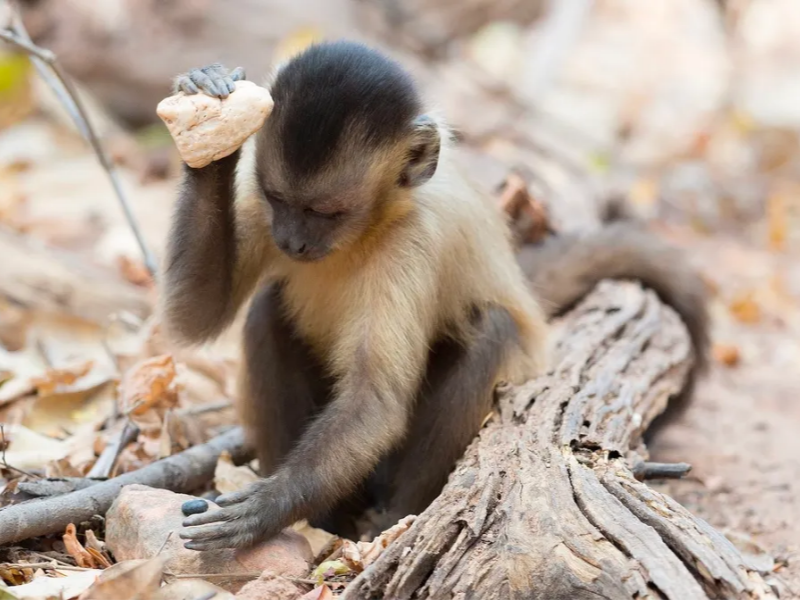
  • Monkeys– Not Humans– Made Old Sets of Stone Tools in Brazil, Study Discovers

    Monkeys– Not Humans– Made Old Sets of Stone Tools in Brazil, Study Discovers

    (Dorit Bar-Zakay/Moment/Getty Images)
    (Dorit Bar-Zakay/Moment/Getty Images)

    Scientists think that old rock tools found in Brazil are the work of capuchin monkeys, not early human beings, the art and design website Artnet reported, mentioning an academic article.

    We are confident that the very early archeological websites from Brazil might not be human-derived but might come from capuchin apes,” wrote archaeologist Agustín M. Agnolín and also paleontologist Federico L. Agnolín in an article released in the peer-reviewed science journal The Holocene in November.

    The article stated that archeologists discovered what they think to be old rock tools made from locally happening quartz and quartzite cobbles during past excavations at Pedra Furada– a collection of over 800 archeological sites in Piauí in northeastern Brazil.

    According to the article, the oldest of the rock tools found seems up to 50,000 years of age, which resulted in some academics theorizing that it offered evidence of early human habitation of the area.

    Unforeseen findings from 2016, however, posed a challenge to that theory.

    The findings revealed that capuchin monkeys in northeastern Brazil can making and using a big range of rock devices.

    This increased the possibility, as was first recommended in 2017, that apes– not humans– could be responsible for generating the Pedra Furada explorations.

    As well as according to Agnolín as well as Agnolín, the researchers behind The Holocene post, there is currently a persuading quantity of proof to suggest that the devices weren’t human-made.

    Our review of the evidence recommends that the old sites in Brazil do not actually belong to the first Americans, however, are really the product of the ape activity,” Federico L. Agnolín informed Argentina’s National Scientific and Technical Research Council (CONICET).

    The scientists compared the tools found at Pedra Furada to those that capuchin apes make today.

    “The outcome was unexpected: There was no distinction between the supposed human devices from 50,000 years back and those produced by monkeys today,” Agustín M. Agnolín informed CONICET.

    The researchers looked to past research study and observations of capuchin monkey populaces which reveal that the primates use small rocks as hammers and huge, flatter rocks as anvils to crack open nuts and seed pods.

    The outcome is that the rocks used frequently break, generating rock fragments that are extremely similar to those produced by human beings when carving stone tools,” stated Agustín M. Agnolín, per CONICET’S news release.

    In addition to this, the researchers stated in The Holocene article that there wasn’t proof to recommend a trace of human existence, noting the absence of hearths or traces of dietary remains.

    Our research reveals that the devices from Pedra Furada and also other nearby sites in Brazil were nothing more than the product of capuchin apes breaking nuts and rocks some 50,000 years before the present,” Federico L. Agnolín informed CONICET.


    Read the original article on SCIENCE ALERT.

    Read more: The Ocean Colour System Gets a ‘Refresh,’ Permitting More Precise and Accurate Measurements