Tag: Moon

  • If an Asteroid Hits the Moon in 2032, Earth could be Affected

    If an Asteroid Hits the Moon in 2032, Earth could be Affected

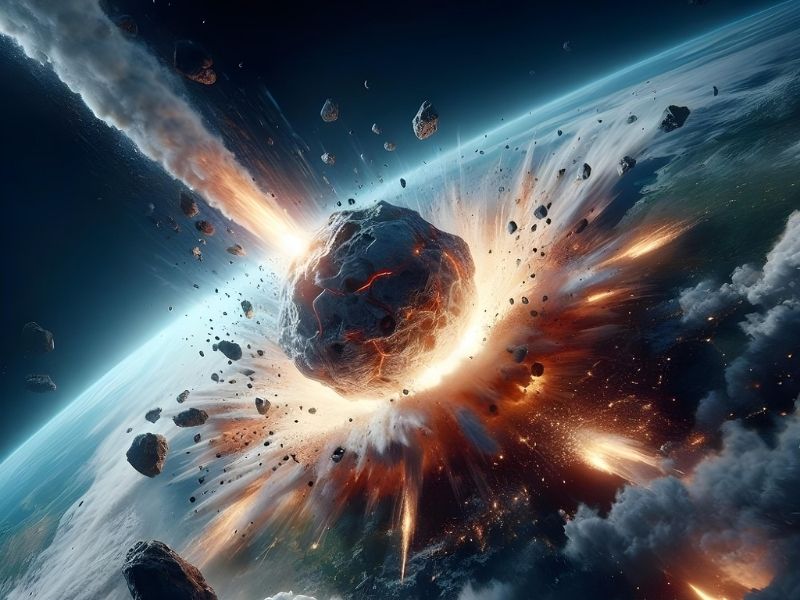
    There’s often a silver lining to any scenario. In 2032, the Moon could quite literally have one if it were struck by a 60-meter-wide asteroid.
    Image Credits:(Mark Garlick/Science Photo Library/Getty Images)

    There’s often a silver lining to any scenario. In 2032, the Moon could quite literally have one if it were struck by a 60-meter-wide asteroid.

    While the probability remains relatively low—about 4 percent—it’s not insignificant.

    The Dual Impact of a Lunar Collision

    Scientists are preparing for both the risks—threats to satellites and meteor fallout—and the rare chance to study the Moon’s geology, seismic activity, and chemistry in detail.

    A recent preprint by Yifan He of Tsinghua University and colleagues, published on arXiv, explores the scientific opportunities that could arise should such an impact occur.

    Image Credits:Orbital path of Asteroid 2024 YR4. (ESA Orbit Visualization Tool)

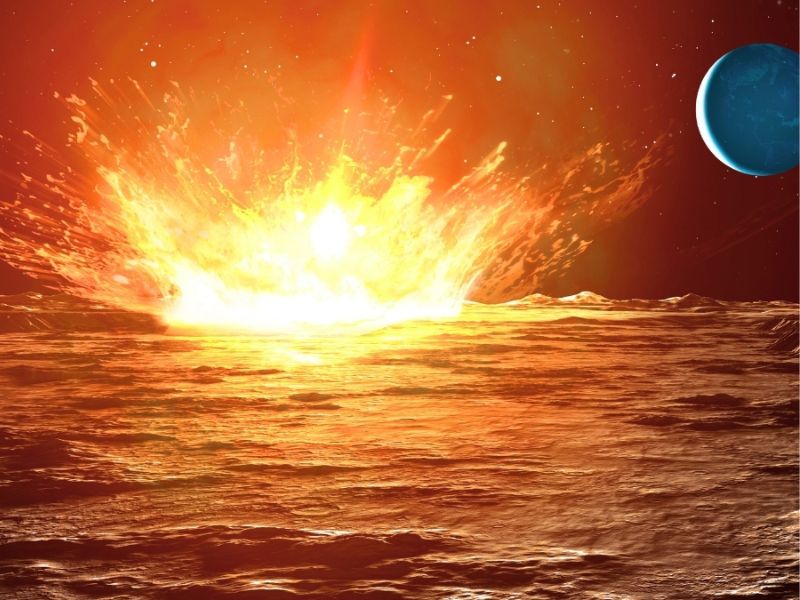
    On December 22, 2032, Asteroid 2024 YR4 carries a 4 percent chance of colliding with the Moon. If a strike occurs, the energy released would be comparable to detonating a medium-sized thermonuclear weapon on the lunar surface.

    Such an impact would be about six orders of magnitude stronger than the most recent significant lunar collision in 2013, which was caused by a far smaller meteoroid.

    A Rare Opportunity for Real-Time High-Energy Impact Research

    For researchers who study high-energy impacts, the event would be an unexpected windfall. Observing a real collision would provide unique data beyond what simulations can offer.

    The strike would vaporize lunar rock, generate plasma, and be visible from much of the Pacific region, where it would be nighttime at the moment of impact.

    Even days after the collision, the molten material from the impact will continue to cool, giving infrared instruments like the James Webb Space Telescope ample opportunity to study the cooling process and observe how lunar craters form in real time.

    The impact is expected to create a crater about 1 km wide and 150–260 meters deep, with a central pool of molten rock roughly 100 meters across. Comparing this crater to others on the Moon will provide insights into its history of bombardment.

    A Record-Breaking Moonquake Offers Insight into the Lunar Interior

    The strike would also trigger a global “moonquake” of magnitude 5.0—the strongest ever recorded by lunar seismometers. Although more quakes are expected as instruments are deployed, this one offers a rare chance to study the Moon’s interior.

    By tracking the quake’s propagation, scientists can learn about the Moon’s internal structure and composition without needing to artificially induce seismic events.

    The final scientific opportunity comes from the debris ejected by the impact. Up to 400 kg could survive reentry, giving astronomers a charred, large-scale lunar sample for free.

    For those familiar with The Eye episode of Andor or Neal Stephenson’s Seveneves, the resulting spectacle would be nothing short of breathtaking.

    Millions of Lunar Fragments Lighting Up the Sky

    Simulations predict that by Christmas 2032, Earth could see up to 20 million meteors per hour, many visible to the naked eye. Among these, roughly 100–400 would be larger fireballs per hour.

    Of course, there’s a downside. The 400 kg of meteorites would likely land in South America, North Africa, or the Arabian Peninsula.

    Though sparsely populated, even a few kilograms of space rock could damage a city like Dubai. An arguably bigger concern is the threat to satellite mega-constellations, which are vital for modern navigation and internet services.

    The event could trigger “Kessler Syndrome,” crippling satellites and blocking safe launches for years.

    Considering a Deflection Mission to Prevent Lunar Impact

    Some space agencies are considering a mission to deflect Asteroid 2024 YR4, though nothing is finalized.

    The impact remains uncertain, with just a 4% chance—less likely than rolling a Nat 20 in D&D.

    If the odds increase, humanity must choose between deflecting the asteroid—sacrificing science—or risking it to protect satellites and lives.


    Read the original article on: Sciencealert

    Read more:Researchers Packed a Powerful Computer Into One Thread
  • NASA Aims to Deploy a Nuclear Reactor on the Moon and This Is the Reason

    NASA Aims to Deploy a Nuclear Reactor on the Moon and This Is the Reason

    NASA and the U.S. Department of Energy have confirmed their ongoing collaboration to create a nuclear fission reactor for use on the Moon’s surface.
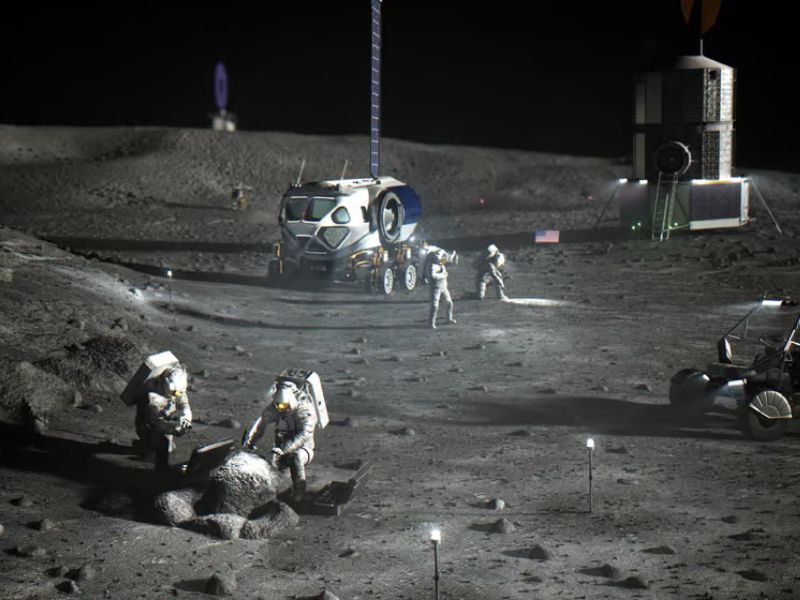
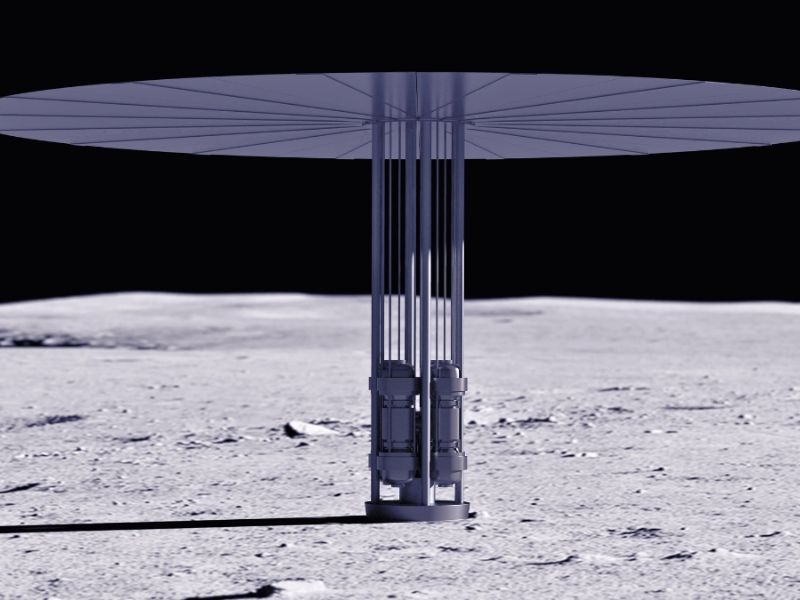
    Image Credits: An artist’s impression of a fission power source on the surface of the Moon. (NASA)

    NASA and the U.S. Department of Energy have confirmed their ongoing collaboration to create a nuclear fission reactor for use on the Moon’s surface.

    NASA announced it aims to finish the reactor’s development, including possible Earth tests, by 2030. The reactor is intended to provide reliable, long-term power for lunar missions, reducing the need to transport fuel from Earth.

    “This agreement lets NASA and the Department of Energy collaborate on technologies for a new era of space exploration,” said NASA administrator Jared Isaacman.

    They face a tough task. Building a safe, reliable nuclear reactor is hard on Earth—on the Moon, it’s even harder. Its harsh environment makes fission reactor design difficult, especially managing waste heat.

    A concept image of NASA’s Fission Surface Power Project. (NASA)

    Cooling a Reactor on the Moon

    On Earth, nuclear reactors use water to remove heat, releasing it as steam. On the Moon, low gravity, near-vacuum, and no atmosphere make fluids behave differently and heat hard to disperse.

    Potential solutions include using solid-state heat conduction or liquid metal coolants, though both introduce extra design challenges.

    The Moon is also blanketed in fine dust. Unlike Mars, which experiences massive dust storms, lunar dust is abrasive and becomes electrostatically charged from solar radiation. It sticks to surfaces, so Moon equipment must be designed to resist dust interference.


    Read the original article on: Sciencealert

    Read more: Effects of Pointing Inaccuracies in Quantum key Distribution Systems

  • Japanese Startup Attempts Moon Landing After First Failure

    Japanese Startup Attempts Moon Landing After First Failure

    The Resilience lander, developed by Japanese company ispace, has spent six months en route to the Moon and is targeting a landing in its far northern region. This marks ispace’s second attempt to reach the lunar surface.
    Image Credits: Pixabay

    The Resilience lander, developed by Japanese company ispace, has spent six months en route to the Moon and is targeting a landing in its far northern region. This marks ispace’s second attempt to reach the lunar surface.

    The touchdown is scheduled for June 5 at 3:24 p.m. ET, near the center of the Mare Frigoris (“Sea of Cold”). ispace will stream the landing live on its YouTube channel, starting about an hour before the scheduled time. You can also watch it via the feed below.

    Resilience Takes the Long Road to the Moon

    Tokyo-based ispace launched its second Moon mission on January 15, with the Resilience lander sharing a ride with another lunar-bound craft. While Firefly Aerospace’s Blue Ghost landed on March 2, Resilience took a longer route. It first entered an elliptical transfer orbit, then used a lunar flyby to switch to a low-energy path toward the Moon. After completing all necessary orbital maneuvers, Resilience is now in low lunar orbit, awaiting its landing attempt.

    For touchdown, the lander will automatically ignite its main engine to slow down and descend from orbit to the surface. On board is a small rover named Tenacious, bound for the Mare Frigoris region in the Moon’s far north, along with scientific instruments—mostly from Japanese commercial space companies—intended to study the lunar terrain.

    Lessons Learned from ispace’s First Failed Moon Landing

    This marks ispace’s second attempt to land on the Moon, following a failed effort in April 2023. During that first mission, the Hakuto-R M1 lander misjudged its altitude—believing it was nearly at the surface when it was still about 5 kilometers (3 miles) above. As a result, it slowed prematurely, ran out of fuel, and crash-landed. The mission carried both commercial and government payloads, including a small two-wheeled robot developed by Japan’s space agency.

    Despite that setback, ispace remains optimistic. “We’ve built on the lessons from Mission 1 and this current journey to the Moon, and we feel confident in our preparations for a successful landing,” said ispace founder and CEO Takeshi Hakamada.

    The Moon’s rugged surface has challenged many recent landers. Texas-based Intuitive Machines, for instance, saw both its Nova-C and Athena landers tip over after landing attempts.


    Read the original article on: Gizmodo

    Read more:Rare ‘Smiley Face’ Moon About to Hit The Sky With Venus And Saturn

  • Our Moon Is About to Glow Blood Red—Here’s the Reason.

    Our Moon Is About to Glow Blood Red—Here’s the Reason.

    Credit: Pixabay

    This Thursday night, for the first time in nearly two-and-a-half years, the Moon will put on a stunning celestial display, glowing in a deep red hue.

    What was once seen as a harbinger of doom is now a perfect reason to step outside and witness the wonders of nature. So grab a blanket and a warm drink, settle in, and enjoy the show as the Moon transforms for a few hours.

    The term “blood moon” is an informal way to describe the Moon’s reddish appearance during a total lunar eclipse.

    Less commonly, it can also refer to a sequence of four total lunar eclipses observed from the same location within two years. Since total eclipses occur only four to five times per decade in any given spot, witnessing four consecutive ones is a rare event.

    Why Does the Moon Turn Red?

    Diagram of a lunar eclipse (not to scale).

    Like any solid object in the path of light, Earth blocks sunlight, casting a shadow into space. However, unlike Earth’s rocky surface, its atmosphere is thin enough to let some light pass through. As sunlight filters through the atmosphere, shorter blue wavelengths scatter, while longer red wavelengths bend around the planet, giving the Moon its eerie crimson glow.

    This same scattering effect makes the sky appear blue during the day and causes sunrises and sunsets to glow in shades of orange and red.

    Because of this refraction and scattering, Earth casts a cone-shaped shadow with a glowing, rust-colored fringe. The Moon only crosses this shadow a few times a year due to its small size, its proximity to Earth, and its slightly tilted orbit.

    On rare occasions, a total lunar eclipse coincides with a supermoon and a blue moon, creating what NASA calls a Super Blue Blood Moon—a seemingly paradoxical but spectacular event.

    During a total lunar eclipse, direct sunlight is completely blocked, leaving only the refracted red light to illuminate the Moon. The result is an eerie, blood-like glow across its surface—a stunning sight that serves as a reminder of the cosmic ballet constantly unfolding above us.


    Read Original Article: Science Alert

    Read More: Sunken Continents Could Unbalance Earth’s Magnetic Field

  • Fragments of Rock Uncover the Moment the Moon Became Solid

    Fragments of Rock Uncover the Moment the Moon Became Solid

    Credit: Pixabay

    The early history of the Moon remains a topic of scientific investigation. Despite extensive knowledge about Earth’s natural satellite, some pieces of its history are still being unraveled.

    Recent studies of rock samples collected during the Apollo missions have provided new insights, revealing that the Moon solidified approximately 4.43 billion years ago—around the same time Earth became capable of sustaining life.

    Team of Researchers Pinpoints the Solidification Timeline

    A team led by Nicolas Dauphas from the University of Chicago analyzed the composition of Moon rock fragments. By studying the different proportions of elements in the rocks, they gained valuable information about the Moon’s early stages. Initially, the Moon was a molten mass, formed by a collision between two early Solar System bodies

    A collision billions of years ago is thought to have created our moon. (ESA/Medialab)

    As the Moon cooled, the molten material began to crystallize, eventually forming separate layers. Nearly 99 percent of the lunar magma ocean solidified, leaving behind a unique residual liquid known as KREEP, which stands for potassium (K), rare earth elements (REE), and phosphorus (P).

    Dauphas and his team examined the KREEP in the rocks, discovering that it formed roughly 140 million years after the Solar System’s birth. This finding is based on Apollo rock samples, with scientists eager to further explore the South Pole-Aitken basin, a region set to be visited by Artemis astronauts. If KREEP is present there, it would suggest a consistent distribution of this material across the Moon’s surface.

    Thorium concentrations on the Moon, as mapped by Lunar Prospector. Thorium correlates with the location of KREEP. (NASA)

    The team identified key clues about the Moon’s cooling process in the decay of a rare earth element called lutetium. Over time, lutetium decays into hafnium, and its presence in rocks helps determine their age. The Moon’s solidification and formation of KREEP resulted in much less lutetium compared to other contemporaneous rocks.

    Breakthrough in Understanding the Moon’s Early Cooling

    By analyzing tiny samples of Moon rocks, Dauphas’ team measured the hafnium-lutetium ratio within lunar zircons. This analysis confirmed that the rocks formed in a KREEP-rich reservoir, with ages indicating the formation of these reservoirs around 4.43 billion years ago—roughly 140 million years after the Solar System’s formation.

    Interestingly, the team’s findings suggest that the crystallization of the lunar magma ocean occurred during the period when leftover planetary embryos and planetesimals bombarded the Moon. These objects, remnants from the Solar System’s formation, continued to impact the early planets, including Earth and the Moon.

    The Moon’s formation likely began around 60 million years after the Solar System’s birth, following a collision between a Mars-sized planet called Theia and the early Earth. This collision launched molten debris into space, eventually coalescing to form the Moon. As the Moon cooled, it developed KREEP layers, marking an essential milestone in its history.

    The decay of lutetium into hafnium in KREEP rocks marks a significant step in understanding the Moon’s earliest phases. Future rock samples from the South Pole-Aitken basin will help scientists fill in more gaps in the Moon’s history, particularly regarding the formation of mare basalts and the cooling of lunar rock.

    Timing of Lunar Cooling and Its Earthly Significance

    Determining the exact timing of lunar cooling not only reveals the Moon’s history but also sheds light on Earth’s evolution. The impact that formed the Moon was likely the last major collision Earth experienced, marking a turning point toward a more stable environment capable of supporting life.

    This discovery aligns with other evidence,” said Dauphas. “It sets the stage for even more revelations about the Moon, especially as the Chang’e and Artemis missions move forward. There are still many unanswered questions waiting for us.”


    Read the original article on: Science Alert

    Read more: Scientists Confirm: The Pandemic Had No Impact on the Moon

  • Scientists Confirm: The Pandemic Had No Impact on the Moon

    Scientists Confirm: The Pandemic Had No Impact on the Moon

    Credit: Pixabay

    Can a pandemic change the Moon’s temperature? A 2024 study suggested global lockdowns reduced Earth’s heat radiation, cooling the Moon. But new research says otherwise.

    The original idea: As businesses shut down in 2020 and people stayed home, carbon emissions dropped, lowering terrestrial radiation—the heat Earth emits and the Moon absorbs. Scientists noted a dip in lunar nighttime temperatures during April and May 2020, aligning with peak lockdowns.

    However, researchers from Missouri University of Science and Technology (Missouri S&T) and the University of the West Indies (UWI) revisited the data and found inconsistencies. Similar temperature drops occurred in 2018 and steadily declined in 2019, unrelated to COVID-19.

    The new analysis found cyclical temperature variations. (Schonberg and Haque, Monthly Notices of the Royal Astronomical Society Letters, 2025)

    Lunar Temperature Shifts Follow Natural Cycles, Not Pandemic Effects

    NASA’s Lunar Reconnaissance Orbiter data points to natural temperature cycles rather than a single pandemic-related dip. Another 2021 study showed emissions reductions during COVID-19 mainly affected Earth’s lower atmosphere, not enough to alter lunar temperatures.

    “We’re not denying temperatures dropped at times,” says Missouri S&T engineer William Schonberg. “But it’s a stretch to say human activity was the main cause.”

    The new study even suggests fewer pollutants and clearer skies could have increased heat reflection to the Moon, potentially warming it instead.

    Many factors influence lunar temperatures, but researchers conclude human activity—during COVID-19 or otherwise—likely has little to no measurable impact.

    “During the Moon’s nighttime, Earth’s heat and radiation might have a tiny effect,” Schonberg adds, “but it would be too small to notice.”


    Read Original Article: Science Alert

    Read More: “Shocking”: Record-Breaking January Heat Leaves Scientists Stunned

  • 4 Key Factors to Consider Before Mining the Moon

    4 Key Factors to Consider Before Mining the Moon

    By the end of this decade, nations and private companies could begin mining the Moon surface. As space becomes increasingly accessible, it’s essential to pause and consider what commercial activities should be allowed, especially on the Moon.
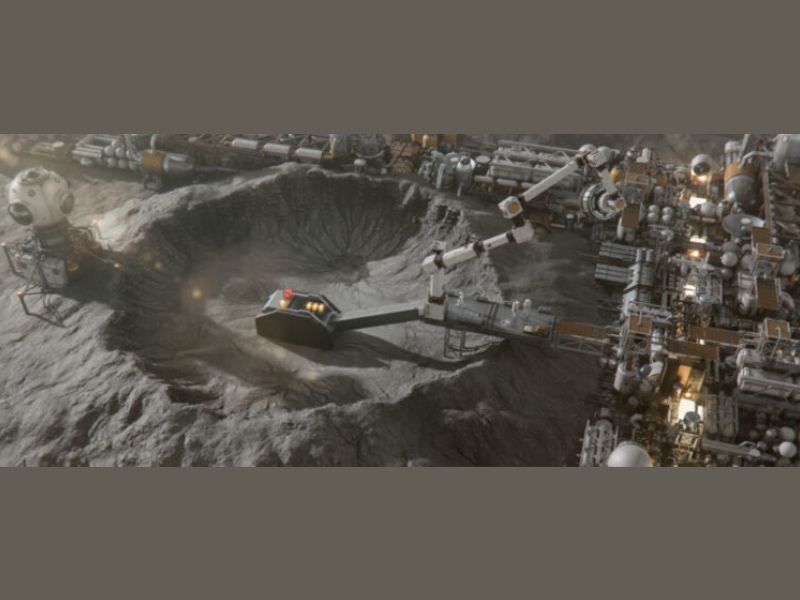
    Artist’s concept of a mining base on the Moon. (gremlin/Getty Images)

    By the end of this decade, nations and private companies could begin mining the Moon surface. As space becomes increasingly accessible, it’s essential to pause and consider what commercial activities should be allowed, especially on the Moon.

    This is the moment to establish clear rules and regulations to protect humanity’s shared future in space. Proper governance will ensure the Moon remains a symbol of inspiration and exploration for generations to come.

    NASA’s multibillion-dollar Artemis program aims to do more than return astronauts to the Moon—it seeks to pave the way for resource extraction. Similarly, China is charting a comparable path, sparking a new lunar race where private companies compete to extract and potentially sell the Moon’s resources back to governments, creating a cosmic supply chain.

    Currently, all supplies for space exploration are shipped from Earth, making essentials like water and fuel astronomically expensive. By the time one liter of water reaches the Moon, it costs more than gold. However, converting the Moon’s water ice into hydrogen and oxygen for on-site refueling could drastically reduce costs and make deeper space missions, such as journeys to Mars, more practical.

    In addition, the Moon contains rare Earth metals critical for technologies like smartphones. Mining these resources could ease the strain on Earth’s depleting reserves.

    Notably, private companies might beat space agencies to lunar mining, with some startups potentially beginning operations before NASA sends its next astronaut to the Moon.

    Could Mining Change How We See the Moon from Earth?

    Mining operations on the Moon could alter its appearance from Earth. When material is extracted, lunar dust is kicked up. Without an atmosphere to slow it down, this dust can travel significant distances.

    Managing lunar dust will be crucial. (Project Apollo Archive/Flickr)

    This surface material, which has been “space weathered,” appears dull compared to the more reflective material beneath. Disturbing the dust could cause some areas to look brighter, while others may darken as dust resettles. Even small-scale mining might create visible changes over time.

    Effective dust management will be critical to minimizing disruptions and ensuring sustainable mining practices.

    Who Owns the Moon?

    The 1967 Outer Space Treaty asserts that no nation can claim ownership of the Moon or any celestial body. However, the question of whether companies can extract lunar resources without violating this treaty remains unresolved.

    Two subsequent agreements offer different interpretations. The 1979 Moon Treaty designates the Moon and its resources as the “common heritage of mankind,” often viewed as an explicit ban on commercial mining. In contrast, the 2020 Artemis Accords allow for mining while affirming the Outer Space Treaty’s rejection of territorial claims.

    The Outer Space Treaty also emphasizes that space exploration should benefit all humanity, not just wealthy nations and corporations. Some argue that any future lunar mining efforts must share their bounty equitably with all nations.

    What Would Miners’ Lives Be Like on the Moon?

    Imagine working 12-hour shifts in harsh, isolating conditions. You’re exhausted, dehydrated, and surrounded by injured colleagues. With no alternative employment or recourse, you’re trapped in space under unsafe conditions.

    This dystopian scenario underscores the importance of addressing the risks of lunar mining before operations begin.

    Working in low gravity introduces serious health hazards, including:

    • Bone and muscle loss
    • Osteoporosis
    • Kidney and cardiovascular damage
    • Compromised immune systems

    Cosmic radiation adds further risks, including increased cancer rates and potential fertility issues. Prolonged isolation and psychological stress would compound the challenges.

    Robust regulations and guidelines are necessary to protect the health and well-being of space workers. Enforcement, however, presents a unique challenge. Regulatory bodies on Earth would be far removed, leaving miners vulnerable to exploitation and unsafe working conditions.

    Astrobiologist Charles S. Cockell warns that space environments are “tyranny-prone,” where powerful individuals could exploit workers with little oversight or accountability.

    A Call for Responsible Lunar Exploration

    The Moon holds immense potential as a resource hub and a stepping stone for human exploration. However, history has shown the devastating consequences of unchecked exploitation.

    Before mining begins, humanity must prioritize fairness, safety, and human rights by establishing comprehensive regulations. By doing so, we can ensure the Moon’s resources are used responsibly, benefiting all of humanity without compromising the ideals of exploration and innovation.


    Read Original Article: Science Alert

    Read More: What We’ve Learned From the JWST Three Years After Its Launch

  • New Research Reveals the Moon Is Older Than Previously Believed

    New Research Reveals the Moon Is Older Than Previously Believed

    Credit: Pixabay

    Recent research from scientists in the U.S., France, and Germany suggests the Moon formed as early as 4.53 billion years ago—hundreds of millions of years earlier than previously thought. This new timeline could explain lunar mysteries like the scarcity of massive impact basins and the Moon’s lower metal content compared to Earth, while offering fresh insights into Earth’s early evolution, according to geologist Francis Nimmo’s team.

    The prevailing theory is that a Mars-sized object collided with a molten Earth, ejecting material that coalesced to form the Moon. Afterward, the Moon likely hosted a global magma ocean that cooled to create its surface. Previous estimates placed the Moon’s formation around 4.35 billion years ago, but recent findings from lunar zircon grains challenge this.

    Zircon crystals provide a reliable method for determining the age of rocks. During their formation, these crystals incorporate uranium while rejecting lead. Over time, uranium decays into lead at a predictable rate, allowing scientists to accurately calculate the crystals’ ages by analyzing the uranium-to-lead ratios. Surprisingly, some lunar zircon crystals have been dated to 4.46 billion and even 4.51 billion years—much older than the 4.35-billion-year estimate for the Moon’s magma ocean. These findings suggest that zircon crystals predate the magma ocean, presenting a puzzling contradiction.

    The revised timeline for the formation and remelting of the Moon. (Nimmo et al., Nature, 2024)

    New Model Suggests Early Moon Formation and Tidal Heating Caused Crustal Remelting 4.35 Billion Years Ago

    To resolve the inconsistency, Nimmo and his team propose that the Moon formed earlier than previously thought and underwent crustal remelting around 4.35 billion years ago, likely due to tidal heating from its early, eccentric orbit.

    This timeline explains both the older zircon crystals and younger surface rocks, dating the Moon to between 4.43 and 4.53 billion years. Since Earth is about 4.54 billion years old, the Moon has been Earth’s companion almost its entire existence.

    The findings also address lunar mysteries, such as fewer impact basins, which tidal remelting may have erased, and the Moon’s lower surface metal content, with early metals sinking below the surface. While this timeline provides answers, some mysteries remain—unless extraterrestrials scattered zircons for fun.


    Read Original Article: Science Alert

    Read More: An Interstellar Visitor May Have Shaped the Orbits in Our Solar System

  • NASA’s Moon Return Missions Face Further Delays

    NASA’s Moon Return Missions Face Further Delays

    The Artemis II and III missions, which aim to return U.S. astronauts to the Moon, have been delayed once again. At a press briefing, NASA officials revealed that issues with the heat shield and life support systems would push back the launches to 2026 and 2027.
    The Artemis program is meant to establish a permanent human presence on the Moon
    NASA

    The Artemis II and III missions, which aim to return U.S. astronauts to the Moon, have been delayed once again. At a press briefing, NASA officials revealed that issues with the heat shield and life support systems would push back the launches to 2026 and 2027.

    On December 5, NASA Administrator Bill Nelson, Deputy Administrator Pam Melroy, Associate Administrator Jim Free, and Artemis II commander Reid Wiseman updated the public on the Artemis program, which focuses on returning astronauts to the Moon and establishing a permanent presence there.

    Issues with Heat Shield and Life Support Systems

    The officials explained that the delay is due to ongoing issues with the heat shield, which protects the crew capsule during reentry, and problems with the environmental control and life support systems on the Orion spacecraft. These challenges have resulted in the need to push back the mission timelines once again.

    The Orion spacecraft being stacked atop the SLS rocket
    NASA

    The Artemis II mission, initially planned for launch between 2019 and 2021, featured two U.S. astronauts and one Canadian astronaut orbiting the Moon. They first postponed the mission to 2023, then moved it to September 2025, and now set it for April 2026.

    Problems with the Heat Shield

    Similarly, NASA has scheduled Artemis III, which aims to land astronauts at the Moon’s south pole, for no earlier than mid-2027. Some speculate that the mission might scrap the lunar landing or replace it with a mission focused on low Earth orbit for technology testing.

    The primary reason for the delays lies with the heat shield. Engineers created the shield, the largest ever made for a crewed spacecraft, using a special epoxy novolac resin, Avcoat, embedded in a fiberglass honeycomb matrix. They originally developed it for the Apollo Command Module and have since reformulated it to meet modern environmental standards.

    Problems arose during the Artemis I uncrewed mission when the heat shield didn’t perform as expected.During reentry at 25,000 mph (40,000 km/h), they found that the shield’s sections charred and didn’t ablate properly.Subsequent tests revealed that gases generated by the intense heat of reentry hadn’t escaped as they should, leading to cracks and damage to the shield.

    The charred heat shield of Artemis I
    NASA

    This delay is the latest in a series of setbacks for the Artemis program, which has faced criticism over its mission goals and reliance on outdated 1970s Space Shuttle technology for the Space Launch System (SLS) rocket. The program has also experienced significant cost overruns, with the budget soaring to $93 billion by 2023, and a launch cost of at least $2.2 billion every two years.

    Challenges in the Context of Growing Competition

    These challenges are particularly notable at a time when SpaceX plans to launch a rocket larger than the SLS 25 times in 2025, with a lower cost and a more frequent launch schedule. Other private companies are also advancing lunar and interplanetary missions.

    Despite the setbacks, NASA continues to assemble the Orion spacecraft for both Artemis II and III and remains confident in the program’s future. However, the delays and the apparent reluctance to embrace more current space technologies have led some critics to suggest that NASA might focus more on deep space exploration, where it has had recent successes, and step away from human spaceflight and space launch programs.

    Nelson’s Statement on Artemis Program

    The Artemis campaign is the most daring, technically challenging, collaborative, international endeavor humanity has ever set out to do,said Nelson. We have made significant progress over the last four years, and I’m proud of the work our teams have done to prepare us for the next step in exploration. We need to get this next test flight right—that’s how Artemis will succeed.


    Read the original article on: New Atlas

    Read more: NASA’s Orbiter Finds New Tunnels on the Moon

  • The Spacesuit that Chinese Astronauts Will use on the Moon

    The Spacesuit that Chinese Astronauts Will use on the Moon

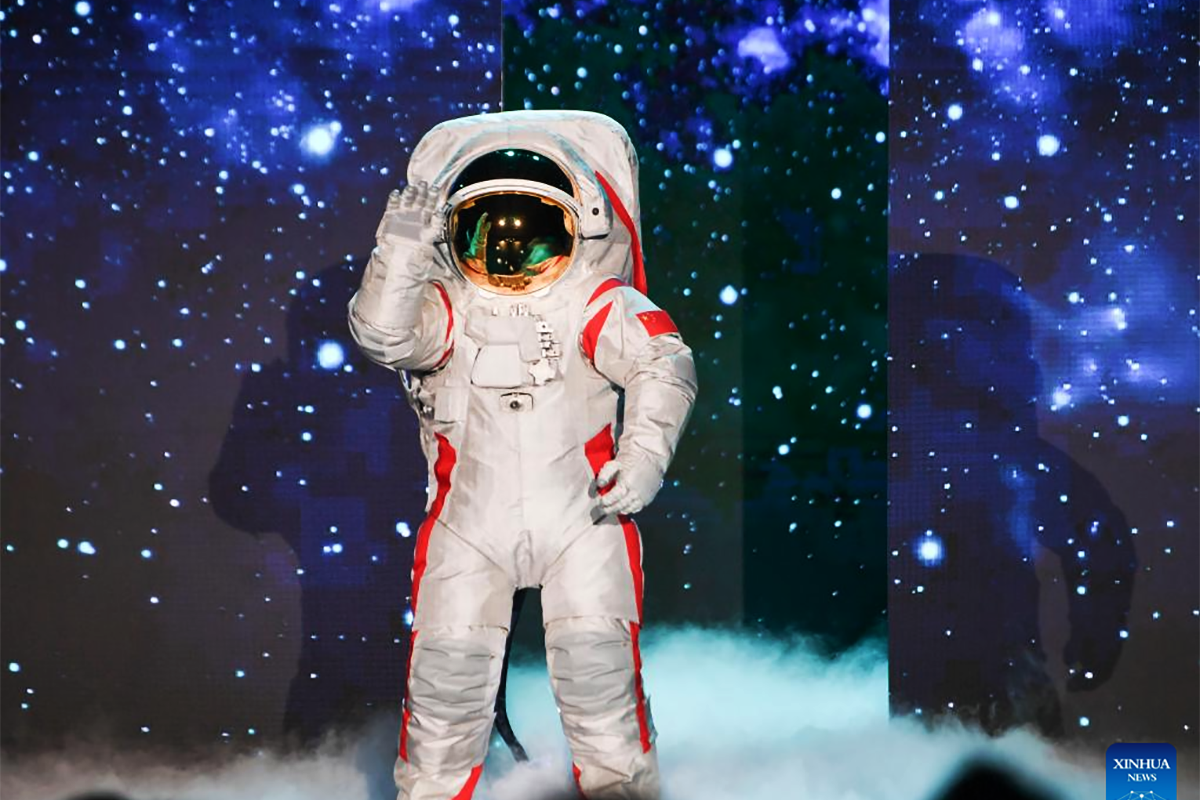
    China aims to send astronauts to the Moon by around 2030 and recently showcased the new spacesuits they’ll be using. During a media event, the China Manned Space Agency (CMSA) demonstrated the suits with two astronauts testing them out for the cameras.
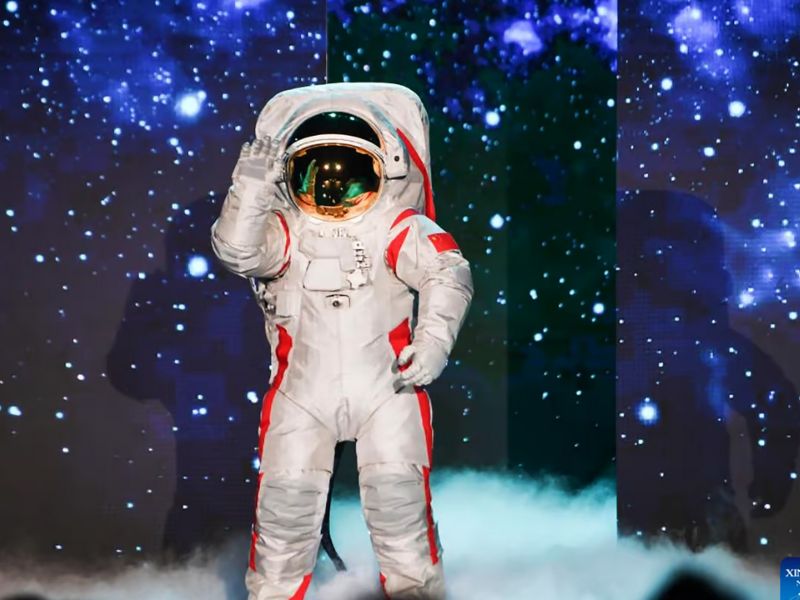
    China’s new space suit takes to the stage
    Xinhua/Wang Quanchao

    China aims to send astronauts to the Moon by around 2030 and recently showcased the new spacesuits they’ll be using. During a media event, the China Manned Space Agency (CMSA) demonstrated the suits with two astronauts testing them out for the cameras.

    Based on current plans, the CMSA plans to land near the Moon’s south pole by the end of the decade using its Mengzhou crewed spacecraft and Lanyue crewed lunar lander. However, reaching the Moon is only part of the challenge—space suits are equally crucial, as they enable astronauts to venture outside and explore.

    The Challenge of Lunar Space Suits

    This is a significant challenge, as lunar space suits haven’t been in use since the Apollo missions, which concluded with Apollo 17 in 1972, aside from experimental and developmental efforts. Modern space suits fall into two categories: emergency suits, designed to protect astronauts during launch and reentry in case of air pressure loss, and more advanced EVA suits.

    The latter are constructed from stronger materials and feature flexible joints, allowing astronauts to exit the spacecraft in orbit while shielding them from the harsh conditions of space.

    Chinese Moon Suit

    Overcoming Unique Lunar Hazards

    Moon suits are a completely different challenge. They must protect the wearer from vacuum, extreme temperatures on the lunar surface, and micrometeorite impacts. Additionally, they need to shield against the highly abrasive lunar dust and withstand ground temperatures as hot as boiling water under sunlight, which melted boot covers during the Apollo missions.

    The suit’s joints must also provide enough flexibility for walking and performing tasks, while an efficient, self-contained life support system is crucial, effectively turning the suit into a human-shaped spaceship.

    Unveiled at the third Spacesuit Technology Forum at the China Astronaut Research and Training Center in Chongqing, southwest China, the new suit was showcased by astronauts Zhai Zhigang and Wang Yaping. They walked onto a stage featuring a large video screen, starry backdrops, and a fog machine, while Yang Liwei, deputy chief designer of China’s manned space program and the country’s first astronaut, delivered the presentation.

    A Design Balancing Art and Function

    The suit, featuring distinctive red stripes on the arms inspired by traditional Chinese art and on the legs evoking rocket flames, was demonstrated to the audience. The astronauts bent, squatted, walked, kneeled, and climbed a ladder to show its mobility. The trailing umbilicals and their ease of movement suggest the life support system was likely omitted to reduce weight under Earth’s gravity, which is six times stronger than on the Moon.

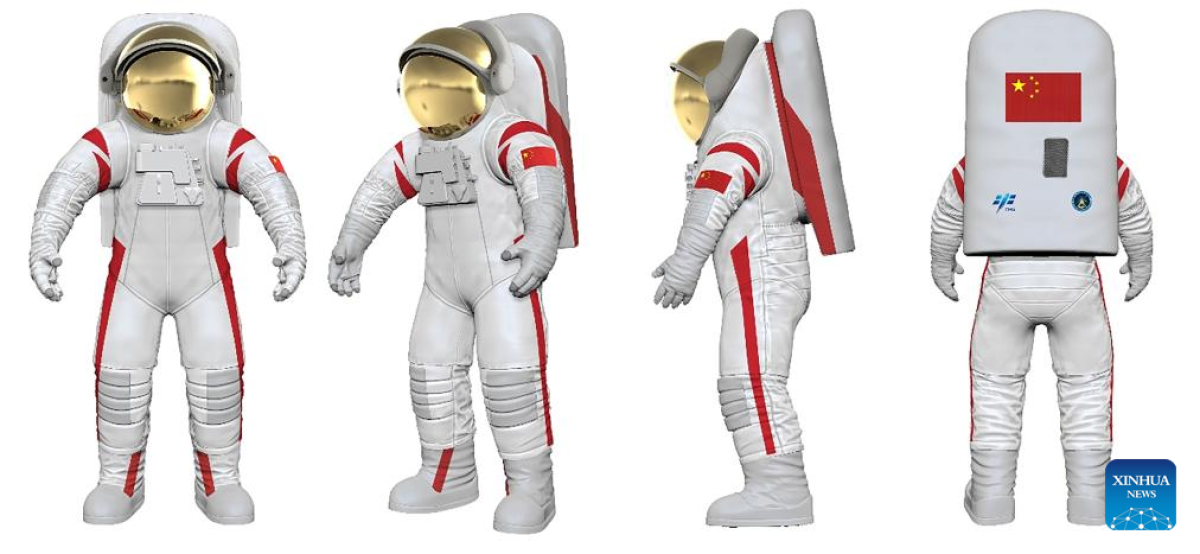
    Views of the new Moon suit
    Xinhua/Wang Quanchao

    There weren’t many technical details provided about the suit, aside from its multifunctional integrated control panel, flexible and reliable gloves, cameras, and panoramic glare-proof helmet visor.

    However, some inferences can be made based on its design, which appears to be inspired by the Chinese Feitian space suit, itself modeled after the Soviet/Russian Orlan suit. The Orlan suit was first used on the Salyut space station missions, and its latest version is still in use on the International Space Station (ISS).

    Similar to the Orlan, the new Chinese suit likely features a solid torso with soft limbs and entry through a back panel, which also houses the life support system. This resemblance can be traced back to China’s import of Orlan-M suits around 2000 for its Shenzhou crewed orbital program.

    If the new suit follows similar specifications, it would weigh about 120 kg (260 lb) when fully equipped, support up to eight hours of use on internal systems, and be suitable for at least 15 missions.


    Read the original article on: New Atlas

    Read more: The US makes a Tense Return to the Moon after Fifty Years