Tag: Music

  • AI-made playlists every Monday on Amazon Music

    AI-made playlists every Monday on Amazon Music

    Since Spotify introduced its AI DJ, Amazon Music has been building its own AI-powered tools, such as AI-generated playlists and AI-assisted search, to better compete.
    Credits: Amazon Music

    Since Spotify introduced its AI DJ, Amazon Music has been building its own AI-powered tools, such as AI-generated playlists and AI-assisted search, to better compete.

    Today, Amazon Music is rolling out a new feature called “Weekly Vibe” for all U.S. subscribers on iOS and Android, designed to make the listening experience more personal.

    Personalized Playlists for Your Evolving Taste

    Weekly Vibe addresses a common problem for music fans: growing tired of the same songs. Every Monday, it uses AI to craft playlists based on your recent listening habits, adapting to your changing “musical moods” and interests. The feature also recommends new, similar tracks to help you discover fresh music.

    Image Credits: Amazon

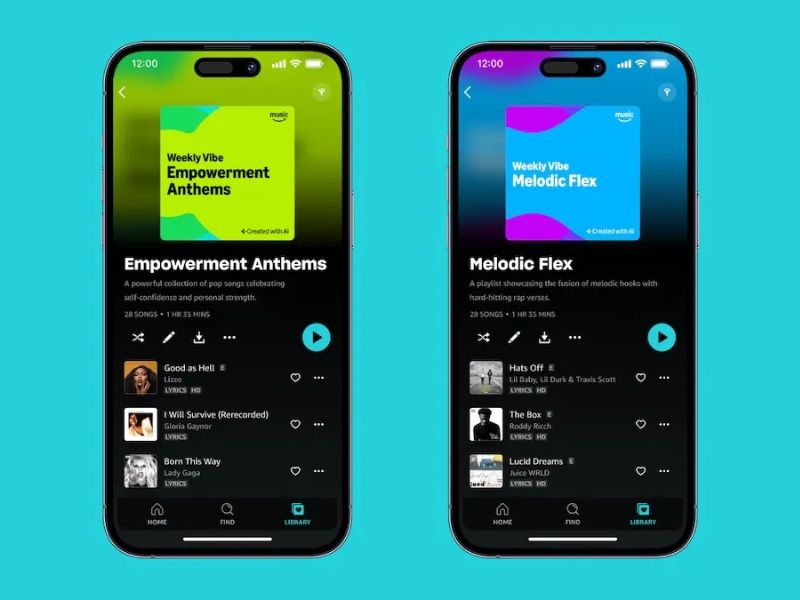
    To access your Weekly Vibe playlist, open Library at the bottom of the screen and tap Made for You. A fresh weekly playlist featuring a theme, title, description, and curated tracks.

    You can share these playlists with friends, post them on social media, or save them to your library for later listening.

    Maestro Powers Weekly Vibe with AI-Driven Personalization

    Weekly Vibe builds on Amazon Music’s Maestro playlist generator, launched in beta last year. Maestro creates personalized playlists from prompts like your mood or emojis.

    The latest AI feature on the platform, “Explore,” lets you delve into your favorite artists by highlighting their top tracks and recommending other artists you might like.


    Read the original article on: Techcrunch

    Read more: Cravings Are Not a Reliable Indicator of Cancer, According to Experts

  • TikTok Launches ‘TikTok for Artists,’ a Music Insights Platform

    TikTok Launches ‘TikTok for Artists,’ a Music Insights Platform

    TikTok officially launched TikTok for Artists on Tuesday, a new music insights platform aimed at helping artists grow their careers. The launch follows a two-month test phase in select countries.
    Image Credits: Pixabay

    TikTok officially launched TikTok for Artists on Tuesday, a new music insights platform aimed at helping artists grow their careers. The launch follows a two-month test phase in select countries.

    The platform is designed to support artists and their teams in connecting with fans, enhancing promotion, and guiding content strategy on TikTok. It offers access to detailed data on how an artist’s music and posts are performing on the platform.

    Metrics include views, post counts, and creator engagement for each song, as well as insights into post performance. It also provides demographic data about followers, such as age, language, and gender.

    TikTok for Artists Provides Guides, Tools, and Additional Support

    According to the company, TikTok for Artists also offers step-by-step guides to using TikTok’s tools and features, along with extra support and resources.

    Image Credits:TikTok

    TikTok also revealed a new “Pre-Release” feature that enables artists to promote upcoming albums on the platform. This tool allows fans to pre-save albums directly to their Spotify or Apple Music libraries, making the music instantly accessible upon release.

    Given TikTok’s significant influence on music trends and viral hits, introducing tools to help artists boost promotion and fan interaction is a natural step. TikTok for Artists could play a key role in helping artists grow their audience and broaden their reach.

    TikTok for Artists Launch Follows Shutdown of TikTok Music Streaming Service

    The launch of TikTok for Artists follows ByteDance’s shutdown of TikTok Music eight months ago to focus on enhancing TikTok’s role in music discovery and streaming.

    Over the past year, it’s clear that TikTok is shifting away from competing with services like Spotify and Apple Music, focusing instead on becoming a platform for music discovery and promotion.

    TikTok for Artists is now available in over 25 countries, including the US, UK, Japan, Australia, Canada, and several in Europe, the Middle East, and Latin America. TikTok says the platform will expand to more countries soon.


    Read the original article on: Techcrunch

    Read more: Study Finds Social Media Isn’t Entirely Harmful To Teen Mental Health

  • Firefly All-in-one Turntable Reacts To Music With a Dancing Light Show

    Firefly All-in-one Turntable Reacts To Music With a Dancing Light Show

    The Hotaru turntable “adds an enticing visual element to analog audio, creating a multisensory engagement with the music”
    Audio Technica

    Interest in vinyl records has been growing steadily in recent years, and for those looking for something unique to play their analog treasures on, Audio Technica might have the perfect answer—especially if you missed the chance to grab one of Brian Eno’s limited-edition models.

    Debut at Milan Design Week: Meet the Hotaru

    Recently unveiled at Milan Design Week, the Hotaru (ホタル, which means “firefly” in Japanese) closely resembles the aesthetic of Eno’s Turntable II from 2024. The good news is that Audio Technica’s model will be produced in larger quantities and offered at a significantly lower price.

    That said, it’s still far from affordable: each of the 1,000 planned units will retail for US$9,999.99. In return, though, the Hotaru delivers a visually stunning experience. Its translucent platter appears to float above a speaker-integrated base and lights up in sync with the music, creating a true light show.

    The Hotaru turntable appears to float above its speaker-packing base
    Audio Technica

    But the floating look isn’t just for show. According to Audio Technica, magnets positioned in the base and in the turntable itself repel each other, causing the platter to levitate and thus minimizing vibrations that could degrade sound quality.

    The lighting system features 20 color shades and three different modes: the Basic mode keeps a single color throughout playback; Gradation transitions smoothly between hues; and Link responds dynamically to the character of the music.

    Technical Specs and Audio Performance

    On the technical side, the straight tonearm with a VM cartridge promises to capture every detail from the vinyl and sends the signal to the built-in amplifier, which outputs the sound through integrated speakers—although the company hasn’t shared many technical specifics about the sound system.

    The Hotaru turntable’s speaker base is also home to system controls
    Audio Technica

    The Hotaru is currently available for pre-order, but interested buyers need to register first for a chance to reserve one. If accepted into the purchase process starting in August, be ready to shell out nearly ten grand. Shipping is expected to begin in October.

    Now, if exclusivity isn’t your main concern and you’d rather spend your money elsewhere, you can still enjoy Audio Technica’s brilliant design at a much lower cost — the compact and stylish Sound Burger sells for just a few hundred dollars.


    Read the original article on: New Atlas

    Read more: Smart Guitar Maker Unveils Effortless Music Creation Tool

  • Next-Gen Earphones Monitor your Vital Signs While you Enjoy your Music

    Next-Gen Earphones Monitor your Vital Signs While you Enjoy your Music

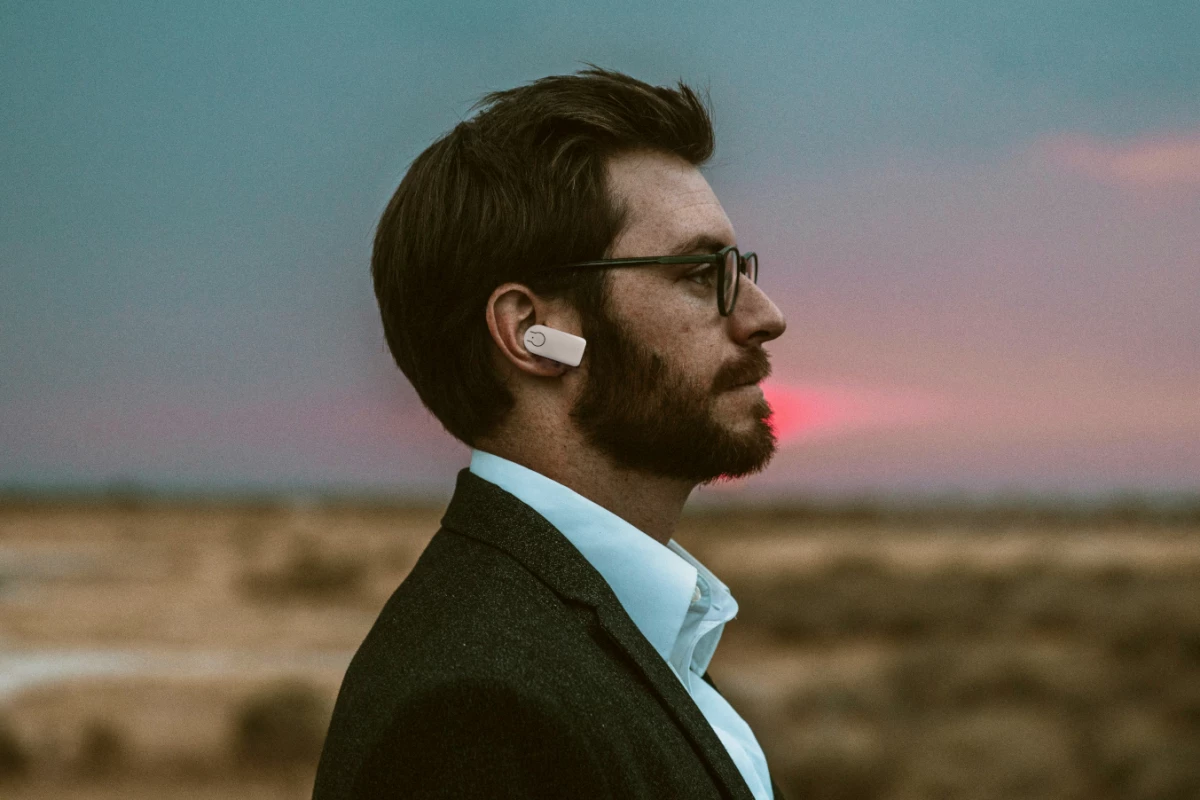
    If you're already putting something in your ear, why not let it keep tabs on your health while it's there? That’s the idea behind OpenEarable 2.0 — a pair of advanced earphones equipped with sensors that track more than 30 physiological metrics.
    The ear canal is well-suited to capturing signals that are difficult to access elsewhere on the body
    TECO, KIT

    If you’re already putting something in your ear, why not let it keep tabs on your health while it’s there? That’s the idea behind OpenEarable 2.0 — a pair of advanced earphones equipped with sensors that track more than 30 physiological metrics.

    Developed by Dr. Tobias Röddiger and his team at Germany’s Karlsruhe Institute of Technology (KIT), these open-source earphones and their companion software are now available for preorder at €2,348 (around US$2,566). Being open-source means developers can modify and improve them, then share their innovations with the wider community.

    While their primary appeal lies in medical use, the OpenEarables could also find roles in areas like workplace safety and athletic performance monitoring.

    Play Music and Monitor Health Simultaneously

    And yes, they function as regular stereo earphones too, streaming music from a paired smartphone. A companion app on the same device processes and displays the physiological data collected by the earphones.

    Notably, Dr. Röddiger confirms that the devices can simultaneously monitor health metrics and play music without any interference between the two functions. However, it’s worth noting that they only work with Android devices that support the Bluetooth LE Audio protocol — meaning they aren’t currently compatible with iPhones.

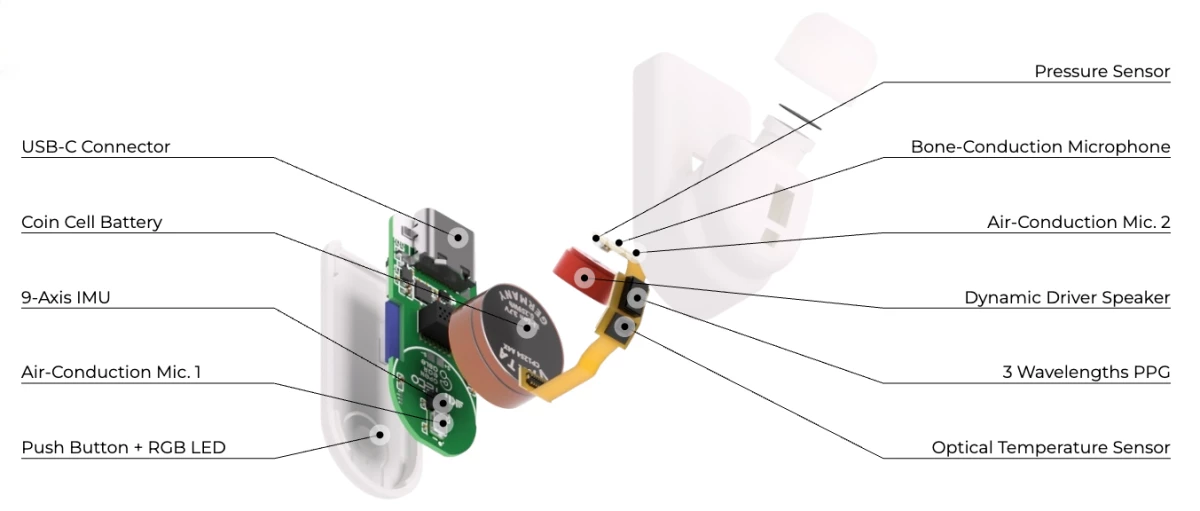
    An exploded diagram of one of the earphones, which also features a dual-core Arm Cortex-M33 microprocessor
    TECO, KIT

    So, what exactly can the OpenEarables track? Here are a few examples…

    Equipped with two infrasound/ultrasound microphones—one directed outward and the other inward into the ear canal—the OpenEarables can monitor heart activity and even verify the user’s identity. A built-in bone-conduction microphone detects activities like eating, silently mouthing words, or teeth grinding during sleep.

    Comprehensive Health Monitoring with Advanced Sensors

    Additional features include a pulse oximeter that measures blood oxygen levels, useful for identifying sleep apnea, assessing stress, or estimating energy use. There’s also an optical skin temperature sensor for monitoring body temperature or tracking ovulation. Other integrated sensors include an ear canal pressure sensor, which can detect eating or tongue movements, and a 9-axis IMU (inertial measurement unit) that monitors breathing patterns and exercise performance.

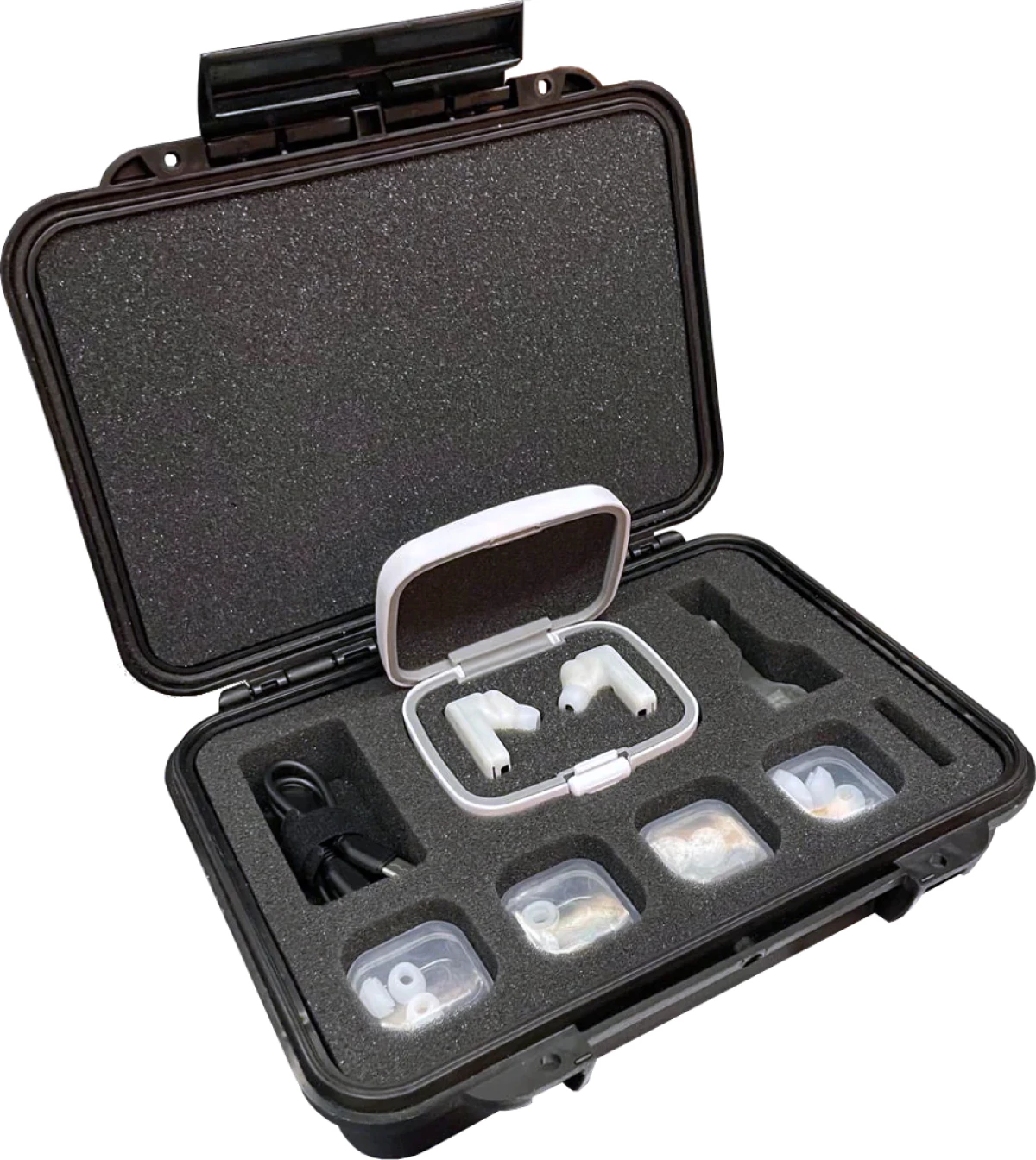
    The complete OpenEarables 2.0 kit sells for €2,348, and should ship in the second quarter of this year
    TECO, KIT

    Up to 8 Hours of Use from a 45-Minute Charge

    A single 45-minute USB charge of each earphone’s battery is reportedly enough for up to eight hours of use, depending on how they are used.

    The platform has been shown to capture physiological data with high accuracy and reliability, delivering results that are more precise than traditional standard measurements,” says Röddiger. “With OpenEarable 2.0, we can not only advance wearable technology but also unlock entirely new application possibilities.”

    For the record, these aren’t the first earphones designed to monitor the body. Previous models have been capable of identifying users, measuring brain activity, analyzing sweat, and diagnosing ear conditions.


    Read the original article on: New Atlas

    Read more: Bluetooth Faces Competition as the First Wi-Fi Earphones are Unveiled

  • Smart Guitar Maker Unveils Effortless Music Creation Tool

    Smart Guitar Maker Unveils Effortless Music Creation Tool

    Lava Music says that the Genie “empowers you to play along with singing, spark ideas, and explore sounds in seconds”
    Lava Music

    The Lava Genie is a unique instrument that, while guitar-shaped, doesn’t have strings and resembles a high-tech Guitar Hero controller redesigned by Yamaha. Instead of traditional strumming, it’s played through taps, “fretting” on a touch-sensitive fingerboard, and strums. Billed as a sampler guitar, it aims to make music creation accessible to anyone in seconds.

    The Genie can be used right out of the box, but its companion mobile app adds extra functionality, guiding users through thousands of songs and allowing access to hundreds of sounds. Lava also offers an AI tool that can transpose user-created tracks for guided play, though some features in the Lava+ app may require a monthly subscription.

    Compact Design with Powerful Sound and Easy Portability

    Its body includes a 12-W full-range dual driver on the front horn and a 20-W bass speaker in the rear, with an instrument jack for connection to an external amplifier. The Genie is portable, splitting in two to fit into a travel case or backpack and running on a 6-hour rechargeable battery that charges via USB-C.

    While similar products like the Sensy Guitar and Artiphon’s Instrument 1 exist, the Genie stands out as beginner-friendly yet versatile for more experienced creators. Lava has launched the product on Kickstarter, with early backers able to pledge $349, which includes three months of free Lava+ membership and free U.S. shipping.

    Given that Lava Music is a well-established company, it offers a safer investment than many crowdfunded projects, with shipping expected to begin in December if everything goes as planned.

    Introducing LAVA GENIE

    Read Original Article On: New Atlas

    Read More: Scitke

  • Heart Experts Recommend Taylor Swift’s Music for Saving Lives

    Heart Experts Recommend Taylor Swift’s Music for Saving Lives

    Scientists have discovered that over 50 songs by Taylor Swift have a tempo that is ideal for administering efficient chest compressions during CPR performed outside of a medical facility. They anticipate that Swift's music could serve as a tool to educate both fans and the general public on CPR techniques, potentially leading to life-saving interventions.
    More than 50 Taylor Swift songs could be used to teach effective CPR
    Depositphotos

    Scientists have discovered that over 50 songs by Taylor Swift have a tempo that is ideal for administering efficient chest compressions during CPR performed outside of a medical facility. They anticipate that Swift’s music could serve as a tool to educate both fans and the general public on CPR techniques, potentially leading to life-saving interventions.

    Dear Reader, the intersection of popular culture and medical science has come together, thanks to the groundbreaking efforts of researchers at Monash University’s Victorian Heart Institute. They have identified more than 50 Taylor Swift songs with beats per minute (bpm) ideally suited for administering effective CPR. It is anticipated that individuals, particularly younger fans of Swift, will utilize her music to enhance their CPR proficiency, enabling them to provide life-saving assistance with tracks like “Don’t Go” or “Soon You’ll Get Better” when the need arises.

    Enhancing Out-of-Hospital Cardiac Arrest Survival Rates through Bystander CPR

    Bystander CPR plays a crucial role in enhancing survival rates during out-of-hospital cardiac arrests. Individuals experiencing cardiac arrest are nearly twice as likely to survive when bystanders administer CPR while waiting for emergency responders. However, effective CPR necessitates maintaining a chest compression rate ranging between 100 and 120 beats per minute (bpm). Upon analyzing the musical catalog of the singer, researchers observed that several of her songs fell within this optimal range. They presented their findings at Swiftposium 2024, an academic conference centered around Taylor Swift.

    Stephen Nicholls, the director of the Victorian Heart Institute and the Victorian Heart Hospital, emphasized the significance of bystander CPR in improving survival rates for cardiac arrest cases. He stated, “A quarter of individuals who suffer a heart attack do not reach the hospital initially, and we understand that survival rates for cardiac arrest can be significantly enhanced with bystander CPR.” Nicholls highlighted the popularity and influence of Taylor Swift’s music among the current generation, noting that music plays a vital role in maintaining effective CPR compressions. He underscored the importance of identifying new songs with the optimal bpm for training as iconic tunes become less relevant over time.

    The Need for Contemporary Music with Suitable Beats per Minute

    For an extended period, the Bee Gees’ track “Stayin’ Alive” has served as a reference point for timing CPR compressions. However, released in 1977, the song may not be familiar to many of today’s younger individuals. Researchers suggest that it would be more beneficial to utilize music from a contemporary artist currently experiencing widespread popularity. Additionally, “Stayin’ Alive,” with its tempo of 103 beats per minute (bpm), falls toward the lower end of the effectiveness range; the optimal song should ideally have a tempo closer to 120 bpm.

    Bee Gees – Stayin’ Alive (Official Video)

    Nicholls expressed, “Harnessing something beloved by people to empower them in mastering a skill that could potentially save a life is incredibly impactful. There exists a CPR-appropriate song for every era of Swift fans.”

    Taylor Swift’s Playlist

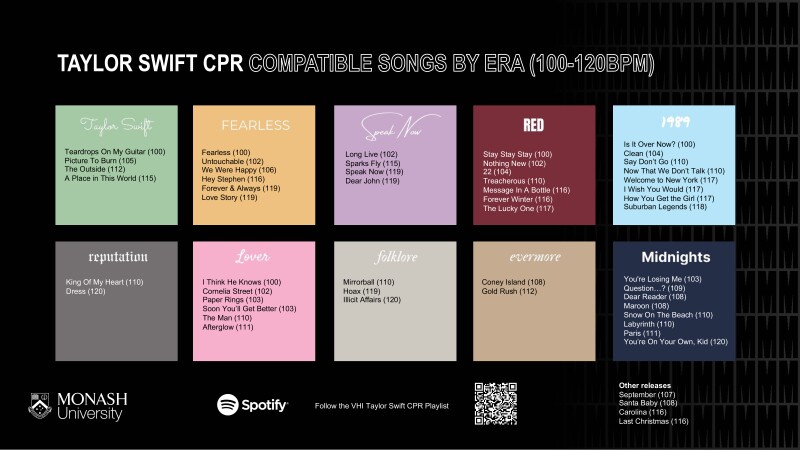
    There are a total of 54 songs from Swift’s catalog that are perfectly suited in terms of beats per minute (bpm). The researchers have compiled a convenient chart categorized by era, listing the bpm for each song. Moreover, to simplify matters, they have curated a Spotify playlist named ‘Taylor Swift CPR Compatible Songs’.

    CPR-compatible Swift songs organized by era, with beats per minute (bpm) in brackets
    Monash University


    Inspiring Heart Health

    Swift’s music is already inspiring an interest in activities related to heart health, as demonstrated by the recent viral ‘Eras Tour’ treadmill challenge. In this challenge, fans run or walk on a treadmill for the entire three-hour setlist of Swift’s tour, mirroring her own commitment as she mentioned in her Time Person of the Year 2023 article.

    Nicholls commented, “Engaging in physical activity offers significant benefits for heart health and can help reduce the risk of disease. Even dedicating as little as 10 minutes a day to exercise can be beneficial as you gradually increase your fitness level. You don’t have to match Taylor’s energy right from the start.”


    Read the original article on: New Atlas

    Read more: Love Languages May Allow You to Understand Your Partner– Yet it’s Not Exactly Science

  • If You Want Smarter Kids Teach Them Music, Not Coding, According To MIT

    If You Want Smarter Kids Teach Them Music, Not Coding, According To MIT

    Most moms and dads desire their kids to be intelligent as well as effective. And while some experts have motivated parents to teach their kids coding, new research is pointing to music as the entrance to smarter children.

    While coding does permit an excellent advantage when it comes to technology, it lacks several benefits that music gives. The argument to teach kids code is that it helps them with their math and language abilities. Nevertheless, current study executed by MIT and published in the Journal of Neuroscience is now showing how powerful music can be on a kid’s brain development.

    According to the authors of the research, learning music during our early life makes the brain more linked, which in turn, makes their brains neurologically capable of many things, not simply music.

    “This study, among other researches, demonstrates how the human brain is shaped by experience,” explains co-author Lutz Jäncke to Inverse.

    What they discovered in their research was that music brains generate more structural and functional connections when compared to those who don’t learn music.

    And while music is one kind of producing these connections, other study has revealed that ballet, golf, and chess generate similar links.

    “The findings matter for any type of proficiency in all areas where one can enhance via intensive, long-time training,” explained co-author Simon Leipold in a discussion with Inverse.

    To carry out their study, the researchers had 103 specialist musicians and 50 non-musicians adopt brain scans. As soon as the scans were taken, they were compared. What they discovered, was that the musicians all have “strikingly similar networks.”

    Furthermore, they had much more structural as well as functional links than non-musicians, particularly in the fields that were related to speech as well as sound.

    Another element that played a significant function was how early the musicians had commenced learning music. “The earlier the musicians had commenced with music practice, the stronger these connectivities,” Jäncke states.

    Their takeaway was that early music training could help kids to develop stronger neural pathways as well as, in turn, make them smarter. “If a person told me after that regarding the possibility of altering the wiring of my brain, I might have spent more time exercising the piano as well as less time on the football area,” Leipold claims.

    As well as to be sincere, I believe I would do the same! If you have a child, and you are desiring the best and most balanced life for them, based upon this research, it seems music is the way to go.


    Read the original aricle on AWARENESS ACT.

    Read more: There’s One Thing Dogs do Not Utilize Their Tail For, Scientists Say.