Tag: Mysteries

  • New Form of Dark Matter May Explain Milky Way’s Core Mysteries

    New Form of Dark Matter May Explain Milky Way’s Core Mysteries

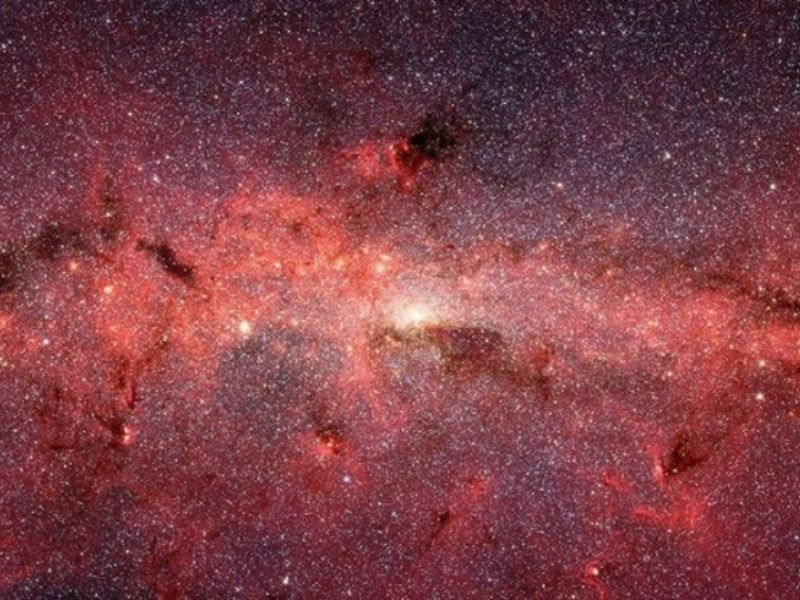
    Center of the Milky Way seen through NASA’s Spitzer Space Telescope’s infrared camera. (NASA, JPL-Caltech/Susan Stolovy (SSC/Caltech) et al.)

    Astronomers have long been intrigued by two puzzling phenomena at the center of our galaxy. First, the gas in the so-called Central Molecular Zone (CMZ)—a dense and turbulent region near the Milky Way’s core—appears to be ionized at a surprisingly high rate. That means atoms are losing electrons and becoming electrically charged.

    Second, scientists have detected a mysterious gamma-ray signal with an energy of 511 kiloelectronvolts (keV), which matches the rest energy of an electron.

    This specific gamma-ray emission occurs when an electron meets its antimatter counterpart, the positron, and they annihilate in a brief burst of light.

    Despite years of observation, the origins of both of these signals have remained elusive.

    Researchers propose in a new study published in Physical Review Letters that dark matter — one of the universe’s most elusive components — may link both mysteries. Specifically, they suggest that a new, lighter form of dark matter than typically considered could be responsible.

    A hidden process at the galactic center

    The CMZ stretches almost 700 light-years and contains some of the densest molecular gas in the galaxy. Researchers have observed that this region ionizes unusually fast, splitting hydrogen atoms into charged particles at unexpectedly high rates.

    Starlight and cosmic rays contribute to this ionization, but they don’t seem to explain the observed intensity.

    The 511 keV gamma-ray signal, first detected in the 1970s, also lacks a definitive source. Researchers have suggested candidates like supernovae, massive stars, black holes, and neutron stars, but none fully explain the emission’s intensity and distribution.

    This led researchers to ask a key question: Could both phenomena stem from the same hidden cause?

    Enter dark matter

    Dark matter makes up around 85% of the matter in the universe, but it doesn’t interact with light. While its gravitational effects are well-documented, its true nature remains unknown. One underexplored possibility is that dark matter particles could be extremely light—just a few million electronvolts in mass, far lighter than a proton. These particles are known as sub-GeV dark matter.

    Artistic representation of dark matter annihilating. (Ramberg from Getty Images Signature/Canva)

    According to the new study, these light dark matter particles could annihilate with their own antiparticles at the galactic center, releasing electrons and positrons. In the dense CMZ gas, those low-energy particles would rapidly lose energy and efficiently ionize surrounding hydrogen by knocking off electrons—closely matching observed ionization patterns.

    Detailed simulations showed that this annihilation process can naturally account for the ionization levels seen in the CMZ, and crucially, the required properties for this dark matter do not conflict with constraints from the early universe. That makes it a strong candidate.

    The positron puzzle

    If dark matter is indeed generating positrons in the CMZ, those particles will eventually slow down and annihilate with electrons, producing 511 keV gamma rays. This would directly link the two mysterious signals.

    The study found that while dark matter alone explains the ionization, it could also contribute to some of the 511 keV emission. This striking possibility suggests that both signals might share the same source—light dark matter.

    However, the brightness of the gamma-ray signal depends on several still-uncertain factors, such as how and where positrons annihilate and how efficiently they form bound states with electrons.

    A new way to study the invisible

    Whether or not the two signals share a common source, the CMZ’s ionization rate is emerging as a powerful tool to study dark matter—especially lighter particles that are difficult to detect with traditional lab-based experiments.

    Move observations of the Milky Way could help test theories of dark matter. (ESO/Y. Beletsky, CC BY-SA)

    The study showed that the predicted ionization profile from dark matter is remarkably flat across the CMZ, which aligns with actual observations.

    Point sources like the central black hole or cosmic ray sources (such as supernovae) can’t easily produce this uniform profile—but a smoothly distributed dark matter halo can.

    These findings suggest that the center of the Milky Way may hold important clues about the nature of dark matter.

    Future telescopes with improved resolution may be able to clarify the spatial connection between the 511 keV line and the ionization rate in the CMZ. Meanwhile, ongoing observations could help confirm—or challenge—the dark matter hypothesis.

    Either way, these curious signals from the heart of the galaxy remind us that the universe still holds many surprises. Sometimes, looking inward—toward the vibrant and dynamic core of our own galaxy—reveals the most unexpected hints of what lies beyond.


    Read the original article on: Science Alert

    Read more: Hailstorms on Jupiter Pelt Giant Slushee Balls of Ammonia and Water
  •  Recent Image Unveils the Mysteries Surrounding the Formation of Planets

     Recent Image Unveils the Mysteries Surrounding the Formation of Planets

    Today, the European Southern Observatory has shared a stunning new image providing valuable insights into the potential formation process of Jupiter-sized planets.
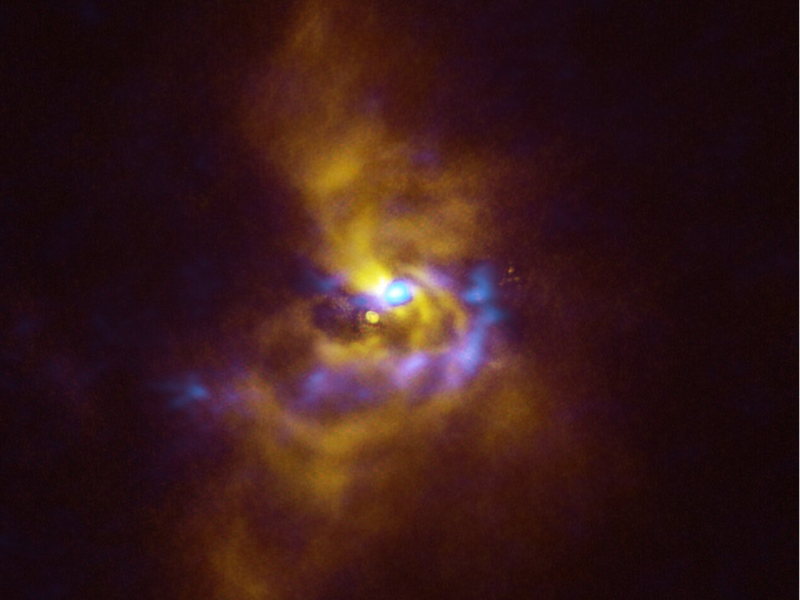
    At the center of this image is the young star V960 Mon, located over 5000 light-years away in the constellation Monoceros. Dusty material with potential to form planets surrounds the star. Observations obtained using the Spectro-Polarimetric High-contrast Exoplanet REsearch (SPHERE – https://www.eso.org/public/teles-instr/paranal-observatory/vlt/vlt-instr/sphere/) instrument on ESO’s VLT (eso.org/public/teles-instr/paranal-observatory/vlt/), represented in yellow in this image, show that the dusty material orbiting the young star is assembling together in a series of intricate spiral arms extending to distances greater than the entire Solar System. Meanwhile, the blue regions represent data obtained with the Atacama Large Millimeter/submillimeter Array (ALMA – eso.org/public/teles-instr/alma/), in which ESO is a partner. The ALMA data peers deeper into the structure of the spiral arms, revealing large dusty clumps that could contract and collapse to form giant planets roughly the size of Jupiter via a process known as “gravitational instability”. Credit: ESO/ALMA (ESO/NAOJ/NRAO)/Weber et al.

    Today, the European Southern Observatory has shared a stunning new image providing valuable insights into the potential formation process of Jupiter-sized planets.

    By employing the advanced capabilities of ESO’s Very Large Telescope (VLT) and the Atacama Large Millimeter/submillimeter Array (ALMA), scientists have identified sizable dusty clusters near a young star.

    These clusters hold the possibility of collapsing and giving rise to massive planets.

    Clumps Around Young Star Hold Potential for Giant Planets

    In fact, Alice Zurlo, a researcher from the Universidad Diego Portales in Chile, expressed great enthusiasm about the captivating discovery. This marks the first-ever detection of clumps surrounding a young star that could potentially give rise to massive planets. The research detailing this remarkable finding has been published in Astrophysical Journal Letters.

    The discovery was made using the Spectro-Polarimetric High-contrast Exoplanet REsearch (SPHERE) instrument on ESO’s VLT, which provided a mesmerizing image of the material around the star V960 Mon.

    This young star, situated over 5000 light-years away in the constellation Monoceros, drew astronomers’ attention when its brightness increased more than twentyfold in 2014. The SPHERE observations following this brightness “outburst” unveiled intricate spiral arms extending beyond the size of our entire solar system, showcasing the material orbiting V960 Mon coming together.

    ALMA Collaboration Unveils Deeper Insights into the Star’s Material Structure

    However, inspired by this finding, astronomers analyzed archived observations of the same system captured with ALMA, an instrument in which ESO is a partner. While the VLT observations examined the surface of the dusty material around the star, ALMA provided a deeper view of its structure.

    However, the ALMA observations revealed that the spiral arms were undergoing fragmentation, leading to the formation of clumps with masses comparable to planets, which supports the concept of gravitational instability as a mechanism for giant planet formation.

    Philipp Weber, a researcher from the University of Santiago, Chile, who led the study, emphasized that this observation is the first real evidence of gravitational instability occurring at planetary scales.

    The research team, which has been investigating planetary formation for over a decade, expressed their excitement about this incredible discovery.

    A Key Player in Unveiling Planetary Formation Secrets

    Moving forward, ESO’s instruments, particularly the Extremely Large Telescope (ELT) under construction in Chile’s Atacama Desert, will play a crucial role in unveiling more details about this intriguing planetary system.

    Concluding, the ELT’s advanced capabilities will allow astronomers to observe the system in greater detail and gain crucial insights into the chemical composition of the material involved in potential planet formation. This promises to further expand our understanding of the fascinating processes shaping planetary birth.


    Read the original article on: Phys.

    Read more: Early Planetary Migration Can Explain Missing Planets.