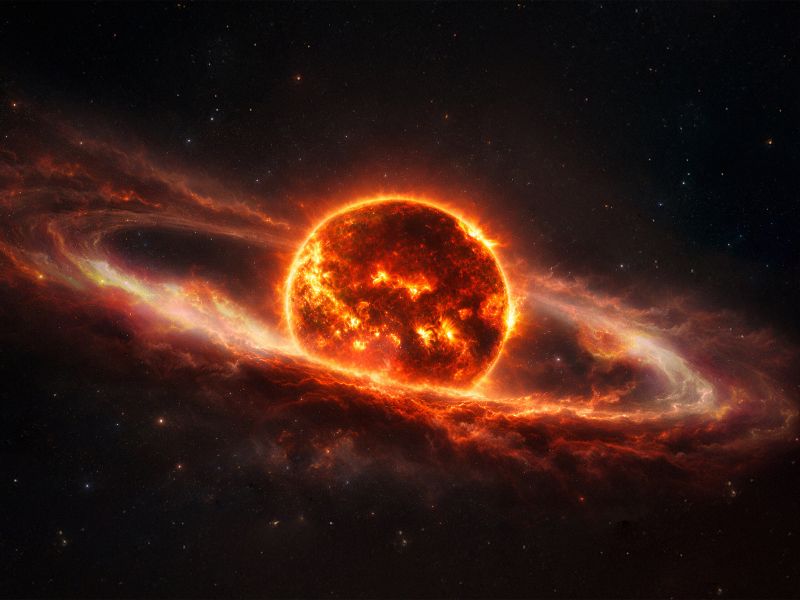
Artist’s rendition of the space weather around M dwarf TIC 141146667. The torus of ionized gas is sculpted by the star’s magnetic field and rotation, with two pinched, dense clumps present on opposing sides of the star. Image Credits:Navid Marvi, Carnegie Science.
How does a star affect the makeup of its planets, and what does this mean for their habitability? Luke Bouma of Carnegie studies this using natural ‘space weather stations’ around at least 10% of young M dwarfs. He is sharing his research at the 247th meeting of the American Astronomical Society.
M Dwarf Planets: How Stars Shape Their Worlds
Most M dwarfs—smaller and cooler than the Sun—host at least one rocky, Earth-sized planet. Though often inhospitable, these worlds offer key insights into how stars shape their planetary environments.
“Stars clearly shape their planets,” Bouma said. “Stars affect planets through light, which is easy to observe, and particles—space weather like solar winds—which are harder to measure but often more impactful.”
The challenge, of course, is that astronomers can’t simply set up a space weather station around a distant star.
Or can they?
Artist’s concept of the space weather around M dwarf TIC 141146667 with magnetic field lines shown. Image Credits: Navid Marvi, Carnegie Science
Unraveling the Mystery of Dimming M Dwarfs
Working with Moira Jardine from the University of St. Andrews, Bouma focused on a peculiar type of M dwarf known as a complex periodic variable. Young, fast-spinning stars show recurring dimming, but it’s unclear if it’s from starspots or orbiting material.
“For a long time, these unusual little dips in brightness puzzled astronomers,” Bouma said. “But we’ve shown that they can actually reveal details about the environment just above the star’s surface.”
Nature’s Space Weather Station Around M Dwarfs
Bouma and Jardine tackled the mystery by creating “spectroscopic movies” of a complex periodic variable star. The brightness dips are caused by cool plasma clumps trapped in the star’s magnetic field, forming a doughnut-shaped torus.
“Once we figured this out, those strange dimming blips stopped being mysteries and became a kind of space weather station,” Bouma said. “The plasma torus lets us track what’s happening with material near the star—where it’s concentrated, how it moves, and how strongly the star’s magnetic field is affecting it.”
Bouma and Jardine estimate that at least 10% of M dwarfs may host plasma structures like this early in their lifetimes. These natural space weather stations could provide astronomers with valuable insights into how stellar particles influence the environments of surrounding planets.
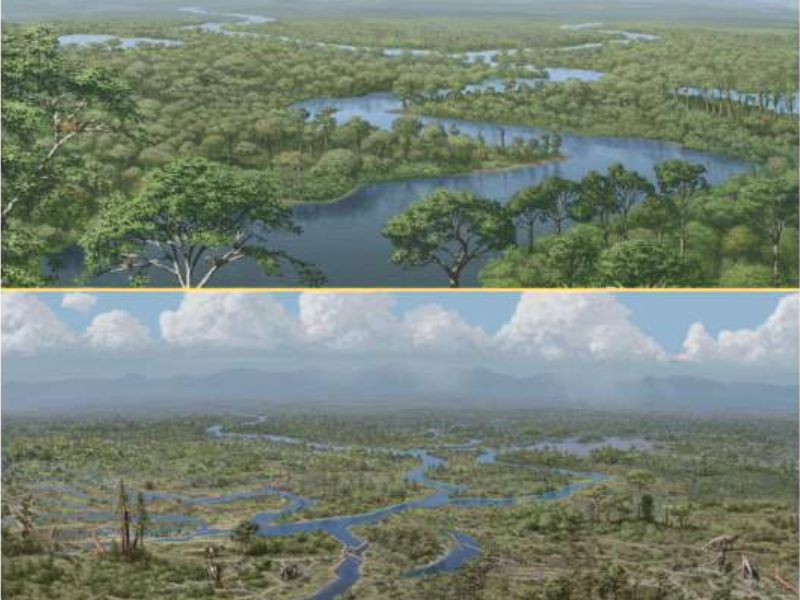
Dinosaurs were “ecosystem engineers,” preventing dense forests from growing. Their sudden demise led to widescale ecological changes, according to a University of Michigan study, as represented here in an artistic rendering. Credit: Julius Csotonyi
According to a study from the University of Michigan, dinosaurs influenced Earth so profoundly that their abrupt extinction caused widespread landscape transformations—including alterations in river patterns—which are now preserved in the geologic record.
Scientists have long noticed a sharp contrast in rock formations from the time just before and just after the dinosaurs’ extinction. Traditionally, they attributed these differences to factors like rising sea levels or other non-living (abiotic) causes. However, new research led by University of Michigan paleontologist Luke Weaver reveals a different story: the disappearance of dinosaurs allowed forests to thrive, which significantly altered river systems.
Weaver and his team studied sites across the western United States where dramatic geologic shifts occurred at the boundary between the age of dinosaurs and the age of mammals.
Dinosaurs as Ecosystem Engineers: Shaping Rivers Through Vegetation Disruption
Their analysis suggests that dinosaurs acted as powerful “ecosystem engineers,” heavily disturbing vegetation by trampling or consuming it, which left landscapes open and sparse. This, in turn, led to wide, unconfined rivers. When the dinosaurs went extinct, forests began to grow unchecked, stabilizing the soil and guiding rivers into broader, more winding paths.
Published in Communications Earth & Environment, their findings highlight how quickly Earth’s surface can transform in the wake of catastrophic events.
“We often think of environmental change as being driven by shifts in climate or tectonics,” said Weaver, assistant professor at U-M’s Department of Earth and Environmental Sciences. “But this study shows that life itself—like the presence or absence of large animals—can reshape both climate and landscapes. The influence goes both ways.”
The Impact of the Chicxulub Asteroid
Dinosaurs went extinct after a massive asteroid struck the Yucatán Peninsula. Scientists searching for evidence of this event observed a clear contrast between the rock layers above the impact debris and those beneath it.
Intrigued by this sudden geological shift, Luke Weaver, along with co-authors Tom Tobin from the University of Alabama and Courtney Sprain from the University of Florida, began studying the phenomenon in the Williston Basin—a region that covers eastern Montana, western North and South Dakota, and parts of north-central Wyoming’s Bighorn Basin.
Their curiosity about this geologic mystery was sparked during graduate fieldwork, where they first encountered unusual patterns in the rock layers while working on a different research project. This led them to investigate the Fort Union Formation, a rock layer deposited after the dinosaurs’ extinction.
The Fort Union Formation is visually striking, made up of colorful, layered rocks that Weaver described as resembling “pajama stripes.” These layers were once thought to represent pond deposits, possibly linked to a period of rising sea levels.
Soil Shifts Point to Dinosaur Extinction’s Impact on Landscapes
However, what caught the researchers’ attention was how different these rocks were from the ones below them, which showed signs of soggy, underdeveloped soils similar to those found on the fringes of a floodplain. This dramatic contrast led the team to suspect that the shift in geology was connected to the Cretaceous-Paleogene (K-Pg) mass extinction. They then turned their focus to understanding what kinds of environments each rock layer represented.
“We realized the ‘pajama stripes’ weren’t pond deposits, but point bar deposits from the inside bends of large, meandering rivers,” said Weaver, assistant curator of fossil mammals at the University of Michigan. “Instead of a quiet, stillwater setting, we were seeing signs of active river systems.”
These river deposits were flanked by lignite layers—low-grade coal from plant matter—which the team believes formed because dense forests, growing after the extinction, stabilized riverbanks and reduced flooding.
“When forests hold riverbanks in place, they block sediment from reaching floodplains, so organic material builds up instead,” Weaver explained.
To determine if this shift followed the K-Pg extinction, the team searched for a layer rich in iridium—a rare element on Earth but common in asteroids. The Chicxulub impact left behind a global, iridium-rich layer, marking the extinction boundary.
At a site in Wyoming’s Bighorn Basin, where the boundary hadn’t been located, Weaver sampled a thin red clay layer between dinosaur- and mammal-bearing rocks.
“The iridium anomaly was right at the transition,” he said. “It confirmed this change wasn’t just local—it likely happened across the Western Interior of North America.”
The Land Before Time
The mystery of dramatic landscape changes before and after the dinosaurs’ extinction puzzled scientists—until Weaver drew parallels with how modern animals like elephants shape ecosystems.
“That was the lightbulb moment,” he said. “Dinosaurs were huge and likely had a big impact on vegetation.”
Working with co-author Mónica Carvalho, who studies plant changes across the K-Pg boundary, the team proposed that the dinosaurs’ extinction allowed forests to flourish, stabilizing soil and reshaping rivers.
“Their disappearance isn’t just seen in fossils,” added Courtney Sprain. “It’s also recorded in the sediments.”
Weaver sees a warning in this ancient event: just like the K-Pg extinction, today’s human-driven changes to biodiversity and climate may leave a sudden, lasting mark in Earth’s geologic record.
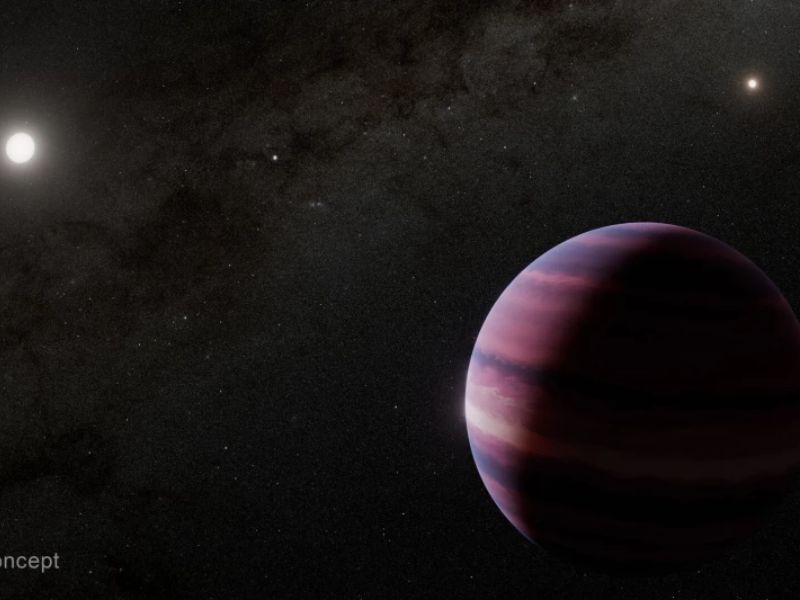
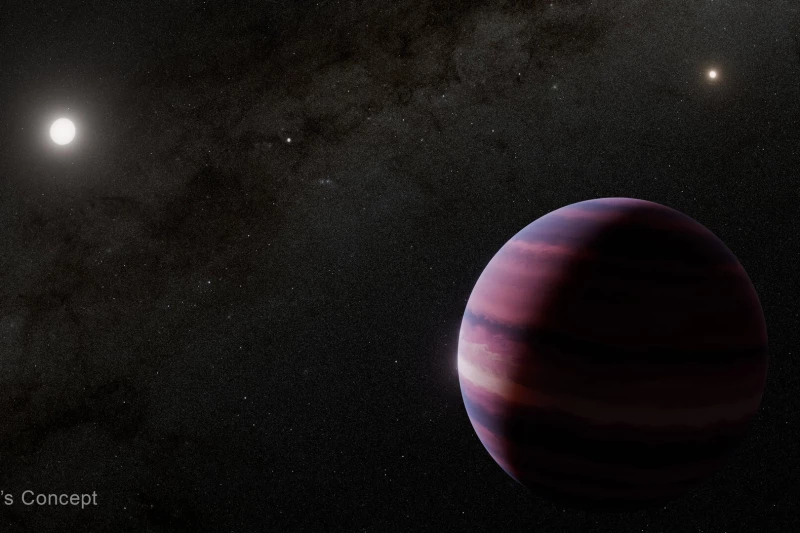
Image Credits:Artist’s concept of the planet circling Alpha Centauri A NASA/ESA/CSA/STScI/R. Hurt/Caltech/IPAC
If Earth ever needs to borrow a cup of sugar, it’s reassuring to think there might be a nearby, potentially livable planet orbiting Alpha Centauri just 4.34 light-years away—assuming the James Webb Space Telescope’s findings hold true.
Alpha Centauri is one of the few stars in our galaxy that has captured the public’s imagination. That makes sense, given it’s our closest stellar neighbor—and there’s always the slim possibility that someone over there might be wondering if life exists here, too.
The Triple-Star System of Alpha Centauri
Alpha Centauri is actually a triple-star system, consisting of Alpha Centauri A and B—two stars that orbit each other—and a third, Proxima Centauri, which orbits the pair. Up until recently, only Proxima Centauri was known to host planets—two confirmed and possibly a third. One of these lies within the habitable zone, the region around a star where liquid water could exist. However, because it orbits so close to its red dwarf star and is frequently blasted by intense radiation, the chances of life there are slim.
Alpha Centauri A, by contrast, holds greater promise from an Earth-like standpoint. It’s a G2V star, just like our Sun—the type of star we know can support life because, well, we exist. The issue was that no planets had ever been detected around Alpha Centauri A, making it seem like the system might be a cosmic disappointment.
That changed with the release of new findings from the James Webb Space Telescope.
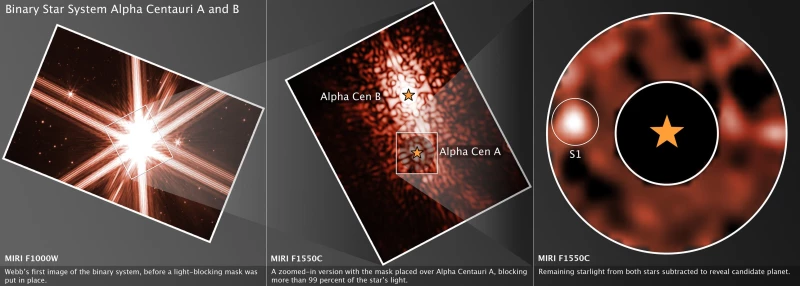
Image Credits:Alpha Centauri as seen by Webb NASA/ESA/CSA/STSci/ A. Sanghi (Caltech)/C. Beichman (JPL)/D. Mawet (Caltech/ J. DePasquale (STScI)
Why Finding Planets Around Sun-Like Stars Is So Difficult
Finding planets around G2 stars is difficult, which is why most known exoplanets orbit red dwarfs. Red dwarfs are smaller and dimmer, and their habitable zones are much closer to the star. This makes it easier to spot slight brightness dips when a planet transits the star. G2 stars, like our Sun, are significantly brighter, and their habitable zones are farther out. Planets in these zones take longer to complete an orbit, which makes them harder to spot and study.
So how do you detect a potential planet that’s 10,000 times fainter than the star it circles? With ingenuity.
How Astronomers Isolated Potential Planets
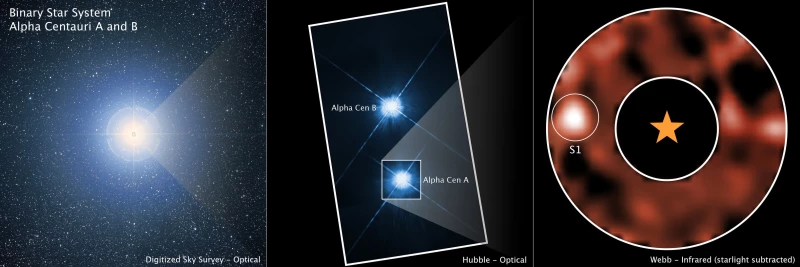
The team used coronagraphic imaging to block Alpha Centauri A’s light and minimize interference from Alpha Centauri B. They did this by referencing a third star, similar to Alpha Centauri A but without a companion. The well-known reference star served as a benchmark to filter out excess light, scattering, and telescope noise. What remained could be potential planets. The team ruled out false positives by eliminating asteroids, satellites, and background galaxies that could mimic a planetary signal.
The investigation required patience. A possible planet seen in August 2024 vanished in follow-up observations in early 2025. This led the researchers back to the drawing board, where they created computer models simulating millions of potential orbits. They eventually found a stable orbit explaining the detection and disappearance—the planet had likely moved too close to Alpha Centauri A to be seen.
Image Credits:Alpha Centauri as seen by DSS, Hubble, and Webb NASA/ESA/CSA/STSci/ A. Sanghi (Caltech)/C. Beichman (JPL)/D. Mawet (Caltech/ J. DePasquale (STScI)
Based on their findings, the research team believes that the newly identified planet—if confirmed—is a gas giant similar in size to Saturn or Jupiter. It lies within the habitable zone of Alpha Centauri A, where the estimated surface temperature is about 225 K (-48 °C or -55 °F). Its orbit is slightly eccentric, completing a full revolution around the star every two to three Earth years.
Moons and Neighboring Worlds
While the planet itself is unlikely to support life due to its gaseous nature, it could host a habitable moon. There’s also the possibility that other, smaller planets within the habitable zone might exist—similar to how Earth, Venus, and Mars all reside in our own system’s habitable region.
For scientists, the ability to search for planets so close to home (at least in cosmic terms) is an encouraging development. That said, the mysteries of extraterrestrial life—and neighborly sugar-lending—remain unanswered for now.
“Being so close, this system gives us a rare chance to study other planetary systems in detail,” said Charles Beichman of NASA’s JPL. “But these stars are bright, nearby, and move quickly, making observations extremely challenging—even for the world’s most powerful space telescope.” Webb was built to detect the most distant galaxies in the universe. The Space Telescope team created a custom observation sequence for this target—and their effort paid off.
The full research papers can be accessed [here] and [here].
Vesta, a large asteroid in our solar system, might be a fragment of an ancient planet shattered by a massive collision 4.5 billion years ago, according to research led by Seth Jacobson of Michigan State University and published in Nature Astronomy.
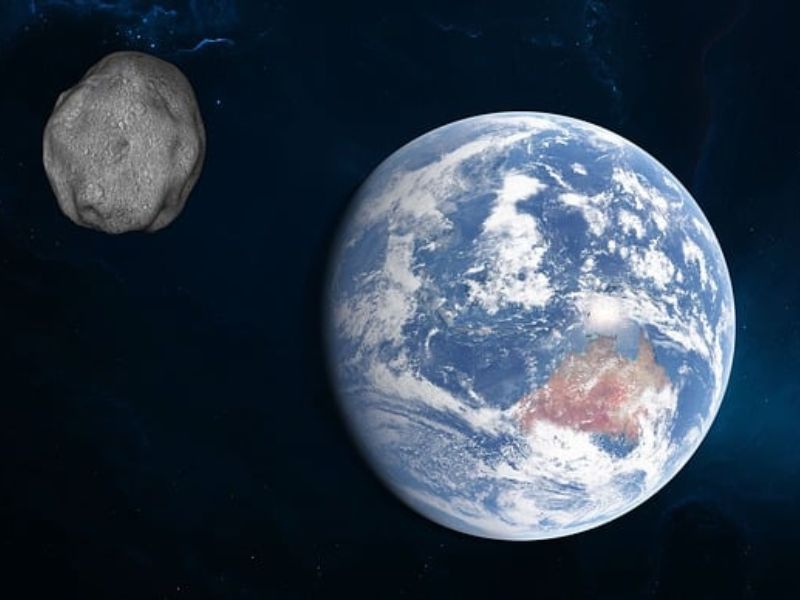
Vesta, with a diameter of 525 km, is the second-largest object in the Asteroid Belt. Previously, scientists viewed it as a protoplanet—a rocky body from the early Solar System that never fully developed into a planet. However, if the new study’s findings are accurate, Vesta’s true nature may be something different.
In this study, researchers analyzed Vesta’s gravitational field and its movement through space—data that could indicate whether the asteroid has a dense core or a more uniform internal structure. A 2012 analysis had suggested that Vesta possessed its own core, supporting the idea that it was a protoplanet.
Credit: canaltech
However, the new study revealed something unexpected: Vesta lacks a dense core. “The absence of a core was quite surprising. It changes the way we think about Vesta,” said Jacobson. The challenge is that Vesta’s surface materials, formed by volcanic activity, would usually generate enough heat for heavier elements to sink and create a core.
Yet, gravitational data indicate that this process never occurred. At the same time, some asteroids originating from Vesta display features that support the volcanic theory. Jacobson suggests two possible explanations: Vesta began differentiation, but the process was halted.
Vesta as a Fragment of a Planetary Impact
The other explanation—Jacobson’s preferred theory—suggests that Vesta was torn from a planet during a massive impact. If the asteroid originated from a differentiated planet with widespread volcanic activity, that would account for the presence of volcanic rocks on Vesta without it having undergone differentiation itself.
If Vesta truly came from another planet, it raises the possibility that other asteroids are also fragments of ancient planets, potentially reshaping our understanding of asteroid origins.
“The Vesta collection is no longer just debris from a body that failed to become a full-fledged planet,” Jacobson said. “These meteorites might be remnants of an ancient planet in its early stages of formation. But we still don’t know which planet that was,” he added.
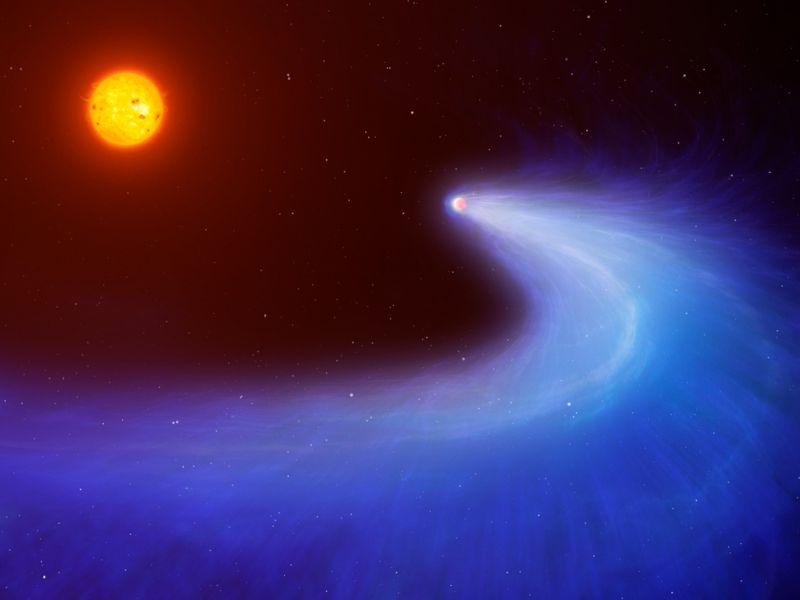
An artist’s interpretation of BD+05 4868 Ab, a dissolving exoplanet with a long tail. (Jose-Luis Olivares/MIT)
Astronomers have identified one of the most inhospitable exoplanets ever seen—a tiny world being scorched by its parent star and trailing a massive, comet-like plume of vaporized rock behind it.
A Molten Planet with a Vapor Tail
While much of exoplanet research focuses on potentially habitable worlds with the right conditions for liquid water, BD+05 4868 Ab is the polar opposite. On this extreme planet, searing temperatures have turned its surface into a molten ocean, which evaporates into space, forming a vast tail of mineral vapor.
“The tail’s size is astonishing—it stretches nearly 9 million kilometers [5.6 million miles], about half the length of the planet’s orbit,” said Marc Hon, an astrophysicist at MIT’s Kavli Institute.
Located around 140 light-years from Earth, BD+05 4868 Ab orbits its star once every 30.5 hours, keeping it roughly 20 times closer than Mercury is to the Sun. This close proximity subjects the planet to relentless heat, which has been gradually stripping it of its mass.
Scientists believe the planet once had over twice its current mass—now estimated to be less than half of Mercury’s—but it’s rapidly shrinking. According to researchers, with each orbit, the planet sheds material equivalent in mass to Mount Everest, suggesting it may disappear entirely within 1 to 2 million years.
“It’s a small planet with weak gravity, making it easy for it to lose material,” explained Avi Shporer, a member of the TESS (Transiting Exoplanet Survey Satellite) mission. “As it loses mass, its gravity weakens further, accelerating the process in a downward spiral.”
Only three other “melting Mercury” exoplanets have been found so far, but none appear to be deteriorating as quickly as this one. For comparison, a similar planet orbiting KIC 12557548 is expected to survive for another 200 million years. BD+05 4868 Ab, however, is disintegrating at a much faster pace.
Not All Planetary Tails Are Alike
Astronomers have observed other planets with tails, mostly large gas giants like HAT-P-32b, which releases helium through massive tails stretching 53 times the planet’s size—but these planets still have far more time before they vanish completely. WASP-69b, another hot Jupiter, loses its atmosphere much more slowly and likely won’t disappear before its star ends its life.
Astronomers discovered BD+05 4868 Ab using the transit method, a common technique in which they monitor dips in a star’s brightness as a planet crosses in front of it.But something unusual stood out: the dimming lasted longer than expected, and the brightness varied from orbit to orbit.
While the initial dip in light is sharp, it takes up to 15 hours – or half the planet’s orbit time – to return to peak brightness. (Hon et al., ApJL, 2025)
“The shape of the transit resembled a comet, with a long tail following the planet,” Hon said. “But unlike a comet’s icy tail, this one likely consists of mineral particles from the planet’s surface, vaporized by intense heat and lingering long enough to form this extended structure.”
Even more curious, researchers noticed a smaller tail leading the planet. This secondary tail may provide insight into how these dust structures form and behave.
A Rare Look Into a Rocky Planet’s Interior
Though clearly not a vacation destination, BD+05 4868 Ab could offer valuable clues about more Earth-like worlds. As the planet’s interior spills into space, astronomers gain a rare opportunity to study the composition of rocky planets.
Scientists hope that the James Webb Space Telescope (JWST) could soon observe the planet’s disintegration in more detail, analyzing the star’s light as it passes through the dust to determine its composition.
This is a rare opportunity to study the internal makeup of a rocky planet,” said Hon. “It could tell us a great deal about the variety and potential habitability of terrestrial planets beyond our own Solar System.
Heist movies are rarely about solving climate change, and for good reason. It’s hard to imagine George Clooney racing down the highway with a truckload of stolen diamonds, saying, “Hey, let’s crush these sparkly gems into powder and scatter them through the stratosphere to cool the planet.”
Calculating Diamonds for Global Cooling
However, a team of researchers led by climate scientist Sandro Vattioni from ETH Zurich in Switzerland has done the calculations on which materials would be most suitable for stratospheric aerosol injection (SAI), a method of global cooling. They found that trillions of dollars’ worth of diamond nanoparticles might do the job.
Before you gather a crew for a diamond heist, remember that no one is suggesting SAI as the best way to avoid climate disaster. There are still safer, cheaper options, such as reducing fossil fuel combustion.
However, studies like this are useful to keep in our back pocket. They might help us avoid worst-case scenarios or costly mistakes. They could even lead to insights into distant exoplanet atmospheres.
For decades, scientists have considered whether injecting reflective particles into the atmosphere could provide just enough shade to counteract the warming effects of greenhouse gases.
Among the options, sulfur dioxide (SO2) has drawn a lot of attention, largely due to its presence in volcanic emissions, which has allowed researchers to study natural experiments over the years.
The Downsides of Sulfur Dioxide
While injecting millions of tons of SO2 into the atmosphere might lower global temperatures by a few degrees, the side effects could be significant. Ozone depletion, stratospheric warming, and the return of acid rain are just a few of the consequences to consider.
Now, Vattioni and his team suggest that the physical properties of sulfur particles may make them less ideal for reflecting sunlight in the first place.
By incorporating the behavior, thermodynamics, and chemistry of seven hypothetical aerosols into climate models, the researchers ranked each material based on heat absorption, reactivity, and reflectivity.
Diamonds as a Viable Alternative
An important factor often overlooked is the tendency of particles to clump together or settle when suspended in the atmosphere. Particles that settle too quickly might not reflect enough sunlight to sufficiently cool the planet. Those that clump too easily could trap heat, warming the stratosphere and altering air currents or moisture capacity.
Among the materials studied — including two types of titanium dioxide, alumina, calcite, diamond, silicon carbide, and sulfur dioxide — injecting five million tons of 150-nanometer-wide diamond particles into the atmosphere proved to be the most effective.
Not only would each diamond particle stay suspended long enough to be effective, but they also wouldn’t clump together or form toxic substances like those that contribute to acid rain.
As for sulfur particles, only rutile, a form of titanium dioxide, fared worse in terms of cooling efficiency.
The one advantage SO2 has is its cost. At around $250 per megaton, sulfur-based aerosols are much cheaper than diamond dust, which would cost about $600,000 per megaton, quickly driving the total price into the tens or hundreds of trillions.
Given the challenges of applying laboratory measurements and computer models to real-world conditions, the study’s predictions are far from certain. In fact, the findings underscore just how far we are from implementing SAI as a solution to global warming.
Which means George Clooney may need to make room in his heist van for a new accomplice with a penchant for tiny diamonds.
The authentic color rendition of Voyager photos reveals a striking similarity in hue between the ice giant planets. Photo credit: Patrick Irwin/University of Oxford/NASA
Uranus and Neptune, the giant ice planets within our solar system, have long been recognized for their similarities. One noticeable distinction, their coloration, has captivated scientific curiosity, with Uranus appearing aquamarine and Neptune displaying a deeper cobalt hue. However, recent revelations indicate that this visual contrast results from image processing, challenging the initial perceptions.
Image Processing Unveiled
The Voyager2 spacecraft, the sole explorer to journey past both planets, captured single-color images, later transformed through processing. Cameras, unlike human eyes, employ filters that emphasize specific features.
Scientists discerned that the processed images deviated from the planets’ true colors, evident in Hubble images, albeit also manipulated. The quest for genuine colors prompted researchers to reprocess Voyager images to align them with human perception.
True Colors Revealed
Observations from the Hubble Space Telescope and the Multi Unit Spectroscopic Explorer (MUSE) on the European Southern Observatory’s Very Large Telescope played a pivotal role in uncovering the authentic hues. These instruments analyzed the planetary light spectrum, aiding in refining the Voyager images to match human vision better.
Neptune’s Subtle Blue and Uranus’s Seasonal Palette
Neptune’s slightly bluer tone stems from a thinner haze, while Uranus exhibits intriguing color variations during its unique seasons. Uranus orbits on its side due to a significant collision, transitioning from one pole facing the Sun to the equatorial regions and then the other pole.
Notably, the planet’s greenish tint at solstices results from reduced methane abundance in the polar regions and an increased presence of brightly scattering methane ice particles.
Decades of Unraveling Mysteries
Decades of meticulous observations have facilitated understanding of Uranus’s seasonal color shifts during its 84-year orbit around the Sun. The study marks a breakthrough, offering a quantitative model to explain Uranus’s color changes, shedding light on the impact of methane ice particles and methane distribution.
Conclusion: Resolving Decades-Long Enigmas
Lead author Professor Patrick Irwin from the University of Oxford emphasizes that this study, combining a quantitative model with imaging data, provides a definitive explanation for the color variations of Uranus and Neptune.
Dr. Heidi Hammel, an expert not involved in the study, acknowledges the comprehensive findings as a resolution to longstanding misconceptions about the planets’ colors.
We use cookies on our website to give you the most relevant experience by remembering your preferences and repeat visits. By clicking “Accept All”, you consent to the use of ALL the cookies. However, you may visit "Cookie Settings" to provide a controlled consent.
This website uses cookies to improve your experience while you navigate through the website. Out of these, the cookies that are categorized as necessary are stored on your browser as they are essential for the working of basic functionalities of the website. We also use third-party cookies that help us analyze and understand how you use this website. These cookies will be stored in your browser only with your consent. You also have the option to opt-out of these cookies. But opting out of some of these cookies may affect your browsing experience.
Necessary cookies are absolutely essential for the website to function properly. These cookies ensure basic functionalities and security features of the website, anonymously.
Cookie
Duration
Description
cookielawinfo-checkbox-analytics
11 months
This cookie is set by GDPR Cookie Consent plugin. The cookie is used to store the user consent for the cookies in the category "Analytics".
cookielawinfo-checkbox-functional
11 months
The cookie is set by GDPR cookie consent to record the user consent for the cookies in the category "Functional".
cookielawinfo-checkbox-necessary
11 months
This cookie is set by GDPR Cookie Consent plugin. The cookies is used to store the user consent for the cookies in the category "Necessary".
cookielawinfo-checkbox-others
11 months
This cookie is set by GDPR Cookie Consent plugin. The cookie is used to store the user consent for the cookies in the category "Other.
cookielawinfo-checkbox-performance
11 months
This cookie is set by GDPR Cookie Consent plugin. The cookie is used to store the user consent for the cookies in the category "Performance".
viewed_cookie_policy
11 months
The cookie is set by the GDPR Cookie Consent plugin and is used to store whether or not user has consented to the use of cookies. It does not store any personal data.
Functional cookies help to perform certain functionalities like sharing the content of the website on social media platforms, collect feedbacks, and other third-party features.
Performance cookies are used to understand and analyze the key performance indexes of the website which helps in delivering a better user experience for the visitors.
Analytical cookies are used to understand how visitors interact with the website. These cookies help provide information on metrics the number of visitors, bounce rate, traffic source, etc.
Advertisement cookies are used to provide visitors with relevant ads and marketing campaigns. These cookies track visitors across websites and collect information to provide customized ads.