Tag: Reveals

  • Hubble Reveals the Stunning Chaos of Star Formation in the Tarantula Nebula

    Hubble Reveals the Stunning Chaos of Star Formation in the Tarantula Nebula

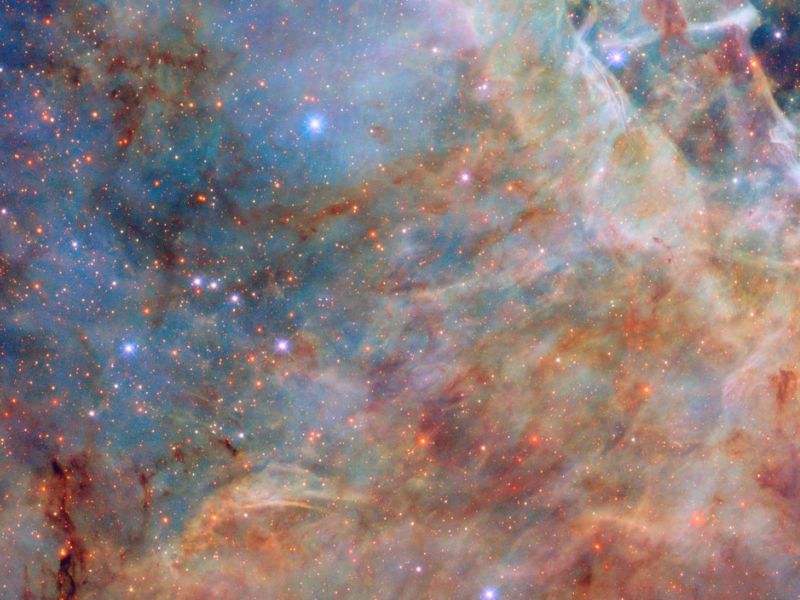
    Hubble reveals the vibrant star-forming complexities of the Large Magellanic Cloud’s Tarantula Nebula, a spectacular display of cosmic dust and colorful stellar phenomena. Credit: ESA/Hubble & NASA, C. Murray

    Dive into a celestial masterpiece with the Hubble Space Telescope’s latest snapshot of the Large Magellanic Cloud, showcasing the Tarantula Nebula’s vibrant star-forming regions.

    Amid serene blue gas and vibrant stars, explore how cosmic dust influences star and planet formation.

    The latest image from the Hubble Space Telescope captures a stunning view of the Large Magellanic Cloud, a dwarf galaxy about 160,000 light-years away. Though smaller than the Milky Way, this galaxy is nonetheless home to incredible celestial phenomena. In fact, it hosts some of the most remarkable and awe-inspiring sights in our cosmic neighborhood.

    Stellar Giants in the Tarantula Nebula

    The Large Magellanic Cloud, with only 10-20% of the Milky Way’s mass, contains some of the most active star-forming regions. This image focuses on the Tarantula Nebula, the largest such region nearby, where massive stars, each around 200 times the mass of our Sun, are born.

    Colors of Creation: Blue Gas and Red Stars


    The nebula shows blue gas, brownish-orange dust, and colorful stars. Dust absorbs more blue light than red, making stars behind the dust appear redder.

    Advancing Astrophysics Through Hubble’s Eyes

    This image combines ultraviolet, infrared, and visible light. By studying these dusty regions in the Large Magellanic Cloud and beyond, scientists aim to understand the role of cosmic dust in star and planet formation.


    Read Original Article: Scitechdaily

    Read More: Gaia Discovers a Swarm of Black Holes Roaming the Milky Way
  • New Research Reveals the Moon Is Older Than Previously Believed

    New Research Reveals the Moon Is Older Than Previously Believed

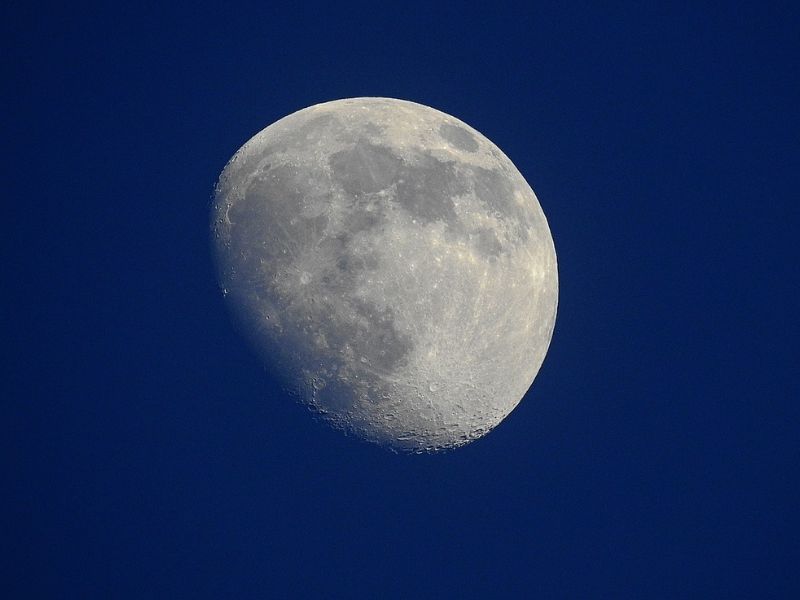
    Credit: Pixabay

    Recent research from scientists in the U.S., France, and Germany suggests the Moon formed as early as 4.53 billion years ago—hundreds of millions of years earlier than previously thought. This new timeline could explain lunar mysteries like the scarcity of massive impact basins and the Moon’s lower metal content compared to Earth, while offering fresh insights into Earth’s early evolution, according to geologist Francis Nimmo’s team.

    The prevailing theory is that a Mars-sized object collided with a molten Earth, ejecting material that coalesced to form the Moon. Afterward, the Moon likely hosted a global magma ocean that cooled to create its surface. Previous estimates placed the Moon’s formation around 4.35 billion years ago, but recent findings from lunar zircon grains challenge this.

    Zircon crystals provide a reliable method for determining the age of rocks. During their formation, these crystals incorporate uranium while rejecting lead. Over time, uranium decays into lead at a predictable rate, allowing scientists to accurately calculate the crystals’ ages by analyzing the uranium-to-lead ratios. Surprisingly, some lunar zircon crystals have been dated to 4.46 billion and even 4.51 billion years—much older than the 4.35-billion-year estimate for the Moon’s magma ocean. These findings suggest that zircon crystals predate the magma ocean, presenting a puzzling contradiction.

    The revised timeline for the formation and remelting of the Moon. (Nimmo et al., Nature, 2024)

    New Model Suggests Early Moon Formation and Tidal Heating Caused Crustal Remelting 4.35 Billion Years Ago

    To resolve the inconsistency, Nimmo and his team propose that the Moon formed earlier than previously thought and underwent crustal remelting around 4.35 billion years ago, likely due to tidal heating from its early, eccentric orbit.

    This timeline explains both the older zircon crystals and younger surface rocks, dating the Moon to between 4.43 and 4.53 billion years. Since Earth is about 4.54 billion years old, the Moon has been Earth’s companion almost its entire existence.

    The findings also address lunar mysteries, such as fewer impact basins, which tidal remelting may have erased, and the Moon’s lower surface metal content, with early metals sinking below the surface. While this timeline provides answers, some mysteries remain—unless extraterrestrials scattered zircons for fun.


    Read Original Article: Science Alert

    Read More: An Interstellar Visitor May Have Shaped the Orbits in Our Solar System

  • Remarkable Fossil Reveals a 12-Million-Year-Old Crocodile

    Remarkable Fossil Reveals a 12-Million-Year-Old Crocodile

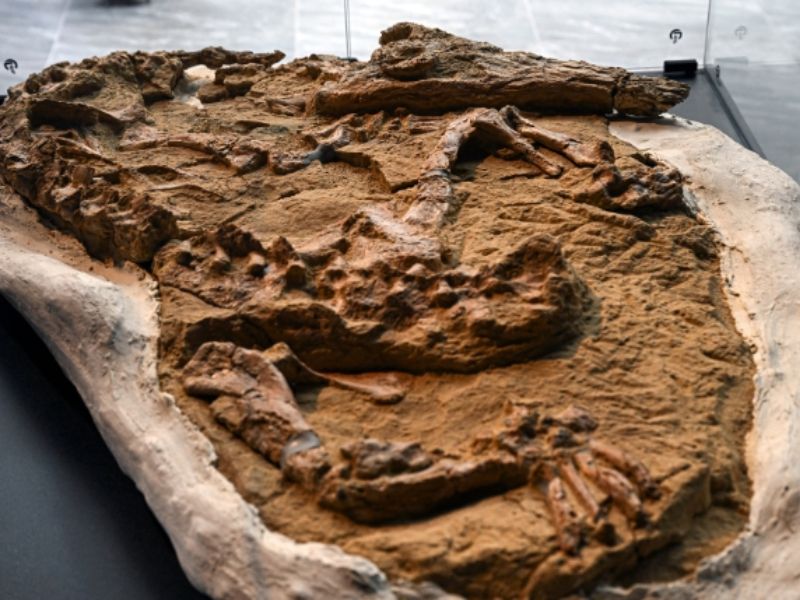
    The almost complete skeleton of a young marine crocodile. (Ernesto Benavides/AFP)

    On Wednesday, paleontologists revealed the fossil of a young marine crocodile, estimated to be 10 to 12 million years old, uncovered in a Peruvian desert. The three-meter-long (nearly 10-foot) gharial, or fish-eating crocodile, was discovered in late 2023 in the Ocucaje Desert, about 350 kilometers (190 miles) south of Lima, in near-perfect condition.

    This is the first juvenile specimen we’ve found,” said vertebrate paleontologist Mario Gamarra during a news conference. “It hadn’t yet reached its full size when it died.”

    Gamarra, who led the fossil’s reconstruction, noted that the skull and jaws of this ancient crocodile differed from modern crocodiles and alligators. “It had an elongated snout and fed exclusively on fish,” he explained. “Its closest living relative is the Indian gharial.”

    The discovery was a collaborative effort between Peru’s Geological, Mining, and Metallurgical Institute and La Union School.

    Fossilised leg and foot of the ancient crocodile. (Ernesto Benavides/AFP

    The Ocucaje Desert is a treasure trove of fossils. Previous finds from the Miocene period (5 to 23 million years ago) include remains of four-legged dwarf whales, dolphins, sharks, and other ancient species.


    Read Original Article: Science Alert

    Read More: Scitke