The U.S. is ramping up solar farm construction so quickly that there aren’t enough workers to keep pace. The Bureau of Labor Statistics projects a 48% rise in solar installer jobs by 2033, but even with that growth, the industry may still face a shortage of skilled labor. A major challenge: many solar farms are located in remote, harsh environments like deserts, making the work both exhausting and unattractive.
“It’s terrible work in remote places,” said James Emerick, co-founder and CEO of Cosmic Robotics, in an interview with TechCrunch. To ease that burden, Cosmic has created a robotic assistant designed to handle the physically demanding parts of the job.
Robots Take on the Heavy Lifting in Solar Installations, Allowing Humans to Focus on Skilled Tasks
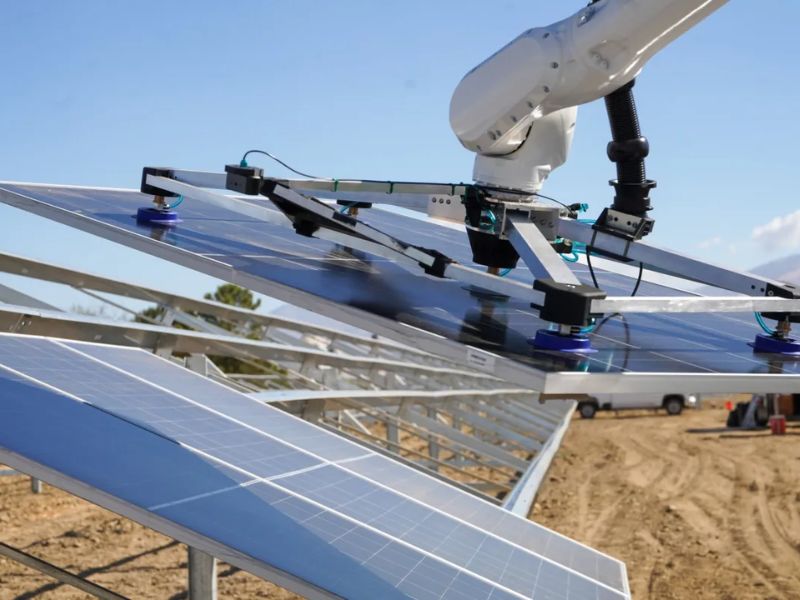
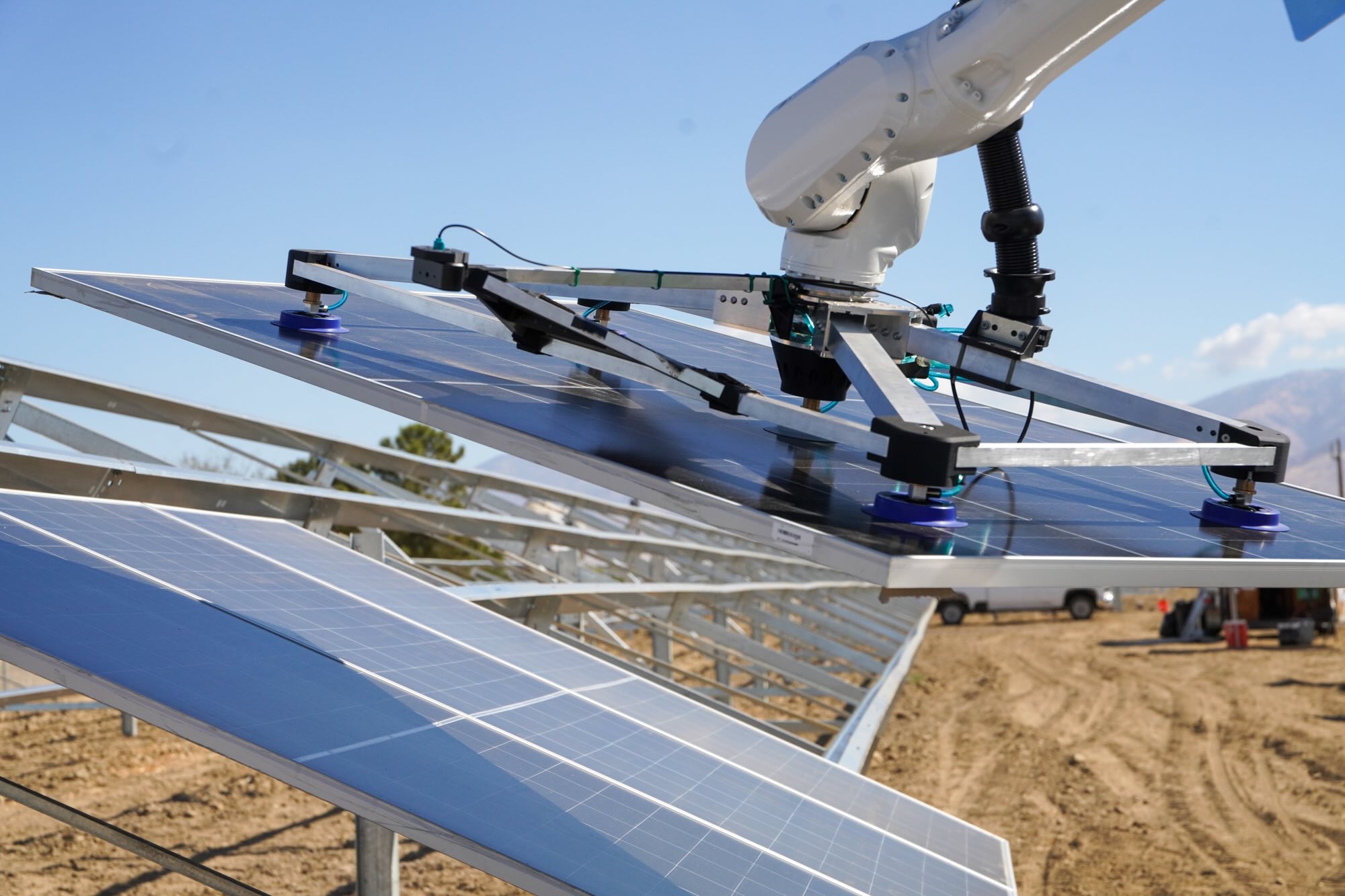
Installing utility-scale solar panels — which can weigh up to 90 pounds — often requires workers to lift and mount them onto elevated racks for hours in extreme heat. Cosmic’s robots are built to manage this heavy lifting, freeing up human workers for more precise tasks that require dexterity and judgment.
To support this vision, Cosmic Robotics has secured a $4 million pre-seed funding round led by Giant Ventures, with backing from HCVC, MaC Ventures, and angel investors including Azeem Azhar, Aarthi Ramamurthy, and Nate Williams.
Their current robot is an eight-wheeled machine equipped with a robotic arm, suction cups, cameras, and a trailer full of solar panels. It uses high-accuracy GPS for navigation and recharges at the construction site depot at the end of the day.
“We see this as a tool to empower workers, not replace them,” said Cosmic Robotics CEO James Emerick. “The job is physically demanding, so introducing technology like this broadens the range of people who can participate in the work.”
Cosmic’s robot is highly precise, capable of placing a solar panel within just a few millimeters of its intended spot. Human crew members still oversee the process and secure the panels to the racks, ensuring everything is correctly aligned.
Cosmic-1A Boosts Efficiency by Matching Human Speed and Working Without Breaks, Doubling Team Productivity
The robot not only eases the physical strain but also accelerates installation. Emerick noted that it could allow a typical crew to split into two teams, potentially doubling daily output. Known as the Cosmic-1A, the robot currently installs a panel every 30 to 40 seconds, on par with the speed of top human installers—but unlike people, it can maintain that pace for extended periods without fatigue. Workers continue to take regular breaks, while the robot stays on task.
With new funding, Cosmic plans to produce several units and have them operating in real-world construction sites by the end of the year.
The innovation could be particularly valuable to data center developers, who are racing to secure enough electricity to meet soaring demand. Solar energy is already a favored solution due to its affordability and quick deployment. Automating the installation process would make it even more appealing.
“There’s something new happening every day in data centers and power generation,” said Emerick. “Speed is everything. You can’t build fast enough or bring computing online quickly enough. That’s why data centers are measured in megawatts—it’s power that defines the scale.”
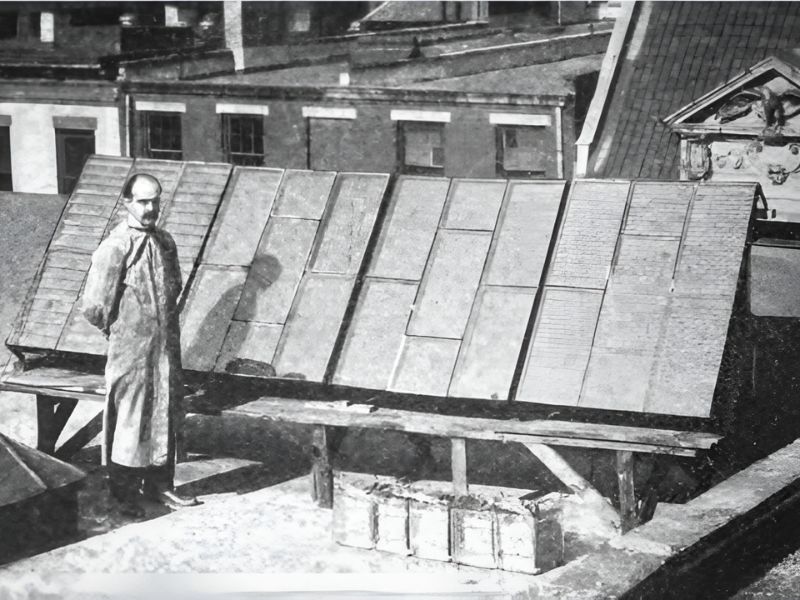
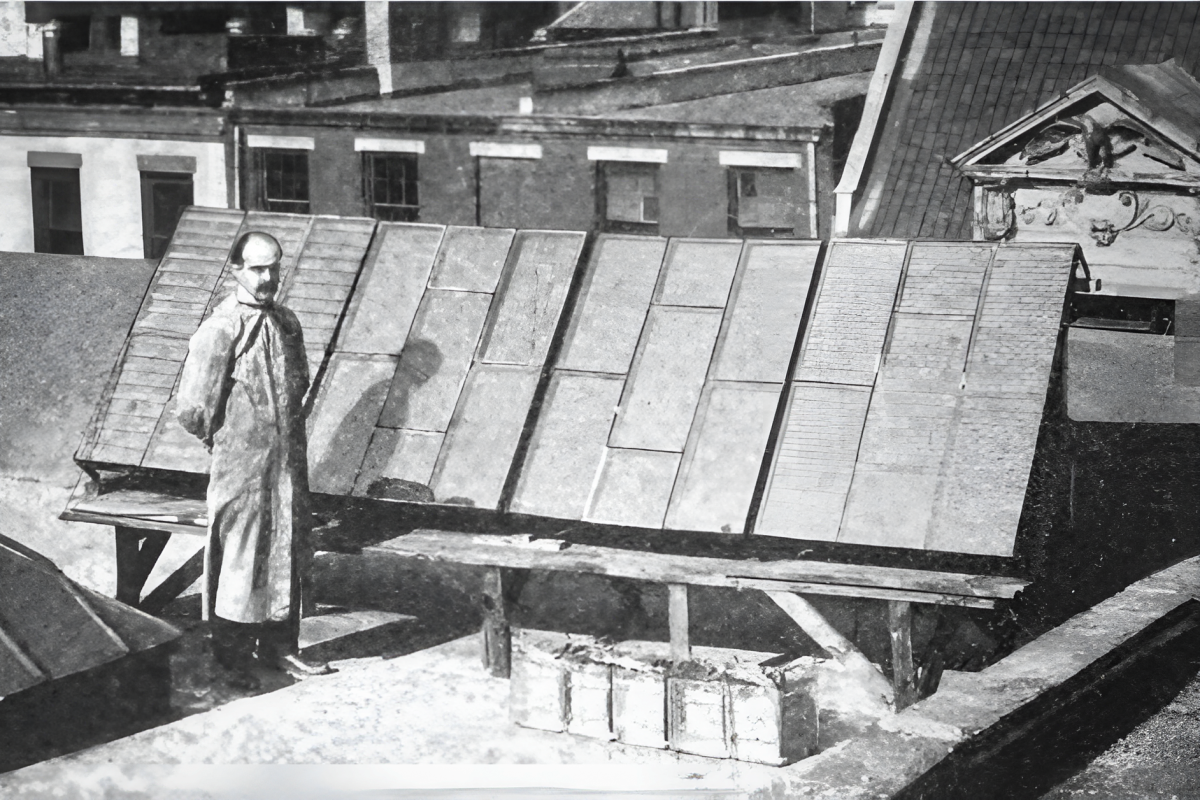
George Cove stands with his third solar array. From “Generating electricity by the sun’s rays” Popular Electricity, volume 2, nr. 12, April 1910
“From a New York rooftop in the 1800s to their debut in space. From tales of kidnappings and bribery to a world-altering inkwell mishap… Solar panels stand as one of humanity’s greatest inventions, and their history is more intriguing than you might expect.”
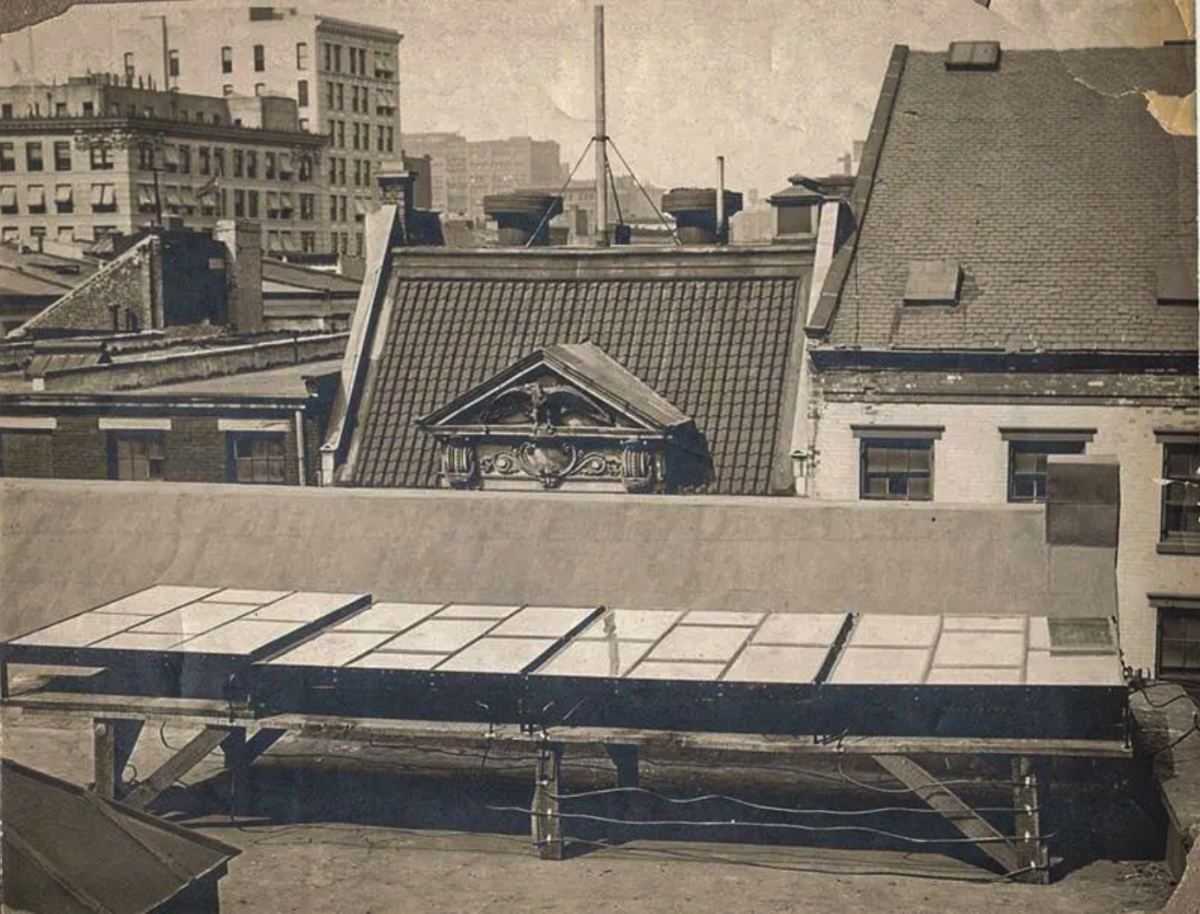
The first photovoltaic solar panel installation took place in 1884, when Charles Fritts mounted a billiard-table-sized array on a wooden frame on a New York City rooftop. Fritts used selenium coated with a thin layer of gold, achieving less than 1% efficiency in converting sunlight into electricity, producing a current he described as “continuous, constant, and of considerable force.”
The first solar array ever installed, by Charles Fritts on a New York rooftop in 1884 via Smithsonian Magazine
George Cove’s Solar Electric Generator and Breakthrough Innovations
Twenty years later, Canadian “serial inventor” George Cove, a polymath known for filing numerous patents in propeller design, tidal energy harvesting, AC generators, and electric clocks and watches, built on Fritts’ work. Cove developed a “solar electric generator” using a semiconductor material with a band gap very close to that of silicon—the main material in today’s solar panels—and incorporated a battery for energy storage and release.
Newspapers reported that Cove’s generator, costing about US$20 (around US$660 today), could power a home for 10 years, eliminating the need to connect to the growing electricity grid. His 1909 demonstration in Halifax drew significant investor interest, leading him to establish a New York workshop and raise $5 million.
However, his story took an odd turn when he claimed he was kidnapped and offered $25,000 plus a house to abandon his work. According to Oxford researcher Dr. Sugandha Srivastav, such tactics weren’t unusual for the time, with figures like Thomas Edison and J.D. Rockefeller known for using underhanded methods to eliminate competitors.
Cove’s Controversial Claims and the Decline of Solar Technology
Cove claimed he rejected the offer and was later released at the Bronx Zoo. Critics, however, accused him of fabricating the incident as a scam or to generate media attention for his business. Regardless, Cove’s business soon collapsed and never recovered, as the rise of coal and oil in 1911 overshadowed solar technology, stalling its progress for nearly 40 years.
“Obstructionism,” Srivastav notes, “has been a significant barrier to the development and deployment of renewable energy in the past and continues to be so today.”
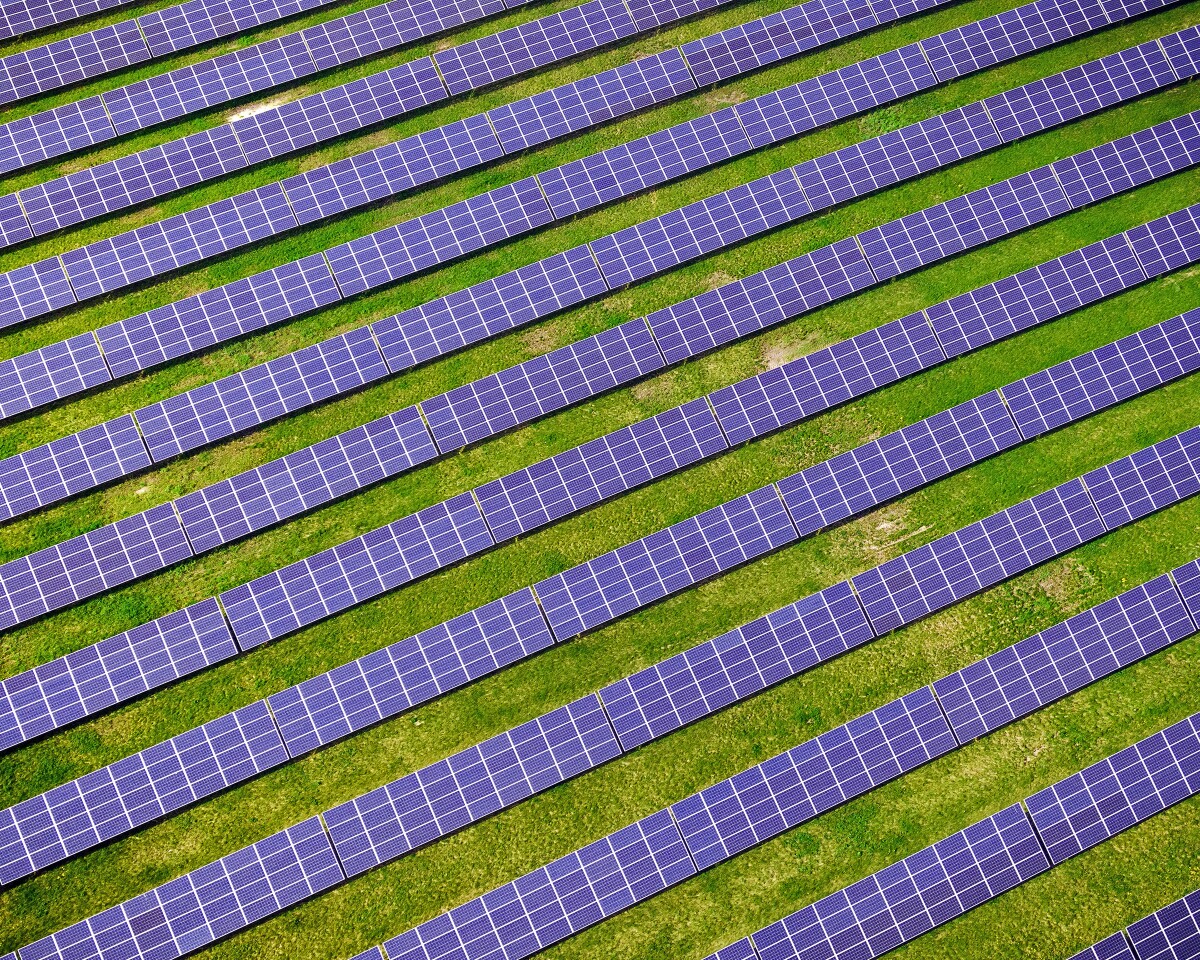
Solar farms may not always look pretty. We’d much rather see them on rooftops or over parking lots than covering up nature, but it still beats building a coal-fired power plant here instead Unsplash
Czochralski’s Discovery of Monocrystalline Structures
Solar energy made little progress in the following decades, but key technologies emerged that later sparked its revival. In 1918, Polish chemist Jan Czochralski accidentally discovered a method for growing monocrystalline structures used in semiconductor wafers, now crucial to 90% of today’s electronics.
This breakthrough came when Czochralski mistakenly dipped his pen into molten tin instead of his inkwell, leading to the discovery of a single crystal structure.
Solar technology stayed dormant until 1954, when Bell Labs scientists developed the first practical silicon solar cell with 6% efficiency, a major improvement thanks to Czochralski’s crystalline silicon method.
Around the same time, Bell Labs also invented the maser, making it a hub of groundbreaking innovation similar to today’s Google X Labs.
Vanguard I, the First Solar-Powered Satellite
The first major use of solar cells occurred in 1958 with the launch of Vanguard I, the first solar-powered satellite. Although it stopped transmitting data in 1964, it remains in orbit today. Solar cells were vital to its six-year operation, as batteries alone couldn’t have sustained it.
From the 1960s to the 1980s, solar panel adoption slowly spread, especially in remote areas where power lines were impractical or costly. Solar power became crucial for radio and TV towers, weather stations, offshore platforms, and in developing countries, it provided electricity for essential services like lighting and vaccine refrigeration.
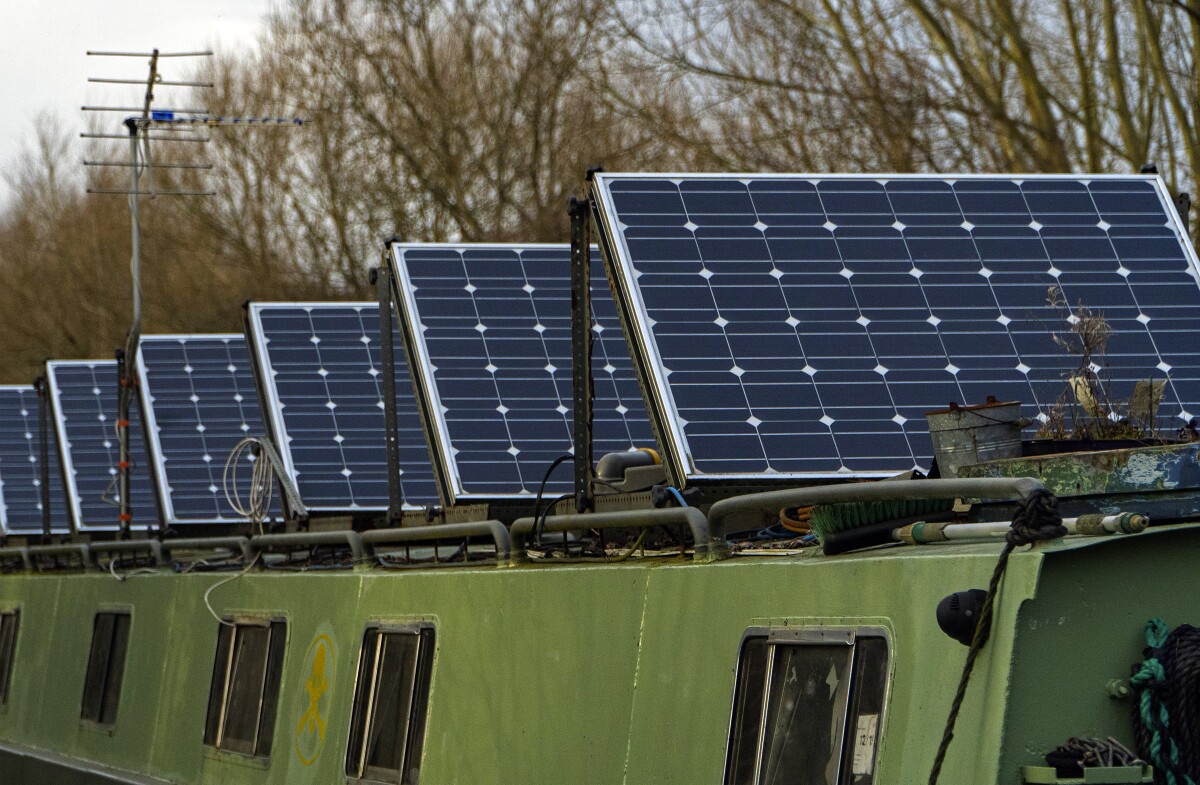
Solar panels in developing countries or just in places where the cost of bringing in powerlines is too expensive Unsplash
Multi-Junction Cells and Their Aerospace Applications
In 1989, multi-junction cells were developed, stacking thin layers of different materials to increase efficiency. By 2006, these cells achieved 46% efficiency, nearly double that of traditional silicon cells. Despite their high cost, they are mainly used in aerospace applications like the International Space Station, which can generate up to 120 kW with its solar arrays.
Recently, perovskite has improved efficiency further. Its unique structure has allowed tandem cells, combining silicon and perovskite layers, to exceed 30% efficiency.
Bifacial solar panels, popular in the last decade, capture sunlight from both sides and are used in utility-scale plants for maximum efficiency. I’ve installed them on my home and RV for their effectiveness.
Today’s solar panels last 25-30 years with only a 1% annual decline in capacity after their lifespan.
Portable and flexible solar technology is expanding the use of this cost-effective energy source.
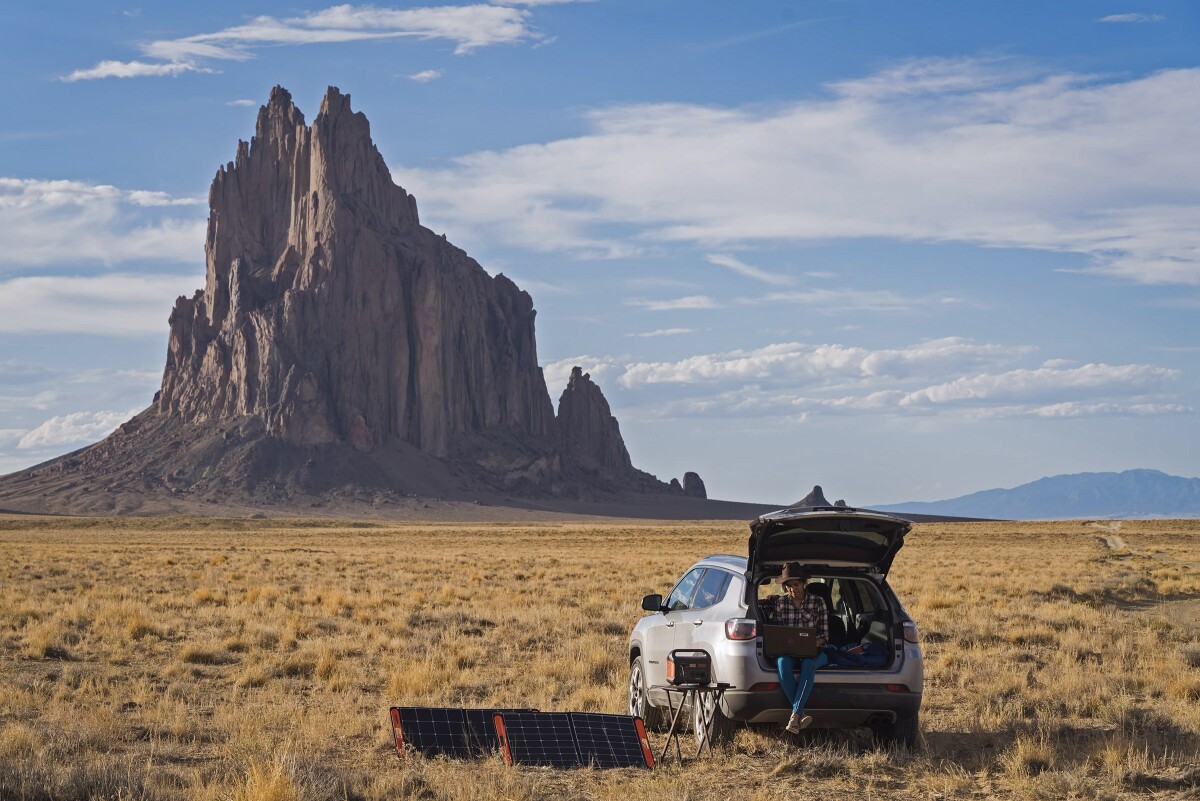
Easily deployable portable solar panels to keep your electronics topped up while out on a great adventure Unsplash
Breakthrough in Solar Technology
A major breakthrough in solar technology has been in battery storage. Since solar power only generates electricity during part of the day, storing excess energy has been essential for making solar a reliable, continuous energy source, especially for municipal power grids.
Advancements in battery technologies and falling costs have made solar power increasingly reliable, even at night, with solar-charged battery banks. Lithium-ion batteries paved the way, and newer technologies like lithium-iron-phosphate (LiFePO4), iron-air, and mechanical storage methods are improving energy density and cost.
These technologies are evolving to support a clean energy future, addressing both short-term power needs and long-term grid stability.
Despite its early challenges, solar power has become a key player in achieving zero carbon emissions by 2050. It is now the second-cheapest electricity source, behind onshore wind, and costs about half as much as coal-fired power.
From Charles Fritts’ initial rooftop device, solar energy has grown into a crucial, economically viable clean energy source, meeting our expanding electricity demands.
This innovation allows for the absorption of sunlight without compromising the view through these transparent surfaces. Credit: Masood Aslami/ pexels.com
A group of scientists from Michigan State University has created a technology capable of transforming see-through surfaces, such as windows in buildings or cell phone screens, into surfaces that can collect solar energy. This innovation allows for the absorption of sunlight without compromising the view through these transparent surfaces.
Transforming Cities into Solar Powerhouses
Envision a city functioning as an extensive system for harnessing solar energy. The solar panels in this scenario possess the capability to provide power to buildings and can be installed onto existing glass exteriors or windows, including older structures.
The solar energy collection system utilizes organic molecules created by Lunt and his colleagues to capture imperceptible sun rays. These materials can be adjusted or fine-tuned by the researchers to exclusively capture ultraviolet and near-infrared wavelengths, which are subsequently transformed into electrical energy.
Harnessing Transparent Solar Power for a Sustainable Future
Under the guidance of engineering researchers from Michigan State University, the authors contend that the extensive adoption of transparent solar applications, in conjunction with rooftop units, has the potential to fulfill a significant portion of the electricity needs in the United States. Furthermore, this adoption could lead to a substantial reduction in the reliance on fossil fuels.
The transition of worldwide energy consumption from fossil fuels to alternative and economically viable renewable energy technologies is crucial. Currently, solar power accounts for a mere 1.5 percent of electricity demand in both the United States and globally.
Read the original article on SIA Magazin.
Read more: European Union sets New Records for Wind and Solar Energy Production.
We use cookies on our website to give you the most relevant experience by remembering your preferences and repeat visits. By clicking “Accept All”, you consent to the use of ALL the cookies. However, you may visit "Cookie Settings" to provide a controlled consent.
This website uses cookies to improve your experience while you navigate through the website. Out of these, the cookies that are categorized as necessary are stored on your browser as they are essential for the working of basic functionalities of the website. We also use third-party cookies that help us analyze and understand how you use this website. These cookies will be stored in your browser only with your consent. You also have the option to opt-out of these cookies. But opting out of some of these cookies may affect your browsing experience.
Necessary cookies are absolutely essential for the website to function properly. These cookies ensure basic functionalities and security features of the website, anonymously.
Cookie
Duration
Description
cookielawinfo-checkbox-analytics
11 months
This cookie is set by GDPR Cookie Consent plugin. The cookie is used to store the user consent for the cookies in the category "Analytics".
cookielawinfo-checkbox-functional
11 months
The cookie is set by GDPR cookie consent to record the user consent for the cookies in the category "Functional".
cookielawinfo-checkbox-necessary
11 months
This cookie is set by GDPR Cookie Consent plugin. The cookies is used to store the user consent for the cookies in the category "Necessary".
cookielawinfo-checkbox-others
11 months
This cookie is set by GDPR Cookie Consent plugin. The cookie is used to store the user consent for the cookies in the category "Other.
cookielawinfo-checkbox-performance
11 months
This cookie is set by GDPR Cookie Consent plugin. The cookie is used to store the user consent for the cookies in the category "Performance".
viewed_cookie_policy
11 months
The cookie is set by the GDPR Cookie Consent plugin and is used to store whether or not user has consented to the use of cookies. It does not store any personal data.
Functional cookies help to perform certain functionalities like sharing the content of the website on social media platforms, collect feedbacks, and other third-party features.
Performance cookies are used to understand and analyze the key performance indexes of the website which helps in delivering a better user experience for the visitors.
Analytical cookies are used to understand how visitors interact with the website. These cookies help provide information on metrics the number of visitors, bounce rate, traffic source, etc.
Advertisement cookies are used to provide visitors with relevant ads and marketing campaigns. These cookies track visitors across websites and collect information to provide customized ads.