Tag: SpaceX

  • Starlink’s Satellite to Phone Service Set for Next Year

    Starlink’s Satellite to Phone Service Set for Next Year

     Credit: CNBC

    Starlink, the satellite internet venture owned by SpaceX, has silently introduced its Direct Cell service on its official website, heralding a breakthrough in connectivity for LTE phones under open skies. This innovative service requires no modifications to existing phone hardware, firmware, or special applications.

    Future Expansion of Services

    According to the website, Starlink has a comprehensive roadmap for Direct to Cell. In 2024, they plan to introduce text services, with voice, data, and IoT connectivity to follow in 2025. This expansion promises to bring a range of communication options for users.

    The standout feature of Direct to Cell is its potential to provide connectivity virtually anywhere, making it particularly appealing for those in remote areas without terrestrial coverage. This satellite service extends LTE phones’ reach beyond traditional cell towers’ constraints.

    Starlink’s satellites with Direct Cell capability boast eNodeB modems, functioning like space-based cell towers. This technology enables seamless network integration, akin to a standard roaming partner.

    SpaceX’s Expertise and Deployment Strategy

    Leveraging SpaceX’s experience in rocket manufacturing and launching, Starlink aims to deploy direct-to-cell satellites on a large scale.

    Initially launched on SpaceX’s Falcon 9 rockets and later on Starship, these satellites will establish immediate connections through laser backhaul to the Starlink constellation, ensuring global coverage.

    Project Evolution and Operator Partners

    Previously referred to as “Coverage Above and Beyond,” Starlink’s project for universal cell phone connectivity has transformed. The website lists additional operator partners, including Optus in Australia, Rogers in Canada, One NZ in New Zealand, KDDI in Japan, and Salt in Switzerland.

    Challenges and Uncertainties

    Despite the ambitious goals set by Starlink, the specifics of what this service can deliver remain unclear. The absence of an official announcement or press release leaves many questions unanswered.

    Peter Kibutu, Advanced Technology Lead at TTP, points out that providing connectivity through unmodified 4G handsets may result in low-bandwidth data and voice services, falling short of contemporary demands. 

    Achieving high-performance connectivity will likely require compliance with 3GPP-compliant 5G NR NTN waveform, which Starlink currently avoids by using its proprietary technology.

    Network X: Shaping the Telco Industry’s Future

    Crucial details such as pricing and service features are yet to be revealed, leaving room for further insights into what Starlink’s offering will entail and how it will compare to other satellite connectivity ventures.

    In an environment where the wireless and wireline industries converge, Network X is the world’s most comprehensive telco event. Taking place from October 24 to 26, 2023, in Paris, the event promises valuable insights from tier 1 telcos, strategies for monetization and deployment, networking opportunities, product innovation, and more. 

    Network X aims to guide your strategic decisions, foster meaningful connections, and facilitate sound investments for your business.


    Read the original article on TeleComs.

    Read More: Roy Allela and the Sign Language Gloves´ Speech.

  • SpaceX Announces Starlink Aviation Service for Planes

    SpaceX Announces Starlink Aviation Service for Planes

    Credit: SpaceX

    SpaceX is launching Starlink Aviation, a new service that will make its satellite internet network available on planes. “With Starlink, passengers will be able to access high-speed, low-latency internet from the moment they walk on their plane,” the company tweeted on October 18.

    Starlink Aviation

    In June 2022, the FCC gave SpaceX authorization to begin selling Starlink terminals– the receiver tools for its satellite-based internet– that work on moving vehicles. The company then announced Starlink Maritime for boats, and it’s currently launching Starlink Aviation for airplanes.

    “Internet in airplanes will feel same as if you were accessing Internet at home!”

    This service will deliver internet speeds up to 350 megabits per second (Mbps) per plane while it flies anywhere in the globe, according to SpaceX. Also, the best in-flight Wi-fi presently available typically tops out at 100 Mbps, and some carriers only provide 9.8 Mbps.

    At the speeds SpaceX offers, every passenger on a plane needs to be able to take video calls, play games, and more simultaneously.

    “Internet in airplanes will feel same as if you were accessing Internet at home!” tweeted SpaceX CEO Elon Musk.

    SpaceX plans to start hardware deliveries in mid-2023.

    The information

    A Starlink Aviation subscription costs between $12,500 and $25,000 monthly, depending on an airline’s needs, plus a one-time hardware fee of $150,000. Customers will have to pay someone to install the system or do it themselves, as SpaceX does not provide that service.

    SpaceX plans to begin hardware deliveries in mid-2023 and is currently taking reservations for $5,000. There are no long-term contracts or information limits for Starlink Aviation, and the hardware is under warranty for as long as a customer subscribes to the service.

    The big picture

    Before a Starlink terminal can be installed on a plane, the airplane’s proprietor or operator will need to obtain a supplemental kind certificate from the FAA– this grants permission to modify the plane from its original design.

    All of the models SpaceX states are presently in the process of being certified for Starlink Aviation are private or regional planes. Still, large commercial planes could be coming soon.

    “Passengers and customers want a fantastic experience that [geostationary] systems simply can not offer”.

    In April, Hawaiian Airlines announced that it would start offering cost-free Starlink WiFi on some flights beginning in 2023, and in June, Jonathan Hofeller, Starlink’s VP of commercial sales, said SpaceX was working on agreements with other airlines.

    “All in all, travelers and customers desire a fantastic experience that [geostationary] systems simply can not provide,” he told attendees at the Connected Aviation Intelligence Summit.


    Read The Original Article On FREETHINK.

    Read more: You Can “See the Future” With These Smart Contact Lenses.

  • Starship’s Advanced Model is Said to Have NASA Officials Sh**ting the Bed

    Starship’s Advanced Model is Said to Have NASA Officials Sh**ting the Bed

    SpaceX’s Starship carrying out test flight maneuvers. Credit: SpaceX

    According to a statement from Politico, Elon Musk recently provided the first big update on SpaceX’s Mars-bound rocket, Starship, and its competitors are monitoring on with “a mix of admiration and fright.” At his latest Starship presentation, SpaceX CEO Musk emphasized the truth that Starship would certainly be reusable repeatedly at a fraction of the cost of previous rockets. It is an advancement that intimidates to leave NASA and various adversaries in its wake as it releases to the proverbial stratosphere.

    Starship will likely launch at a fragment of the cost of NASA’s rockets

    While it has long been understood that Starship would be reusable, the advanced capabilities have other space organizations, even NASA, worried that their own in-development rocket projects will certainly be rendered out-of-date.

    ” They are shitting the bed,” one top Washington space lobbyist informed Politico under conditions of anonymity.

    Starship is designed to be the first recyclable spacecraft that will certainly manage to take staff and cargo to the Moon and Mars prior to returning to Earth. By contrast, NASA’s Space Launch System (SLS) for its Artemis Moon landing missions has actually gone billions of dollars over initial budget plan estimations and is years behind schedule. NASA approximates that an SLS mission will certainly cost roughly $2 billion per launch, while Musk announced in his newest presentation that a Starship mission might cost a comparatively low $1 million.

    Starship might render other rocket programs out-of-date

    That disparity between the capabilities of SpaceX’s machine and the historic space innovator, NASA, might have considerable implications for the space sector all at once. It is a development that has actually slowly played out recently, with SpaceX bringing crewed spaceflight back to the U.S. in 2020. Presently, Starship might take things to an entirely new level.

    ” Once [Starship’s] reliability is demonstrated with a large number of trips, which can happen in an issue of months, it will certainly obsolesce all existing launch systems,” aerospace engineer and consultant Rand Simberg informed Politico. “If SLS is not mosting likely to fly more than once every several years, it is simply not going to be a considerable gamer in the future in space, especially when Starship is flown.”

    Of course, Musk has actually been known to make grand statements that have not come true, and the production of his other company Tesla’s Cybertruck, has actually faced long delays considering it was first revealed in 2019. Still, given the capabilities Starship has actually already shown off in test flights and the recent assurances made by Elon Musk and SpaceX, NASA and private contractors– consisting of Northrup Grumman and Boeing– may find the status altered to the factor they need to go back to the drawing board.


    Read the original article on Interesting Enginnering.

    Related “Riding a Laser to Mars”

  • Riding a Laser to Mars

    Riding a Laser to Mars

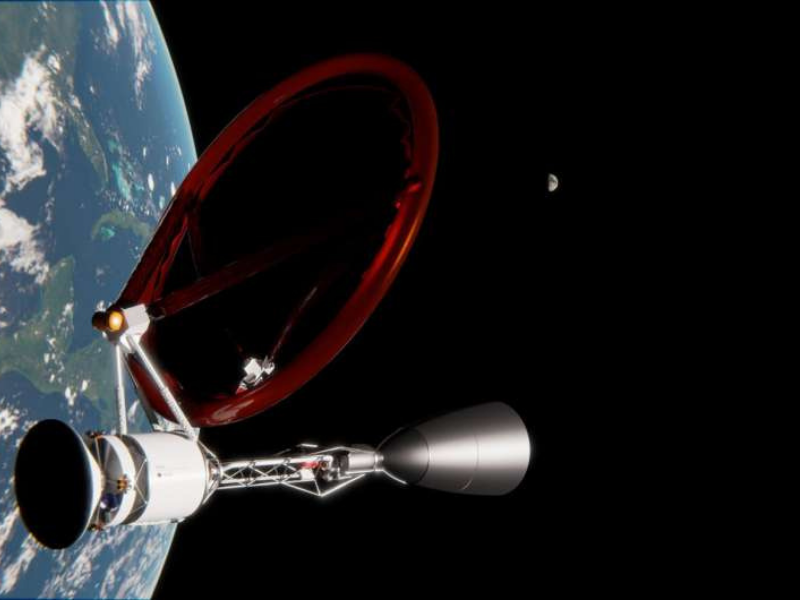
    Laser-thermal propelled spacecraft in Earth orbit awaiting its departure. Credit: Creative Commons Attribution 4.0 International License

    Could a laser send a spacecraft to Mars?

    That is a proposed mission from a group at McGill University, made to fulfill a solicitation from NASA. The laser, a 10-meter vast array in the world, would certainly heat up hydrogen plasma in a chamber behind the spacecraft, creating thrust from hydrogen gas and sending it to Mars in only 45 days. There, it would be aerobrake in Mars’ atmosphere, shuttling supplies to human colonists or, at some point probably, even human beings themselves.

    In 2018, NASA challenged engineers to craft a mission to Mars that would certainly deliver a payload of at the very least 1,000 kilos in no more than 45 days, along with longer trips deep into, as well as out of, the solar system.

    The quick delivery time is stimulated by an aspiration to shuttle shipments and, someday, astronauts to Mars while lessening their exposure to the harmful effects of galactic cosmic rays and solar storms. Elon Musk’s SpaceX pictures a human trip to Mars would certainly take six months with its chemical-based rockets.

    Concepts behind the theory

    McGill’s concept, called laser-thermal propulsion, relies on a variety of infrared lasers based on Earth, 10 meters in diameter, incorporating several invisible infrared beams, each with a wavelength of about one micron, for a powerful total of 100 megawatts– the electric power required for approximately 80,000 U.S. households.

    The payload, orbiting in an elliptical medium Earth orbit, would include a reflector that directs the laser beam originating from Earth into a heating chamber containing a hydrogen plasma. With its core afterward heated up as high as 40,000 Kelvin (72,000 degrees Fahrenheit), hydrogen gas circulating around the core would get to 10,000 K (18,000 degrees Fahrenheit) and be ejected out a nozzle, creating thrust to propel the ship away from Earth for 58 minutes. (Side thrusters would maintain the craft aligned with the laser’s beam as Earth rotates.).

    When the beaming halts, the payload whisks away at a velocity of nearly 17 kilometers per second relative to Earth– fast enough to transcend the moon’s orbital distance in a mere 8 hours. When it gets to the Martian atmosphere in a month and a half, it will still be traveling at 16 km/s; however, as soon as there, putting the payload in a 150-km orbit around Mars is a difficult issue for the engineering team to address.

    It is hard since the payload cannot carry a chemical propellant to fire a rocket to slow itself down– the fuel needed would certainly reduce the payload mass to less than 6 percent of the initial 1,000 kgs. Furthermore, until humans on the red planet can build an identical laser range for the incoming craft to utilize its reflector and plasma chamber to provide reverse thrust, aerocapture is the only way to slow down the payload at Mars.

    Also then, the aerocapture, or aerobraking, in Mars’ atmosphere could be a dicey maneuver, with the spacecraft experiencing slowdowns of up to 8 g (where g is the acceleration caused by gravity at Earth’s surface, 9.8 m/s2), about the human limit, for a few minutes, as it is recorded within a single pass around Mars. The big heat fluxes on the craft due to atmospheric friction would be above conventional thermal protection system materials, but not those under active development.

    Laser-thermal propulsion

    Laser-thermal propulsion of spacecraft right into deep space– Mars and further– contrast with other previously proposed approaches of conveyance, such as:

    • laser-electric propulsion, in which a laser beam would certainly impinge on photovoltaic (PV) cells behind the payload;
    • solar-electric propulsion, in which sunlight on the PV cells produces the propulsive thrust;
    • nuclear-electric propulsion, in which a nuclear reactor develops electricity that produces ions thrust out a thruster;
    • nuclear-thermal propulsion, in which a nuclear reactor’s heat converts liquid to a gas that’s propelled out a nozzle to produce thrust.

    ” Laser-thermal propulsion enables fast transport missions of 1 ton with laser varieties the size of a volleyball court– something laser-electric propulsion can solely do with kilometer-class arrays,” claims Emmanuel Duplay, lead author on the study that worked on the project over two years while part of McGill University’s Summer Undergraduate Research in Engineering Program. Duplay is currently in Delft University of Technology’s Master of Science Program in Aerospace Engineering with a specialization in Spaceflight.

    An excellent advantage of laser-thermal propulsion mission concept introduced by Duplay et al. is its extremely low mass-to-power ratio, in the range 0.001– 0.010 kg/kW–” unmatched,” they write, “far below also those cited for advanced nuclear propulsion technologies, due to the reality that the source of power stays on Earth and the delivered flux can be processed by a low-mass inflatable reflector.”.

    Application of laser-thermal propulsion

    Laser-thermal propulsion had first been studied in the 1970s using 10.6-micron CO2 lasers, the most powerful at the time. Today’s present-day fiber-optic lasers, at one micron, which can be integrated into massively parallel, phased arrays with a big, effective diameter, suggests a focal length of power delivery over two orders of magnitude greater– 50,000 kilometers in Duplay’s laser-thermal propulsion concept.

    Duplay explains that architecture for phased-array lasers is being produced by a team led by physicist Philip Lubin at the University of California at Santa Barbara. Lubin’s team’s array utilizes individual laser amplifiers of roughly 100 watts each– each amplifier is a simple loop of fiber optics and an LED light as a pump and can be mass-produced at low costs– so the Mars mission conceived here would certainly need on order of 1 million individual amplifiers.

    The first people to Mars most likely will not get there utilizing laser-thermal propulsion technology. “However, as more people make the journey to sustain a long-term colony, we will certainly require propulsion systems that obtain us there much faster– if only to prevent radiation hazards,” Duplay says. He speculates that a laser-thermal mission to Mars might launch ten years after the first human missions, so maybe around 2040.


    Read the original article on PHYS.

    Related “Experiments on Parabolic Flight Test Oxygen-Evolving Electrolysis”

  • Scientific Hardware and Space Experiments Returning to Earth on SpaceX CRS-24 Dragon Craft

    Scientific Hardware and Space Experiments Returning to Earth on SpaceX CRS-24 Dragon Craft

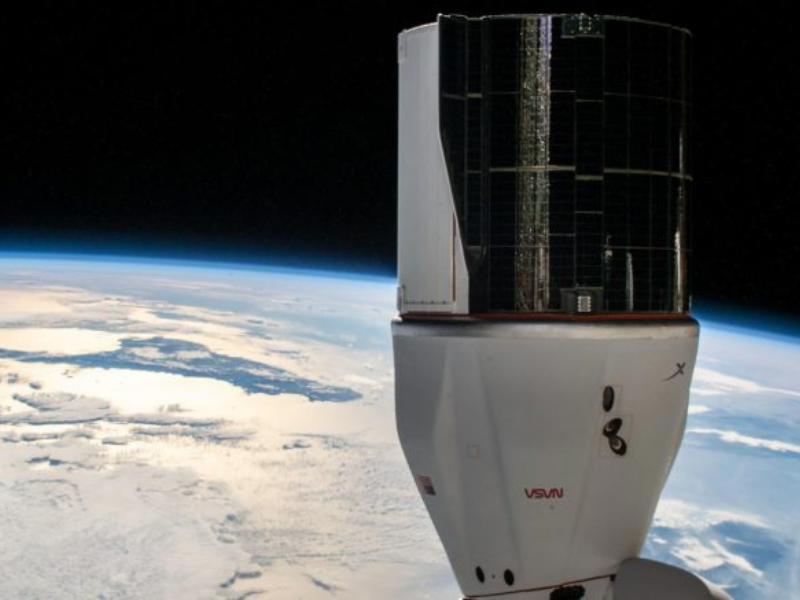
    A SpaceX Cargo Dragon spacecraft docked to the International Space Station. Credit: NASA

    A retired microscope and samples from research studies on colloids and cellular signaling are among the load returning from the International Space Station aboard the 24th SpaceX commercial resupply services mission. The Dragon craft, which reached the station on December 22, 2021, is undocked on January 23 with parachute-assisted splashdown the following afternoon (Monday, January 24) off the coast of Florida.

    These quick return flights permit researchers to make supplementary observations and evaluations of their experiments at Kennedy Space Center, decreasing the impacts of gravity on samples. Investigators afterward can carry out more thorough analyses back at their home laboratories.

    Learn more about some of the equipment and experiment samples making the trip back to Earth:

    Last light for LMM on the Dragon Craft


    In 2009, NASA launched a state-of-the-art light imaging microscope, the Light Microscopy Module (LMM). The microscope now returns to Earth aboard the Dragon Craft for a well-deserved retirement. Financed by NASA’s Biological and Physical Sciences division, this powerful diagnostic tool allowed unique research study of microscopic phenomena in microgravity, giving the capability to remotely acquire and download pictures and video clips at different levels of magnification.

    LMM allowed them to observe and record how matter is organized and moves on the microscopic level. Researchers employed this tool for microgravity research on colloids, tiny particles suspended in a liquid. This liquid contributed to breakthroughs in formulations and the shelf life of consumer items such as toothpaste and shampoo, 3D printing, and technology for finding shifting sands on Mars. The LMM likewise contributed to research studies of plants in microgravity, including the CARA investigation. It also supported thermophysics research studies, including CVB and CVB-2. Both of them are researches on heat transfer systems in microgravity.

    Tiny structures assembly


    InSPACE-4 studies assembly of tiny structures from colloids or particles suspended in a liquid, utilizing magnetic fields. Colloidal structures alter the properties of the assembled material, such as its mechanical response to or interaction with light and heat. Microgravity gives a distinct opportunity to observe assembly in ways and scales not possible on Earth over time.

    Thomas Pesquet of ESA (European Space Agency) performs a session for the InSPACE-4 physics research study, giving insight into how to harness nanoparticles to fabricate and manufacture new materials for Earth and space applications. Credit: NASA

    Outcomes might offer knowledge into harnessing nanoparticles to produce and manufacture new materials. This leads to more sophisticated materials for space applications, including energy transfer, thermal shields, energy production, protection from micrometeorites, and actuators and sensors for human and robotic missions. Additional potential applications include advancing the manufacturing of materials on Earth for applications such as thermal shields, sound damping devices, camouflage, and clinical diagnostics. The technology additionally could support larger-scale applications such as constructing foundation stabilizers for areas susceptible to earthquakes.

    Investigators observed the experiment via video downlink, and vials containing the colloidal structures returned to Earth for additional analysis.

    Cell signaling in microgravity


    Scientists keep on researching how microgravity influences mammalian cells. Cytoskeleton, an investigation from ESA (European Space Agency), examines whether microgravity influences the feature of cellular signaling molecules called RhoGTPases. These molecules perform as “molecular switches”. They are involved in the control of gene expression, programmed cell death, cell spreading, and organization of the cytoskeleton (the network of protein filaments and tubules that give cells their shape).

    This investigation contributes to our knowledge of how the human body responds to microgravity. It might also support the creation of countermeasures to assist crew members in maintaining optimum health on future missions. The work additionally might increase knowledge about cellular function on Earth and contribute to future clinical study here on the ground. Cell cultures are going back to the ground for analysis.


    Read the original article on Scitech Daily.

    Related “A New Japanese Lunar Lander to Join The Race To The Moon: The Ispace Series 2

  • COVID-19 Provokes Liquid Oxygen Shortages Delaying Space X Launch Plans

    COVID-19 Provokes Liquid Oxygen Shortages Delaying Space X Launch Plans

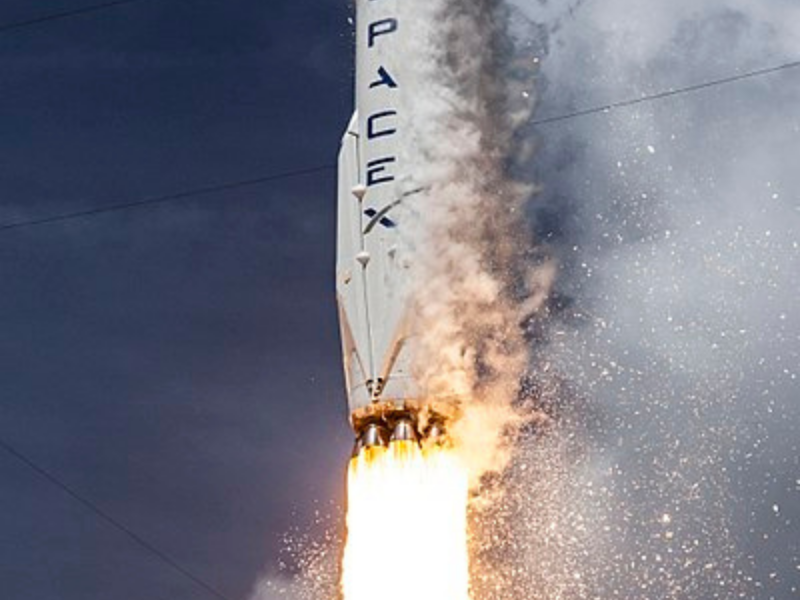
    On the left (SpaceX falcon 9 ). On the right (liquid oxygen). Credit: Derya Ozdemir

    As the COVID-19 cases increase across the globe as a result of the Delta variant, liquid oxygen (LOX), which hospitals employ to treat patients, remains in short supply. LOX is getting hard to find as demand increases, and COVID-19 patients might not be the only ones impacted.


    Undoubtedly, upcoming launches could be influenced, as SpaceX President and COO Gwynne Shotwell explained during the 36th yearly Space Symposium on Tuesday, August 24. Several launch companies count on LOX to get rockets off the ground, given its function as an oxidizer in union with fuels such as liquid hydrogen, methane, and kerosene. This is why acquiring supplies of liquid oxygen is at the moment among one of the most crucial supply chain issues.


    Shotwell mentioned that SpaceX would be affected this year by the shortage of liquid oxygen for launch. Shotwell added that SpaceX would ensure the hospitals are going to have the oxygen that they require. However, for anyone with liquid oxygen to spare, that person would be free to send her an email.


    Shotwell did not clarify the possible impact of the LOX shortage on SpaceX’s upcoming launch calendar. However, the LOX is not the only shortage that’s impacting the company. SpaceX has currently placed Starlink internet satellite launches on hold, considering its last launch was on June 30, an uncommonly long break for the company. According to Shotwell, the global microchip shortage postponed the new user terminals for the company’s Starlink satellite, yet she expects the next Starlink launch to occur in approximately three weeks.


    The LOX shortage is also affecting other companies. Tory Bruno, CEO of United Launch Alliance, explained in a tweet following the conference that the federal contractor that supplies nitrogen for the company’s launch centers at Vandenberg Space Force Base in California is currently attempting to deal with the liquid oxygen shortage in Florida.


    On the other hand, in Florida, on August 20, the Orlando Utilities Commission revealed a 50% decrease in the weekly shipment of liquid oxygen utilized in water filtration systems. Officials advised residents and companies to conserve water to avoid water shortages triggered by the city’s purification systems’ limited capacity.


    Originally published on Interestingengineering.com. Read the original article.