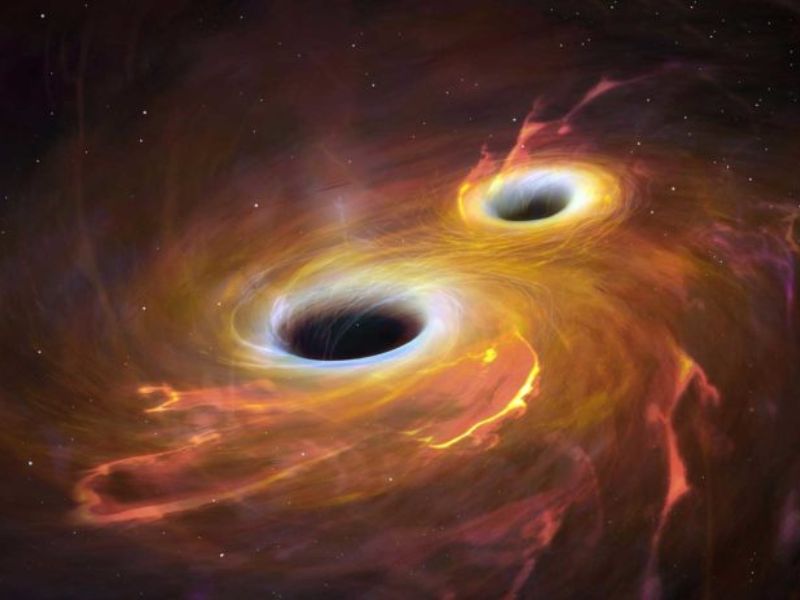
Image Credits: An artist’s impression of two black holes merging
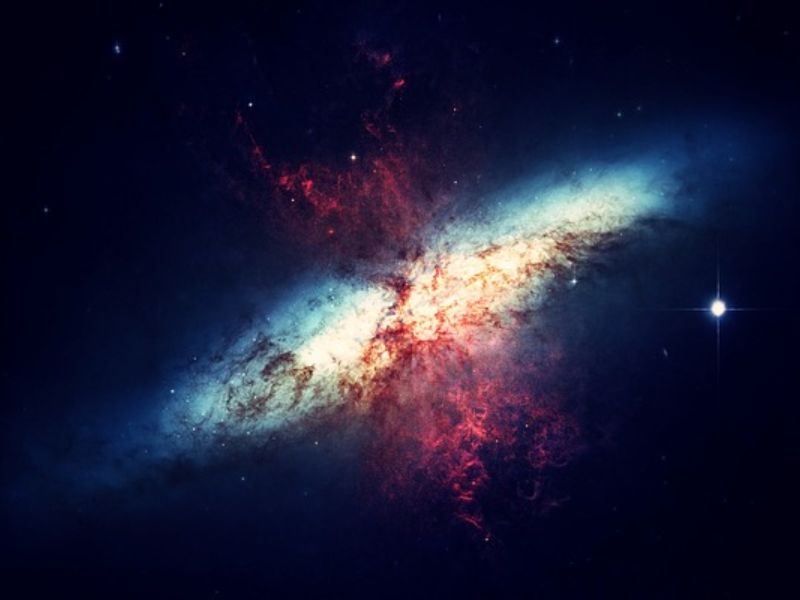
In a newly released image from NASA, the galaxy known as NGC 6240 features two supermassive black holes currently merging. The image combines fresh X-ray data from the Chandra Observatory (displayed in red, orange, and yellow) with an optical image captured by the Hubble Space Telescope, first published in 2008.
The two merging black holes, visible as bright point-like spots at the center of the image, are roughly 3,000 light-years apart. They are this close because they have been slowly spiraling toward one another — a process that started around 30 million years ago.
Merging Black Holes in NGC 6240
In 2020, scientists announced the discovery of two merging black holes using data from Chandra. Since 2002, NGC 6240 has been the focus of extensive follow-up observations by Chandra and other telescopes.
Image Credits:The Chandra image of NGC 6240 containing two supermassive black holes
NGC 6240 is a nearby ultraluminous infrared galaxy (ULIRG) located in the constellation Ophiuchus. It is the product of a collision and merger involving three smaller galaxies.
Scientists believe the merging process began roughly 30 million years ago. They estimate that the two black holes will ultimately come together and form a single, larger black hole within tens to hundreds of millions of years.
Scientists suggest that pairs of massive black holes may account for some of the strange behaviors observed in rapidly growing supermassive black holes, including the warping and bending of their powerful jets. Additionally, merging black hole pairs are believed to be among the strongest sources of gravitational waves in the universe.
In 2024, a system designed to detect sudden brightening events discovered something strange. However, the automated system meant to identify the object couldn’t determine what it was observing. Nearly a year later, we know it was the first tidal disruption event—where a star is torn apart by a supermassive black hole—seen in visible light. Unusually, the black hole isn’t at its galaxy’s center. Instead, an even more massive object resides there, actively consuming matter at the same time.
The object, now called AT2024tvd, was found by the Zwicky Transient Facility, which scans the northern sky every two days. Its software detects sudden changes in brightness, including tidal disruption events where a star is torn apart by a supermassive black hole.
Unusual Location of AT2024tvd Defies Typical Tidal Disruption Event Patterns
Typically, supermassive black holes are found at the center of galaxies. As a result, the scanning software only identifies something as a potential tidal disruption event if it matches a previous light source at the same location. This wasn’t the case with AT2024tvd, which seemed to be more than 2,500 light-years away from the galaxy’s center. Because of this, the software didn’t flag it as a possible tidal disruption event, and it wasn’t until further investigation that people realized what it actually was.
Luckily, researchers were able to arrange follow-up observations across a range of wavelengths, from x-rays to radio waves. The Hubble Space Telescope and the Very Large Array both resolved the brightened object (AT2024tvd) and a bright spot at the galaxy’s center, likely the central supermassive black hole. The brightness of this spot suggests that the black hole is currently consuming matter.
Observational Evidence Confirms AT2024tvd as a Tidal Disruption Event
All the observations confirmed that AT2024tvd is a tidal disruption event. For instance, it maintained a high temperature throughout the observations, unlike a supernova, which typically cools over time. Additionally, there were fewer high-energy X-rays than expected from a supernova. The UV spectrum matched other tidal disruption events, showing elements like carbon and nitrogen that don’t require a supernova to form.
This makes it the fourth tidal disruption event linked to a supermassive black hole not situated at the galaxy’s center, and the first to be initially identified at visible wavelengths.
This brings up two questions: why are there two supermassive black holes here, and why is one located away from the center of the galaxy? The first question is fairly straightforward to answer. It seems that large galaxies form through galaxy mergers, where multiple smaller galaxies combine. Each of these smaller galaxies would have its own black hole. Usually, new supermassive black holes drift to the galaxy’s center and merge with the central one.
The Gradual Process of Black Hole Mergers in Large Galaxies
However, it’s important to note the phrasing: “in most cases” and “eventually.” Even when a merger does occur, the process is gradual, potentially taking millions or even billions of years. As a result, a large galaxy could have as many as 100 extremely massive black holes roaming within it, with around 10 of them having masses over 1 million times that of the Sun. The galaxy that AT2024tvd is located in is very large.
One consequence of these roaming black holes is that not all of them will merge. If two black holes approach the central one simultaneously, gravitational interactions could propel the smaller one at nearly the velocity required to escape the galaxy entirely. As a result, these supermassive black holes could end up far from the galaxy’s center for millions of years.
At present, it’s unclear which of these scenarios explains AT2024tvd’s location. The galaxy it resides in doesn’t appear to have undergone a recent merger, but it’s possible that it could be a remnant from an ancient merger.
It’s worth noting that all the galaxies where we’ve observed off-center tidal disruption events are very large. The study on AT2024tvd suggests larger galaxies, with more past mergers, have more scattered supermassive black holes. The researchers also propose that off-center events will be the only ones we observe in large galaxies. This is because larger galaxies house larger supermassive black holes at their centers. When a black hole is massive enough, its large event horizon lets stars fall in intact, releasing all energy inside.
If you were close enough to witness this, the star would likely simply vanish from view.
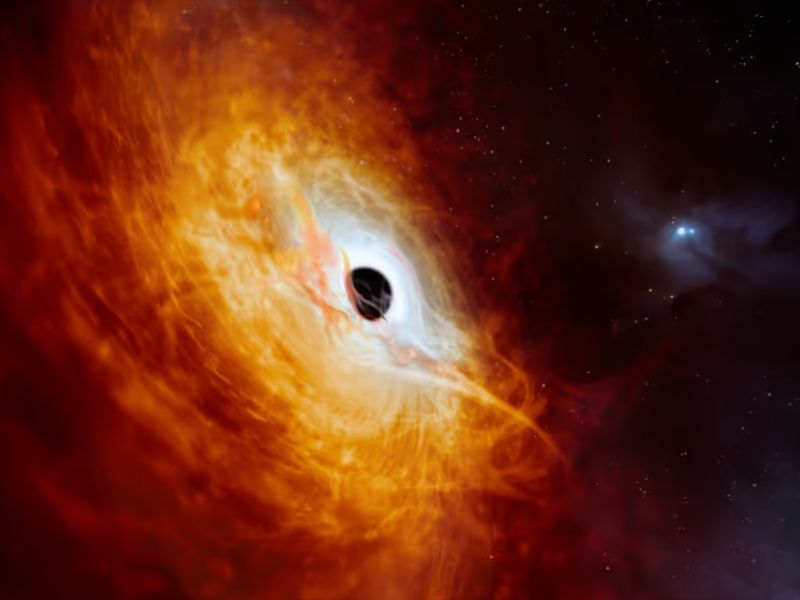
An artist’s impression of the brightest object ever discovered – a quasar that shines with the light of 500 trillion Suns – which is also the fastest growing black hole, eating the equivalent of a Sun a day ESO/M. Kornmesser
One might expect that locating the brightest object in the observable universe would be straightforward, but astronomers have only recently detected it. This overlooked phenomenon is a supermassive black hole, weighing in at 17 billion times the mass of the Sun and continuing to grow. It consumes the equivalent of another Sun’s worth of material every day, earning it the title of the fastest-growing black hole on record.
You might be wondering about a couple of things here. Firstly, black holes are known to be the darkest entities, and light cannot escape their pull, so how is this particular one emitting such an unprecedented amount of light? Well, it’s not originating from the black hole itself, but rather from the swirling disk of matter encircling it, steadily plunging into the void. Intense gravitational forces distort space and time, whipping this material into a frenzied state known as a quasar, emitting brightness equivalent to 500 trillion Suns.
Quasar’s Astonishing Description
“It resembles an immense and magnetically charged storm cell, with temperatures soaring to 10,000°C (18,000°F), lightning illuminating the scene, and winds so swift they could encircle the Earth in a mere second,” explained Associate Professor Christian Wolf, the study’s lead author. “This colossal storm cell spans seven light years, which is 50% larger than the distance from our solar system to the nearest star in the Galaxy, Alpha Centauri.“
Now, onto the second obvious question: why did it take so long to discover the brightest phenomenon likely to ever exist? The answer lies in the vastness of space—utterly incomprehensible in scale. No matter how luminous the entity, locating it amidst the cosmic expanse is akin to finding a needle in a haystack the size of a planet. Moreover, this quasar is situated nearly as distant from us as physically possible, with its light traveling a staggering 12 billion years to reach our eyes. At such extreme distances, it appears akin to a star exhibiting slightly exceptional luminosity. Simply observing a zoomed-in video of it will illustrate why.
Zooming in on the record-breaking quasar J0529-4351
This is why it went unnoticed for such a prolonged period. As AI models analyzed the images dating back to 1980, they lacked the necessary data to recognize that quasars could exhibit such exceptional brightness. As a result, they dismissed it as a star relatively close to Earth. The Siding Spring Observatory in Australia conducted a thorough examination, unveiling its true identity, followed by scrutiny from the Very Large Telescope in Chile.
Unveiling the Truth Behind a Deceptive Quasar
Astute enthusiasts of outer space might recall reports from 2019 suggesting that another quasar had claimed the title of the brightest object in the universe, radiating with the intensity of almost 600 trillion Suns. However, further investigation revealed that this claim was somewhat deceitful, as it utilized a spacetime phenomenon known as a gravitational lens, artificially boosting its brightness by 50 times. Accounting for this factor significantly reduces its luminosity to a mere 11 trillion Suns. At that point, one might question the significance.
In contrast, the newly discovered quasar is achieving its luminosity through sheer effort, consuming the equivalent of the Sun’s mass every single day. This also earns it the distinction of being the fastest-growing black hole ever documented. For comparison, the previous record-holder was considerably less efficient, taking two days to consume a Sun’s worth of material. It’s clear that this quasar is truly dedicated to its task.
We use cookies on our website to give you the most relevant experience by remembering your preferences and repeat visits. By clicking “Accept All”, you consent to the use of ALL the cookies. However, you may visit "Cookie Settings" to provide a controlled consent.
This website uses cookies to improve your experience while you navigate through the website. Out of these, the cookies that are categorized as necessary are stored on your browser as they are essential for the working of basic functionalities of the website. We also use third-party cookies that help us analyze and understand how you use this website. These cookies will be stored in your browser only with your consent. You also have the option to opt-out of these cookies. But opting out of some of these cookies may affect your browsing experience.
Necessary cookies are absolutely essential for the website to function properly. These cookies ensure basic functionalities and security features of the website, anonymously.
Cookie
Duration
Description
cookielawinfo-checkbox-analytics
11 months
This cookie is set by GDPR Cookie Consent plugin. The cookie is used to store the user consent for the cookies in the category "Analytics".
cookielawinfo-checkbox-functional
11 months
The cookie is set by GDPR cookie consent to record the user consent for the cookies in the category "Functional".
cookielawinfo-checkbox-necessary
11 months
This cookie is set by GDPR Cookie Consent plugin. The cookies is used to store the user consent for the cookies in the category "Necessary".
cookielawinfo-checkbox-others
11 months
This cookie is set by GDPR Cookie Consent plugin. The cookie is used to store the user consent for the cookies in the category "Other.
cookielawinfo-checkbox-performance
11 months
This cookie is set by GDPR Cookie Consent plugin. The cookie is used to store the user consent for the cookies in the category "Performance".
viewed_cookie_policy
11 months
The cookie is set by the GDPR Cookie Consent plugin and is used to store whether or not user has consented to the use of cookies. It does not store any personal data.
Functional cookies help to perform certain functionalities like sharing the content of the website on social media platforms, collect feedbacks, and other third-party features.
Performance cookies are used to understand and analyze the key performance indexes of the website which helps in delivering a better user experience for the visitors.
Analytical cookies are used to understand how visitors interact with the website. These cookies help provide information on metrics the number of visitors, bounce rate, traffic source, etc.
Advertisement cookies are used to provide visitors with relevant ads and marketing campaigns. These cookies track visitors across websites and collect information to provide customized ads.