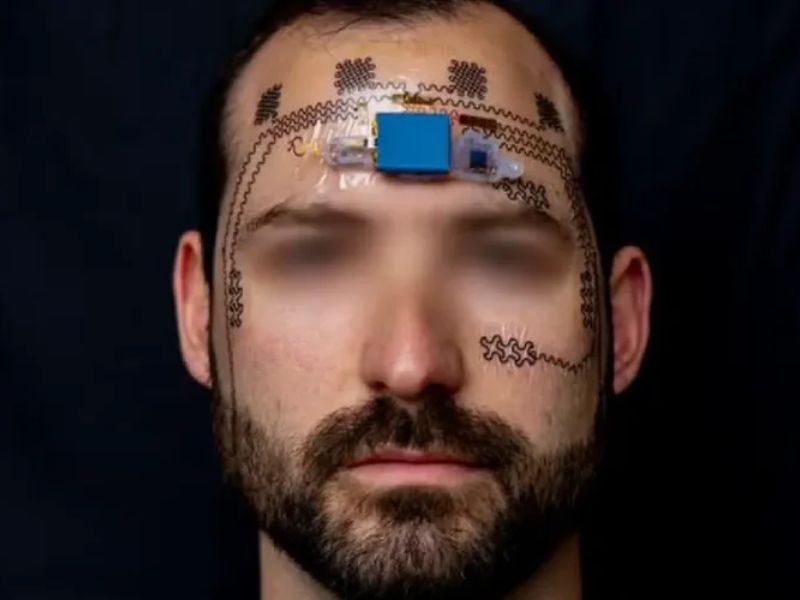
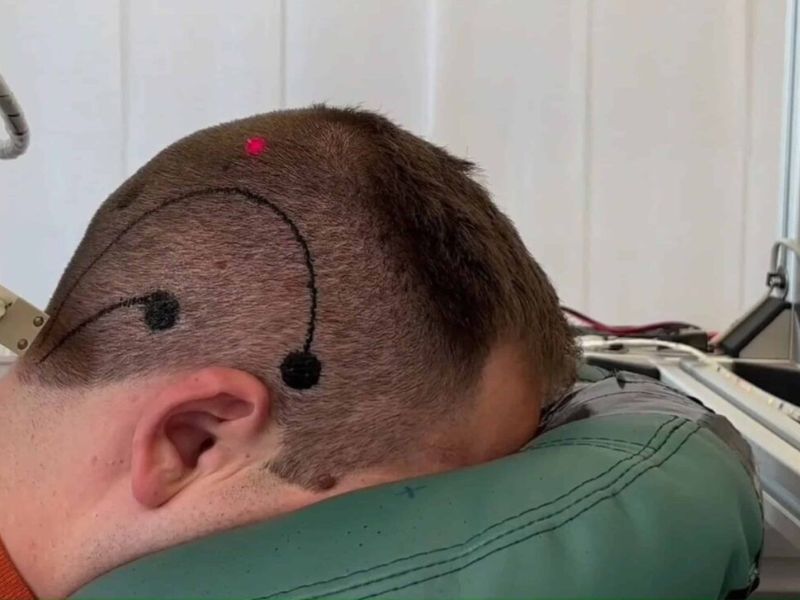
Image Credits:E-Tattoo: dispositivo é capaz de detectar sinais de esforço cognitivo em tempo real (Dispositivo/Huh et al/Divulgação)
A wireless electronic tattoo created by U.S. researchers may help tackle overwork and reduce illnesses linked to intense mental strain.
The research describing the device was published this Thursday, the 29th, in the journal Device. It explains how the technology—known as an e-tattoo—operates, including its ability to record brainwave activity without the need for traditional equipment.
“Technology is advancing faster than human evolution,” said Professor Nanshu Lu, who led the study at the University of Texas at Austin. “As demands increase, so does mental workload…”
Early Tests Show Brainwave Changes Under Increasing Mental Demand
During early experiments, six volunteers wore the electronic tattoo while completing memory tasks of different difficulty levels. As the tasks became more demanding, changes in their brainwave signals were observed.
Using this data, the researchers trained a computational model that can anticipate levels of mental effort. The e-tattoo was also able to differentiate between varying degrees of cognitive strain.
At present, workload is commonly measured using tools such as NASA’s Task Load Index, which relies on self-reported questionnaires. The e-tattoo is proposed as an alternative approach.
Its sensors are ultra-thin, adhesive, and flexible, allowing them to conform comfortably to the skin. The system uses a lightweight battery and components designed for user comfort, and the tattoos are customized to ensure precise measurements.
Lower-Cost Alternative to Traditional Monitoring Equipment
This solution also offers major cost advantages: disposable sensors cost about US$20, while the chip and battery are around US$200—far less than the equipment that can exceed US$15,000.
According to study co-author Luis Sentis, the aim is to make the e-tattoo affordable and suitable for home use. “One of my goals is to turn the e-tattoo into something people can use at home,” he said.
The research team is already advancing to the next phase, developing ink-based sensors that can function on hair, with the intention of extending the technology’s application to a wider range of surfaces.
Do tattoos shield your skin from the sun or worsen its effects? A recent study I conducted with colleagues raises some concerns.
We discovered that individuals with tattoos had a 29% higher risk of developing melanoma, a severe skin cancer often linked to UV exposure.
In contrast, tattoos didn’t seem to raise the risk of squamous cell carcinoma, another UV-related skin cancer. Though both cancers stem from similar causes, they originate in different cell types, with melanoma being significantly more dangerous.
Mainstream Expression with Uncertain Health Impacts
Tattoos serve as a strong means of self-expression and a key part of contemporary identity. In Sweden, roughly one in three adults has a tattoo, highlighting how body art has become widely mainstream.
Despite their widespread popularity, scientists still don’t know whether tattoos affect health or how any potential effects might develop over time.
Epidemiologists are working to answer these questions, but the research is challenging. People who get tattoos often differ from those who don’t in ways that can influence health outcomes.
Another obstacle is that most medical records don’t indicate whether someone has tattoos, making long-term patterns hard to track. Without this key information, it’s difficult to determine if tattoos themselves impact health or if observed differences are due to other factors.
Both melanoma and squamous cell carcinoma develop slowly and are relatively rare, making long-term studies difficult. Tracking large groups of tattooed and non-tattooed individuals over many years would be costly and time-consuming.
Case-Control Study of Tattoos and Cancer
To address this, our team took a different approach. We focused on people already diagnosed with cancer and looked back to determine who had tattoos. This method, called a case-control study, offers an efficient way to identify potential links.
Sweden has high-quality national registers that track health and demographic data. Using the National Cancer Register, we identified everyone aged 20 to 60 diagnosed with melanoma in 2017 or squamous cell carcinoma between 2014 and 2017.
This included 2,880 melanoma cases and 2,821 squamous cell carcinoma cases. For each case, we selected three age- and sex-matched controls from the Total Population Register who had no history of skin cancer.
We then sent questionnaires to all participants asking about tattoos—including decorative tattoos, permanent makeup, and medical tattoos—as well as their size, location, and age at first tattoo. This helped us determine whether tattoos were acquired before or after cancer diagnosis.
Ultimately, 5,695 people participated in the melanoma study (1,598 with melanoma) and 6,151 in the squamous cell carcinoma study (1,600 with that cancer).
Tattoo-Related Risks for Melanoma and Squamous Cell Carcinoma
Individuals with tattoos had a 29% higher likelihood of developing melanoma compared to those without tattoos. The risk appeared greatest among people who had tattoos for over ten years, but the smaller sample size in this group means the findings should be interpreted with caution.
For squamous cell carcinoma, tattoos had no impact. The findings were consistent across analyses, indicating no link between tattoos and this type of skin cancer.
We also found no evidence that larger tattoos increased risk, which was surprising given that bigger tattoos contain more ink and potentially harmful substances.
One possible reason is that tattoo ink doesn’t stay confined to the skin. The immune system treats it as foreign and transports some particles to the lymph nodes, where they can remain long-term. While it’s unclear if this causes harm, it could trigger chronic inflammation, which has been associated with cancer development.
Another possibility is measurement error, as people often overestimate tattoo size. Future studies using more precise methods may help clarify this.
Influence of Lifestyle and other Confounding Factors
What sets this study apart is the breadth of lifestyle factors we were able to examine. We considered sun exposure (both at work and during leisure), tanning bed use, smoking, education, marital status, and household income, along with skin type, pigmentation, age, and sex.
These details are important because they can affect both the likelihood of getting tattoos and developing cancer. For example, people who spend more time in the sun may be more prone to both tattoos and melanoma. Adjusting for these differences helps reduce bias and increases confidence in the results.
In research, this is called confounding. If confounding factors aren’t properly controlled, they can skew findings and produce misleading conclusions.
A recent US study suggested that large tattoos might lower melanoma risk, but it didn’t account for key factors like skin type or UV exposure.
The findings may reflect behavior rather than biology. For instance, individuals with large tattoos might avoid sunbathing or tanning beds to protect their tattoos, which could naturally limit UV exposure.
Do tattoos cause skin cancer? The short answer is that we don’t know yet. Our study suggests a potential link between tattoos and melanoma, but a single study cannot prove causation.
Understanding Risks and Staying Vigilant with Tattoos
Further research is needed to explore possible biological mechanisms, such as chronic inflammation, and to investigate how different inks or colors interact with UV exposure. Tattoo pigments vary widely, and many can break down into harmful by-products when exposed to sunlight or laser removal treatments.
If you have tattoos, there’s no need to panic, but staying vigilant is important. Protect your skin from UV radiation as usual: use sunscreen, avoid excessive tanning, and regularly check for new or changing moles.
Our findings underscore the need for long-term monitoring and improved recording of tattoo data in health records. With tattoos now common globally, this represents a significant public health concern. Ongoing research into the biology and long-term effects of tattoos will help people make informed decisions about their bodies, their art, and their health.
Traditional non-invasive brain imaging methods involve electrodes, sticky gels, and wires, which can be uncomfortable, unsightly, and time-consuming. However, scientists have recently developed a promising alternative in the form of temporary electronic tattoos.
E-Tattoos: A More Comfortable and Accurate Alternative
These e-tattoos use liquid ink applied to the scalp. In a recent study, they proved to be just as accurate as conventional electroencephalography (EEG) techniques, while offering easier setup. They also have the advantage of working through short hair.
The team from the University of Texas at Austin and the University of California, Los Angeles (UCLA) believes their innovation could improve patient monitoring and disease diagnosis. “Our innovations in sensor design, biocompatible ink, and high-speed printing pave the way for future on-body manufacturing of electronic tattoo sensors, with applications in clinical and non-clinical settings,” says electrical engineer Nanshu Lu from the University of Texas.
The new approach is quicker and more convenient than a traditional EEG. (de Vasconcelos, Cell Biomaterials, 2024)
The researchers assert that their method is more comfortable for the subject, provides longer-lasting results without signal degradation, and offers greater accuracy. The e-tattoos are made from conductive polymers and are directly applied to the head using a custom inkjet printer.
Measuring Brain Activity with E-Tattoos
Originally used to monitor muscle fatigue and heart rate, these tattoos have now been shown to also measure brain activity, with specialized algorithms determining the optimal placement on the scalp.
Further improvements have been made by replacing part of the wiring in a typical EEG with the printed e-ink. The team used shorter conventional wires to transmit data back to a recording device, ensuring no interference from additional signals.
“This adjustment allowed the printed wires to transmit signals without introducing noise,” explains materials scientist Ximin He from UCLA.
Although they have made progress, the researchers aim to embed wireless transmission capabilities into the e-tattoos and adapt their technology to accommodate a wider variety of hair types and styles.
E-Tattoos: The Future of Brain-Computer Interfaces (BCIs)
Eventually, these e-tattoos could form the foundation of brain-computer interfaces (BCIs), which not only read brain activity but potentially interpret it to trigger actions. Current BCI setups are bulky and challenging to use. Replacing them with e-tattoos could make this technology more accessible to a broader population.
“Our study could potentially transform the design of non-invasive brain-computer interface devices,” says neuroengineer José Millán from the University of Texas at Austin.
We use cookies on our website to give you the most relevant experience by remembering your preferences and repeat visits. By clicking “Accept All”, you consent to the use of ALL the cookies. However, you may visit "Cookie Settings" to provide a controlled consent.
This website uses cookies to improve your experience while you navigate through the website. Out of these, the cookies that are categorized as necessary are stored on your browser as they are essential for the working of basic functionalities of the website. We also use third-party cookies that help us analyze and understand how you use this website. These cookies will be stored in your browser only with your consent. You also have the option to opt-out of these cookies. But opting out of some of these cookies may affect your browsing experience.
Necessary cookies are absolutely essential for the website to function properly. These cookies ensure basic functionalities and security features of the website, anonymously.
Cookie
Duration
Description
cookielawinfo-checkbox-analytics
11 months
This cookie is set by GDPR Cookie Consent plugin. The cookie is used to store the user consent for the cookies in the category "Analytics".
cookielawinfo-checkbox-functional
11 months
The cookie is set by GDPR cookie consent to record the user consent for the cookies in the category "Functional".
cookielawinfo-checkbox-necessary
11 months
This cookie is set by GDPR Cookie Consent plugin. The cookies is used to store the user consent for the cookies in the category "Necessary".
cookielawinfo-checkbox-others
11 months
This cookie is set by GDPR Cookie Consent plugin. The cookie is used to store the user consent for the cookies in the category "Other.
cookielawinfo-checkbox-performance
11 months
This cookie is set by GDPR Cookie Consent plugin. The cookie is used to store the user consent for the cookies in the category "Performance".
viewed_cookie_policy
11 months
The cookie is set by the GDPR Cookie Consent plugin and is used to store whether or not user has consented to the use of cookies. It does not store any personal data.
Functional cookies help to perform certain functionalities like sharing the content of the website on social media platforms, collect feedbacks, and other third-party features.
Performance cookies are used to understand and analyze the key performance indexes of the website which helps in delivering a better user experience for the visitors.
Analytical cookies are used to understand how visitors interact with the website. These cookies help provide information on metrics the number of visitors, bounce rate, traffic source, etc.
Advertisement cookies are used to provide visitors with relevant ads and marketing campaigns. These cookies track visitors across websites and collect information to provide customized ads.