Tag: Telescope

  • World’s First Lunar Radio Telescope Gears Up for a Far‑Side Expedition

    World’s First Lunar Radio Telescope Gears Up for a Far‑Side Expedition

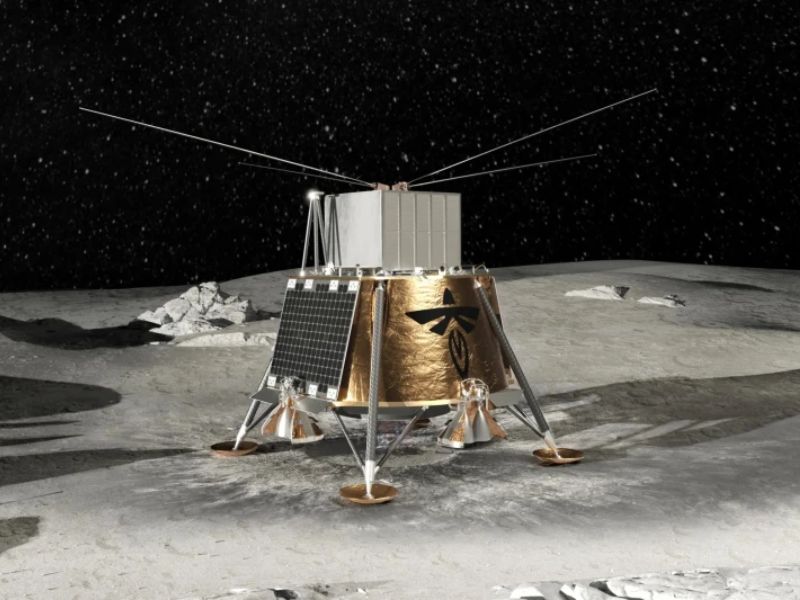
    LuSEE-Night atop the Blue Ghost 2 lander
    Brookhaven National Laboratory

    Radio astronomers crave silence, so the inaugural off‑planet radio telescope is headed somewhere truly quiet: the Moon’s hidden hemisphere. The Lunar Surface Electromagnetics Experiment – Night (LuSEE‑Night) will touch down on the far side, using the lunar bulk to muffle the cacophony of Earth‑generated radio chatter.

    Revolutionizing Astronomy Through Radio Waves

    Radio astronomy has completely reshaped our view of the cosmos, unveiling pulsars, quasars, radio galaxies, interstellar molecules, supermassive black holes and the faint microwave afterglow of the Big Bang. Yet eavesdropping on the universe from Earth is maddeningly difficult. Beyond conventional broadcasts, satellites and ubiquitous mobile networks, there are spark‑spitting engines, microwave ovens, lightning, GPS beacons, ionospheric reflections and even the occasional bird dropping on an antenna—all polluting the airwaves.

    Engineers combat this noise with digital filters and by building observatories in remote sanctuaries like Goonhilly (UK) or legally protected “radio‑quiet” zones in the United States, South Africa, Australia and Brazil. Even there, the din is too loud for the cosmos’ faintest whispers.

    So researchers at the U.S. Department of Energy’s Brookhaven National Laboratory, partnering with NASA, the University of California–Berkeley and Lawrence Berkeley Lab, decided to relocate to the quietest neighborhood they could find: the lunar farside, where 7.3 × 10¹⁹ tonnes of rock block Earth’s radio noise.

    LuSEE-Night: The Pathfinder Mission

    The first venture is the LuSEE‑Night pathfinder. Slated to ride Firefly Aerospace’s Blue Ghost 2 lander later this year or early next, LuSEE‑Night will prove that a remote, autonomous radio telescope can survive on the Moon and beam back solid science.
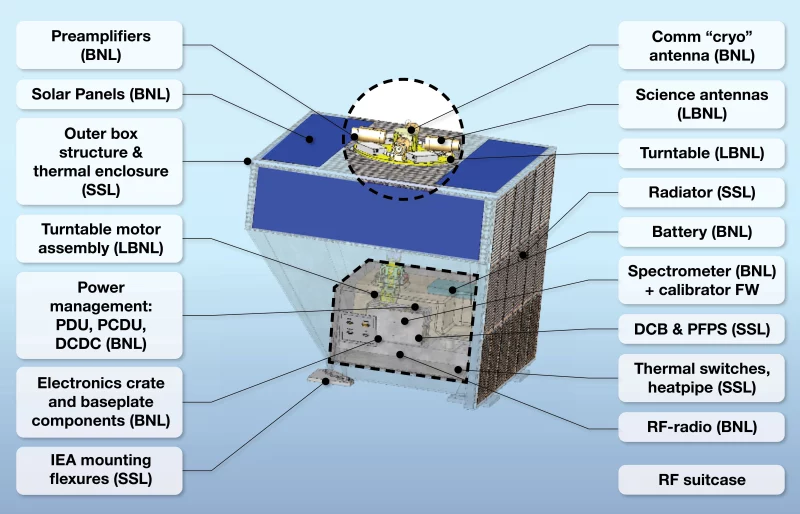
    Diagram of LuSEE-Night
    Brookhaven National Laboratory

    The cube‑shaped instrument (about 1 × 1 × 0.7 m) listens across 0.1–50 MHz with a four‑channel 50 MHz receiver and a radio spectrometer. Four 3‑m beryllium‑copper helical‑spring monopoles unfold into two orthogonal dipoles spanning roughly 6 m tip‑to‑tip. The antenna frame can rotate—both to aim at specific sky patches and to calibrate itself against the local electromagnetic environment. A lunar orbiter will transmit test codes to fine‑tune the system.
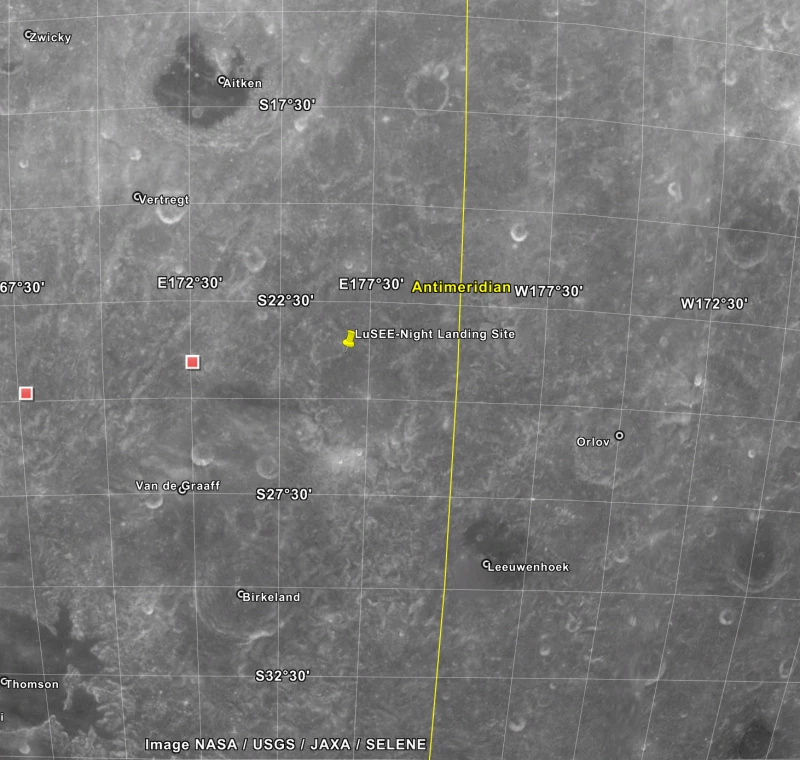
    Planned landing site of LuSEE-Night
    Brookhaven National Laboratory

    Moonlife is harsh, so LuSEE‑Night carries a sun‑reflecting thermal shield plus a hefty 40 kg lithium‑ion battery (6.5–7.16 kWh). That battery powers heaters during the fortnight‑long lunar night, when temperatures plummet to −173 °C.

    Assuming a yet‑to‑be‑named relay satellite keeps the data link open, the experiment could operate for up to 18 months. If it succeeds, astrophysicists may one day sculpt an entire farside crater into a dish so enormous that the late Arecibo Observatory would seem like a toy walkie‑talkie by comparison.


    Read the originala article on: New Atlas

    Read more: Uranus Is Hotter Than Previously Believed
  • Watch Live: NASA Launches a Space Telescope That May Redefine the Universe’s Origins

    Watch Live: NASA Launches a Space Telescope That May Redefine the Universe’s Origins

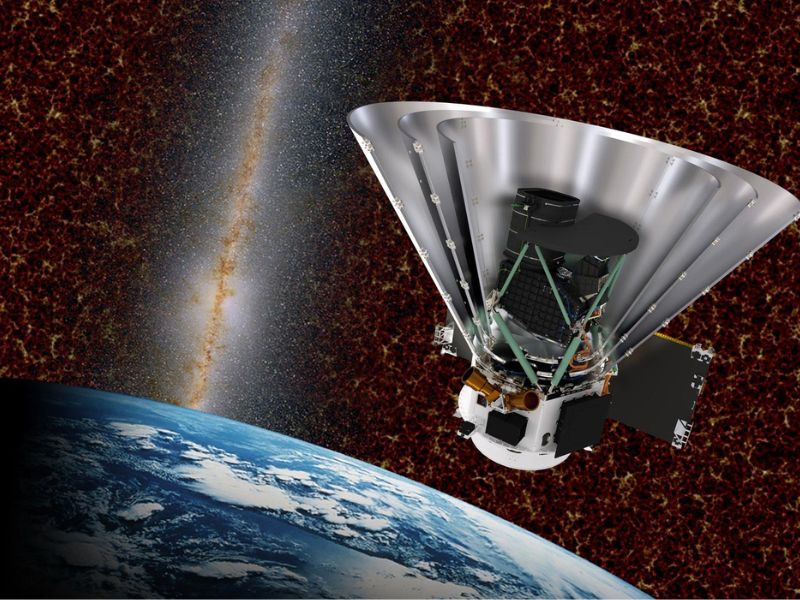
    The Spectro-Photometer for the History of the Universe, Epoch of Reionization and Ices Explorer (SPHEREx) mission will provide the first all-sky spectral survey. Over a two-year planned mission, the SPHEREx Observatory will collect data on more than 450 million galaxies along with more than 100 million stars in the Milky Way in order to explore the origins of the universe. Credit: NASA

    NASA is preparing for an exciting dual-mission launch featuring SPHEREx, a space telescope designed to uncover the universe’s history and search for life’s building blocks, and PUNCH, a mission that will study the Sun’s outer layers and solar wind.

    A SpaceX Falcon 9 rocket will carry both missions into space from Space Launch Complex 4 East at Vandenberg Space Force Base in California. The launch window opens on Friday, February 28, at 10:09 p.m. EST (7:09 p.m. PST). NASA will provide live coverage on NASA+.

    Mission Objectives

    • SPHEREx will investigate how the universe evolved and identify key molecules linked to life in our galaxy.
    • PUNCH consists of four small spacecraft that will track how the Sun’s corona transitions into solar wind, shaping space weather.
    NASA’s SPHEREx is situated on a work stand ahead of prelaunch operations at the Astrotech Processing Facility at Vandenberg Space Force Base in California. The SPHEREx space telescope will share its ride to space on a SpaceX Falcon 9 rocket with NASA’s PUNCH mission. Credit: USSF 30th Space Wing/Christopher

    Prelaunch Events & Coverage

    NASA will host live-streamed briefings leading up to launch:

    Tuesday, February 25 – Science Overview (2 p.m. EST)

    Experts will discuss the science goals of SPHEREx and PUNCH, featuring NASA astrophysics and heliophysics leaders.

    Thursday, February 27 – Prelaunch News Conference (3:30 p.m. EST)

    NASA officials, project managers, and SpaceX representatives will provide mission updates and discuss launch preparations.

    Launch Day Coverage – Friday, February 28

    • 12 p.m. – SPHEREx & PUNCH Launch Preview (NASA+)
    • 9:15 p.m. – Live launch coverage begins
    • 10:09 p.m. – Launch window opens

    How to Watch & Participate

    NASA’s website will feature live updates, streaming links, and behind-the-scenes coverage. The public can also register for NASA’s virtual guest program, which includes curated launch resources, real-time notifications, and a digital stamp for the NASA virtual guest passport.


    Read Original Article: Sci Tech Daily

    Read More: SpaceX Says Starship Self-Destructed Due to Propellant Leaks, Fires, and a Comms Blackout

  • NASA Launches 2025 with Spacewalk to Repair X-Ray Telescope and Upgrade the ISS

    NASA Launches 2025 with Spacewalk to Repair X-Ray Telescope and Upgrade the ISS

    NASA astronauts Suni Williams and Nick Hague successfully completed a critical spacewalk, achieving multiple key objectives. Credit: NASA

    NASA astronauts Suni Williams and Nick Hague completed a 6-hour spacewalk on January 16, concluding their mission at 2:01 p.m. EST. This mission, which marked Hague’s fourth spacewalk and Williams’ eighth, was the 273rd in support of the International Space Station’s (ISS) assembly, maintenance, and upgrades.

    NASA astronauts Nick Hague and Suni Williams, both NASA astronauts, are pictured evaluating their spacesuits in a pressurized configuration in the Quest airlock. Credit: NASA

    The astronauts tackled several critical tasks during the spacewalk. They replaced a faulty rate gyro assembly, applied protective patches to repair damaged light filters on the NICER (Neutron Star Interior Composition Explorer) x-ray telescope, and installed a new reflector device on one of the station’s international docking adapters. Additionally, they inspected key access areas and connector tools to prepare for future maintenance of the Alpha Magnetic Spectrometer.

    Beginning their spacewalk at 8:01 a.m. EST, Hague and Williams each took on specific roles. Hague, designated as spacewalk crew member 1, wore a suit with red stripes, while Williams, as crew member 2, wore an unmarked suit. Their efforts not only launched 2025’s first spacewalk but also advanced the ISS’s ongoing operations and capabilities.

    Astronaut Suni Williams replaces a planar reflector, a visiting vehicles navigation device, near the SpaceX Dragon crew spacecraft docked to the Harmony module’s space-facing port during her eighth walk. Credit: NASA+

    Read Original Article: Scitechdaily

    Read More: Unusual Blobs Detected Deep Within Earth in Surprising Locations

  • New Telescope Instruments Will Investigate the  Universe For Water

    New Telescope Instruments Will Investigate the Universe For Water

    Since water plays a crucial role in supporting life forms based on carbon, scientists actively search for it when exploring the potential for extraterrestrial life.
    Credit: Pexels

    Since water plays a crucial role in supporting life forms based on carbon, scientists actively search for it when exploring the potential for extraterrestrial life. This includes investigating other planets through probes and using space-based telescopes to observe the cosmos.

    Detecting water from Earth-based instruments is considerably challenging. However, recently developed water-detecting receivers, integrated into the ALMA radio telescope situated in the dry and elevated region of Chile, offer scientists an innovative ground-based method to explore the existence of life beyond our planet.

    Enhanced Capabilities with Band 5 Receivers

    Expanding upon the successful testing of Band 5 receivers on the Atacama Pathfinder Experiment (APEX) telescope in the previous year, the Atacama Large Millimeter/submillimeter Array (ALMA) has now been equipped with new receivers. These receivers operate within the wavelengths of 1.42 mm to 1.83 mm (211 GHz to 163 GHz), encompassing the low-energy range of the electromagnetic spectrum.

    ALMA typically operates within frequencies ranging from 30 GHz to 960 GHz (9.9 mm to 0.31 mm wavelengths) across ten distinct frequency bands. Consequently, the integration of the new Band 5 receivers significantly broadens ALMA’s capability to observe radio frequencies from various regions of the sky.


    According to ALMA Program Scientist Leonardo Testi, the incorporation of the new receivers will greatly enhance the ability to identify water, an essential component for life as we understand it, within our Solar System, as well as in far-reaching areas of our galaxy and beyond. Additionally, these receivers will enable ALMA to investigate the presence of ionized carbon in the early Universe.

    Optimal Conditions for Water Detection

    Under normal circumstances, detecting water in space using such receivers posed significant challenges due to interference from water molecules present in Earth’s atmosphere.

    However, ALMA’s advantageous location atop the Chajnantor plateau in the moisture-free environment of the Atacama desert in northern Chile, situated approximately 5,000 meters (16,400 feet) above sea level, allows the new receivers to exploit their sensitivity fully. This unique setting provides an opportunity not readily available in many other locations on Earth.

    The Band 5 receivers are designed to operate at specific vibrational frequencies associated with various molecules, including water (H2O), carbon monosulfide (CS), hydrogen isocyanide (HNC), and silicon monoxide (SiO). These molecules play crucial roles in astrochemical investigations pertaining to the formation and transformation of interstellar gases.

    Initial testing of the new receivers focused on conducting detailed observations of H2O, CS, and HNC in Arp 220, a collision of giant galaxies situated in the middle of the Milky Way. Spectral studies were also conducted on the red supergiant star Sgr B2 (N) in Sagittarius, along with the detection of SiO and H2O during the examination of VY Canis Majoris, one of the largest known stars.

    ALMA Band 5 Opens Doors to In-Depth Water Studies

    We are thrilled to witness these initial outcomes from ALMA Band 5, even with a limited number of antennas,” expressed Robert Laing, a member of the European Southern Observatory (ESO) team. “With the complete ALMA array’s remarkable sensitivity and angular resolution, we will be able to conduct comprehensive studies of water in various celestial objects, including developing and mature stars, the interstellar medium, and regions adjacent to supermassive black holes.”

    The data obtained from the preliminary Band 5 tests has been thoroughly examined and processed by technical experts and astronomers from ESO and the European ALMA Regional Centre (ARC) network. The results have been published on the official ALMA website.

    ESO further reports that the new receivers are currently being installed and prepared for imminent deployment on the ALMA instrument, marking their active involvement in upcoming observations.


    Read the original article on: New Atlas

    Read more: Virtually Pure Argon May Whisper Secrets About Universe’s Dark Matter