Tag: Traffic Jams

  • Severe Alert for the U.S. as Hurricane ‘Traffic Jams’ Become Ten Times More Likely

    Severe Alert for the U.S. as Hurricane ‘Traffic Jams’ Become Ten Times More Likely

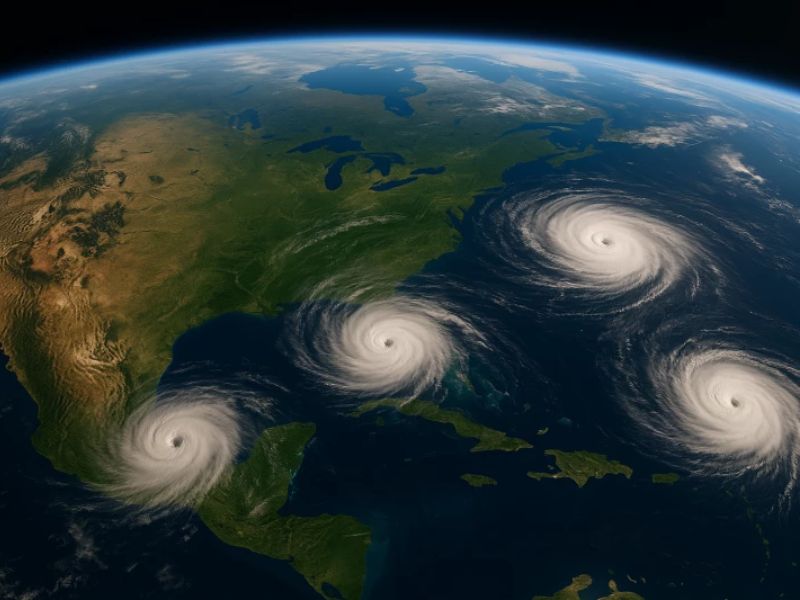
    Clustered storms, like in 2017 when Harvey, Irma and Maria hit in quick succession, have the potential to cause more extensive damage than a single hurricane
    Created with ChatGPT 5

    The North Atlantic has overtaken the western North Pacific as the world’s most active region for hurricane clusters, with their likelihood increasing tenfold over the past 46 years. A groundbreaking study offers the first solid evidence of how global warming is altering where these multi-storm events occur, warning that the U.S. East Coast should brace for impact.

    Researchers from Fudan University reached these conclusions after analyzing 46 years of observational data alongside high-resolution climate model simulations. Their findings reveal that the probability of the North Atlantic producing more storm clusters than the former leading hotspot – the western North Pacific – has jumped from 1.4% to 14.3%. This shift appears to be linked to changing patterns of warm and cool ocean waters, creating ideal conditions for multiple storms to develop from the same basin in quick succession.

    What Hurricane Clusters Mean for Coastal Communities

    Hurricane clusters occur when two or more tropical storms form in the same ocean region around the same time, often striking in rapid sequence and magnifying damage. Historic examples include the 2017 season, when Hurricanes Harvey, Irma, and Maria hit back-to-back, overwhelming disaster response systems, and 2020, when five named storms swirled in the Atlantic simultaneously.

    For the United States, this means significantly higher risks for the Gulf Coast, the East Coast, Puerto Rico, and the U.S. Virgin Islands. In densely populated areas with fragile infrastructure, the reduced recovery time between storms can make the aftermath far more devastating.

    Study co-leader Dazhi Xi from the University of Hong Kong explained that the team first built a probabilistic model to explore the role of storm frequency, duration, and seasonality in forming clusters. However, these factors alone could not fully explain the recent surge in cluster events, as some arise purely by chance while others are linked by atmospheric processes.

    Additional analysis incorporating synoptic-scale waves – large atmospheric patterns that can spark storm formation or cause one storm to trigger another – revealed the North Atlantic’s growing tendency for such clusters. Wen Zhou of Fudan University noted that the revised statistical approach can now distinguish between physically connected clusters and those occurring by coincidence.

    The Role of ‘La Niña-like’ Warming

    The research points to a “La Niña-like” warming pattern – slower heating in the eastern Pacific compared to the west – as the main driver behind the North Atlantic’s tenfold increase in cluster risk. This warming not only changes storm frequency in the Atlantic and northwestern Pacific but also strengthens synoptic-scale waves, fueling the regional shift in cluster activity.

    While the work is based on probability modeling, it underscores a major climatic change over the last half-century. Hurricanes arriving in close succession can cripple emergency services, disrupt supply chains, and hit already weakened infrastructure. The researchers predict this trend will persist at least until mid-century, leading to more seasons with bursts of damaging storms hitting within days of each other.

    The study’s authors stress that hazard assessments must account for clustered events rather than treating each storm as independent. They suggest future research should explore more advanced models to capture the dynamic interactions between storms and better predict landfall patterns, ultimately improving disaster preparedness.


    Read the original article on: New Atlas

    Read more: Breakthrough Cryocooler Paves the Way for Crewed Missions to Mars

  • Traffic Jams Trigger a 24-Hour Blood Pressure Surge

    Traffic Jams Trigger a 24-Hour Blood Pressure Surge

    Creeping along in heavy traffic on a highway, especially when headed to an appointment or, worse, the airport, can elevate anyone's blood pressure (BP). However, scientists have discovered that this BP surge occurs irrespective of external stressors and may be attributed to the low-quality air entering the car from surrounding traffic.
    An unpleasant, and also unhealthy, view
    Depositphotos

    Creeping along in heavy traffic on a highway, especially when headed to an appointment or, worse, the airport, can elevate anyone’s blood pressure (BP). However, scientists have discovered that this BP surge occurs irrespective of external stressors and may be attributed to the low-quality air entering the car from surrounding traffic.

    Conducting a randomized crossover trial, researchers at the University of Washington (UW) were astonished to find a connection between sitting in traffic and inhaling unfiltered air, leading to a 4.5 mm Hg increase in blood pressure. This increase peaked at approximately 60 minutes of exposure but persisted for up to 24 hours afterward.

    The body employs a intricate set of systems to maintain consistent blood pressure to the brain,” explained lead researcher Joel Kaufman, a physician and professor at UW. “It’s a highly intricate and tightly regulated system, and it seems that somewhere, within one of those mechanisms, traffic-related air pollution disrupts blood pressure.”

    Controlled Experiments on Commuting Blood Pressure Impact

    In the research, 16 participants aged 22-45 were chauffeured as passengers through peak-hour traffic in Seattle over three days to assess the impact of traffic pollution on blood pressure. For two days, the vehicle’s air circulation functioned normally to replicate typical driving conditions, while on another day, the car was equipped with a high-efficiency particulate air (HEPA) filter, blocking 86% of particulate pollution.

    Blood pressure measurements were collected a day before, during, and after the drive, encompassing 14 three-minute tests. Image-based central retinal arteriolar equivalents (CRAEs) were measured before and after, along with assessments of brachial artery diameter and gene expression.

    The average adjusted systolic blood pressure reading, elevated by 4.5 mm Hg compared to the baseline, is akin to the impact of a high-sodium diet.

    We are aware that modest increases in blood pressure like this, when observed at a population level, correlate with a significant rise in cardiovascular disease,” Kaufman emphasized. “There is a growing understanding that air pollution contributes to heart problems. The revelation that roadway air pollution, even at relatively low levels, can exert such a substantial influence on blood pressure is a crucial element in the puzzle we are working to unravel.”

    Insights into Traffic-Related Air Pollution (TRAP) and Ultrafine Particle Filtration

    Traffic-related air pollution (TRAP) stands as the primary contributor to air quality variations in U.S. metropolitan areas. TRAP is characterized by elevated levels of ultrafine particles, each measuring less than 100 nanometers in diameter, and these particles have frequently been linked to various adverse health outcomes related to air quality. In this context, the ultrafine particle concentration was minimal, equivalent to an Air Quality Index of 36 (a score below 100 is deemed satisfactory). Nonetheless, the filters effectively eliminated nearly all traces before entering the car.

    Ultrafine particles, the pollutant most efficiently filtered in our experiment—where levels are notably high on the road and low in the filtered environment,” Kaufman explained. “Hence, there’s an indication that ultrafines may have particular significance [for blood pressure]. Substantiating this requires further investigation, but this study offers a strong hint about the potential impact.”

    Although the specific mechanism in TRAP triggering blood pressure changes is not yet fully understood, the researchers took precautions to eliminate other potential confounding factors.

    Studies on this topic often struggle to distinguish the effects of pollution from other roadway exposures like stress and noise, but with our approach, the sole distinction between drive days was air pollution concentration,” noted lead author Michael Young, a former UW postdoctoral fellow in the Department of Environmental and Occupational Health Sciences. “The findings are valuable because they can replicate situations that millions of people actually experience every day.”


    Read the original article on: New Atlas

    Read more: Medication Activates Dormant Bone Cells to Ease Lower Back Discomfort