Tag: Universe

  • A Spinning Universe Could Solve One of Physics’ Biggest Mysteries

    A Spinning Universe Could Solve One of Physics’ Biggest Mysteries

    Credit: Nasa

    When we observe the cosmos, a striking pattern emerges: Earth spins, the Sun spins, and even our Milky Way galaxy is rotating. Now, a bold new model proposes that the entire Universe might also be rotating. If proven, this revelation could resolve one of modern cosmology’s most persistent puzzles.

    We’ve long known that the Universe is expanding—but determining the precise rate of that expansion has proven to be a major challenge. Two different measurement methods yield two distinct values for the Hubble constant, and paradoxically, the more accurate these measurements become, the more confident scientists are in both. This discrepancy, known as the “Hubble tension,” has reached a critical point in the field.

    In an attempt to reconcile the difference, researchers from Hungary and the United States introduced a slight rotational component to a mathematical model of the Universe. Surprisingly, this small adjustment significantly reduced the discrepancy—offering a promising new perspective on the problem.

    The Unexpected Solution: Cosmic Rotation

    István Szapudi, an astronomer at the University of Hawai‘i and co-author of the study, expressed his astonishment at the outcome. According to Szapudi, the rotating Universe model aligns with current astronomical observations and complements other theoretical frameworks that also allow for cosmic rotation. “So maybe,” he says, “everything really is spinning.”

    Based on the team’s calculations, it would take the Universe trillions of years to complete a single rotation. Given that the cosmos is less than 14 billion years old, it’s still in the early stages of this cosmic spin—like watching the opening move of a vast, graceful ballet.

    While this rotational pace may seem imperceptibly slow to us, the researchers found that it’s near the maximum allowed speed without violating the cosmic speed limit set by light. Fortunately, this means there’s no need to worry about time loops or sci-fi-style paradoxes.

    A Familiar Idea with a New Twist

    The concept of a rotating Universe isn’t entirely new. Recent studies have suggested such motion might explain why galaxies seem to prefer spinning in one direction more than the other—something unexpected in a perfectly balanced, non-rotating cosmos.

    However, this is the first time rotation has been proposed as a direct solution to the Hubble tension, representing an innovative approach to one of cosmology’s most complex issues.

    In this chart, the curved line shows how the Hubble constant values align in a rotating Universe model, connecting local measurements (in blue) with distant ones (in orange).
    (Szigeti et al., Monthly Notices of the Royal Astronomical Society, 20259)

    To outsiders, this debate over a few kilometers per second per megaparsec might sound like semantics—but in reality, the implications are profound. At the heart of the debate is the Hubble constant, which plays a key role in calculating the Universe’s size, age, and the influence of dark energy.

    Why the Hubble Constant Matters

    The Hubble constant is essential for estimating cosmic distances, gauging the scale of the Universe, and understanding its rate of expansion. Altering it without caution risks undermining the entire Standard Model of Cosmology—like pulling a critical piece from a tower of blocks.

    One method for measuring the Hubble constant involves studying signals from the early Universe, such as the cosmic microwave background (CMB) and baryon acoustic oscillations. These yield a consistent value of around 67 km/s/Mpc.

    Closer to home, astronomers use “standard candles”—objects like specific stars and supernovae with known brightness levels—to measure distances and calculate expansion rates. This approach gives a higher value of about 73 km/s/Mpc.

    Two Numbers, One Universe—and a Rotational Fix

    It might seem tempting to split the difference between these two values and call it a day, but the precision of both measurements is so high that the discrepancy is statistically significant. Physicists are left grappling with two conflicting yet solid numbers.

    The new model proposes that both values could be correct within their own observational contexts. Rotation, the researchers argue, could affect how the expansion appears over distance—explaining the divergence between local and distant measurements.

    Their model’s curve shows how the Hubble constant varies in a rotating Universe, effectively bridging the gap between nearby (blue) and faraway (orange) observations. It offers a graceful explanation that links the two perspectives.

    The Deeper Meaning of a Spinning Cosmos

    If the Universe truly is rotating, it raises profound philosophical and scientific questions. What force could set the entire cosmos into motion? One intriguing theory speculates that our Universe might exist within the spinning interior of a black hole from another Universe—since black holes are known to rotate at near-relativistic speeds.

    Although these ideas sound like the stuff of science fiction, they’re grounded in cutting-edge mathematics and astrophysical data. Before drawing any dramatic conclusions, however, the team plans to develop a full computational model to explore testable predictions.

    In the meantime, we can imagine the Universe performing a grand, circular dance—just like everything within it, from electrons to galaxies. Perhaps rotation is a fundamental preference of nature itself.

    What Comes Next in Cosmic Research?

    Scientists must now search for observable evidence that supports—or contradicts—this rotating Universe model. If confirmed, it would revolutionize our understanding of the cosmos, requiring a major revision of our models of its structure and history.

    Ironically, the idea of a spinning cosmos echoes ancient, pre-Copernican views of the heavens. But today, those old notions are reborn with modern precision—proof that sometimes, the future of science lies in revisiting the past with new eyes.


    Read the original article on: Hype Science

    Read more: Astronomers Find Unusual Slow-Spinning Radio Source That ‘Shouldn’t Exist’

  • AI Breakthrough Uncovers Hidden Signals in the Universe

    AI Breakthrough Uncovers Hidden Signals in the Universe

    Machine learning is helping LIGO scientists extract meaningful signals from chaotic data, opening doors for future breakthroughs in astrophysics and data science. Credit: SciTechDaily.com

    A newly developed AI-driven tool is transforming how scientists process vast amounts of data from the LIGO gravitational wave observatory. Without requiring human input, it identifies environmental noise sources—such as earthquakes and ocean waves—that interfere with signal detection, significantly enhancing data clarity.

    Researchers at the University of California, Riverside, have pioneered a machine-learning system that autonomously detects patterns and filters noise in LIGO’s massive datasets. This breakthrough not only improves gravitational wave detection but also has potential applications in particle physics and industrial systems.

    At a recent IEEE big-data workshop, the UCR team showcased their unsupervised learning approach, designed to analyze LIGO’s auxiliary channel data. Their work aims to refine signal accuracy and expand machine learning’s role in scientific discovery.

    LIGO, the Laser Interferometer Gravitational-Wave Observatory, captures gravitational waves—subtle distortions in spacetime caused by massive celestial events. Comprising two 4-km-long interferometers in Hanford, Washington, and Livingston, Louisiana, LIGO uses laser beams to detect these waves, providing crucial insights into black holes, cosmology, and extreme astrophysical phenomena.

    However, LIGO’s extreme sensitivity makes it vulnerable to external disturbances. Thousands of sensors across the sites monitor environmental conditions that might affect detection accuracy, generating vast amounts of complex data that require sophisticated analysis.

    A Machine Learning Breakthrough in Noise Detection

    Credit: LIGO

    “Our machine learning tool detects patterns without human input,” said Jonathan Richardson, who leads the UCR LIGO group. “It accurately identifies environmental conditions, helping us pinpoint noise sources and improve detector performance.”

    LIGO’s sensors track disruptions like ground tremors and distant ocean waves, which can introduce glitches that affect data quality. Equipped with over 100,000 auxiliary channels, LIGO continuously monitors environmental factors using seismometers and accelerometers.

    The AI tool classifies various noise types, including earthquakes and human activity. Vagelis Papalexakis, a UCR computer science professor, presented the research at an IEEE workshop, highlighting how AI enhances gravitational wave studies.

    “Our model autonomously finds patterns that match those identified by human operators,” he said. By securing a major dataset release, the team enabled further research. “We found a strong link between external noise and data glitches, which could help reduce interference,” Papalexakis added.

    A New Era for Machine Learning in Scientific Research

    The UCR team spent a year analyzing LIGO’s data channels and led the effort to release their dataset to the scientific community. With over 3,200 members in the LIGO collaboration, this marks a significant step toward integrating machine learning into gravitational wave research.

    “Our tool integrates data from various sensors and distills it into a unified environmental state,” Richardson explained. “By linking noise events to their sources, we can take actionable steps to improve LIGO’s performance.”

    “If we identify patterns, we can modify the detector—such as replacing components—to reduce noise,” Richardson added. “Our goal is to use this tool to uncover new environmental factors affecting LIGO and drive experimental improvements.”

    Pooyan Goodarzi, a doctoral researcher and co-author, emphasized the impact of sharing their dataset publicly. “Data like this is often restricted,” he said. “By making it accessible, we hope to inspire further interdisciplinary research in data science and machine learning.”

    This AI-driven advancement not only enhances LIGO’s sensitivity but also paves the way for broader applications in astrophysics and beyond.


    Read Original Article: Scitechdaily

    Read More: Black Hole at the Heart of Our Galaxy Observed in Dynamic ‘Bubbling’ Activity

  • Gravitational-Wave Discovery May Reshape Our Understanding of the Universe

    Gravitational-Wave Discovery May Reshape Our Understanding of the Universe

    Scientists have developed a novel optical system to enhance LIGO’s sensitivity, pushing gravitational-wave detection to unprecedented depths. This breakthrough could unlock cosmic secrets and revolutionize astrophysics. Credit: SciTechDaily.com

    By refining mirror correction techniques, scientists can now push laser power to extreme levels, unlocking new insights into the early universe and black hole physics.

    A recent study in Physical Review Letters introduces an optical breakthrough that could dramatically enhance gravitational-wave detection. Led by Jonathan Richardson of the University of California, Riverside, the research outlines how this technology improves current observatories like LIGO while laying the foundation for next-generation detectors.

    Since LIGO’s groundbreaking 2015 detection, its 4-kilometer interferometers have transformed our understanding of the universe. Future upgrades, alongside the planned 40-kilometer Cosmic Explorer, aim to detect gravitational waves from the universe’s earliest moments. Achieving this goal, however, requires surpassing LIGO’s current laser power limits.

    Artist’s impression of a Cosmic Explorer observatory. Cosmic Explorer is a next-generation observatory concept that will greatly deepen and clarify humanity’s gravitational-wave view of the cosmos.

    To address this challenge, researchers developed a high-resolution adaptive optics system that corrects distortions in LIGO’s massive mirrors. As laser power increases, heat-induced distortions reduce sensitivity, but this new technology enables extreme power levels, allowing detectors to capture fainter, more distant signals.

    Unlocking the Secrets of the Universe

    Richardson explains that gravitational waves—ripples in spacetime caused by massive cosmic collisions—offer a unique way to study the universe. LIGO has already detected around 200 events, mostly black hole mergers, but researchers hope to discover entirely new astrophysical phenomena.

    LIGO’s detectors are limited by quantum mechanics, particularly the quantum properties of laser light used in interferometers. Richardson’s team developed an innovative optical correction system that projects low-noise infrared radiation onto LIGO’s mirrors, ensuring higher sensitivity. This non-imaging optical approach is the first of its kind in gravitational-wave detection.

    Cosmic Explorer, the U.S. successor to LIGO, will feature 40-kilometer interferometer arms—ten times LIGO’s size—making it the largest scientific instrument ever built. At full sensitivity, it will detect gravitational waves from a time before the first stars formed, offering a glimpse into the universe’s infancy.

    This research is key to answering fundamental questions about the universe, including its expansion rate and the nature of black holes. Conflicting measurements of cosmic expansion could be resolved through gravitational-wave observations, while precise readings of black hole event horizons will allow direct tests of general relativity and alternative theories.

    The new adaptive optical devices are designed to deliver ring-like targeted heating patterns to the surface of the 34-cm-diameter core optics in LIGO to control the effect of increasing thermal distortion as the laser power is increased toward the megawatt scale. Credit: Richardson lab, UC Riverside

    By pioneering these advancements, scientists are bringing us closer to unraveling the universe’s deepest mysteries.


    Read Original Article: Scitechdaily

    Read More: Risk of 2032 Asteroid Impact Reduced: Key Details You Should Know

  • A Physicist Explains How to Visualize the Universe’s Astonishing Expansion

    A Physicist Explains How to Visualize the Universe’s Astonishing Expansion

    When you bake a loaf of bread or a batch of muffins, you place the dough in a pan. As it bakes, the dough expands into the pan, causing any chocolate chips or blueberries to spread farther apart.
    Credit: Pixabay

    When you bake a loaf of bread or a batch of muffins, you place the dough in a pan. As it bakes, the dough expands into the pan, causing any chocolate chips or blueberries to spread farther apart.

    In some ways, the Universe’s expansion is similar. However, there’s a key difference: while dough expands into a pan, the Universe has nothing to expand into. It expands within itself.

    This concept can be puzzling because the Universe, by definition, includes everything. There’s no pan—just dough. Even if there were a pan, it would be part of the Universe and would expand with it.

    As a physics and astronomy professor who’s studied the Universe for years, I understand how difficult this idea can be to grasp. You don’t experience anything like this in daily life. It’s akin to asking which direction is farther north of the North Pole.

    To help visualize the expansion, think about how galaxies move away from our own, the Milky Way. Scientists track these movements to define the rate of the Universe’s expansion, allowing them to imagine expansion without needing something to expand into.

    The Universe expands like a baking muffin. The objects in space move farther apart, with more space between them. (UChicago Creative)

    The Big Bang: The Universe’s Rapid Expansion 13.8 Billion Years Ago

    The expansion funnel visually shows how the Universe’s rate of expansion has increased over time. At the left of the funnel is the Big Bang, and since then, the Universe has expanded at a faster and faster rate. (NASA)

    The Universe began 13.8 billion years ago with the Big Bang, an event that wasn’t an explosion but a rapid expansion from a dense, hot singularity. This expansion—called inflation—caused every point in the Universe to move outward.

    Afterward, the Universe condensed and cooled, leading to the formation of matter and light. Over time, it evolved into the Universe we know today.

    In 1922, physicist Alexander Friedman first proposed that the Universe could expand. Later, Edwin Hubble confirmed this by showing that galaxies were moving away from the Milky Way. In 1929, he revealed that not only was the Universe expanding, but its expansion rate was accelerating.

    This accelerating expansion remains a mystery. Scientists still struggle to explain how the Universe can overcome gravity’s pull and expand at an increasing rate. To visualize this, they often use the “expansion funnel” model, where the narrow end represents the Universe’s beginning and the widening funnel illustrates its expansion.

    Dark Energy: The Mysterious Force Driving the Universe’s Accelerating Expand

    Dark matter and dark energy make up most of the Universe. (Green Bank ObservatoryCC BY-NC-ND)

    The energy behind this accelerating expansion is called dark energy. Though scientists can’t measure or observe it directly, they estimate dark energy makes up about 68% of the Universe’s total energy. In contrast, ordinary matter accounts for just 5%.

    But what lies beyond the expanding Universe? Currently, scientists have no evidence of anything beyond our known Universe. However, some propose the existence of multiple Universes, which could help resolve issues in current models of our Universe.

    One challenge is reconciling quantum mechanics, which governs the small-scale world, with gravity, which operates on a large scale. In the quantum world, objects behave probabilistically and can come in and out of existence. In classical mechanics, objects behave predictably, without such fluctuations.

    These two realms don’t fit together easily. Some theories, like string theory and multiverse models, attempt to bridge this gap, suggesting that multiple Universes might explain how gravity and quantum mechanics could coexist.

    Regardless of these theories, the Universe will continue to expand, with galaxies growing farther apart over time.

    An infinitely expanding Universe lies beyond the Milky Way galaxy. DECaPS2/DOE/FNAL/DECam/CTIO/NOIRLab/NSF/AURA, M. Zamani & D. de Martin via AP

    Read Original Article: Science Alert

    Read More: Scitke

  • A Vast X-Ray Image Spans Half the Universe Capturing Over a Million Sources

    A Vast X-Ray Image Spans Half the Universe Capturing Over a Million Sources

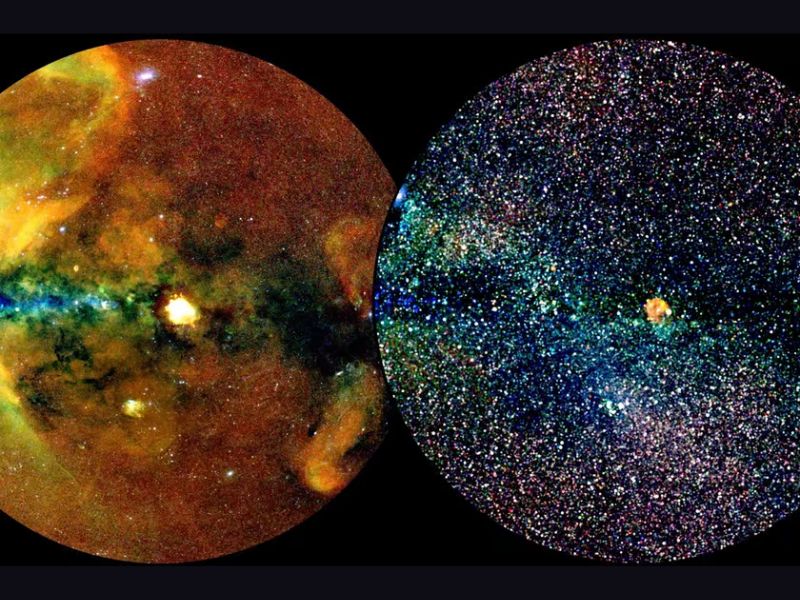
    Astronomers have utilized the eROSITA space telescope to chart half of the universe in X-ray light. This newly created map, featuring nearly a million X-ray sources, serves as the foundation for numerous scientific papers, with many more anticipated in the future.
    The eROSITA map seen in two different ways: Left shows extended X-ray emissions, while the right image shows point-like X-ray sources
    MPE, J. Sanders for the eROSITA consortium

    Astronomers have utilized the eROSITA space telescope to chart half of the universe in X-ray light. This newly created map, featuring nearly a million X-ray sources, serves as the foundation for numerous scientific papers, with many more anticipated in the future.

    Positioned at Lagrange Point 2, eROSITA is a soft X-ray imaging telescope situated near the James Webb Space Telescope. The primary objective was to conduct a comprehensive survey of the entire sky in X-ray wavelengths, identifying new galaxies, clusters, supermassive black holes, and other celestial objects. Additionally, the telescope aims to study massive structures and contribute to the measurement of dark energy, the enigmatic force driving the universe’s accelerated expansion.

    Unveiling eRASS1

    The inaugural data release is named the eROSITA All-Sky Survey Catalogue (eRASS1), compiled from information collected by the telescope from December 12, 2019, to June 11, 2020. During this period, eROSITA recorded 170 million individual X-ray photons. By analyzing the energy and arrival time of each photon, a comprehensive map of the cosmos can be constructed.

    This map encompasses half of the nocturnal sky, specifically the western hemisphere, and encompasses more than 900,000 X-ray sources. Among these sources are approximately 710,000 supermassive black holes actively consuming matter at the cores of galaxies, 180,000 X-ray-emitting stars within the Milky Way, 12,000 galaxy clusters, and a variety of less common entities like pulsars, supernova remnants, binary stars, and other X-ray sources.

    These figures are astonishing in the realm of X-ray astronomy,” remarked Andrea Merloni, the eROSITA principal investigator. “In just six months, we have detected more sources than the extensive flagship missions XMM-Newton and Chandra have achieved in almost 25 years of operation.”

    eRASS1’s Revelations

    However, this initial public release of data is accompanied by the publication of nearly 50 new papers based on eRASS1. Among the findings are the identification of over 1,000 galaxy superclusters, the observation of a 42 million light-year-long gas filament connecting two clusters, investigations into how X-ray emissions from stars impact the habitability of their planets, and studies of X-rays emitted by supernova remnants, stars, and various celestial objects.

    This marks only the initial phase, as eROSITA conducted three additional sky scans between June 2020 and February 2022, before the joint German-Russian project was temporarily halted due to the Russian invasion of Ukraine. The data from these subsequent scans will be disclosed in the near future.

    To conclude, the complete collection of scientific publications derived from this data can be accessed on the eROSITA website.


    Read the original article on: New Atlas

    Read more: Hubble Space Telescope Detects Water Vapor in Atmosphere of Small Exoplanet

  • New Telescope Instruments Will Investigate the  Universe For Water

    New Telescope Instruments Will Investigate the Universe For Water

    Since water plays a crucial role in supporting life forms based on carbon, scientists actively search for it when exploring the potential for extraterrestrial life.
    Credit: Pexels

    Since water plays a crucial role in supporting life forms based on carbon, scientists actively search for it when exploring the potential for extraterrestrial life. This includes investigating other planets through probes and using space-based telescopes to observe the cosmos.

    Detecting water from Earth-based instruments is considerably challenging. However, recently developed water-detecting receivers, integrated into the ALMA radio telescope situated in the dry and elevated region of Chile, offer scientists an innovative ground-based method to explore the existence of life beyond our planet.

    Enhanced Capabilities with Band 5 Receivers

    Expanding upon the successful testing of Band 5 receivers on the Atacama Pathfinder Experiment (APEX) telescope in the previous year, the Atacama Large Millimeter/submillimeter Array (ALMA) has now been equipped with new receivers. These receivers operate within the wavelengths of 1.42 mm to 1.83 mm (211 GHz to 163 GHz), encompassing the low-energy range of the electromagnetic spectrum.

    ALMA typically operates within frequencies ranging from 30 GHz to 960 GHz (9.9 mm to 0.31 mm wavelengths) across ten distinct frequency bands. Consequently, the integration of the new Band 5 receivers significantly broadens ALMA’s capability to observe radio frequencies from various regions of the sky.


    According to ALMA Program Scientist Leonardo Testi, the incorporation of the new receivers will greatly enhance the ability to identify water, an essential component for life as we understand it, within our Solar System, as well as in far-reaching areas of our galaxy and beyond. Additionally, these receivers will enable ALMA to investigate the presence of ionized carbon in the early Universe.

    Optimal Conditions for Water Detection

    Under normal circumstances, detecting water in space using such receivers posed significant challenges due to interference from water molecules present in Earth’s atmosphere.

    However, ALMA’s advantageous location atop the Chajnantor plateau in the moisture-free environment of the Atacama desert in northern Chile, situated approximately 5,000 meters (16,400 feet) above sea level, allows the new receivers to exploit their sensitivity fully. This unique setting provides an opportunity not readily available in many other locations on Earth.

    The Band 5 receivers are designed to operate at specific vibrational frequencies associated with various molecules, including water (H2O), carbon monosulfide (CS), hydrogen isocyanide (HNC), and silicon monoxide (SiO). These molecules play crucial roles in astrochemical investigations pertaining to the formation and transformation of interstellar gases.

    Initial testing of the new receivers focused on conducting detailed observations of H2O, CS, and HNC in Arp 220, a collision of giant galaxies situated in the middle of the Milky Way. Spectral studies were also conducted on the red supergiant star Sgr B2 (N) in Sagittarius, along with the detection of SiO and H2O during the examination of VY Canis Majoris, one of the largest known stars.

    ALMA Band 5 Opens Doors to In-Depth Water Studies

    We are thrilled to witness these initial outcomes from ALMA Band 5, even with a limited number of antennas,” expressed Robert Laing, a member of the European Southern Observatory (ESO) team. “With the complete ALMA array’s remarkable sensitivity and angular resolution, we will be able to conduct comprehensive studies of water in various celestial objects, including developing and mature stars, the interstellar medium, and regions adjacent to supermassive black holes.”

    The data obtained from the preliminary Band 5 tests has been thoroughly examined and processed by technical experts and astronomers from ESO and the European ALMA Regional Centre (ARC) network. The results have been published on the official ALMA website.

    ESO further reports that the new receivers are currently being installed and prepared for imminent deployment on the ALMA instrument, marking their active involvement in upcoming observations.


    Read the original article on: New Atlas

    Read more: Virtually Pure Argon May Whisper Secrets About Universe’s Dark Matter

  • James Webb Helps Astronomers Look to the Past of the Universe

    James Webb Helps Astronomers Look to the Past of the Universe

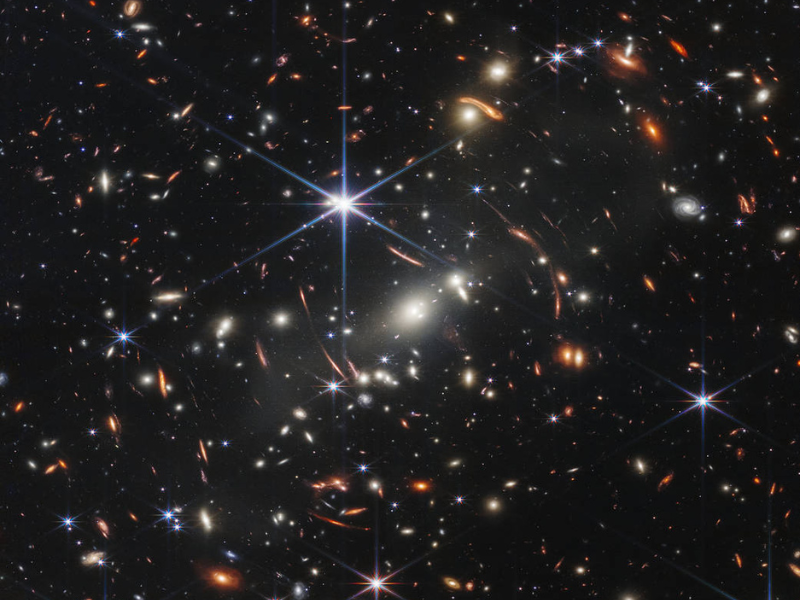
    The James Webb image of SMACS 0723. Credit: NASA, ESA, CSA, and STScI

    James Webb first Full-color images help astronomers make a new discovery.

    James Webb’s discovery is yet to give us not just a new insight but also a treasure trove of data held by every image it has released.

    The first full-color James Webb image, released by President Joe Biden on July 11, reveals a vast network of galaxies and peers billions of years into the past. Within that network, astronomers think they have determined the most far-off globular clusters ever detected, according to a BBC report.

     Introducing the Sparkler Galaxy

    Globular clusters are dense star collections whose beginnings aren’t entirely comprehended. The Milky Way is the residence of approximately 100 of these compact clusters that are understood to have less heavy chemical elements linked to younger stars such as our Sun. Still, researchers are uncertain exactly how and when they came to be.

    The new James Webb image, SMACS 0723, reveals a remote globular cluster amplified by gravitational lensing. Astronomers from the University of Toronto located the cluster and named it “the Sparkler Galaxy” since it’s bordered by small yellow-red dots that resemble sparks. They described their findings in a paper in The Astrophysical Journal Letters.

    Several zoomed in images of the Sparkler Galaxy. Credit: NASA, ESA, CSA, and STScI

    Those “sparks” would not have appeared to us if it weren’t for the power of James Webb. Thanks to the gravitational lensing in the SMACS 0723 image, the Sparkler Galaxy even appears three times because of strange distorting effects. Gravitational lenses not only amplify far-off objects but additionally distort them and have been found to produce “mirror” images of far-off galaxies.

    The team at the University of Toronto initially believed that the “sparks” could be different objects far past or in front of the Sparkler Galaxy. However, having three versions of the Sparkler Galaxy show the same dots highly indicates they are linked.

    James Webb looks toward the beginning of time

    The astronomers think the sparkles are globular clusters like the ones seen around the Milky Way. Most importantly, however, we’re seeing clusters that are considerably older and were produced much earlier in the history of the Universe.

    The image of the Sparkler Galaxy reveals what it looked like nine billion years ago, approximately 4.5 billion years after the Big Bang. The University of Toronto crew detailed that the galaxy cluster is redder than anticipated, suggesting it is older than they would have believed, provided how early it is in the Universe, relatively speaking.

    That indicates they assume the globular sparkles developed just a few hundred million years after the Big Bang. They might also contain some of the first stars developed in the Universe. In an interview with the BBC, one of the astronomers, Dr. Lamiya Mowla from Toronto’s Dunlap Institute for Astronomy & Astrophysics, stated, “when we first opened the SMACS image, we too were searching for the furthest stuff, the farthest things. And then we literally got sidetracked by the shiniest, sparkly object.”

    Looking at the images, we can understand why even astronomers can get sidetracked, especially when one realizes they are looking into the beginnings of our Universe. The truly remarkable thing is that we may never be able to fully analyze every tiny dot highlighted in immense detail.


    Originally published by: Interesting Engineering