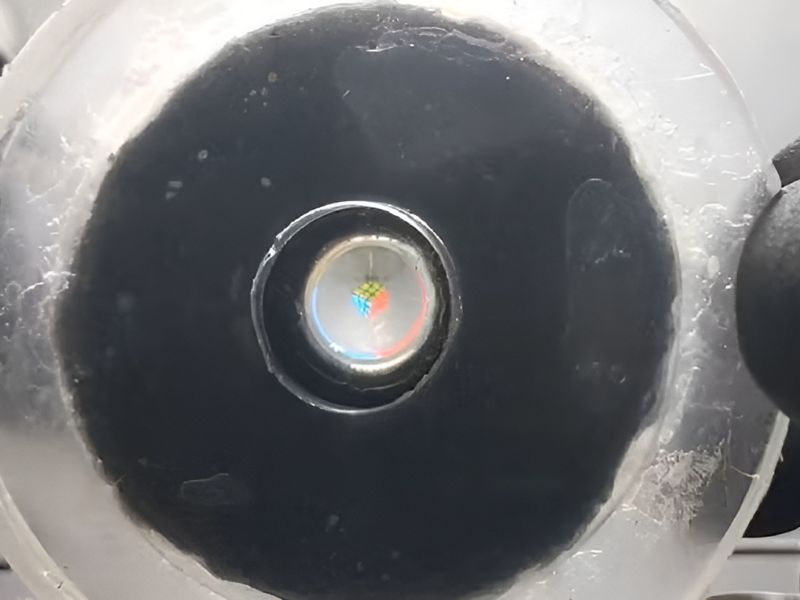

Inspired by the human eye, our biomedical engineering team at Georgia Tech has developed an adaptive lens made from soft, light-sensitive materials.
Traditional adjustable cameras rely on bulky, rigid lenses and a pupil to control focus and brightness. In contrast, the human eye achieves this through soft, flexible tissues in a compact design.
A Soft, Light-Responsive Lens That Mimics the Human Eye
Our innovation, the photo-responsive hydrogel soft lens (PHySL), replaces solid components with soft polymer “muscles” made from hydrogel — a water-based material. These hydrogel muscles adjust the lens’s shape to change its focal length, mimicking the action of the eye’s ciliary muscles.
The hydrogel contracts when exposed to light, enabling contact-free control by simply projecting light onto the lens. By targeting specific areas with light, we can finely tune the lens’s shape. Without rigid parts, this flexible system is safer, more adaptable, and better suited for use with living tissue.
Camera-based artificial vision powers many technologies, including robots and medical devices. Yet, the optical components in these systems still rely mainly on rigid, electrically powered materials. This rigidity poses challenges for emerging technologies like soft robotics and biomedical devices, which require flexible, low-power, and self-sufficient systems. Our soft lens is particularly well-suited for these applications.
Flexible, Adaptive Machines Inspired by Nature
Soft robots, inspired by living organisms, are built from flexible materials and structures that make them more resilient and adaptable. This approach is enabling advances in surgical endoscopes, gentle robotic grippers for handling fragile objects, and robots capable of moving through environments inaccessible to rigid machines.
Similar principles benefit biomedical tools, where tissuelike materials create softer, safer interfaces between machines and the human body. Such materials allow devices to move naturally with the body, improving safety and comfort. Examples include skinlike wearable sensors and hydrogel-coated implants.

This research combines ideas from adjustable optics and soft “smart” materials. Although such materials are commonly used to create soft actuators—components that enable movement, like grippers or propellers—their use in optical systems has been more difficult to achieve.
Most current soft lens designs rely on liquid-filled chambers or electronically powered actuators, which add complexity and restrict their use in fragile or wireless systems. Our light-responsive design provides a simpler, electronics-free solution.
Advancing Performance Through Next-Generation Hydrogel Materials
We plan to enhance our system’s performance by leveraging recent advances in hydrogel technology. Emerging studies have produced various stimuli-responsive hydrogels capable of faster and stronger contractions. By integrating these new materials, we aim to boost the functional performance of our photo-responsive hydrogel soft lens.
We also seek to demonstrate its potential in innovative camera applications. In our current work, we created a proof-of-concept, electronics-free camera that combines our soft lens with a custom light-activated microfluidic chip. Our next step is to integrate this system into a soft robot, enabling vision without electronics. This would mark a major step forward in showcasing how our design can support new forms of soft visual sensing.
Read the original article on: Robohub
Read more:What is the Domain Name System? An Engineer Explains