

Imagine improving your eyesight in less than a minute—without lasers, scalpels, or discomfort. Scientists have unveiled a groundbreaking, non-invasive method that reshapes the cornea using only a gentle electrical current and a temporary shift in pH. Early experiments suggest it can reverse myopia without surgery, marking one of the most significant advances in vision correction since LASIK.
Introducing Electromechanical Reshaping (EMR)
This innovative technique, called electromechanical reshaping (EMR), modifies the cornea through low-level electrical stimulation. Researchers from Occidental College and the University of California, Irvine, described their progress during the American Chemical Society’s Fall 2025 meeting.
The cornea—the transparent, dome-shaped layer at the front of the eye—acts as the primary lens, bending light to focus it on the retina. Composed of tightly arranged collagen fibers, it must remain smooth and strong to function properly. However, when its curve is irregular, conditions like nearsightedness (myopia) or farsightedness (hyperopia) occur.
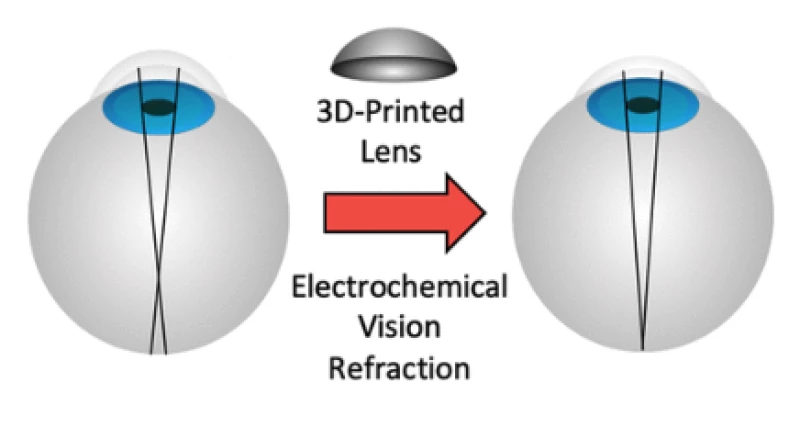
Hill, et al./ACS Biomaterials Science & Engineering/(CC By 4.0)
Currently, LASIK surgery is the most common option for eliminating glasses or contacts. It uses a laser to remove tiny amounts of corneal tissue beneath a flap, reshaping the surface so light focuses correctly. While LASIK boasts a high success rate—roughly 95% of patients achieve clear vision shortly after surgery—it is invasive, costly, and permanently alters the cornea’s structure.
A New Approach to Reshaping the Eye
Instead of cutting tissue, Hill and his colleagues explored a different approach: working with the cornea’s natural composition. Because it is largely made of collagen and charged proteins, the cornea’s shape can be temporarily softened by altering its chemical environment. By applying a mild current through a specially designed platinum “contact lens” electrode, the team shifted the tissue’s pH, making it more flexible. This brief window allowed the cornea to be reshaped inside the electrode mold.
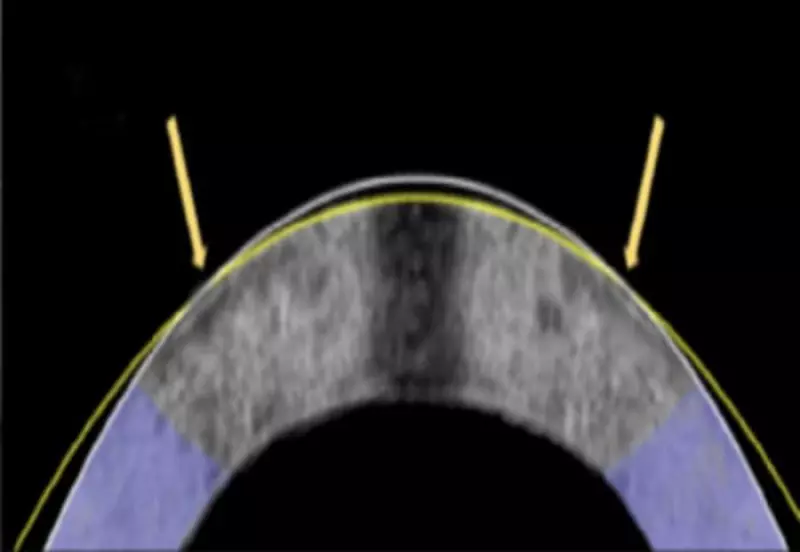
Daniel Kim and Mimi Chen
Once the current stopped and the pH normalized, the cornea stiffened again, holding its new form. The entire procedure took about a minute, involved no cutting, and showed no signs of cell death or structural damage in lab tests. Researchers believe EMR could one day serve as an alternative to LASIK.
An Accidental Discovery
The discovery happened completely by accident, explained Brian Wong, professor and surgeon at UC Irvine. I was investigating how living tissues could be molded and stumbled across this chemical modification process.
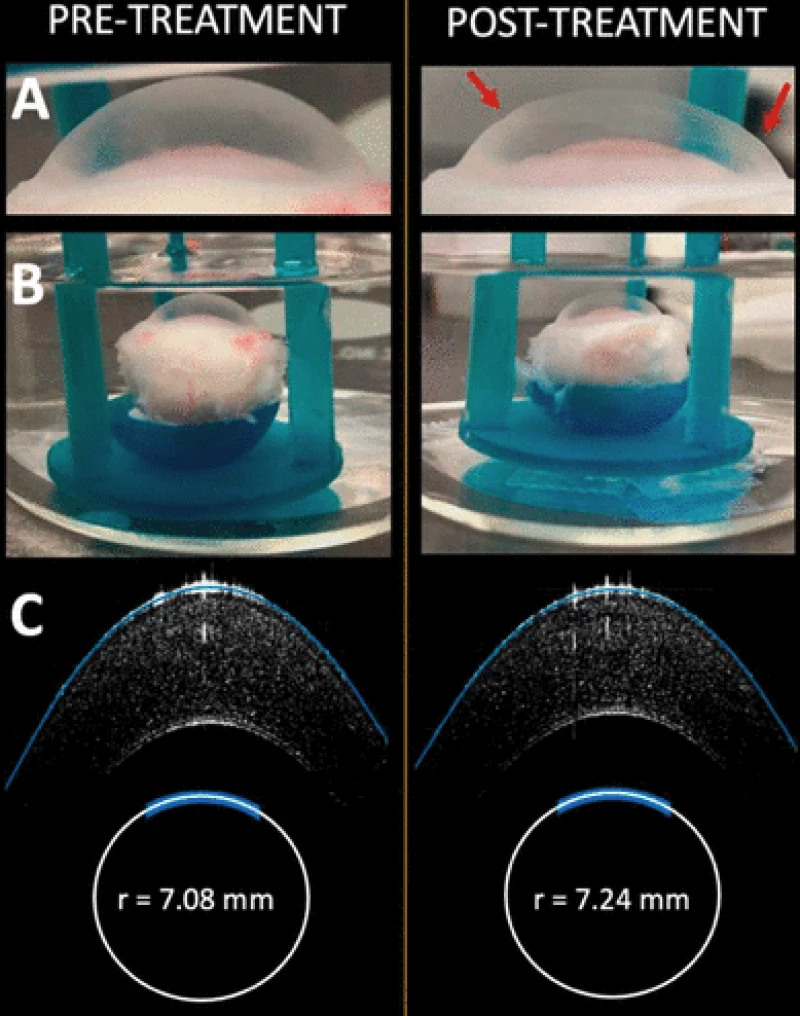
Daniel Kim and Mimi Chen
To test the method, the team applied EMR to 12 rabbit corneas, successfully reshaping 10 of them to correct for myopia. Within moments, the tissue adopted the electrode’s preset curve, and early measurements confirmed proper reshaping—achieved without lasers, incisions, or trauma.
Despite these promising results, EMR is still in the experimental phase. The technique has only been tested on isolated corneas, not live animals. Wong noted that the next step will be extensive animal trials to determine its safety, durability, and the range of corrections it can provide.
Looking Toward Clinical Use
There’s still a long journey from where we are now to clinical application, Hill said. But if we get there, the method could be broadly applicable, far less expensive, and potentially even reversible.
Researchers first published details of EMR in 2023 in ACS Biomaterials Science & Engineering. Michael Hill, Daniel Kim, and Michelle Chen later presented the most recent findings at the ACS Fall 2025 meeting.
Read the original article on: New Atlas
Read more: Implantable Heart Patch Heals Tissue and Closes Holes


