

Soft Robotics Lab/ETH Zurich
Researchers have created a 3D-printed, biodegradable cardiac patch designed to both seal holes in the heart and encourage tissue regeneration, offering a potentially safer option than traditional surgical materials.
The Global Burden of Heart Disease
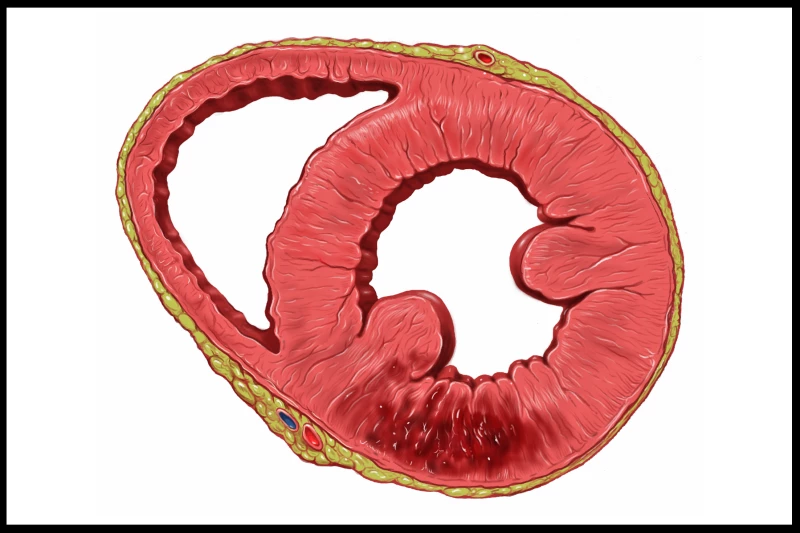
Heart disease remains the world’s leading cause of death, with heart attacks at the center of the crisis. Survivors often face long-term complications due to the loss of heart cells and the buildup of scar tissue, which weakens the heart’s performance. In severe cases, the heart wall may rupture, requiring emergency intervention.
For years, scientists have worked on implantable patches to support damaged heart tissue. Now, a team from ETH Zurich in Switzerland has unveiled a new type of patch that not only covers defective areas but also actively promotes healing.
Conventional heart patches don’t integrate with native tissue and remain in the body permanently,” explained Lewis Jones, lead author and researcher at ETH Zurich’s Soft Robotics Lab. “Our patch was designed to merge with existing heart tissue.
Aiming for Complete Repair
Professor Robert Katzschmann, co-author of the study, added: “We aimed to build a patch that not only closes a defect but truly contributes to full repair.”
To achieve this, the researchers engineered the “RCPatch,” a reinforced, implantable scaffold 3D-printed from a biodegradable polyester metamaterial.The researchers tuned its stiffness to mimic the flexibility of natural heart tissue. They used computer modeling and simulations to generate hundreds of lattice structures before selecting one with mechanical properties closely resembling heart tissue.
A Scaffold That Disappears
The researchers infused the scaffold with a fibrin-based hydrogel containing heart muscle cells derived from reprogrammed adult cells. To minimize blood leakage and provide a surface for surgical attachment, the team added a mesh also coated with fibrin hydrogel.
Wikimedia Commons/Patrick J. Lynch CC BY-SA 3.0
The scaffold is strong enough to hold living cells, but once they integrate with the tissue, it degrades completely,” Jones explained. “This ensures no foreign material remains in the body.
In the lab, the patch began contracting within three days as the cells became active.The researchers subjected it to thousands of stretch-and-compression cycles to replicate heartbeats. They then implanted the RCPatch over an 8-mm hole in the left ventricle of a pig’s heart.
Promising First Results
The results were promising: once attached, bleeding from the hole nearly stopped immediately, with only minor bleeding continuing for about 10 minutes. “We showed that the patch maintains structural stability even under real blood pressure,” said Katzschmann.
Despite the success, the study had limitations. It was an early proof-of-concept tested on a single animal and only for a short duration. Real heart ruptures often leave larger, more irregular holes, and it remains uncertain how well the patch would perform over weeks or months in a living system.
Still, with further refinement, the RCPatch could represent a biodegradable, regenerative alternative to animal-derived patches. If successful, it may improve heart repair procedures and reduce the long-term risks that follow heart attacks.
Read the original article on: New Atlas
Read more: Research Reveals Higher Likelihood of Heart Attacks Occurring on Mondays


