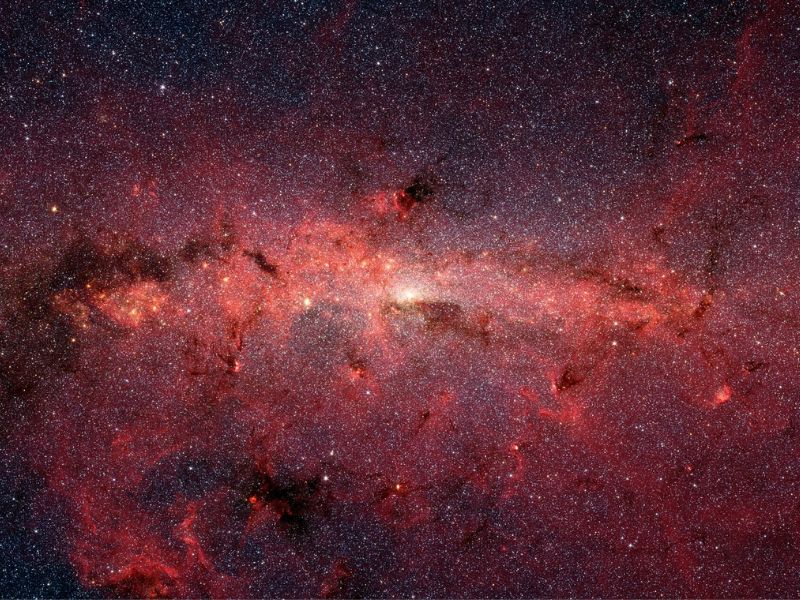
Tag: Wave

  • Study Maps Our Solar System’s Path Through a Gigantic Galactic Wave

    Study Maps Our Solar System’s Path Through a Gigantic Galactic Wave

    Credit: Pixabay

    Our Solar System moves through the Milky Way at about 200 km/s, following a complex orbit around the galaxy’s center. Along its journey, it has encountered different cosmic environments, some of which may have influenced Earth’s climate. New research suggests that around 14 million years ago, the Solar System passed through the Orion star-forming complex—a significant part of a larger structure known as the Radcliffe Wave. This wave, discovered in 2020, is an immense, wave-like formation of gas and dust stretching nearly 9,000 light-years across the Orion arm of the Milky Way.

    The Radcliffe Wave is home to several active star-forming regions, including the Orion molecular cloud complex and the Perseus and Taurus molecular clouds. Because of its density, this region likely compressed the Sun’s heliosphere—the protective bubble created by the solar wind—when the Solar System moved through it. As a result, more interstellar dust was able to enter the Solar System and potentially reach Earth, influencing climate patterns and leaving traces in geological records.

    A team of researchers, led by Efrem Maconi from the University of Vienna, published their findings in Astronomy and Astrophysics. Using data from the European Space Agency’s Gaia mission and spectroscopic observations, they reconstructed the movement of the Solar System and the Radcliffe Wave over millions of years. Their results indicate that the closest approach between the two occurred between 14.8 and 12.4 million years ago—precisely when Earth experienced the Middle Miocene Disruption (MMD). This period was marked by significant climatic shifts and widespread extinctions of both marine and terrestrial species.

    Tracing the Solar System’s Path: A Link Between the Radcliffe Wave and Earth’s Climate Shifts

    An overview of the Radcliffe wave and selected clusters in a heliocentric Galactic Cartesian frame. The Sun is placed at the center, and its position is marked with a golden-yellow. The red dots represent molecular clouds and tenuous gas bridge connections that constitute the Radcliffe wave. The blue points represent the 56 open clusters associated with the region of the Radcliffe wave that is relevant to this study. The size of the circles is proportional to the number of stars in the clusters. (Maconi et al. 2025)

    By analyzing the trajectories of 56 open star clusters associated with the Radcliffe Wave, the researchers confirmed that the Solar System and this dense interstellar region intersected from about 18.2 to 11.5 million years ago. This overlap suggests a possible connection between the influx of interstellar dust and Earth’s changing climate. João Alves, a professor of astrophysics at the University of Vienna and co-author of the study, explains that the study builds on previous research into the Radcliffe Wave and highlights how astronomical events may have had a direct impact on Earth’s past.

    One possible mechanism for this influence is the accumulation of interstellar dust in Earth’s atmosphere. The interstellar medium contains isotopes such as iron-60 (60Fe), a byproduct of supernova explosions, which can leave detectable signatures in geological records. While current technology may not yet be sensitive enough to confirm these traces, future advancements in detection methods could provide stronger evidence. Additionally, the increased presence of cosmic dust may have contributed to global cooling, a phenomenon previously proposed in a 2005 study suggesting that Earth encounters dense giant molecular clouds (GMCs) approximately every 100 million years.

    Solar System’s Passage Through Radcliffe Wave May Have Triggered Middle Miocene Climate Shift

    During the Middle Miocene, Earth was undergoing significant geological and climatic changes. The period is best known for the Middle Miocene Climatic Optimum (MMCO), a warm phase during which tropical ecosystems expanded. However, it was soon followed by the Middle Miocene Disruption, a period of cooling and extinction that closely aligns with the timing of the Solar System’s passage through the Radcliffe Wave. Researchers propose that interstellar dust could have played a role in this climatic shift by altering atmospheric composition or influencing cloud formation.

    The authors acknowledge that their findings rely on approximations due to the challenges of reconstructing the past structure and motion of interstellar gas clouds. However, their study offers compelling evidence that our Solar System’s journey through the Milky Way may have had tangible effects on Earth’s climate and evolutionary history.

    The well-known Orion Nebula (center), and the less well-known NGC 1977 (The Running Man Nebula) on the left. NGC 1977 was still forming when the Solar System passed through this region about 14 million years ago. (Chuck Ayoub/Wikimedia Commons/CC BY-SA 4.0)

    Alves Explains How Tracing the Solar System’s Path Reveals Interstellar Encounters’ Impact on Earth

    “This discovery builds upon our previous work identifying the Radcliffe Wave,” Alves notes. “By tracing our Solar System’s movement through the galaxy, we can begin to understand how these encounters with interstellar structures might have shaped Earth’s past environment.”

    Future research will explore the significance of this contribution in greater detail. The team plans to refine their models and investigate whether other periods of climate transition in Earth’s history might also correlate with the Solar System’s passage through dense interstellar regions. Advances in astrophysics, geology, and paleoclimatology could further uncover the intricate ways in which cosmic forces have influenced the evolution of our planet. Earth’s climate is affect by the internal process and the Milky Way.


    Read Original Article: Science Alert

    Read More: Breathtaking Lunar Sunset Images May Unravel a Long-Standing Mystery
  • Expert Identifies Irregular Brain Wave Patterns as Potential Indicator of ADHD

    Expert Identifies Irregular Brain Wave Patterns as Potential Indicator of ADHD

    Credit: Pixabay

    Children with attention deficit hyperactivity disorder (ADHD) are not lazy, undisciplined, or lacking manners. Instead, their brains develop and function differently, marked by unique neurological activity patterns and neurochemical imbalances. These differences classify ADHD as a neurodevelopmental disorder rather than a behavioral issue.

    The Neurological Basis of ADHD

    The neurological variations in ADHD manifest as attention difficulties, disorganization, hyperactivity, or impulsivity. While these traits are often most evident in childhood, where ADHD affects about 5% of the population, they frequently persist into adulthood, impacting around 2.5% of adults. Consequently, ADHD can influence social, academic, and occupational outcomes throughout a person’s life.

    Although some risk factors, such as maternal smoking during pregnancy or low birth weight, are associated with ADHD, they are not direct causes. Instead, genetic factors play a more significant role, as heredity accounts for 74% of cases.

    Moving Beyond Behavioral Diagnoses

    Currently, ADHD diagnoses rely heavily on observing cognitive and behavioral traits relative to age expectations. However, advances in computational neuroscience offer a new frontier. Emerging tools analyze brain activity patterns instead of relying solely on behavioral observations, providing a more objective diagnosis.

    Using mathematical algorithms, these tools identify similarities in brain activity between individuals with ADHD, offering a complementary or future alternative to traditional diagnostic methods.

    Brain Wave Patterns in The Disease

    Our brain’s neurons communicate via electrical activity, producing brain waves linked to cognitive states. In ADHD, studies have identified divergent patterns in the P3B and N200 waves.

    • P3B waves, which reflect attention and information processing, tend to be weaker or delayed in ADHD individuals.
    • N200 waves, involved in error detection, impulse control, and attention focus, show irregular functioning, contributing to difficulties in self-regulation.

    Insights from Neuroimaging

    Advanced neuroimaging techniques, like magnetic resonance imaging (MRI), reveal structural differences in ADHD brains:

    • The corpus callosum, which connects the brain’s hemispheres, often shows reduced size or volume.
    • The frontal lobe, responsible for attention and executive functions, is typically smaller.
    • The caudate nucleus, crucial for dopamine release and the brain’s reward system, is also affected.

    Lower cortical volumes in regions such as the frontal, temporal, parietal, and occipital lobes are particularly significant, with reductions in the orbitofrontal areas impacting self-control and inhibition.

    Chemical and Metabolic Factors

    Other imaging methods, like positron emission tomography (PET), highlight decreased glucose metabolism in key regions related to emotional regulation, memory, sensory processing, and attention. For example:

    • Reduced blood flow to white matter in the frontal areas impairs executive functions like decision-making and impulse control.
    • Lower blood supply in regions such as the basal nuclei and striatum disrupts dopamine regulation, further affecting attention and motivation.

    Additionally, studies indicate reduced dopamine levels in ADHD brains, directly impacting the reward system, learning, and focus.

    Reducing Stigma and Embracing Strengths

    Neuroscience has made it clear that this disease is a legitimate neurodevelopmental condition, not a matter of poor discipline or laziness. Recognizing this helps avoid false positives and ensures accurate diagnoses by considering environmental factors and other potential explanations.

    It is crucial to provide tools and strategies to help individuals with ADHD manage their challenges while emphasizing their strengths. Support from schools, families, and therapists can create an environment where individuals with ADHD thrive.

    Although school can be challenging for children with ADHD, with proper support, many grow up to achieve remarkable success. Celebrities like Will Smith, Jim Carrey, and Justin Timberlake, alongside entrepreneurs like Ingvar Kamprad (IKEA) and Richard Branson (Virgin), exemplify this potential.

    The true challenge lies not in ADHD itself but in society’s understanding and support of the condition.


    Read Original Article: Science Alert

    Read More: This Key Blood Measurement Could Signal Your Future Disease Risk

  • First U.S. Onshore Wave Energy Project Receives Green Light

    First U.S. Onshore Wave Energy Project Receives Green Light

    In 2022, Eco Wave Energy (EWP) announced its ambitious plan to relocate its wave energy array from Gibraltar to the Port of Los Angeles. Now, after significant preparation and collaboration, the company has received final approval to establish the first onshore wave energy project in the US.
    EWP is looking to complete installation of its energy system at the Port of LA site but Q1 2025, which should look and operate similar to the company’s pilot setup at Jaffa Port in Israel (shown)
    Eco Wave Power

    In 2022, Eco Wave Energy (EWP) announced its ambitious plan to relocate its wave energy array from Gibraltar to the Port of Los Angeles. Now, after significant preparation and collaboration, the company has received final approval to establish the first onshore wave energy project in the US.

    Wave Energy Technology Makes Waves in the US

    EWP’s innovative technology works by mounting floaters on coastal infrastructure, which harness the motion of waves to drive hydraulic pistons that generate electricity through a generator.

    After proving the concept in 2012 and successfully operating a grid-connected pilot in Gibraltar for nearly six years, the company took steps to transition the project to the US. Unused components were recycled, while the energy conversion unit was overhauled and updated to meet US standards. By late 2022, the upgraded unit had arrived at AltaSea’s campus in the Port of LA, a key hub for climate and energy innovation.

    AltaSea CEO Terry Tamminen and EWP’s founder/CEO Inna Braverman sign the collaboration agreement for the pilot wave energy system at the Port of LA
    Eco Wave Power

    EWP Expands to the US with Portable Wave Energy Technology and Key Partnerships

    AltaSea CEO Terry Tamminen visiting the wave energy power station at Jaffa Port, Israel, in 2022
    Eco Wave Power

    CEO Inna Braverman highlighted the portability of their technology, calling the US expansion “just the start.” In 2023, EWP launched a US subsidiary and began securing approvals.

    Following a feasibility study, EWP partnered with Shell to pilot the installation. Now approved by the US Army Corps of Engineers, the project will feature eight floaters on Municipal Pier One and an energy conversion unit housed in shipping containers.

    Installation is slated for completion by the first quarter of next year, with potential expansion to 77 additional US sites identified by EWP.


    Read Original Article: New Atlas

    Read More: Scitke