Tag: X-Ray

  • The XFELO Laser Creates Highly Focused, Ultra-Precise X-Ray Beams

    The XFELO Laser Creates Highly Focused, Ultra-Precise X-Ray Beams

    A group of engineers and scientists has demonstrated for the first time that a hard X-ray cavity can achieve net X-ray gain. In their experiment, crystal mirrors repeatedly reflected the X-ray pulses, amplifying them in a process similar to that of an optical laser. This proof-of-concept at the European XFEL produced an exceptionally coherent, laser-like beam with a level of quality never before achieved in the hard X-ray range.
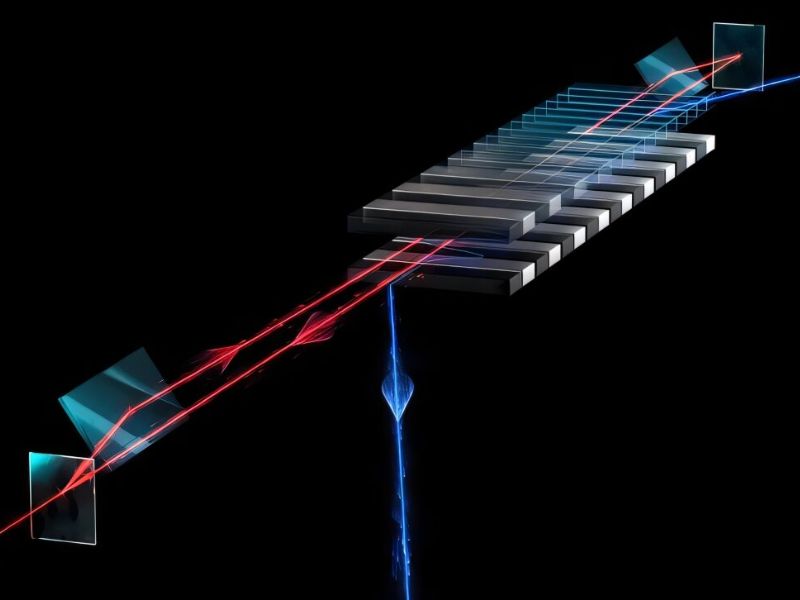
    Illustration of the XFELO system. Image Credits: European XFEL

    A group of engineers and scientists has demonstrated for the first time that a hard X-ray cavity can achieve net X-ray gain. In their experiment, crystal mirrors repeatedly reflected the X-ray pulses, amplifying them in a process similar to that of an optical laser. This proof-of-concept at the European XFEL produced an exceptionally coherent, laser-like beam with a level of quality never before achieved in the hard X-ray range.

    Achieving lasing within a cavity has long been difficult for short-wavelength X-rays, for several reasons, including the fundamental challenge that such light is hard to reflect at large angles. The X-ray Free-Electron Laser Oscillator (XFELO) approach overcomes these limitations and enables new opportunities for research, ranging from the study of ultrafast chemical processes to high-resolution investigations of the smallest biological structures. The researchers report the findings in the journal Nature.

    From an XFEL to an XFELO

    Today’s free-electron lasers produce X-ray pulses using linear electron accelerators. Powerful electric fields accelerate bunches of roughly 100 billion electrons to nearly the speed of light. These electrons then travel through specialized magnetic devices known as undulators, which force them into a rapid, slalom-like motion. As the electrons constantly change direction, they emit intense, tightly focused X-ray radiation in the forward direction. At the European XFEL, as many as 27,000 electron bunches per second pass through the undulators, creating X-ray pulses at the same frequency.

    Despite their outstanding quality, these X-ray pulses still exhibit a degree of energy spread. The newly developed XFELO approach significantly narrows this spread, producing X-ray light with a precisely defined energy—an essential feature for high-precision experiments.

    In an XFELO setup, the X-ray beam circulates multiple times within a resonator cavity. This cavity consists of two sets of diamond mirrors with a series of undulators placed between them. During each round trip, the X-ray light interacts with a fresh electron bunch from the accelerator, progressively reinforcing and sharpening the beam. As Harald Sinn, X-ray optics expert and head of the Instrumentation Department at European XFEL, explains, “Each pass makes the light stronger and more focused.”

    A Razor-Thin Peak

    “With each round trip, the X-ray pulse sheds noise while the focused light sharpens,” explains DESY accelerator scientist Patrick Rauer, whose doctoral research laid the foundation for the resonator cavity and who now leads its implementation at DESY. “The signal grows more stable, and a single, distinct frequency begins to emerge—this spike.” That spike corresponds to a unique X-ray pulse with an exceptionally sharp definition.

    Jörg Rossbach, then a physics professor at the University of Hamburg, originally suggested employing a resonator cavity at the European XFEL. Over the following decades, researchers extensively analyzed and modeled the concept, eventually enabling Rauer and his colleagues from DESY’s accelerator division, along with scientists and engineers from Harald Sinn’s instrumentation teams at European XFEL, to design a concrete resonator cavity system. Fittingly, during beamtime at the European XFEL dedicated to studying the resonator’s performance, it was Jörg Rossbach—now a professor emeritus—who first spotted the spike in the data.

    Exceptional Level of Accuracy

    The resonator cavity at the European XFEL stretches approximately 66 meters. High-quality diamond crystals reflect the X-ray light, guiding it repeatedly through the cavity, while optical mirrors provide extra focusing and stability. Key challenges included precisely positioning the crystals and synchronizing the X-ray pulses with the electron bunches. Maintaining the stability of the 1.7-kilometer accelerator—both in terms of energy, timing down to femtoseconds, and position down to micrometers—over several days was essential for the experiment’s success. “It took years to achieve this level of performance, which is now unmatched in the world of high-repetition-rate accelerators,” says Rauer.

    “The successful demonstration proves that the resonator concept can be practically implemented,” says Sinn. “Compared to previously used methods, it produces X-ray pulses with much narrower wavelengths, as well as significantly improved stability and coherence.” This opens entirely new possibilities for highly precise experiments in physics, materials science, chemistry, and biology. “With this system, researchers can explore structures and processes that were previously barely measurable,” adds Thomas Feurer, managing director at European XFEL.

    In the coming years, the team aims to further intensify the X-ray light, maintain stability over longer operating periods, and prepare the technique for use by a broader research community. DESY Accelerator Division Director Wim Leemans notes, “This collaborative effort has realized a long-envisioned way to enhance the laser-like properties of coherent hard X-ray pulses at the European XFEL, and users will benefit greatly from their work.” The ultimate goal is a new generation of X-ray sources offering extraordinary precision and brilliance, enabling unprecedented insights into the tiniest and fastest processes.


    Read the original article on: Phys.Org

    Read more: If an Asteroid Hits the Moon in 2032, Earth could be Affected
  • Scientists Create Color X-Ray Technology

    Scientists Create Color X-Ray Technology

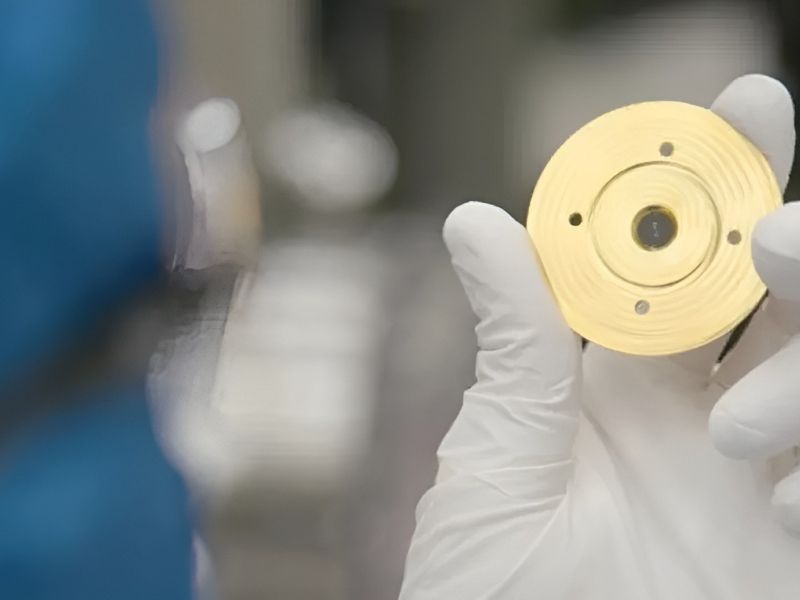
    “This technology moves X-rays from black-and-white to color, making it easier to spot materials and defects,” said Noelle Collins.
    Image Credits: © Sandia National Labs

    This technology moves X-rays from black-and-white to color, making it easier to spot materials and defects,” said Noelle Collins.

    Project leader Edward Jiménez said the new Color Hyperspectral X-ray Imaging with Multimetal Targets (CHXI MMT) technology was developed with Noelle Collins and Courtney Sovinec.

    Sandia Team Tests Technology on Multiple Metal Samples

    The Sandia National Laboratories team in the U.S. demonstrated the technique using small, standardized samples of metals such as tungsten, molybdenum, gold, samarium, and silver.

    Each metal emits a unique color of X-ray light,” Sovinec said. “Using an energy detector, we count photons to gauge density and identify a sample’s elements.

    According to Jiménez, the result is color X-ray images offering “revolutionary clarity and a deeper understanding of an object’s composition.”

    Breakthrough Broadens X-ray Applications

    Researchers say the breakthrough is a major leap in X-ray technology, with potential uses in airport security and non-destructive testing.

    The team also envisions advancements in medical diagnostics, particularly in the early detection of diseases like cancer.

    We hope CHXI MMT will enhance our ability to detect diseases such as cancer and enable more precise analysis of tumor cells,” said Edward Jiménez.

    He added that staining sharpens the beam and image resolution, improving detection of microcalcifications linked to breast cancer.

    Over 130 years after Wilhelm Röntgen’s X-ray discovery, U.S. scientists have created a more precise imaging method using metals and their unique light colors.


    Read the original article on: Noticias ao minuto

    Read more: Next-Gen Memory: Tungsten-Based SOT-MRAM Provides Rapid, Low-Energy Storage

  • Observations Indicate That The X-Ray Source AX J145732−5901 Is Likely A Galaxy Cluster

    Observations Indicate That The X-Ray Source AX J145732−5901 Is Likely A Galaxy Cluster

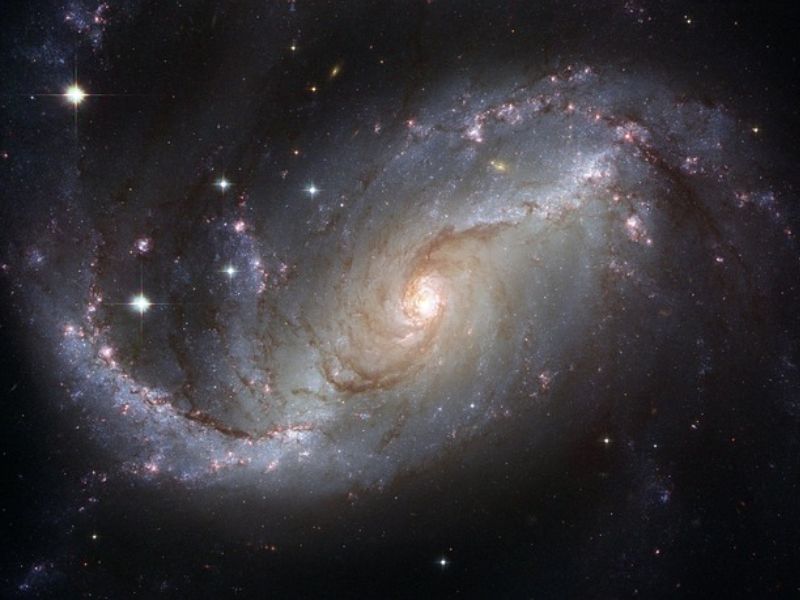
    Japanese astronomers have found that the unknown X-ray source AX J145732−5901 is a galaxy cluster behind the galactic plane. The researchers outlined these findings in a paper released on April 30 on the arXiv preprint server.
    Credit: Pixabay

    Japanese astronomers have found that the unknown X-ray source AX J145732−5901 is a galaxy cluster behind the galactic plane. The researchers outlined these findings in a paper released on April 30 on the arXiv preprint server.

    Discovery and Early Observations of AX J145732−5901 with ASCA

    NASA launched the ASCA satellite in 1993 to study distant active galaxies,galaxy clusters, cosmic X-ray background sources, and other high-energy phenomena. It enabled astronomers to detect faint X-ray sources, even through the dense matter of the galactic plane.

    AX J145732−5901 is an unidentified X-ray source first detected in 2001 during the ASCA Galactic plane survey. Earlier observations classified it as a heavily absorbed, extended source and suggested that a galaxy cluster might lie hidden behind the Milky Way’s plane. However, researchers had not yet conducted a detailed spectral analysis to confirm this hypothesis.

    Suzaku Observations Confirm the Nature of AX J145732−5901

    Recently, a team of astronomers led by Shigeo Yamauchi from Nara Women’s University in Japan analyzed X-ray data from the Suzaku satellite to investigate AX J145732−5901. Their findings support the earlier assumption about its nature.

    We reanalyzed the ASCA data of AX J145732−5901 using insights from Suzaku-based studies of Galactic ridge X-ray emission and the cosmic X-ray background,” the researchers stated in their paper.

    Specifically, the study revealed that AX J145732−5901 exhibits extended X-ray emission measuring 14 by 10 arcminutes, equivalent to about 5.87 by 4.24 million light-years. The emission stretches along the east-west axis and appears to contain localized structural features.

    The X-ray spectrum of AX J145732−5901 shows a 5.94 keV emission line and strong absorption, with a hydrogen column density of about 100 sextillion atoms per square centimeter—much higher than the galactic average. This strong absorption supports the idea that the source lies beyond our galaxy.

    Luminosity and Distance Estimates of AX J145732−5901

    The paper reports that AX J145732−5901 has an X-ray luminosity of about 260 tredecillion erg/s in the 1–10 keV range. Its distance is estimated at 1.8 billion light-years, with an angular extent of around 1.43 billion light-years.

    From these findings, the researchers concluded that AX J145732−5901 is a galaxy cluster located behind the galactic plane. Its X-ray morphology suggests it is an unrelaxed, or merging, cluster.

    The researchers also calculated that AX J145732−5901 contains roughly 30 trillion solar masses of gas. Assuming a 15% gas fraction, they estimated the cluster’s total mass at about 200 trillion solar masses.


    Read the original article on: Phys.Org

    Read more: Lo’s Global Volcanic Activity Results from Focused Tidal Heating in its Upper Mantle

  • Silver Foam and High-Power Lasers Create the World’s Brightest X-Ray

    Silver Foam and High-Power Lasers Create the World’s Brightest X-Ray

    A groundbreaking innovation at Lawrence Livermore National Laboratory (LLNL) has combined high-power lasers with an ultralight silver metal foam to create the brightest X-ray source ever recorded, boasting twice the intensity of anything previously achieved.
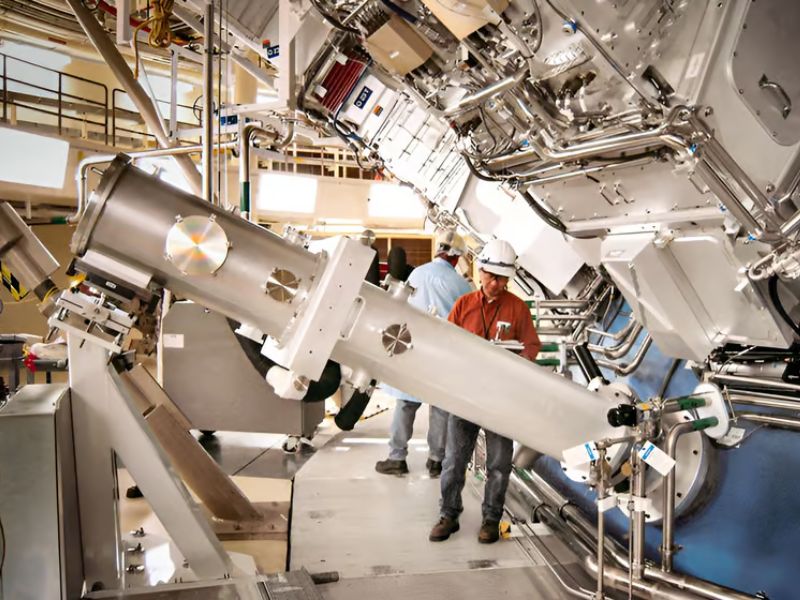
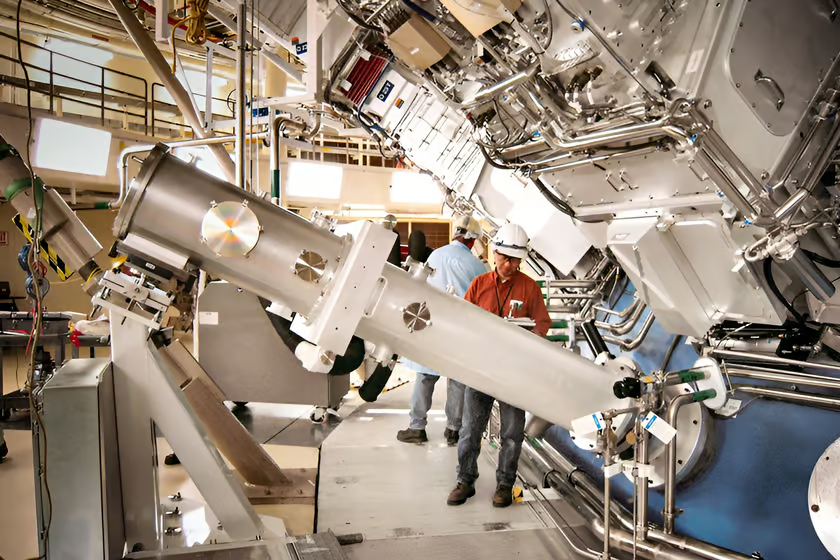
    An x-ray detector at the National Ignition Facility was used to measure the energy spectrum and intensity of x-ray bursts created in the experiments
    Lawrence Livermore National Laboratory

    A groundbreaking innovation at Lawrence Livermore National Laboratory (LLNL) has combined high-power lasers with an ultralight silver metal foam to create the brightest X-ray source ever recorded, boasting twice the intensity of anything previously achieved.

    Applications of Ultra-Bright X-Rays

    While ultra-bright X-rays may not be useful in everyday life, they play a crucial role in advanced research. Applications include studying the atomic-level structure of materials, observing chemical reactions in real-time, obtaining detailed images of biological samples, and analyzing complex molecules.

    These exceptionally bright X-rays are particularly important at facilities like LLNL, which leads cutting-edge research on nuclear fusion. Beyond scientific exploration, these studies have practical applications, such as developing fusion reactors and ensuring the safety and reliability of the United States’ nuclear weapons stockpile.

    The key advantage of these X-rays lies in their extremely high resolution, making them ideal for examining highly dense materials, such as the plasmas generated during inertial confinement fusion.In this process, high-energy laser beams bombard pellets of deuterium and tritium. Interestingly, researchers at the National Ignition Facility (NIF) use the same super-lasers designed for fusion research to produce this new ultra-bright X-ray light.

    Production of X Rays animated

    A New Approach to Generating X-Rays

    Traditionally, X-rays, like those used in dental offices, are generated by bombarding a metal target with an electron beam. However, this new system replaces the electron beam with a laser and uses a special metal target made of silver foam.

    Researchers create this foam, shaping it into 4-mm-wide cylinders using silver nanowires suspended in a special mold.After undergoing a supercritical drying process to remove the solution, the result is a metal foam with just one-thousandth the density of regular silver—about the same density as air.

    Why Use “Fluffy” Silver?

    The highly porous structure of the silver foam allows heat to flow much faster through it. As a result, the entire cylinder can heat uniformly in just 1.5 billionths of a second.

    The outcome is an X-ray source with energy exceeding 20,000 electron volts. While this might seem small on an everyday scale, it is extremely significant in the realm of nuclear physics.

    The new ultra-bright X-Ray uses fusion-grade lasers and a silver metal foam
    Lawrence Livermore National Laboratory

    According to LLNL researchers, this new X-ray technology will not only deepen our understanding of fusion processes but also enable the study of the hot, bright metal plasmas produced, which exist far from thermal equilibrium.

    These results mean we need to rethink our assumptions about heat transport and how we calculate it in these particular metal plasmas, said Jeff Colvin, a scientist at LLNL.


    Read the orginal article on: New Atlas

    Read more:X-rays May Help Divert Hazardous Asteroids Heading toward Earth

  • A Vast X-Ray Image Spans Half the Universe Capturing Over a Million Sources

    A Vast X-Ray Image Spans Half the Universe Capturing Over a Million Sources

    Astronomers have utilized the eROSITA space telescope to chart half of the universe in X-ray light. This newly created map, featuring nearly a million X-ray sources, serves as the foundation for numerous scientific papers, with many more anticipated in the future.
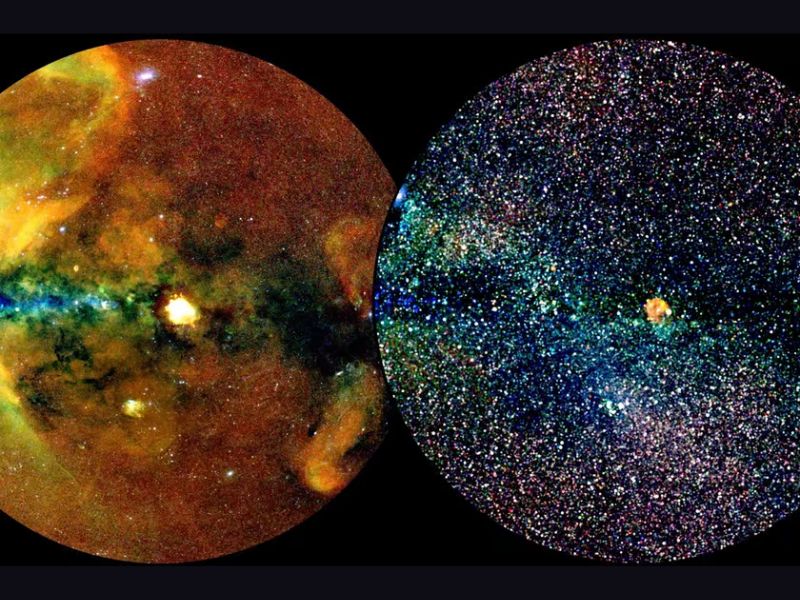
    The eROSITA map seen in two different ways: Left shows extended X-ray emissions, while the right image shows point-like X-ray sources
    MPE, J. Sanders for the eROSITA consortium

    Astronomers have utilized the eROSITA space telescope to chart half of the universe in X-ray light. This newly created map, featuring nearly a million X-ray sources, serves as the foundation for numerous scientific papers, with many more anticipated in the future.

    Positioned at Lagrange Point 2, eROSITA is a soft X-ray imaging telescope situated near the James Webb Space Telescope. The primary objective was to conduct a comprehensive survey of the entire sky in X-ray wavelengths, identifying new galaxies, clusters, supermassive black holes, and other celestial objects. Additionally, the telescope aims to study massive structures and contribute to the measurement of dark energy, the enigmatic force driving the universe’s accelerated expansion.

    Unveiling eRASS1

    The inaugural data release is named the eROSITA All-Sky Survey Catalogue (eRASS1), compiled from information collected by the telescope from December 12, 2019, to June 11, 2020. During this period, eROSITA recorded 170 million individual X-ray photons. By analyzing the energy and arrival time of each photon, a comprehensive map of the cosmos can be constructed.

    This map encompasses half of the nocturnal sky, specifically the western hemisphere, and encompasses more than 900,000 X-ray sources. Among these sources are approximately 710,000 supermassive black holes actively consuming matter at the cores of galaxies, 180,000 X-ray-emitting stars within the Milky Way, 12,000 galaxy clusters, and a variety of less common entities like pulsars, supernova remnants, binary stars, and other X-ray sources.

    These figures are astonishing in the realm of X-ray astronomy,” remarked Andrea Merloni, the eROSITA principal investigator. “In just six months, we have detected more sources than the extensive flagship missions XMM-Newton and Chandra have achieved in almost 25 years of operation.”

    eRASS1’s Revelations

    However, this initial public release of data is accompanied by the publication of nearly 50 new papers based on eRASS1. Among the findings are the identification of over 1,000 galaxy superclusters, the observation of a 42 million light-year-long gas filament connecting two clusters, investigations into how X-ray emissions from stars impact the habitability of their planets, and studies of X-rays emitted by supernova remnants, stars, and various celestial objects.

    This marks only the initial phase, as eROSITA conducted three additional sky scans between June 2020 and February 2022, before the joint German-Russian project was temporarily halted due to the Russian invasion of Ukraine. The data from these subsequent scans will be disclosed in the near future.

    To conclude, the complete collection of scientific publications derived from this data can be accessed on the eROSITA website.


    Read the original article on: New Atlas

    Read more: Hubble Space Telescope Detects Water Vapor in Atmosphere of Small Exoplanet