

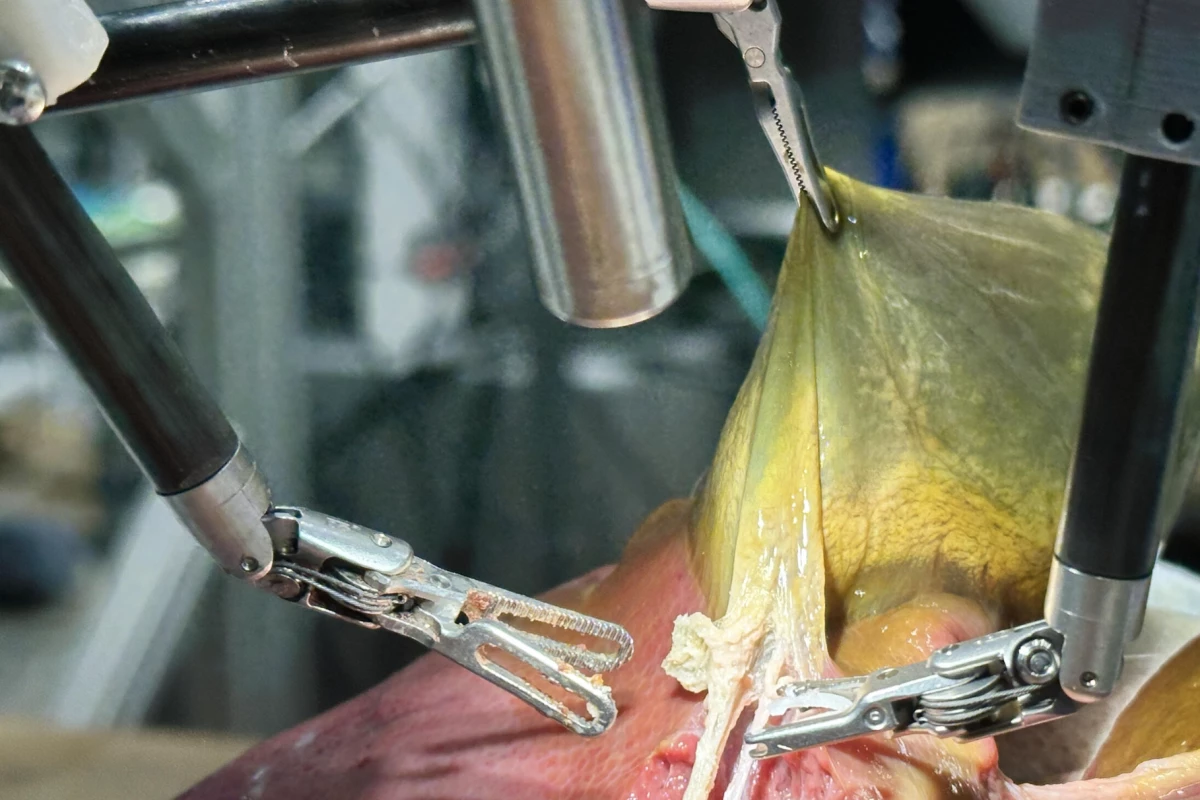
Juo-Tung Chen/Johns Hopkins University
We’re moving closer to operating rooms where we’re the only humans present, thanks to the world’s first surgery carried out by a robot that could respond and learn in real time. Its precision and expertise were on par with that of veteran surgeons.
Researchers at Johns Hopkins University trained a robot using surgical videos, then tasked it with independently performing a gallbladder removal—guided only by voice commands, similar to how a surgical team supports a lead surgeon. Called SRT-H (Surgical Robot Transformer-Hierarchy), the robot translated its training into practice, repeatedly and successfully removing the gallbladder while making real-time adjustments as needed.
New Robot Marks Leap Toward Fully Autonomous Operating Rooms
“This development shifts us from robots that simply carry out predefined surgical tasks to those that genuinely comprehend surgical procedures,” explained medical roboticist Azwl Krieger. “It’s a crucial leap toward autonomous surgical systems that can operate effectively in the chaotic and unpredictable environment of real-world patient care.”
SRT-H marks a major breakthrough in the field, showcasing not just mechanical precision but also the more complex capability to adapt and respond in real time—making adjustments as needed rather than strictly following a predetermined plan.
Robot Performs Complex Gallbladder Surgeries on Human-Like Models with Precision and Accuracy Across Multiple Procedures
While this study highlights SRT-H’s ability to perform complete gallbladder removals (cholecystectomies) across eight different procedures, it’s important to note these surgeries were conducted on highly realistic human-like models—not actual humans. Still, the synthetic tissues closely resembled human anatomy, and the robot smoothly completed the operation, which involved 17 distinct tasks, each taking only a few minutes. SRT-H accurately identified key ducts and arteries, applied clips with precision, and cleanly cut tissue with surgical scissors.
“This work marks a significant advancement over previous efforts because it addresses some of the core challenges in bringing autonomous surgical robots into real-world clinical environments,” said lead author Ji Woong “Brian” Kim, a former postdoctoral researcher at Johns Hopkins and now at Stanford University. “It proves that AI models can be made reliable enough for autonomous surgery—something that once seemed far-off but is now within reach.”
ChatGPT-Powered Surgical Robot Learns and Adapts in Real Time, Mimicking Human Surgeons Through Experience
SRT-H is powered by the same machine learning architecture as ChatGPT, allowing it to interpret spoken instructions from nearby medical staff, learn in real time, and adapt its actions if it encounters tissue that looks or behaves differently than expected. Although the robot’s initial training was imitation-based, it continues to improve through experience—much like a human surgeon.
Previously, SRT-H achieved a flawless success rate when performing the same gallbladder procedure on pig organs (from cadavers or synthetic sources). The field of surgical robotics is progressing rapidly; just a year ago, the Johns Hopkins team trained a robot to complete three core surgical skills: needle handling, tissue manipulation, and suturing—all in mere seconds.
Krieger’s 2022 STAR Robot Made History with First Autonomous Surgery on a Live Animal—Though Heavily Guided by Humans
Before that, in 2022, Krieger’s earlier project—the Smart Tissue Autonomous Robot (STAR)—performed the first fully autonomous surgery on a live animal, conducting laparoscopic surgery on a pig. However, STAR required considerable human guidance, with staff marking tissues and the robot following a predefined path.
According to Krieger, the new system is “like teaching a robot to drive any road under any condition, making smart decisions as it goes.”
Although SRT-H currently takes longer than human surgeons to complete its procedures, the quality of its outcomes matches those of experienced professionals. It’s not yet approved for use on human patients, but the researchers anticipate that this milestone could be reached within the next decade.
“Just as surgical residents master different parts of procedures at different speeds, this research shows the promise of developing autonomous surgical robots through modular, step-by-step progress,” said study co-author and Johns Hopkins surgeon Jeff Jopling.
Next, SRT-H is set to broaden its capabilities by being trained in a wider range of surgical procedures, moving it closer to full autonomy—potentially reaching a point where it can carry out successful surgeries without supervision or external input.
“This really demonstrates that complex surgical procedures can be performed autonomously,” said Krieger. “It’s a strong proof of concept showing that an imitation learning framework can reliably automate intricate operations with remarkable precision.”
Read the original article on: New Atlas
Read more: Humanoid Robot Insists it has no Intention of ‘Replacing Human Artists’


