

Created with ChatGPT 5
In a groundbreaking experiment, scientists have successfully transferred a courtship behavior from one species to another, causing the recipient to perform the foreign action as if it were innate. While cross-species gene transfers have previously influenced traits, this marks the first time an entirely new behavior has been genetically introduced into another animal.
Rewiring the brain with a single gene
Researchers at Nagoya University accomplished this by altering a single gene to rewire neural connections, effectively transferring behavior between two fruit fly species: Drosophila subobscura and D. melanogaster. Though both belong to the same family, their neural circuits drive very different courtship rituals.
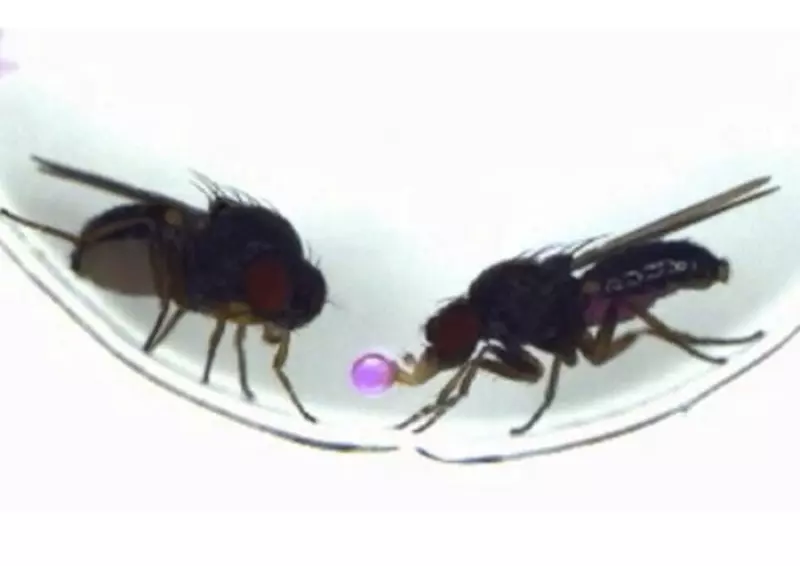
The achievement is the result of nearly ten years of work by the Japanese team. In 2017, co-first author Ryoya Tanaka helped map and compare the mating circuits of the two species—D. melanogaster, which attracts mates by singing, and D. subobscura, which offers regurgitated food as a “nuptial gift.” Using optogenetics, the researchers confirmed that a gene known as Fruitless (Fru), present in both species, controlled courtship but produced very different behaviors in each.
Tanaka et al., 2025
Pushing this further, the team genetically altered D. melanogaster males—whose lineage split from D. subobscura about 35 million years ago—to abandon singing and adopt gift-giving instead. Over evolutionary time, environmental pressures and mating preferences had shaped their distinct “love languages”: one evolved wing muscles and circuits for song, while the other refined neural pathways for presenting food. That lost behavior has now been reactivated through genetic engineering.
Flipping the Fru gene
By switching on the Fru gene within insulin-producing neurons of D. melanogaster, the researchers rewired brain circuits, enabling the singing flies to perform the food-giving ritual. The transformation occurred without any learning or external influence—it emerged purely from reprogrammed neural wiring.
Depositphotos
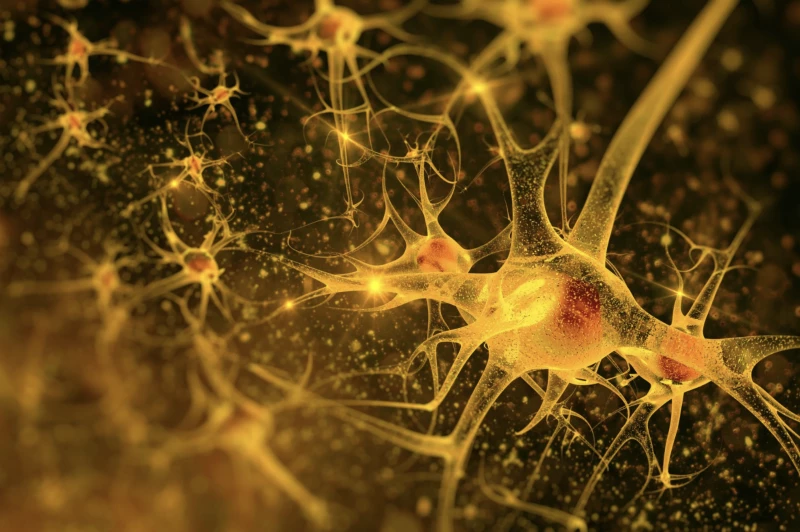
“When we activated the Fru gene in these neurons, they extended new projections that connected to the brain’s courtship center, creating circuits that drove gift-giving in D. melanogaster for the first time,” explained Tanaka, co-lead author at Nagoya University’s Graduate School of Science.
Dormant behaviors reawakened
This discovery demonstrates that animals may harbor dormant behaviors within their neural architecture—behaviors that can be reawakened by flipping the right genetic switch. “Our findings show that the evolution of new behaviors doesn’t always require new neurons,” said co-lead author Yusuke Hara from Japan’s National Institute of Information and Communications Technology (NICT). “Sometimes, small-scale genetic rewiring of existing neurons is enough to generate behavioral diversity and drive species differentiation.”
Tyler Sloan and Amy Sterling for FlyWire, Princeton University, (Dorkenwald et al., 2024)
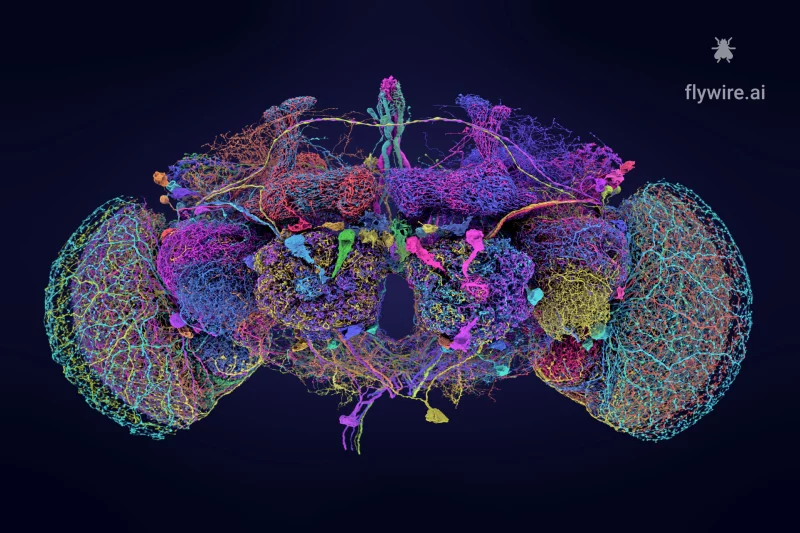
Beyond fruit flies, the implications are significant. These insects share about 60% of their genes with humans, and roughly three-quarters of human genetic diseases have fly counterparts. Research on D. melanogaster has already earned six Nobel Prizes, and in 2024 scientists produced the most detailed neuronal map of a fly brain to date.
This study provides compelling evidence that subtle genetic modifications—even to a single gene—can reshape behavior at a species-wide level. While no one is suggesting engineered instincts in humans, the research suggests that some of our own behaviors may lie dormant, encoded in our biology, waiting for the right molecular trigger.
Senior author Daisuke Yamamoto of NICT said the team has shown that complex behaviors like nuptial gift-giving originate from their genetic roots. This helps us understand how evolution invents new strategies that ensure survival and reproduction.
Read the original article on: New Atlas
Read more: Blood Clotting Discovery Heralds A “New Era In Vascular Biology”


