
JSK
Most four-legged robots we see today feature rigid, single-piece bodies, a design that works well for many of their tasks.However, for tight or vertical spaces, a flexible frame offers key advantages—making the KLEIYN robodog stand out.
The Advantage of a Flexible Spine
While robots like ANYmal, Lynx, and Go2 showcase impressive agility and are often used for transport tasks, their stiff spines limit mobility in cramped environments. In contrast, a robot with a bendable spine can adapt its shape to climb through narrow spaces, such as the inside of a chimney.
Engineers from the University of Tokyo—known for innovations like the DRAGON flying robot and musculoskeletal humanoids—have unveiled KLEIYN, a robodog with a jointed torso. Its flexible waist lets it shorten or bend its frame to tackle uneven terrain, ideal for rescue missions or tight spaces.
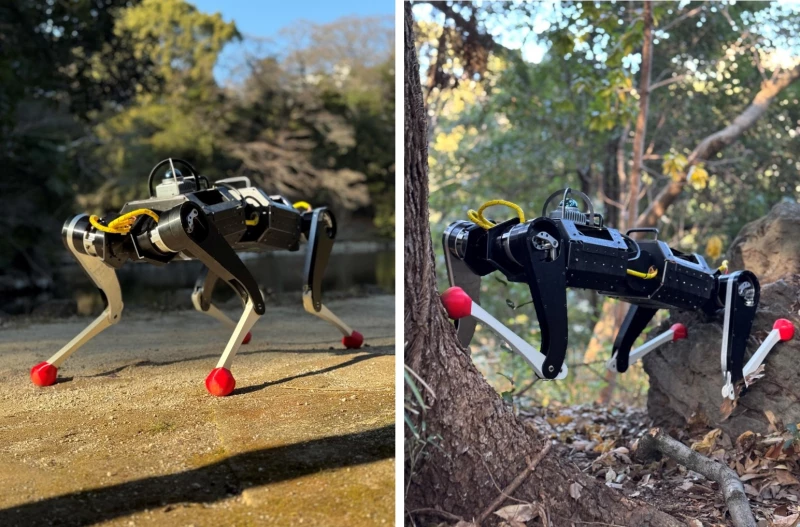
JSK
Instead of using claws or suction to climb vertical surfaces, the researchers equipped KLEIYN with powerful leg joints that press firmly against smooth opposing walls, creating enough friction to keep it suspended. This strategic approach eliminates the need for complex gripping mechanisms.
Advanced Leg Mechanics for Versatile Mobility
Each of KLEIYN’s legs has three degrees of freedom and an additional pitch joint at the shoulder and rear knee. The actuators deliver 25 Nm of torque with a 1:10 gear ratio. Unlike similar robots, KLEIYN’s opposing calf design improves vertical grip without affecting normal walking.
The waist mechanism, offering a single degree of freedom, is powered by a 40-Nm motor with 1:9 gear reduction.Two symmetrical aluminum sections house the battery and systems—front with a LiDAR and IMU, and rear for balance.
Virtual Training for Real-World Performance
The team used Contact-Guided Curriculum Learning to train the robot for climbing tight vertical spaces. This virtual environment allowed KLEIYN to master climbing techniques before being tested physically. The researchers then constructed wall setups with gaps of 800, 900, and 1,000 mm to evaluate its climbing abilities.
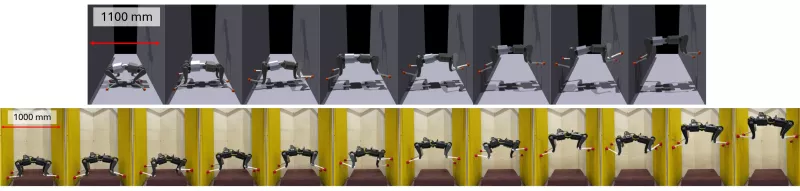
JSK
In the 800-mm scenario, KLEIYN achieved climbing speeds of up to 170 mm per second—50 times faster than UCLA’s SiLVIA hexapod, which scales at 3 mm/s. Additional trials demonstrated its capability to walk on stairs and uneven ground with ease.
A Promising Tool for Inspection and Rescue
Weighing 13 kg and measuring 760 mm long, KLEIYN’s compact size suits it for industrial inspections and search-and-rescue tasks. Its combination of mechanical design and virtual training makes it a standout in the evolving field of robotics.
The researchers published a detailed paper on the project on arXiv and included additional visuals in the video below.
Read the original article on: New Atlas
Read more: Watch: Wheeled robodog tackles tough terrain at high speed

