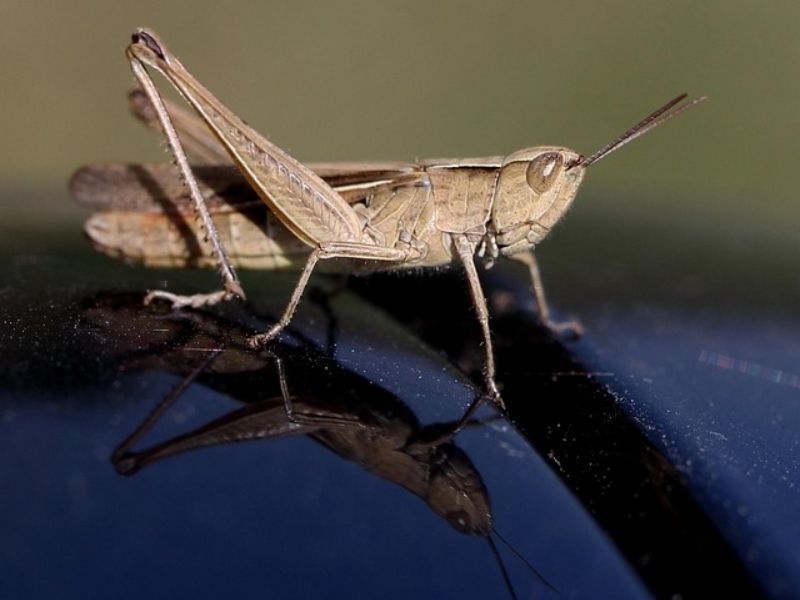

Over the past 10 to 20 years, most Hawaiian field crickets (Teleogryllus oceanicus) have lost their ability to produce mating songs because of a wing mutation known as “flatwing.” While this mutation protects males from a parasitic fly that locates them through their song—making it largely advantageous—researchers are now examining how its swift spread has influenced the crickets’ social behavior.
New Insights into Female Cricket Interactions Prompted by Male Song
Previous studies have primarily focused on interactions between male crickets or between males and females, often examining mating behavior and male aggression. However, researchers have largely overlooked how female crickets interact with one another. A recent study published in Proceedings of the Royal Society B begins to address this gap by exploring female-female interactions and how these behaviors change in the presence of male song.
Although the flatwing mutation also appears in female crickets, it only alters wing structure in males. To better understand the mutation’s broader impact on social behavior, researchers included both flatwing and non-flatwing females in their study. They paired females with either the same or different genotypes and exposed them to either recorded male song or silence. In total, the researchers observed 334 individual crickets across 167 trials, closely tracking how they interacted.
Overall, the female crickets were highly social, but they interacted more often and for longer durations when male song was present. According to the researchers, “Intrasexual female social behavior was widespread, observed in 86.5% of the individuals.” The most common form of interaction was antennal contact, which likely serves as a way for females to detect and assess one another. Exposure to male song increased this behavior—females were more likely to engage in antennal contact, did so more frequently, and for extended periods.
Pairs of female crickets with matching genotypes (either both flatwing or both normal-winged) tended to interact more frequently than mixed-genotype pairs. However, all groups—regardless of genotype—showed increased social behavior when exposed to male song.
Antennal Contact Dominates as Key Interaction, While Aggression and Flight Remain Rare
Researchers observed five types of behavior during the trials: antennal contact, mounting, mounting acceptance, biting, and attempts to flee. Antennal contact was by far the most common, followed by biting, an action interpreted as aggression. Only 27 crickets tried to fly away, mostly in the absence of male song.
Mounting was observed just twice, with only one instance where the behavior was accepted by the other cricket. While rare, the researchers noted that this behavior likely went unnoticed in past studies due to the limited focus on female-female interactions.
These findings raise new questions about the broader effects of the flatwing mutation and emphasize the need to examine social behaviors in both sexes, especially in the context of rapid evolutionary shifts.
As the researchers note, “The reproductive success of flatwing males is closely linked to female mate choice, which may be a stronger factor than satellite behavior in reducing parasitism risk. This suggests female-female social interactions could indirectly influence that risk—a possibility that warrants further investigation.”
Read the original article on: Phys.Org
Read more: Gut Cells Promote Self-Renewal By Signaling In Ways Similar To Brain Cells