

Conifer
China currently dominates around 90% of the global market for rare earth magnets, overseeing both their extraction and refinement. As a result, components like neodymium, dysprosium, and terbium—essential to electric vehicle motors, drones, wind turbines, and smartphones—are largely under China’s influence, with supply and geopolitical shifts giving the country significant leverage.
Conifer’s Iron-Based Alternative to Rare Earths
Conifer Motors, a company based in California, aims to sidestep this dependency by eliminating rare earth materials entirely. Instead, it’s building electric motors using one of the Earth’s most plentiful resources: iron.
This concept isn’t entirely new. In the past, iron-based magnets were considered too weak for demanding applications. However, Conifer has found a solution: an axial-flux motor design.
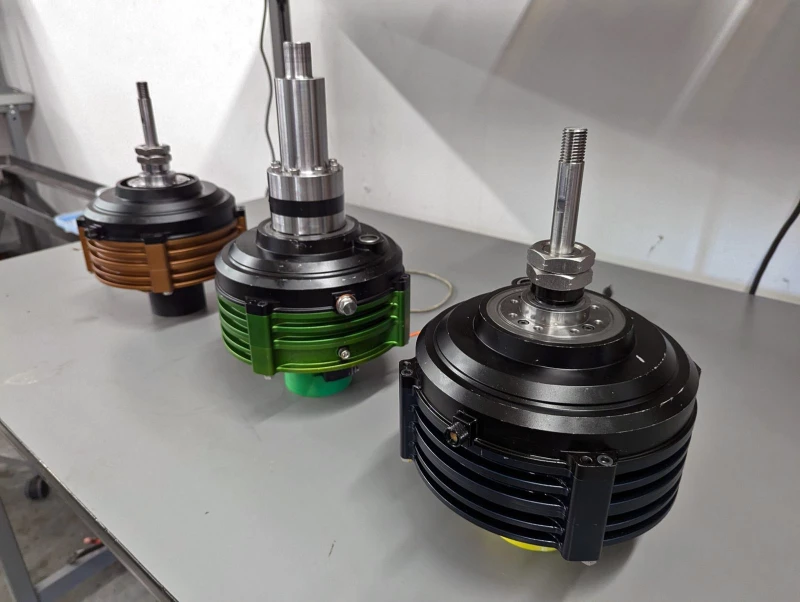
Most electric motors today use a radial-flux configuration, where magnets spin around a central shaft in a cylinder-like form—simple, dependable, and easily scalable. Axial-flux motors, by contrast, resemble flat disks—more like tuna cans than soda cans. Thanks to their shape, they typically generate more torque at lower RPMs, benefiting from a shorter magnetic path and broader diameter.
Conifer
Though axial-flux motors have existed since the 1800s—Nikola Tesla even experimented with them—they never gained popularity due to manufacturing difficulties and cooling challenges. Radial-flux motors were simply easier to build and met most performance needs. (We’ll avoid diving into “raxial-flux” for now.)
Modern Tech Revives Old Motor Concepts
Today, 21st-century advancements—such as improved motor controllers, modern thermal systems, CNC machining, and lightweight materials—have revitalized the potential of axial-flux motors. These innovations make manufacturing more efficient and performance more competitive.
Rather than targeting the mainstream EV market, Conifer is focusing on small-scale electric motors ranging from 1 to 25 horsepower (0.75 to 18.65 kW). Their applications include HVAC systems, pumps, tools, and even compact vehicles like scooters, ATVs, and urban delivery units with in-wheel motor setups.

Conifer
What sets Conifer apart is that its motors use ferrite (iron-based) magnets instead of rare earth ones. Because iron is widely available, the motors can be produced domestically without relying on rare earth supply chains or foreign policies.
The in-wheel motor design simplifies vehicle architecture by removing components like axles, differentials, and traditional powertrains. This leads to lower production costs, reduced energy losses, and potentially enhanced traction control since each wheel operates independently.
Borrowing Manufacturing Tricks From Battery Tech
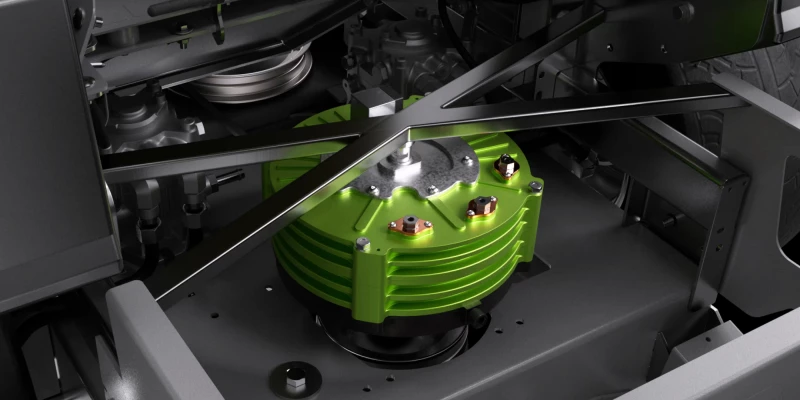
To cut costs and increase scalability, Conifer borrows a technique from battery manufacturing. Instead of traditional coil winding, they use a flat, layered winding method—similar to how battery cells are stacked—and automate the process to accommodate motors of varying sizes without custom retooling.
Conifer
Their axial-flux design strategically places more magnetic mass further from the rotation axis and spins faster than typical axial motors. This approach harnesses the flywheel effect for greater torque and efficiency, though it results in slower response times and heavier braking loads. But in applications like HVAC fans or commuter scooters, that extra inertia can actually be beneficial.
That said, iron magnets still can’t match the strength of rare earth magnets. So, don’t expect to see them powering Teslas or other high-performance electric cars anytime soon. And while in-wheel motors offer convenience, the added unsprung weight can impact ride comfort and handling, especially for lightweight two-wheeled vehicles.
Still, Conifer’s ability to manufacture motors using locally sourced materials—without relying on fragile global supply chains or geopolitical negotiations—is a significant achievement. That independence may prove to be its greatest advantage.
Read the original article on: New Atlas
Read more: SS Innovations Has Deployed More Than 100 Surgical Robots


